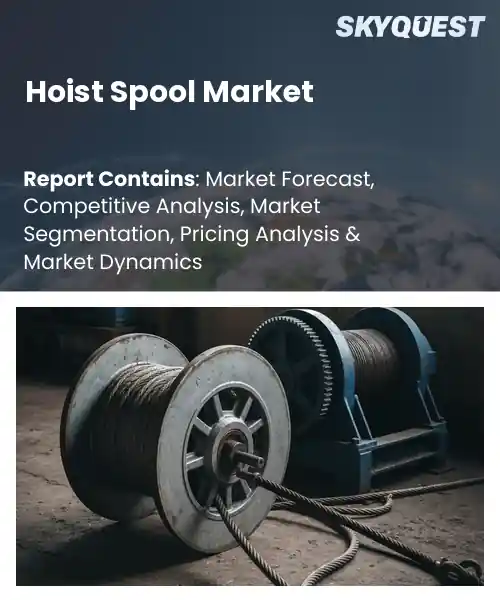
Hoist Spool Market
Report ID: SQMIG20I3371
Report ID: SQMIG20I3371
[email protected]
USA +1 351-333-4748
Report ID:
SQMIG20I3371 |
Region:
Global |
Published Date: July, 2026
Pages:
157
|Tables:
149
|Figures:
78


Global Hoist Spool Market size was valued at USD 624.4 Million in 2024 and is poised to grow from USD 658.12 Million in 2025 to USD 1002.38 Million by 2033, growing at a CAGR of 5.4% during the forecast period (2026-2033).
The worldwide hoist spool market supplies the cylinders used to wind cables or ropes on for lifting operations and is vital for the current world of construction and material handling. The importance of this market can be seen in providing dependable and compact energy transmission for overhead cranes, offshore structures, and renewable energy sites. There was a rise in demand for these spools in the 1990s owing to urbanization, resulting in the need for high-rise buildings. Also, during the early 2000s, corrosion-resistant spools made from polymers were needed for offshore wind power plants. This transition from conventional steel drums to composite drums has resulted in increased efficiency.
The other driver of growth in this market is automation in the use of heavy lifting equipment, where there is a need for spools that can provide information about maintenance and monitoring. With the adoption of Industry 4.0 in the production plants, sensors installed in the spools give real-time information regarding torque, wear, and temperatures, thus eliminating any chances of failure in advance. Not only does this reduce downtime at the ports where container ships operate, but it also increases safety for offshore wind farm construction where accessibility is difficult.
How is AI-driven Automation Impacting the Hoist Spool Market?
AI-enabled automation technology is transforming the hoist spool market through the incorporation of intelligent sensors and machine learning algorithms in traditional machinery. Such innovations provide the ability to monitor the condition of machinery, predict possible malfunctions, and control loads, thus helping reduce downtime and prolonging the life span of the machinery. Hoist spool manufacturers are collaborating AI technologies with IoT platforms to provide operators with immediate notifications and remote adjustment of spools' performance. This transformation helps increase the safety level on construction sites and logistics hubs as well as reduce expenses related to operation. In response to rising customer demands, intelligent spools have become a popular choice for customers, resulting in increased market dynamics and innovations.
Market snapshot - (2026-2033)
Global Market Size
USD 624.4 Million
Largest Segment
Carbon Steel
Fastest Growth
Stainless Steel
Growth Rate
5.4% CAGR
To get more insights on this market click here to Request a Free Sample Report
Global hoist spool market is segmented by material, hoist type, application, end user, distribution channel and region. Based on material, the market is segmented into Carbon Steel, Alloy Steel, Stainless Steel, and Others. Based on hoist type, the market is segmented into Wire Rope Hoists, Electric Hoists, Chain Hoists, and Others. Based on application, the market is segmented into Manufacturing, Construction, Mining, Marine, and Others. Based on end user, the market is segmented into Industrial Facilities, Warehouses, Construction Companies and Others. Based on distribution channels, the market is segmented into OEM, Aftermarket, and Others. Based on region, the market is segmented into North America, Europe, Asia Pacific, Latin America and Middle East & Africa.
Carbon steel segment dominates because its cost efficiency and robust mechanical properties align closely with the demanding load bearing requirements of hoist spool designs. Manufacturers favor carbon steel for its ease of fabrication, weldability and proven performance under cyclic stress, which reduces production lead times and maintenance intervals. These attributes create a reliable supply chain and encourage widespread adoption across diverse applications, cementing its leadership in the market today globally.
Meanwhile, alloy steel segment is witnessing the strongest growth momentum as advanced high strength alloys enable lighter yet stronger spool constructions. Engineers are integrating alloy steel to meet increasing performance standards and to reduce overall system weight, significantly driving new design opportunities and expanding the market’s future potential today.
Wire rope hoist segment ranks as the best performer due to the high lifting capability and accurate performance required in modern hoist spool systems. The adaptability of wire ropes in providing smooth operation and low maintenance makes it possible to manufacture compact and safe spools for lifting heavy loads. Such benefits are behind the wide adoption of wire rope hoist by various sectors of the industry. As a result, it maintains its leadership in the market all around the world.
However, the electric hoist segment is set to become the future growth driver because of the increased need for smart solutions that involve high energy efficiency and digital integration.
To get detailed segments analysis, Request a Free Sample Report
The North American region enjoys several advantages including the availability of advanced industrial facilities, automation, engineering knowledge and supply chains. The presence of prominent manufacturers and equipment suppliers drives the constant need for innovation and customization of products. Safety norms and the requirement for effective material handling in industries like construction, mining, and automobiles provide a conducive environment for hoist spool products. Apart from this, the presence of mature logistics and skilled labor facilitates quick installation and after-sales services. All these features make the USA and Canada the foremost region for hoist spools.
Market for Hoist Spools in the US is characterized by active construction, a well-developed production industry, and a focus on safety regulations. Buyers appreciate quality products that are easy to integrate into automated loading equipment. The existence of various tier-1 vendors contributes to price competitiveness and fast turnaround of products, whereas an extensive maintenance infrastructure helps provide support services in industrial centers all around the country.
Hoist Spool Market presence in Canada benefits from a strong focus on mining, energy extraction, and large‑scale infrastructure development. Operators value equipment that can withstand harsh climatic conditions and demanding load cycles, prompting manufacturers to emphasize durability and corrosion resistance. Collaborative relationships between OEMs and local distributors facilitate tailored solutions, while a well‑trained workforce supports efficient installation and ongoing service. This ecosystem sustains steady demand across the country's industrial corridors.
The European market for hoist spools grows at a rapid pace owing to a perfect blend of high value-added engineering, safety and environmental considerations, along with proactiveness in implementing digital technology. Advanced manufacturing and renewable energy infrastructure require high investment from leading industrialized nations, which in turn requires high-quality material handling components. International joint research projects facilitate innovations in spools designed with low weight and energy consumption. Additionally, the presence of a strong supply chain and a competent workforce increase responsiveness towards customer requirements. Circular economic philosophy also contributes to the growth of this market.
Hoist Spool Market activity in Germany is anchored by a robust automotive and heavy engineering sector that prioritizes precision and reliability. German manufacturers favor highly engineered spools that integrate with automated production lines and adhere to rigorous quality certifications. Strong collaboration between research institutes and equipment makers fuels continual design improvements, while a dense network of specialist distributors ensures rapid delivery and localized technical support. This foundation sustains Germany’s leading position within the European landscape.
Hoist Spool Market growth in the United Kingdom is propelled by a dynamic construction sector and increasing adoption of smart logistics solutions. British firms seek versatile spools that can be rapidly reconfigured for modular building projects and integrated with IoT‑enabled monitoring systems. The country’s strong emphasis on innovation, supported by government incentives for advanced manufacturing, encourages local suppliers to develop high‑efficiency products. A well‑structured distribution channel further accelerates market penetration across regional hubs.
Hoist Spool Market presence in France is emerging as renewable energy and infrastructure modernization projects gain momentum. French companies value spools that combine lightweight construction with high load capacity, aligning with the nation’s push for energy‑efficient solutions. Increased collaboration between academic research centers and equipment manufacturers is fostering innovative designs tailored to the specific requirements of wind and solar installations. Growing awareness of after‑market service quality further supports market acceptance among end users.
Asia Pacific is gearing up to establish itself as a leader in the hoist spool market with rapid industrialization, automation investments, and a greater emphasis on performance material handling systems. Companies in leading economies are increasingly adopting modern design concepts that focus on longevity during difficult conditions of operation, as well as increased integration of supply chains with global distributors. Increased demands from industries like shipbuilding, electronics assembling, and renewable energy infrastructure are contributing to the development of versatile spool designs.
Hoist Spool Market activity in Japan is characterized by a dedication to precision engineering and compact design suitable for tight production spaces. Japanese firms prioritize spools with superior corrosion resistance and seamless integration into highly automated assembly lines. Close cooperation between component suppliers and major manufacturers accelerates the adoption of lightweight, energy‑saving models. A strong culture of continuous improvement and rigorous quality assurance supports the market’s reputation for reliability across diverse industrial applications.
Presence in Hoist Spool Market in South Korea is due to the country’s rapidly developing heavy industries and widespread use of smart factory technologies. Korean companies pay much attention to producing high-strength spools which can stand extreme operating conditions with sensors. The close cooperation between research facilities and manufacturing companies allows quickly prototyping new ideas, while the well-developed export system ensures prompt delivery of the products to neighboring countries.
To know more about the market opportunities by region and country, click here to
Buy The Complete Report
Increasing Infrastructure Investment
The rise in infrastructure-related projects in emerging economies is making manufacturers focus on providing dependable material handling solutions, with hoist spools being an essential part of such systems. In the case of increasing development in sectors such as construction, mining, and energy, there is a rising need for machinery that would be able to sustain constant heavy loads and at the same time minimize downtime. This creates incentives for suppliers to come up with innovative and scalable solutions, thus promoting market growth via increased visibility, longer life of equipment, and compatibility with development goals.
Adoption of Automated Handling
The integration of automated handling systems and robotics across manufacturing and logistics environments is driving demand for high‑performance hoist spools that can operate continuously under precise control. As industries adopt smart technologies, the requirement for spools that support synchronized motion, reduce wear, and enhance safety becomes paramount. This shift encourages suppliers to develop lightweight, corrosion‑resistant designs and to incorporate advanced materials, thereby expanding market opportunities and reinforcing the relevance of hoist spools in next‑generation material handling solutions. Customers value reliability and reduced maintenance of such spools, further accelerating adoption across sectors.
High Initial Capital Expenditure
The relatively high initial investment required to procure the latest technology in hoist spool systems serves as a hindrance for many small- and medium-sized businesses from purchasing new systems. Due to limited capital, firms tend to maximize the use of existing products by extending their lives rather than replacing them, restricting the penetration of more efficient systems into the market. Such an economic constraint restricts adoption rates especially in places where funds are not available. Therefore, manufacturers are compelled to concentrate on developing economically feasible systems.
Stringent Safety and Regulatory Standards
Strict safety regulations and industry standards mandate rigorous testing, certification, and compliance procedures for hoist spool designs, which increase development timelines and production costs. Manufacturers must incorporate redundant safety features, adhere to load‑rating certifications, and undergo periodic inspections, creating additional layers of complexity. These requirements can delay product launches and elevate price points, making it challenging for suppliers to offer competitively priced solutions. As a result, market entry barriers rise, and some firms may defer investment until regulatory frameworks become more harmonized. Compliance costs also affect after‑sales support, influencing overall profitability.
Request Free Customization of this report to help us to meet your business objectives.
The nature of competition for the global hoist spool market is influenced by some well-known manufacturers extending their portfolios via strategic acquisitions of component manufacturers and setting up joint ventures with automation vendors to incorporate intelligent monitoring into hoist spool systems. The latest collaborations among top-notch gear makers and Internet of Things platform developers have fast-tracked the implementation of predictive maintenance features, while several players have also joined the race via the acquisition of smaller companies with unique winding technologies.
SkyQuest’s ABIRAW (Advanced Business Intelligence, Research & Analysis Wing) is our Business Information Services team that Collects, Collates, Correlates, and Analyses the Data collected by means of Primary Exploratory Research backed by robust Secondary Desk research.
As per SkyQuest analysis, the global hoist spool market is driven first by strong infrastructure investment that fuels demand for reliable material‑handling components across industries and second by the rapid adoption of automated handling systems which require spools with integrated sensors and predictive‑maintenance capabilities. High initial capital expenditure may be considered a barrier for many smaller operators. North America remains the dominant region thanks to its advanced industrial base and extensive supply chains, while carbon‑steel spools dominate the material segment because of their cost efficiency and proven performance in the sector.
| Report Metric | Details |
|---|---|
| Market size value in 2024 | USD 624.4 Million |
| Market size value in 2033 | USD 1002.38 Million |
| Growth Rate | 5.4% |
| Base year | 2024 |
| Forecast period | (2026-2033) |
| Forecast Unit (Value) | USD Million |
| Segments covered |
|
| Regions covered | North America (US, Canada), Europe (Germany, France, United Kingdom, Italy, Spain, Rest of Europe), Asia Pacific (China, India, Japan, Rest of Asia-Pacific), Latin America (Brazil, Rest of Latin America), Middle East & Africa (South Africa, GCC Countries, Rest of MEA) |
| Companies covered |
|
| Customization scope | Free report customization with purchase. Customization includes:-
|
To get a free trial access to our platform which is a one stop solution for all your data requirements for quicker decision making. This platform allows you to compare markets, competitors who are prominent in the market, and mega trends that are influencing the dynamics in the market. Also, get access to detailed SkyQuest exclusive matrix.
Table Of Content
Executive Summary
Market overview
Parent Market Analysis
Market overview
Market size
KEY MARKET INSIGHTS
COVID IMPACT
MARKET DYNAMICS & OUTLOOK
Market Size by Region
KEY COMPANY PROFILES
Methodology
For the Hoist Spool Market, our research methodology involved a mixture of primary and secondary data sources. Key steps involved in the research process are listed below:
1. Information Procurement: This stage involved the procurement of Market data or related information via primary and secondary sources. The various secondary sources used included various company websites, annual reports, trade databases, and paid databases such as Hoover's, Bloomberg Business, Factiva, and Avention. Our team did 45 primary interactions Globally which included several stakeholders such as manufacturers, customers, key opinion leaders, etc. Overall, information procurement was one of the most extensive stages in our research process.
2. Information Analysis: This step involved triangulation of data through bottom-up and top-down approaches to estimate and validate the total size and future estimate of the Hoist Spool Market.
3. Report Formulation: The final step entailed the placement of data points in appropriate Market spaces in an attempt to deduce viable conclusions.
4. Validation & Publishing: Validation is the most important step in the process. Validation & re-validation via an intricately designed process helped us finalize data points to be used for final calculations. The final Market estimates and forecasts were then aligned and sent to our panel of industry experts for validation of data. Once the validation was done the report was sent to our Quality Assurance team to ensure adherence to style guides, consistency & design.
Analyst Support
Customization Options
With the given market data, our dedicated team of analysts can offer you the following customization options are available for the Hoist Spool Market:
Product Analysis: Product matrix, which offers a detailed comparison of the product portfolio of companies.
Regional Analysis: Further analysis of the Hoist Spool Market for additional countries.
Competitive Analysis: Detailed analysis and profiling of additional Market players & comparative analysis of competitive products.
Go to Market Strategy: Find the high-growth channels to invest your marketing efforts and increase your customer base.
Innovation Mapping: Identify racial solutions and innovation, connected to deep ecosystems of innovators, start-ups, academics, and strategic partners.
Category Intelligence: Customized intelligence that is relevant to their supply Markets will enable them to make smarter sourcing decisions and improve their category management.
Public Company Transcript Analysis: To improve the investment performance by generating new alpha and making better-informed decisions.
Social Media Listening: To analyze the conversations and trends happening not just around your brand, but around your industry as a whole, and use those insights to make better Marketing decisions.
REQUEST FOR SAMPLE
 REQUEST FREE CUSTOMIZATION
Global Hoist Spool Market size was valued at USD 624.4 Million in 2024 and is poised to grow from USD 658.12 Million in 2025 to USD 1002.38 Million by 2033, growing at a CAGR of 5.4% during the forecast period (2026-2033).
The competitive landscape is shaped by a handful of established manufacturers expanding product lines through strategic acquisitions of niche component suppliers and forming joint ventures with automation firms to integrate smart monitoring into hoist spool systems. Recent partnerships between leading gear producers and IoT platform providers have accelerated the rollout of predictive maintenance capabilities, while several players have entered the market by acquiring smaller firms with specialized winding technology, directly enhancing their portfolio breadth and geographic reach. 'Columbus McKinnon Corporation', 'KITO Crosby', 'Ingersoll Rand Inc.', 'Yale Lift Truck Technologies', 'Hitachi Industrial Equipment Systems Co., Ltd.', 'Konecranes Plc', 'Demag Cranes & Components GmbH', 'ABUS Kransysteme GmbH', 'Street Crane Company Limited', 'SWF Krantechnik GmbH', 'GH Cranes & Components', 'Liebherr-International AG', 'Terex Corporation', 'Morris Material Handling Ltd.', 'Henan Mine Crane Co., Ltd.', 'Nucleon (Xinxiang) Crane Co., Ltd.', 'Anupam Industries Limited', 'ElectroMech Material Handling Systems (India) Pvt. Ltd.', 'Lodestar Hoists', 'J.D. Neuhaus GmbH & Co. KG'
The surge in infrastructure projects across emerging economies is prompting manufacturers to prioritize reliable material handling solutions, and hoist spools are integral to such systems. As construction, mining, and energy sectors expand, the need for equipment that can support continuous heavy loads while minimizing downtime becomes critical. This environment encourages suppliers to innovate and scale production, thereby fostering market growth through enhanced visibility, longer equipment lifecycles, and alignment with broader development objectives. These projects stimulate demand for maintenance services and spare parts, reinforcing the ecosystem and creating revenue channels for manufacturers.
Digital Twin Integration: Manufacturers are adopting digital twin technology to create virtual replicas of hoist spool systems, enabling real‑time performance monitoring and predictive maintenance. This approach accelerates design iterations, reduces physical prototyping cycles, and improves reliability by identifying failure modes before deployment. The seamless connection between simulated models and physical equipment fosters collaborative engineering across geographies, shortens time‑to‑market, and supports custom‑fit solutions for complex lifting applications, driving greater customer confidence and differentiated value propositions through enhanced data-driven decision making across the supply chain.
Why does North America Dominate the Global Hoist Spool Market? |@12


Want to customize this report? This report can be personalized according to your needs. Our analysts and industry experts will work directly with you to understand your requirements and provide you with customized data in a short amount of time. We offer $1000 worth of FREE customization at the time of purchase.
Feedback From Our Clients


 USA (+1) 351-333-4748

