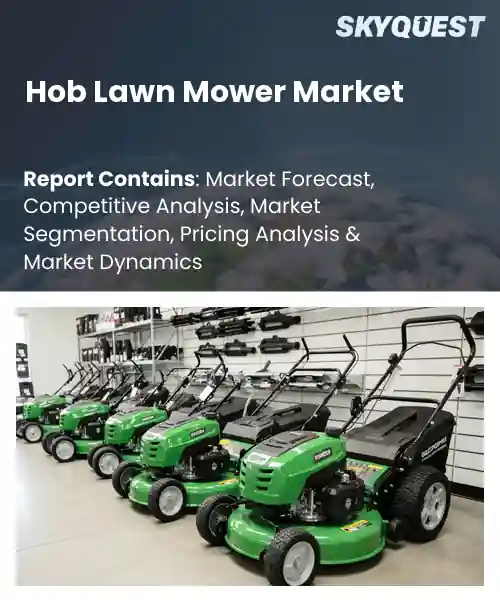
Hob Lawn Mower Market
Report ID: SQMIG25E2241
Report ID: SQMIG25E2241
[email protected]
USA +1 351-333-4748
Report ID:
SQMIG25E2241 |
Region:
Global |
Published Date: February, 2026
Pages:
157
|Tables:
181
|Figures:
79


Global Hob Lawn Mower Market size was valued at USD 898.2 Million in 2024 and is poised to grow from USD 957.48 Million in 2025 to USD 1596.57 Million by 2033, growing at a CAGR of 6.6% during the forecast period (2026-2033).
The global hob lawn mower industry which contains walk-behind and ride-on and battery and robotic systems for residential and light business turf maintenance services, experiences its main growth through rising city populations and the increasing number of middle-class homeowners. The market connects consumer choices and municipal maintenance expenditures with professional landscaping work which creates powertrain and cutting technology supply chains. The category developed from manual reel mowers to gasoline-powered devices during the mid-20th century, followed by battery-powered and automated technologies which emerged during the last twenty years, when John Deere released its walk-behind equipment and Husqvarna introduced its robotic solutions.
Moreover, the global hob lawn mower market growth depends on battery electrification because decreasing battery prices together with improved energy density enable better performance while decreasing costs for both home users and business fleets. Homeowners in suburban and urban areas now adopt battery models more frequently because lithium-ion prices decrease while manufacturers implement efficient brushless motors which extend battery runtimes and reduce noise levels. The momentum creates business opportunities which enable robotic-as-a-service solutions to establish partnerships with energy providers for charging ecosystem development that helps landscaping businesses and municipalities meet their emission and noise reduction goals.
How is AI Improving Autonomous Navigation in the Hob Lawn Mower Market?
The global hob lawn mower market outlook changes by using AI technology to create autonomous navigation systems which combine perception mapping with decision-making capabilities. Mowers use camera and lidar perception methods combined with sensor fusion and adaptive path planning skills to navigate their operational area which includes two-dimensional space and three-dimensional vertical space. The current state shows a shift away from wire boundaries toward virtual mapping and continuous learning models which reduce setup and manual rescues. Existing manufacturers coupled with new startups to establish demand which drives innovation at a rapid pace.
Husqvarna and Mammotion enhance their edge detection capabilities while classifying obstacles through their use of vision and positioning technology. The application of these capabilities enables autonomous mowing to operate in a reliable manner which establishes consistent performance and involves simple maintenance procedures.
LOPKIN exhibited a self-recovering mower in January 2026 which uses AI vision with robotic arms and accurate positioning technology to resume its mowing function after becoming stuck. The system achieves increased operational dependability through its automatic operation which decreases the time required for system recovery and human interaction.
Market snapshot - (2026-2033)
Global Market Size
USD 898.2 Million
Largest Segment
Gasoline Lawn Mowers
Fastest Growth
Robotic Lawn Mowers
Growth Rate
6.6% CAGR
To get more insights on this market click here to Request a Free Sample Report
The global hob lawn mower market is segmented based on product type, power source, cutting width, application, end-user, distribution channel, and region. By product type, the market is categorized into push lawn mowers, self-propelled lawn mowers, riding lawn mowers, robotic lawn mowers, electric lawn mowers, and gasoline lawn mowers. Based on power source, it is divided into electric (corded), battery-powered (cordless), gasoline, and hybrid. In terms of cutting width, the market is segmented into less than 18 inches, 18–22 inches, 22–26 inches, and above 26 inches.
Based on application, it includes residential use, commercial use, professional landscaping, sports turf and grounds maintenance, and municipal use. By end user, the market is classified into homeowners, landscaping companies, golf courses and sports facilities, government and municipalities, and retail or rental outlets. Based on distribution channel, it is segmented into direct OEM sales, dealers and distributors, retail stores, and online sales. Geographically, the market is segmented into North America, Europe, Asia Pacific, Latin America, and the Middle East & Africa.
As per the global hob lawn mower market analysis, homeowners and professionals now prefer cordless options because battery-powered (cordless) products deliver quiet performance plus easier maintenance work while battery technology continues to achieve rapid improvements in energy density. The industry requires cordless machines because environmental issues plus stricter emission regulations push users to choose alternatives instead of traditional fuel-based equipment. The retail and original equipment manufacturer markets enable battery platforms to achieve product parity with traditional models through their battery systems which support modular designs and extended runtime capabilities, which in turn strengthens market dominance across diverse applications.
However, the hybrid segment develops into the fastest expanding market segment because it delivers professional users through its solution which combines runtime power reliability with reduced emissions. Manufacturers work on hybrid drivetrains along with control systems to develop innovative products which help demand use cases while creating new market prospects for fleet and service expansion.
According to the global hob lawn mower market forecast, self-Propelled Lawn Mowers segment dominates because its combination of operator ease and improved ground engagement and adaptable power delivery match the needs of residential and commercial users. The aging population of homeowners and contractors now prefer ergonomic designs because these designs reduce physical stress while increasing mowing productivity. OEM companies achieve transmission durability and power train scalability through their design choices, which leads to reliable performance across different terrains, this in turn creates widespread market acceptance of Hob Lawn Mowers which establishes its status as the leading product in the market.
Whereas the robotic lawn mower segment shows the strongest growth trend because better autonomy and improved sensor technology and advanced connectivity capabilities, which lead to reduced operational costs, now enable systems to perform maintenance without human supervision. The combination of increasing service provider and tech-savvy homeowner acceptance, along with IoT system interoperability and known operational times, creates new business opportunities with ongoing revenue generation for businesses that require IoT system-based solutions across various market segments.
To get detailed segments analysis, Request a Free Sample Report
As per the hob lawn mower market regional forecast, North America holds the top position because of its combination of structural advantages and increased demand. The strong tradition of lawn maintenance in residential and commercial spaces drives consistent customer demand, which dedicated retail outlets and professional landscaping service providers deliver through their extensive product distribution networks. Manufacturing companies gain advantages from their sophisticated supply chain systems and extensive dealer distribution networks and dedicated research and development resources which help them launch battery electric and robotic products.
The aftermarket services and parts ecosystems enable products to maintain extended operational life cycles while establishing customer trust. Customers demand ongoing product development because they prioritize convenience and performance while safety regulations and emissions standards require products to undergo continuous improvement. The combination of brand recognition and strategic partnerships between original equipment manufacturers and distribution platforms enables OEMs to maintain market dominance, which transforms the area into a major hub for Hob lawn mower innovation and high-value sales.
The hob lawn mower industry in the United States demonstrates a mature market structure which includes multiple segments serving the needs of residential customers as well as professional landscapers and public sector clients. Retail shops and specialized dealers together with online platforms provide customers with a complete range of options that include basic push lawn mowers and advanced robotic and battery-powered models. The market operates under three essential factors which include intensive marketing efforts and available financing solutions and established service networks that provide maintenance services and spare parts.
Product assortment decisions get influenced by regional landscaping traditions and seasonal product usage patterns while manufacturers must meet safety regulations through their US products which require development of dependable and convenient and high-performing technologies.
The Canadian hob lawn mower sector shows a strong preference for products that demonstrate both durability and the ability to operate in different weather conditions found throughout the country. Buyers prefer products with dependable performance and easy maintenance which has driven demand for walk-behind and self-propelled models that also include electric options where infrastructure exists. The distribution system relies on specialty dealers together with national retail chains which deliver both installation services and aftermarket assistance. Homeowners who maintain their yards together with professional landscaping need to create ongoing demand that manufacturers address by developing products with extended life spans and straightforward operation and winter maintenance capabilities.
The hob lawn mower market in Europe experiences rapid growth because customers change their buying habits and regulations become stricter, and companies develop new competitive products. Urbanization together with increased need for compact green spaces creates a greater requirement for equipment that offers enhanced mobility through its smaller design. The combination of strong dealer networks together with service ecosystems establishes better pathways for product adoption in key markets while European customers show greater interest in premium features that include noise reduction and automation and integrated connectivity.
Existing brands compete against each other in different countries to develop distinct products while their local solutions address specific customer needs. Advanced technology development together with consumer demand for multiple product options drives market expansion.
The German hob lawn mower market appeals to buyers who prefer engineering excellence and operational efficiency and adherence to regulatory standards. The market demands machines which combine reliable performance with durable construction and the ability to implement emission control technologies and safety systems. The distribution system operates through professional dealers together with specialized retailers who provide complete service support and replacement parts for customers.
German landscapers and environmentally aware homeowners both seek equipment that combines sustainable design with high operational efficiency which leads manufacturers to create products with lasting durability and flexible design options and complete user instructions. The local standards together with consumer expectations create a buying environment where customers consider product engineering accuracy and lifetime value as essential elements in their purchase decision.
The United Kingdom hob lawn mower market shows rapid uptake of innovative formats such as compact electric and autonomous mowers driven by dense urban green spaces and convenience-seeking consumers. The retail and online distribution channels maintain excellent responsiveness because both promotional campaigns and delivery method flexibility help boost product testing and acceptance. Small landscaping businesses together with professional service workers create a market need for tools which provide both flexibility and simple maintenance procedures. The demand for low-noise and environmentally friendly products drives manufacturers to modify their models according to local market demands. The market dynamic favors agile players who can rapidly introduce consumer-focused features and localized support.
French consumers are increasingly interested in garden lifestyle products and environmental sustainability which leads to rising demand for equipment that operates quietly and produces low emissions. Urban homeowners and small-scale landscapers increasingly explore compact and battery-operated models suited to constrained spaces and noise-sensitive neighborhoods. The distribution system is changing because specialty retailers and online platforms now provide better access to products, while service networks are growing to meet maintenance service demands. Manufacturers who enter the French market focus on three key areas which include simple product ownership and appealing aesthetic design and product usage instructions that help customers select products based on their performance requirements and environmental noise management needs.
Asia Pacific develops its Hob lawn mower market through industrial growth and increasing consumer needs and its plans for manufacturing capacity development. The combination of growing middle-class homeownership and rising demand for garden maintenance services creates household needs while local production facilities cut expenses and boost supply chain efficiency. The regional manufacturers and global brands create products which match different market demands by providing compact fuel-efficient and electric solutions which work in both urban and suburban areas.
E-commerce distribution networks expand as they enable businesses to access new customer markets through their online sales channels. The market experiences increasing tech adoption through automation and battery technology advancements while international companies work with local distributors to broaden their market access. The region transforms its industrial base into an active hub which develops products and drives market expansion.
The hob lawn mower market in Japan requires compact design and precise operation and advanced technological solutions to serve the requirements of narrow urban areas and limited garden environments. Users prefer lawn mowers which operate quietly and occupy minimal space and consume less energy because manufacturers create products with essential features and easy-to-use controls. The distribution network uses specialty retailers together with advanced online systems which deliver complete product data and post-purchase support. The market values artisanal product creation together with product development which improves user movement and operational efficiency while satisfying regional demand for dependable and compact products.
The South Korean hob lawn mower market penetration develops through consumer demand for space-saving lawn care products which feature smart technology and digital connectivity. Urban green initiatives and a growing lifestyle emphasis on outdoor spaces drive demand for compact electric and automated mowers. Retail channels combine traditional dealers with tech-savvy e-commerce platforms that highlight product features and service packages. Manufacturers develop products through localized attributes which enhance user experiences and their complete after-sales service system. The business environment rewards fast product development together with strong brand partnership relationships which help brands meet changing consumer demands.
To know more about the market opportunities by region and country, click here to
Buy The Complete Report
Advances In Battery Technology
The development of battery chemistry together with energy management tools achieves longer operational durations while reducing weight, which enables manufacturers to produce wireless hob lawn mowers that match consumer demands for easy handling and silent operation. The new battery technology decreases maintenance needs while improving product mobility, which enables users to operate the device in multiple property sizes and different commercial environments. The wider product range enables retailers to show more types of products, which makes products more appealing to customers. The new market conditions let manufacturers create premium products while retaining specific attributes, which increases product demand and market presence.
Rising Demand For Smart Gardening
Consumers display increased interest toward smart home solutions which drive demand for hob lawn mowers that feature automation and sensor technology together with remote control functions for easy lawn maintenance tasks. The new features decrease needed labor hours while they make precise lawn Mowing available to more people, which becomes appealing to both busy home workers and property managers. Manufacturers create intelligent features to boost product value, which leads to product differentiation, which makes retailers want to market advanced models. The market experiences stronger product interaction because better brand loyalty links Prince William, who saves time, with yard care technologies.
High Upfront Purchase Costs
The high initial costs which advanced hob lawn mower models require drive economic buyers away from these products, which reduces market potential in areas where consumers prefer budget-friendly equipment. The produces electronic equipment translates into retail prices which make products less affordable and result in longer times between product replacements. Retailers experience challenges when they need to show premium products against basic products which results in lower premium product sales. The producers face difficulties because they need to create a pricing balance between product features while product interest leads to lower market expansion.
Limited-Service Infrastructure Availability
The absence of after-sales service systems together with limited technician access creates obstacles for customers who want to buy specialized hob lawn mowers and who need advanced maintenance services for battery systems and electronic controls. The absence of accessible service centers results in ownership problems for customers who need fast help and local warranty service, which leads them to reject the prospect of buying the product. The branding gets damaged because consumers face poor customer service experiences from businesses which need third-party maintenance providers. The lack of maintenance service systems stops markets from adopting advanced products because the maintenance systems required for support are not operational yet.
Request Free Customization of this report to help us to meet your business objectives.
The current state of the global hob lawn mower market shows existing players and new robotic startups using technology acquisition and partnership deals to establish market control through their respective business deals which include Amazon acquiring iRobot and John Deere buying Bear Flag Robotics. The market players establish their competitive position through their sales of products which include perimeter-free navigation systems and RTK and vision systems that Volta and Segway developed, and which served as the foundation for new product launches and sales channel expansion.
Navimow: Established in 2021. Their main objective is to deliver GPS-based, perimeter-free robotic lawn mowers tailored for residential users and to scale distribution across North America and Europe through competitive pricing and retail partnerships. The brand launched its European i Series in March 2024 and introduced the X3 Series at CES in January 2025 before selling the X3 through retail channels in spring 2025 as part of its strategy to enter larger lawn care markets.
SkyQuest’s ABIRAW (Advanced Business Intelligence, Research & Analysis Wing) is our Business Information Services team that Collects, Collates, Correlates, and Analyses the Data collected by means of Primary Exploratory Research backed by robust Secondary Desk research.
As per SkyQuest analysis, the global hob lawn mower market will continue to expand because battery technology improvements now deliver longer operational times and quieter machines which require less maintenance and people want smart gardening technology and autonomous solutions. High upfront costs of product purchases prevent price-sensitive markets with limited-service networks from adopting products which hinders their market development. North America maintains its status as the leading region because of traditional lawn care practices and extensive distribution of networks and dealer systems. The battery-powered cordless segment leads to the product mix because both consumers and professionals choose it over gasoline products which produce less noise and lower emissions.
| Report Metric | Details |
|---|---|
| Market size value in 2024 | USD 898.2 Million |
| Market size value in 2033 | USD 1596.57 Million |
| Growth Rate | 6.6% |
| Base year | 2024 |
| Forecast period | (2026-2033) |
| Forecast Unit (Value) | USD Million |
| Segments covered |
|
| Regions covered | North America (US, Canada), Europe (Germany, France, United Kingdom, Italy, Spain, Rest of Europe), Asia Pacific (China, India, Japan, Rest of Asia-Pacific), Latin America (Brazil, Rest of Latin America), Middle East & Africa (South Africa, GCC Countries, Rest of MEA) |
| Companies covered |
|
| Customization scope | Free report customization with purchase. Customization includes:-
|
To get a free trial access to our platform which is a one stop solution for all your data requirements for quicker decision making. This platform allows you to compare markets, competitors who are prominent in the market, and mega trends that are influencing the dynamics in the market. Also, get access to detailed SkyQuest exclusive matrix.
Table Of Content
Executive Summary
Market overview
Parent Market Analysis
Market overview
Market size
KEY MARKET INSIGHTS
COVID IMPACT
MARKET DYNAMICS & OUTLOOK
Market Size by Region
KEY COMPANY PROFILES
Methodology
For the Hob Lawn Mower Market, our research methodology involved a mixture of primary and secondary data sources. Key steps involved in the research process are listed below:
1. Information Procurement: This stage involved the procurement of Market data or related information via primary and secondary sources. The various secondary sources used included various company websites, annual reports, trade databases, and paid databases such as Hoover's, Bloomberg Business, Factiva, and Avention. Our team did 45 primary interactions Globally which included several stakeholders such as manufacturers, customers, key opinion leaders, etc. Overall, information procurement was one of the most extensive stages in our research process.
2. Information Analysis: This step involved triangulation of data through bottom-up and top-down approaches to estimate and validate the total size and future estimate of the Hob Lawn Mower Market.
3. Report Formulation: The final step entailed the placement of data points in appropriate Market spaces in an attempt to deduce viable conclusions.
4. Validation & Publishing: Validation is the most important step in the process. Validation & re-validation via an intricately designed process helped us finalize data points to be used for final calculations. The final Market estimates and forecasts were then aligned and sent to our panel of industry experts for validation of data. Once the validation was done the report was sent to our Quality Assurance team to ensure adherence to style guides, consistency & design.
Analyst Support
Customization Options
With the given market data, our dedicated team of analysts can offer you the following customization options are available for the Hob Lawn Mower Market:
Product Analysis: Product matrix, which offers a detailed comparison of the product portfolio of companies.
Regional Analysis: Further analysis of the Hob Lawn Mower Market for additional countries.
Competitive Analysis: Detailed analysis and profiling of additional Market players & comparative analysis of competitive products.
Go to Market Strategy: Find the high-growth channels to invest your marketing efforts and increase your customer base.
Innovation Mapping: Identify racial solutions and innovation, connected to deep ecosystems of innovators, start-ups, academics, and strategic partners.
Category Intelligence: Customized intelligence that is relevant to their supply Markets will enable them to make smarter sourcing decisions and improve their category management.
Public Company Transcript Analysis: To improve the investment performance by generating new alpha and making better-informed decisions.
Social Media Listening: To analyze the conversations and trends happening not just around your brand, but around your industry as a whole, and use those insights to make better Marketing decisions.
REQUEST FOR SAMPLE
 REQUEST FREE CUSTOMIZATION
Global Hob Lawn Mower Market size was valued at USD 898.2 Million in 2024 and is poised to grow from USD 957.48 Million in 2025 to USD 1596.57 Million by 2033, growing at a CAGR of 6.6% during the forecast period (2026-2033).
The competitive landscape in the global Hob Lawn Mower market is defined by incumbents and agile robotics startups deploying acquisition and partnership strategies to secure technology and channel advantages, for example Amazon's acquisition of iRobot and John Deere's purchase of Bear Flag Robotics. Vendors also compete on perimeter-free navigation and RTK and vision systems pioneered by Volta and Segway's Navimow, which has driven recent product launches and channel expansion. 'Honda Power Equipment', 'Husqvarna', 'Toro', 'John Deere', 'Craftsman', 'Snapper', 'Cub Cadet', 'Ryobi', 'Black+Decker', 'Ego Power+', 'Makita', 'Greenworks', 'Briggs & Stratton', 'Land Pride', 'Stihl', 'MTD Products', 'Ariens', 'Yard Machines', 'Victor Garden Products', 'Sun Joe'
Advances in battery chemistry and energy management extend run times and reduce weight, enabling manufacturers to design cordless hob lawn mowers that meet consumer expectations for convenience and quiet operation. Improved batteries lower perceived maintenance and enhance portability, which broadens use across varied property sizes and commercial applications. As a result, product appeal increases and retailers can offer broader assortments, encouraging adoption. This shift also allows manufacturers to focus on premium features and differentiated models, supporting greater market acceptance and expanded category visibility.
Smart Connectivity Integration: Manufacturers are increasingly embedding wireless connectivity, app driven controls, and diagnostic communication into lawn mowers to deliver scheduling, remote monitoring and predictive maintenance alerts. This convergence enables ecosystem partnerships with landscape service platforms and creates revenue through software features and subscriptions. Consumers value seamless integration with smart home systems, driving demand for interoperable devices. Product differentiation through user experience and data driven performance optimization is becoming a strategic focus for brands seeking to deepen customer engagement and prolong product lifecycles.
Why does North America Dominate the Global Hob Lawn Mower Market? |@12


Want to customize this report? This report can be personalized according to your needs. Our analysts and industry experts will work directly with you to understand your requirements and provide you with customized data in a short amount of time. We offer $1000 worth of FREE customization at the time of purchase.
Feedback From Our Clients


 USA (+1) 351-333-4748

