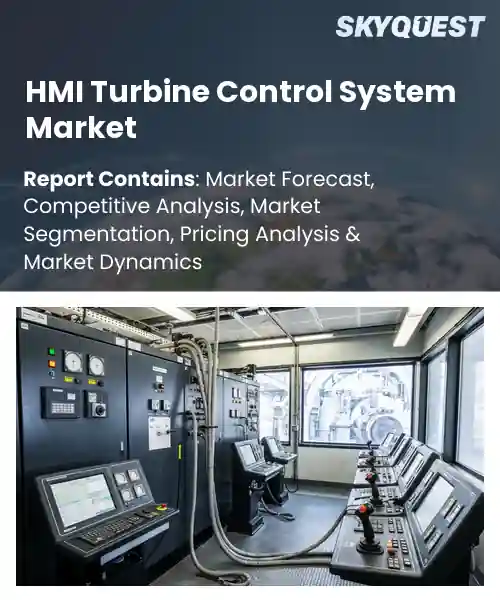
HMI Turbine Control System Market
Report ID: SQMIG20D2806
Report ID: SQMIG20D2806
[email protected]
USA +1 351-333-4748
Report ID:
SQMIG20D2806 |
Region:
Global |
Published Date: August, 2026
Pages:
157
|Tables:
118
|Figures:
77


Global HMI Turbine Control System Market size was valued at USD 2.74 Billion in 2024 and is poised to grow from USD 2.92 Billion in 2025 to USD 4.79 Billion by 2033, growing at a CAGR of 6.4% during the forecast period (2026-2033).
The key driver is the growing need for decarbonization, with operators seeking HMI turbine control systems that can integrate renewable sources and enable adaptive load management. Utilities that utilize smart HMI platforms can better coordinate wind, solar and conventional turbines, leading to less curtailment and enhanced grid stability. For example, a Texas combined-cycle plant that installed ABB’s 800xA suite, which modified the interface to reduce fuel consumption by 3% and maintenance windows. Therefore, manufacturers are constructing firmware agnostic architectures and offering analytics services in the cloud, generating income streams while responding to regulatory pressure for transparency and emissions reporting.
How is AI and IoT Integration Shaping The HMI Turbine Control System Market?
AI and IoT are transforming HMI turbine control systems into predictive, self‑optimizing platforms. Sensors transmit performance data in real-time to cloud analytics, while machine-learning models predict wear, tune fuel flow and change blade angles without operator input. This convergence means less downtime, improved safety and longer asset life, making upgrades more palatable for aging fleets. Now, operators see dashboards that combine traditional control panels with contextual information to make quicker decisions and troubleshoot remotely. The change also supports regulatory compliance by providing ongoing tracking of emissions and vibration signatures, resulting in a more resilient and efficient power generation environment.
Market snapshot - (2026-2033)
Global Market Size
USD 2.74 Billion
Largest Segment
Hardware
Fastest Growth
Software
Growth Rate
6.4% CAGR
To get more insights on this market click here to Request a Free Sample Report
Global hmi turbine control system market is segmented by component, turbine type, application, end user and region. Based on component, the market is segmented into Hardware, Software and Services. Based on turbine type, the market is segmented into Gas Turbines, Steam Turbines, Hydro Turbines and Wind Turbines. Based on application, the market is segmented into Power Generation, Oil & Gas and Industrial Manufacturing. Based on end user, the market is segmented into Utilities, Industrial Facilities and EPC Contractors. Based on region, the market is segmented into North America, Europe, Asia Pacific, Latin America and Middle East & Africa.
Hardware segment dominates because it forms the physical foundation of any HMI turbine control system, delivering the robust, real‑time interfaces required for safe turbine operation. Engineers prioritize rugged processors, displays, and I/O modules that can withstand extreme temperatures and vibrations. This necessity drives continuous investment in advanced materials, modular designs, and integrated diagnostics, ensuring that hardware remains the primary decision factor for buyers seeking reliability and long‑term asset protection.
Meanwhile, Software segment is witnessing the strongest growth momentum as developers embed AI‑driven analytics, predictive maintenance, and cyber‑security layers into HMI platforms. These capabilities unlock efficiency and lower downtime, prompting operators to upgrade firmware and application suites. Surge in transformation initiatives is accelerating market expansion and creating integration opportunities across turbine fleets.
Gas Turbines segment dominates because they are the most widely deployed power sources in utility and industrial settings, demanding real‑time monitoring and rapid response capabilities from HMI control systems. Their high speed and thermal stress require precise interface designs, leading manufacturers to prioritize robust, low‑latency hardware and specialized software protocols. This critical performance need drives continuous enhancements, cementing gas turbines as the flagship application for advanced HMI solutions.
Meanwhile, Wind Turbines segment emerges as the key high‑growth area as offshore and onshore projects integrate HMI systems to manage variable rotor speeds and safety interlocks. Advances in control algorithms and grid‑support functionalities attract developers seeking flexible, low‑emission generation. This momentum propels adoption, expanding market reach and fostering partnership ecosystems within HMI turbine control domain.
To get detailed segments analysis, Request a Free Sample Report
The Asia Pacific region benefits from a confluence of advanced manufacturing capabilities, deep engineering talent, and aggressive adoption of automation across the power sector. Local original equipment manufacturers lead in integrating sophisticated human‑machine interfaces with turbine control architectures, while governments provide strong policy backing for modernizing energy infrastructure. A cultural emphasis on precision and reliability drives continuous innovation in user‑centric design, and the region’s expansive supply chains ensure rapid component availability. Together, these factors create a resilient ecosystem that attracts both domestic and international suppliers, cementing Asia Pacific’s leadership in the HMI turbine control system arena.
HMI Turbine Control System Market in Japan thrives on a heritage of high‑precision engineering and a commitment to reliability that resonates throughout its power generation industry. Domestic turbine builders collaborate closely with interface developers to embed fault‑tolerant features, while regulatory frameworks encourage continual upgrades of legacy assets. The strong focus on digital transformation and predictive maintenance further fuels demand for intuitive, high‑resolution displays that enhance operator awareness and safety.
HMI Turbine Control System Market in South Korea is propelled by a robust electronics sector and swift industrial growth that prioritizes export‑ready technology solutions. Government initiatives promote smart energy projects, encouraging integration of sophisticated interfaces that support real‑time monitoring and remote operation. The emphasis on cost‑effective yet high‑performance solutions drives local manufacturers to refine ergonomic designs and advanced visualization tools, reinforcing the country’s competitive edge in turbine control technology.
North America experiences strong momentum as utilities pursue higher efficiency, tighter emissions controls, and greater grid resilience. Operators seek intuitive interfaces that streamline complex turbine management, reduce downtime, and enable seamless data exchange with broader energy management platforms. The region’s mature power infrastructure, combined with substantial investment in renewable and offshore wind projects, creates a fertile environment for advanced human‑machine interfaces. Moreover, a collaborative ecosystem of research institutions, OEMs, and technology providers accelerates the adoption of next‑generation control solutions designed to meet evolving operational and regulatory demands.
HMI Turbine Control System Market in the United States benefits from a large, diversified generation portfolio that values cutting‑edge interface technology for both conventional and renewable assets. Industry leaders prioritize scalable solutions that integrate analytics and cloud connectivity, supporting a shift toward predictive maintenance and enhanced situational awareness. Strong collaboration between turbine manufacturers and software developers drives continuous improvement of ergonomic layouts and visual fidelity, aligning with stringent reliability standards across the nation’s power network.
HMI Turbine Control System Market in Canada reflects a strategic focus on integrating remote and harsh‑environment turbines with user‑friendly control panels that withstand extreme conditions. The emphasis on sustainable energy sources, particularly hydro and emerging wind projects, fuels demand for interfaces that deliver real‑time performance insights and facilitate swift operator response. Partnerships between local utilities and technology firms emphasize modular designs that can be customized for varied geographic and climatic challenges, reinforcing the market’s growth trajectory.
Europe advances its role by leveraging stringent environmental directives and a strong tradition of engineering excellence to drive sophisticated turbine control solutions. The region places high priority on interoperable standards that enable seamless communication across heterogeneous energy assets, fostering a collaborative landscape among manufacturers, research consortia, and policy makers. Investment in digital twins, augmented reality training, and advanced visualization tools enhances operator proficiency and system reliability. This coordinated approach, combined with a focus on renewable integration and decarbonization goals, positions Europe at the forefront of innovative HMI turbine control technology deployment.
HMI Turbine Control System Market in Germany capitalizes on a deep engineering heritage and a proactive Industry 4.0 mindset that emphasizes connectivity and data‑driven decision making. Leading turbine producers collaborate with interface specialists to embed high‑resolution graphics and intuitive navigation that support complex operational scenarios. Regulatory emphasis on safety and efficiency drives continuous refinement of ergonomic layouts, ensuring that German turbine control systems remain benchmark examples of reliability and user‑centered design.
HMI Turbine Control System Market in the United Kingdom is shaped by a vigorous offshore wind sector and a national agenda for carbon reduction. Operators demand robust, weather‑resilient interfaces that provide clear visual cues and facilitate rapid troubleshooting under challenging sea‑based conditions. Close cooperation between maritime turbine manufacturers and software innovators yields tailored solutions that integrate real‑time weather data, optimizing performance while maintaining stringent safety standards.
HMI Turbine Control System Market in France reflects a balanced energy mix that includes nuclear, hydro, and expanding wind capacity, prompting a need for versatile control platforms. Emphasis on digital transformation encourages the deployment of interfaces that harmonize data from diverse generation sources, enhancing overall grid stability. Collaborative research initiatives focus on refining user experience and embedding advanced diagnostic tools, positioning French turbine control solutions as exemplars of adaptability and technological sophistication.
To know more about the market opportunities by region and country, click here to
Buy The Complete Report
Increasing Renewable Energy Adoption
Advancements In HMI Interface Technology
High Initial Capital Expenditure
Stringent Regulatory Compliance Requirements
Request Free Customization of this report to help us to meet your business objectives.
The HMI turbine control system market is shaped by intense rivalry among technology leaders who pursue strategic M&A, joint ventures, and advanced cybersecurity‑focused product upgrades to secure turbine fleet modernization contracts, while new entrants leverage cloud‑based HMI platforms to differentiate on integration speed and data analytics capabilities.
SkyQuest’s ABIRAW (Advanced Business Intelligence, Research & Analysis Wing) is our Business Information Services team that Collects, Collates, Correlates, and Analyses the Data collected by means of Primary Exploratory Research backed by robust Secondary Desk research.
As per SkyQuest analysis, the global HMI turbine control system market is being propelled primarily by the surge in renewable energy adoption, which pushes turbine makers to seek intuitive real‑time interfaces, while a second significant driver is the rapid advancement of HMI interface technology such as touch‑screen responsiveness, augmented reality and predictive analytics that enhance operator efficiency. The hardware segment remains dominant because robust processors and displays form the essential foundation for safe turbine operation. Asia Pacific leads the market due to strong manufacturing capabilities, supportive policies and extensive supply chains. However, the high initial capital expenditure required for advanced systems acts as a restraint, slowing adoption among smaller operators.
| Report Metric | Details |
|---|---|
| Market size value in 2024 | USD 2.74 Billion |
| Market size value in 2033 | USD 4.79 Billion |
| Growth Rate | 6.4% |
| Base year | 2024 |
| Forecast period | (2026-2033) |
| Forecast Unit (Value) | USD Billion |
| Segments covered |
|
| Regions covered | North America (US, Canada), Europe (Germany, France, United Kingdom, Italy, Spain, Rest of Europe), Asia Pacific (China, India, Japan, Rest of Asia-Pacific), Latin America (Brazil, Rest of Latin America), Middle East & Africa (South Africa, GCC Countries, Rest of MEA) |
| Companies covered |
|
| Customization scope | Free report customization with purchase. Customization includes:-
|
To get a free trial access to our platform which is a one stop solution for all your data requirements for quicker decision making. This platform allows you to compare markets, competitors who are prominent in the market, and mega trends that are influencing the dynamics in the market. Also, get access to detailed SkyQuest exclusive matrix.
Table Of Content
Executive Summary
Market overview
Parent Market Analysis
Market overview
Market size
KEY MARKET INSIGHTS
COVID IMPACT
MARKET DYNAMICS & OUTLOOK
Market Size by Region
KEY COMPANY PROFILES
Methodology
For the HMI Turbine Control System Market, our research methodology involved a mixture of primary and secondary data sources. Key steps involved in the research process are listed below:
1. Information Procurement: This stage involved the procurement of Market data or related information via primary and secondary sources. The various secondary sources used included various company websites, annual reports, trade databases, and paid databases such as Hoover's, Bloomberg Business, Factiva, and Avention. Our team did 45 primary interactions Globally which included several stakeholders such as manufacturers, customers, key opinion leaders, etc. Overall, information procurement was one of the most extensive stages in our research process.
2. Information Analysis: This step involved triangulation of data through bottom-up and top-down approaches to estimate and validate the total size and future estimate of the HMI Turbine Control System Market.
3. Report Formulation: The final step entailed the placement of data points in appropriate Market spaces in an attempt to deduce viable conclusions.
4. Validation & Publishing: Validation is the most important step in the process. Validation & re-validation via an intricately designed process helped us finalize data points to be used for final calculations. The final Market estimates and forecasts were then aligned and sent to our panel of industry experts for validation of data. Once the validation was done the report was sent to our Quality Assurance team to ensure adherence to style guides, consistency & design.
Analyst Support
Customization Options
With the given market data, our dedicated team of analysts can offer you the following customization options are available for the HMI Turbine Control System Market:
Product Analysis: Product matrix, which offers a detailed comparison of the product portfolio of companies.
Regional Analysis: Further analysis of the HMI Turbine Control System Market for additional countries.
Competitive Analysis: Detailed analysis and profiling of additional Market players & comparative analysis of competitive products.
Go to Market Strategy: Find the high-growth channels to invest your marketing efforts and increase your customer base.
Innovation Mapping: Identify racial solutions and innovation, connected to deep ecosystems of innovators, start-ups, academics, and strategic partners.
Category Intelligence: Customized intelligence that is relevant to their supply Markets will enable them to make smarter sourcing decisions and improve their category management.
Public Company Transcript Analysis: To improve the investment performance by generating new alpha and making better-informed decisions.
Social Media Listening: To analyze the conversations and trends happening not just around your brand, but around your industry as a whole, and use those insights to make better Marketing decisions.
REQUEST FOR SAMPLE
 REQUEST FREE CUSTOMIZATION
Global Hmi Turbine Control System Market size was valued at USD 2.74 Billion in 2024 and is poised to grow from USD 2.92 Billion in 2025 to USD 4.79 Billion by 2033, growing at a CAGR of 6.4% during the forecast period (2026-2033).
The HMI turbine control system market is shaped by intense rivalry among technology leaders who pursue strategic M&A, joint ventures, and advanced cybersecurity‑focused product upgrades to secure turbine fleet modernization contracts, while new entrants leverage cloud‑based HMI platforms to differentiate on integration speed and data analytics capabilities. 'Siemens AG', 'GE Vernova Inc.', 'Emerson Electric Co.', 'ABB Ltd.', 'Schneider Electric SE', 'Honeywell International Inc.', 'Yokogawa Electric Corporation', 'Mitsubishi Electric Corporation', 'Hitachi Energy Ltd.', 'Rockwell Automation, Inc.', 'Valmet Oyj', 'ANDRITZ AG', 'Voith GmbH & Co. KGaA', 'Woodward, Inc.', 'Baker Hughes Company', 'Toshiba Energy Systems & Solutions Corporation', 'Wärtsilä Corporation', 'Phoenix Contact GmbH & Co. KG', 'Beckhoff Automation GmbH & Co. KG', 'COPA-DATA GmbH'
Growing integration of wind and solar farms is prompting turbine manufacturers to seek more sophisticated control solutions, and HMI systems provide the intuitive visualization and real-time data handling required for efficient operation. This demand is driven by operators needing to manage complex renewable assets, reduce downtime, and optimize performance under variable conditions, thereby encouraging investment in advanced HMI turbine control platforms that support seamless monitoring and rapid decision making across distributed energy resources and enhancing overall plant reliability while meeting stakeholder expectations.
Edge Computing Integration: As turbine control systems adopt edge computing, HMI platforms are shifting from centralized architectures to distributed processing nodes located near the turbine. This reduces latency, enhances real‑time decision making, and enables predictive maintenance without reliance on high‑bandwidth cloud links. Operators gain immediate visual feedback and adaptive control interfaces, while manufacturers can roll out software updates more efficiently, fostering a resilient ecosystem that supports higher turbine availability and operational flexibility in remote or offshore installations through advanced analytics.
Why does Asia Pacific Dominate the Global HMI Turbine Control System Market? |@12


Want to customize this report? This report can be personalized according to your needs. Our analysts and industry experts will work directly with you to understand your requirements and provide you with customized data in a short amount of time. We offer $1000 worth of FREE customization at the time of purchase.
Feedback From Our Clients


 USA (+1) 351-333-4748

