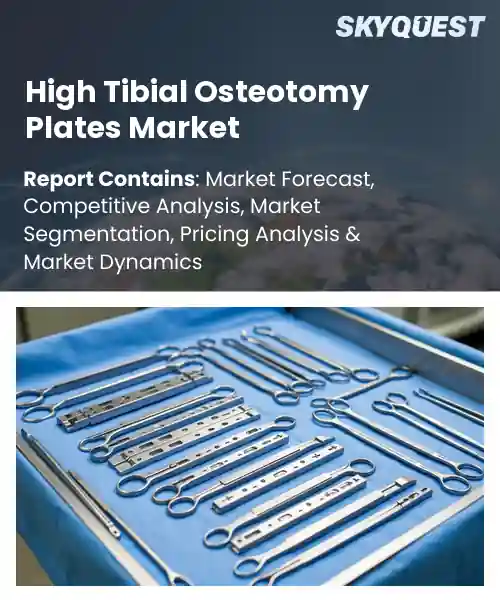
High Tibial Osteotomy Plates Market
Report ID: SQMIG35A3707
Report ID: SQMIG35A3707
[email protected]
USA +1 351-333-4748
Report ID:
SQMIG35A3707 |
Region:
Global |
Published Date: June, 2026
Pages:
157
|Tables:
142
|Figures:
78


Global High Tibial Osteotomy Plates Market size was valued at USD 282.5 Million in 2024 and is poised to grow from USD 300.07 Million in 2025 to USD 485.4 Million by 2033, growing at a CAGR of 6.22% during the forecast period (2026-2033).
The global high tibial osteotomy plates market centers on implants used to correct varus malalignment and unload the medial compartment of the knee, representing a key niche between conservative care and total knee arthroplasty. Increasingly active patients and a rapidly increasing elderly population are looking for ways to preserve their joints as an alternative to joint replacement; therefore, the overall need for trustworthy fixation solutions has grown rapidly. The evolution of the market has progressed from basic tension band constructs to anatomically contoured, locking plate systems like TomoFix, which help to provide better stability and earlier weight bearing alignment. The combination of this technical evolution, improved surgical technique and an increase in surgeon acceptance of these advances are the key factors that drive global market growth today.
A key trend driving the global high tibial osteotomy plates sector adoption is implant and technique innovation, which has directly improved clinical outcomes and broadened indications. As locking, anatomically contoured plates and guides reduced intraoperative time and increased fixation reliability, surgeons became more willing to offer HTO to younger, active patients who faced early total knee arthroplasty. Consequently hospitals observed shorter rehabilitation and lower revision rates in cohorts, reinforcing reimbursement and purchasing decisions. Simultaneously expanding orthopaedic infrastructure in emerging markets and targeted training programs creates opportunities for manufacturers to scale, because increased surgeon capability translates to higher procedure volumes and revenue growth.
How is AI Improving Design and Outcomes in the High Tibial Osteotomy Plates Market?
AI is raising the technical bar for high tibial osteotomy plates by combining generative design, predictive simulation and patient specific planning. Designers use machine learning driven optimization to refine plate geometry and screw trajectories so implants sit closer to the bone and reduce soft tissue irritation. This also helps the surgeon with AI enhanced preoperative planning by creating custom cutting guides and allowing the surgeon to predict how stable the fixation will be in each individual patient's anatomy. The market place is leaning toward providing anatomically contoured, low profile locking plates and custom solutions to reduce variability and speed up recovery. Early research and industry case studies show generative design and 3D planning improving implant fit and surgical confidence.
In January 2025, Stryker launched the PHiTO plate system in Japan and the growing use of AI driven planning and design automation helps produce patient specific plates and guides that improve fit and reduce intraoperative adjustments thereby supporting market efficiency and adoption.
Market snapshot - (2026-2033)
Global Market Size
USD 282.5 Million
Largest Segment
Opening Wedge HTO Plates
Fastest Growth
Opening Wedge HTO Plates
Growth Rate
6.22% CAGR
To get more insights on this market click here to Request a Free Sample Report
Global high tibial osteotomy plates market is segmented by product type, material, application, end-user, distribution and region. Based on product type, the market is segmented into opening wedge HTO plates, closing wedge HTO plates and dome osteotomy plates. Based on material, the market is segmented into titanium and stainless steel. Based on application, the market is segmented into medial knee osteoarthritis and tibial plateau fractures. Based on end-user, the market is segmented into hospitals, orthopedic clinics and ASCs. Based on distribution, the market is segmented into direct sales, distributors and online. Based on region, the market is segmented into North America, Europe, Asia Pacific, Latin America and Middle East & Africa.
Based on the global high tibial osteotomy plates market growth, opening wedge HTO plates segment dominates because their geometry permits controlled angular correction with minimal soft tissue disruption, matching surgeon demand for predictable alignment outcomes in medial knee realignment. Improved locking screw interfaces and plate profiles deliver reliable fixation and postoperative stability, prompting adoption across hospitals and clinics. The manufacturer continues to be the market leader in developing instrumentation kits for surgical use, providing training to surgeons, and developing their designs iteratively for improvement.
However, closing wedge HTO plates are gaining traction as the most rapidly expanding area owing to renewed clinical interest in classic osteotomy techniques updated with low profile plates and streamlined workflows. Improvements to design that have made fixation simpler, less invasive, and targeted surgeon education programs are leading to faster adoption; they are also opening new clinical applications and generating new business opportunities.
Titanium segment dominates because its superior biocompatibility, favorable strength to weight ratio, and corrosion resistance address clinical concerns for implants used in high tibial osteotomy. Lightweight alloys with lower potential for allergic reactions and easier integration with bone encourage surgeons to use them where possible, as well as make them possible to produce thinner, and more anatomically contoured plates by using advanced surface treatments and additive manufacturing methods. These advantages in material properties help surgeons choose which products to purchase and encourage continued innovation in high tibial osteotomy plates market.
However, stainless steel is gaining momentum due to lower cost, established manufacturing, and alloy treatments that reduce corrosion and improve fatigue resistance. More quickly adopting this product because its mechanical behaviour is predictable, it has compatibility with current lock systems and its attractiveness to both those end users which have separate buildings, and those who may purchase it based on pricing allow for increased potential for adopting this product.
To get detailed segments analysis, Request a Free Sample Report
As per the global high tibial osteotomy plates market share, North America leads due to an integrated ecosystem that aligns advanced clinical practice, concentrated research capabilities, and mature market infrastructure. The widespread use of new plate design is aided by the large concentration of specialized orthopedic facilities in addition to the high level of familiarity that surgeons have with respect to joint-preserving techniques. Clinical evidence generation and iterative product development is enhanced through strong collaboration between manufacturers and academic institutions. Financial incentives and established purchasing mechanisms for hospitals and specialty clinics are also present to alleviate barriers to adoption. The regulatory climate and professional environment provide opportunities for postmarket assurances and training/educational programs which further help to build clinician confidence. These factors further consolidate market leadership within a region.
High Tibial Osteotomy Plates Market in the United States is characterized by concentrated clinical expertise and a robust innovation pipeline. Leading orthopedic centers and high procedure volumes support rapid clinical evaluation and early adoption of novel plate systems. Close engagement between device firms and surgeon groups enables iterative refinements and procedural training. Reimbursement pathways and hospital procurement practices facilitate access, while strong post market data collection and specialty societies promote best practice dissemination. The combination of clinical leadership and commercial sophistication positions the United States as a primary driver of product development and adoption.
High tibial osteotomy plates market in Canada reflects a health system that prioritizes evidence based decision making and regional center expertise. Long-term value from supply relationships and reliability of devices are supported by collaborative relationships between provincial hospitals and teaching hospitals, manufacturers, clinical trial participants, and training programs. There are variations in market scale throughout Canada; however, targeted clinical networks and a commitment to implementing and using standardized products have resulted in similar levels of acceptance of advanced plate technology across specialized hospitals.
Based on global high tibial osteotomy plates regional forecast, Europe is experiencing rapid expansion driven by a convergence of clinical emphasis on joint preservation, supportive regulatory harmonization, and active industry presence across key countries. The development of orthopedic research hubs and specialized hospitals has resulted in a push for the use of advanced plating systems. Multi-centre collaborative studies between clinical societies and manufacturers enable around-the-world Clinical Guidelines to increase clinician confidence. Procurement reform and changing reimbursement methods in various regions have resulted in greater access to advanced implants. Experienced local manufacturers and contract manufacturing capabilities minimise launch timelines while assisting with customisation efforts. Growth is further enhanced by the development of new training programs and knowledge exchange throughout Europe for diffusion of best practices and novel device design concepts.
High tibial osteotomy plates market in Germany is anchored by strong manufacturing competence and high concentration of specialty orthopedic clinics. Together, clinical research organizations and businesses in the device sector work to develop new designs, which are evaluated through rigorous testing. In addition, hospitals that have implemented dedicated programs for preserving joints will support the systematic training for using these devices as well as their adoption by the healthcare community. This combination of industrial depth and clinical excellence underpins Germany position as the dominant market within the region.
High tibial osteotomy plates market in the United Kingdom exhibits rapid growth fueled by innovation friendly clinical networks and proactive adoption of evidence based surgical techniques. Academic hospitals and specialist centers lead in evaluating new plate systems, often in partnership with international manufacturers. Technologies with evident clinical benefits can easily be integrated through reimbursement and procurement systems. Centralized guidelines, as well as focused surgeon training initiatives, promote consistent adoption. These dynamics create a conducive environment for rapid growth and early market penetration of advanced plating solutions.
High tibial osteotomy plates market in France is emerging through strengthened clinical interest and growing industry engagement. More and more specialist and university-based health care facilities are evaluating ways to preserve joints. This has led to an increased focus on advanced plate technology. Regulatory and procurement processes are centered on demonstrating clinical value and effectiveness. All manufacturers must provide evidence of clear benefit to demonstrate value. The partnership between industry and clinicians is improving the opportunities for training. As clinical experience accumulates, France is transitioning from selective use toward broader consideration of osteotomy plate solutions in appropriate patient groups.
As per global high tibial osteotomy plates regional outlook, Asia Pacific is advancing its role through a multifaceted approach that combines local innovation, capacity building, and strategic partnerships with global manufacturers. There are also more clinical specializations within medicine, leading to more experience with the procedures being applied in multiple settings. Local manufacturers are upgrading existing products and quality, while partnerships with established international product providers enhance technology transfer and promote local development. The urban development of healthcare infrastructure, research conducted in clinical settings and increasing sophistication of the purchasing of product at healthcare facilities support greater utilization. The introduction of strategies to address the affordability and logistics will assist in penetrating the market. The combined efforts will create an enhanced clinical capability and market presence across the area.
High tibial osteotomy plates market in Japan benefits from advanced orthopedic research and a culture of precision engineering. Innovative plate designs are often assessed by consultant hospitals and research facilities, frequently collaborating closely with domestic and international manufacturers. There is an emphasis on the need for clinical evidence and reliable devices to support a gradual and measured adoption of new devices across tertiary centres. Through a combination of training programmes and the efforts of professional societies, many surgical best practices have been disseminated to clinicians. The most critical elements in the current market environment are high-quality devices and a strong relationship between the clinician and the manufacturer.
High tibial osteotomy plates market in South Korea is strengthening through rapid clinical skill development and active collaboration between industry and academic centers. The presence of a limited number of specialized hospitals is promoting the use of procedures and giving these facilities the ability to perform clinical evaluations. An increase in the overall use of advanced plate systems in the U.S., due in part to the focus on innovation, training on the use of new procedures, and the efficiency of supply chains, should also promote broader use of these devices throughout the country.
To know more about the market opportunities by region and country, click here to
Buy The Complete Report
Rising Prevalence Of Knee Osteoarthritis
Advances In Plate Design and Materials
Limited Reimbursement and Cost Concerns
Surgical Complexity and Training Requirements
Request Free Customization of this report to help us to meet your business objectives.
Competition in the global high tibial osteotomy plates market outlook is intensifying as incumbents and new entrants push patient specific solutions, additive manufacturing and digital planning. Strategic activity is concrete. Examples include acquisitions of niche implant portfolios and patient specific platforms by large orthopedics firms. Major players are pairing with 3D printing specialists and startups to lock in surgeon workflows and shorten time to care.
Top Player’s Company Profile
Recent Developments
SkyQuest’s ABIRAW (Advanced Business Intelligence, Research & Analysis Wing) is our Business Information Services team that Collects, Collates, Correlates, and Analyses the Data collected by means of Primary Exploratory Research backed by robust Secondary Desk research.
As per SkyQuest analysis, one key driver behind the global high tibial osteotomy plates industry is the rising prevalence of knee osteoarthritis increasing demand for joint‑preserving surgery, while one restraint is limited reimbursement and cost concerns that slow adoption. The dominating region is North America due to advanced clinical practice and procurement, and the dominating segment is opening wedge HTO plates because of predictable alignment control and surgeon preference. A second driver is continued innovation in plate design, materials and AI enabled patient specific planning that improves fit and outcomes, and growing surgeon training initiatives support broader clinical uptake. The growth in the market as a whole comes from both clinical need and the advancement of technology, but is limited by the barriers of economics and reimbursement.
| Report Metric | Details |
|---|---|
| Market size value in 2024 | USD 282.5 Million |
| Market size value in 2033 | USD 485.4 Million |
| Growth Rate | 6.22% |
| Base year | 2024 |
| Forecast period | (2026-2033) |
| Forecast Unit (Value) | USD Million |
| Segments covered |
|
| Regions covered | North America (US, Canada), Europe (Germany, France, United Kingdom, Italy, Spain, Rest of Europe), Asia Pacific (China, India, Japan, Rest of Asia-Pacific), Latin America (Brazil, Rest of Latin America), Middle East & Africa (South Africa, GCC Countries, Rest of MEA) |
| Companies covered |
|
| Customization scope | Free report customization with purchase. Customization includes:-
|
To get a free trial access to our platform which is a one stop solution for all your data requirements for quicker decision making. This platform allows you to compare markets, competitors who are prominent in the market, and mega trends that are influencing the dynamics in the market. Also, get access to detailed SkyQuest exclusive matrix.
Table Of Content
Executive Summary
Market overview
Parent Market Analysis
Market overview
Market size
KEY MARKET INSIGHTS
COVID IMPACT
MARKET DYNAMICS & OUTLOOK
Market Size by Region
KEY COMPANY PROFILES
Methodology
For the High Tibial Osteotomy Plates Market, our research methodology involved a mixture of primary and secondary data sources. Key steps involved in the research process are listed below:
1. Information Procurement: This stage involved the procurement of Market data or related information via primary and secondary sources. The various secondary sources used included various company websites, annual reports, trade databases, and paid databases such as Hoover's, Bloomberg Business, Factiva, and Avention. Our team did 45 primary interactions Globally which included several stakeholders such as manufacturers, customers, key opinion leaders, etc. Overall, information procurement was one of the most extensive stages in our research process.
2. Information Analysis: This step involved triangulation of data through bottom-up and top-down approaches to estimate and validate the total size and future estimate of the High Tibial Osteotomy Plates Market.
3. Report Formulation: The final step entailed the placement of data points in appropriate Market spaces in an attempt to deduce viable conclusions.
4. Validation & Publishing: Validation is the most important step in the process. Validation & re-validation via an intricately designed process helped us finalize data points to be used for final calculations. The final Market estimates and forecasts were then aligned and sent to our panel of industry experts for validation of data. Once the validation was done the report was sent to our Quality Assurance team to ensure adherence to style guides, consistency & design.
Analyst Support
Customization Options
With the given market data, our dedicated team of analysts can offer you the following customization options are available for the High Tibial Osteotomy Plates Market:
Product Analysis: Product matrix, which offers a detailed comparison of the product portfolio of companies.
Regional Analysis: Further analysis of the High Tibial Osteotomy Plates Market for additional countries.
Competitive Analysis: Detailed analysis and profiling of additional Market players & comparative analysis of competitive products.
Go to Market Strategy: Find the high-growth channels to invest your marketing efforts and increase your customer base.
Innovation Mapping: Identify racial solutions and innovation, connected to deep ecosystems of innovators, start-ups, academics, and strategic partners.
Category Intelligence: Customized intelligence that is relevant to their supply Markets will enable them to make smarter sourcing decisions and improve their category management.
Public Company Transcript Analysis: To improve the investment performance by generating new alpha and making better-informed decisions.
Social Media Listening: To analyze the conversations and trends happening not just around your brand, but around your industry as a whole, and use those insights to make better Marketing decisions.
REQUEST FOR SAMPLE
 REQUEST FREE CUSTOMIZATION
Global High Tibial Osteotomy Plates Market size was valued at USD 282.5 Million in 2024 and is poised to grow from USD 300.07 Million in 2025 to USD 485.4 Million by 2033, growing at a CAGR of 6.22% during the forecast period (2026-2033).
Competition in the global high tibial osteotomy plates market is intensifying as incumbents and new entrants push patient specific solutions, additive manufacturing and digital planning. Strategic activity is concrete. Examples include acquisitions of niche implant portfolios and patient specific platforms by large orthopedics firms. Major players are pairing with 3D printing specialists and startups to lock in surgeon workflows and shorten time to care. 'Arthrex Inc.', 'Smith & Nephew', 'Stryker Corporation', 'Zimmer Biomet', 'DePuy Synthes (J&J)', 'Exactech Inc.', 'Tomofix (DePuy)', 'Aesculap (B. Braun)', 'Conmed Corporation', 'Acumed LLC', 'Nouvag AG', 'Biomet (Zimmer)', 'Synthes (DePuy)', 'PEAK Surgical (Medtronic)', 'Conventus Orthopaedics', 'OsteoMed LLC', 'Paragon 28', 'Medartis AG', 'Enovis Corporation', 'KLS Martin Group'
Rising rates of degenerative knee conditions increase demand for surgical interventions that preserve joint function, thereby promoting adoption of high tibial osteotomy plates. As conservative management often fails to address progressive malalignment and pain, clinicians increasingly consider osteotomy procedures to delay joint replacement, which drives preference for reliable fixation hardware. Growing clinician familiarity with the technique and favorable patient outcomes encourage hospitals and surgical centers to invest in specialized implants, creating sustained procurement cycles and expanding market opportunities for manufacturers of HTO plate systems.
Minimally Invasive Procedure Adoption: Surgeons and hospitals are favoring techniques and implant designs that enable smaller incisions, reduced soft tissue disruption, and faster postoperative recovery. High tibial osteotomy plate manufacturers are responding with lower-profile geometries, streamlined instrumentation, and compatibility with minimally invasive workflows. This trend drives closer collaboration between device developers and clinicians to refine surgical steps, improve implant ergonomics, and support patient-centric outcomes through design innovation and procedure optimization across care settings, and encourage adoption of evidence-informed clinical pathways to enhance long-term results.
Why does North America Dominate the Global High Tibial Osteotomy Plates Market? |@12


Want to customize this report? This report can be personalized according to your needs. Our analysts and industry experts will work directly with you to understand your requirements and provide you with customized data in a short amount of time. We offer $1000 worth of FREE customization at the time of purchase.
Feedback From Our Clients


 USA (+1) 351-333-4748

