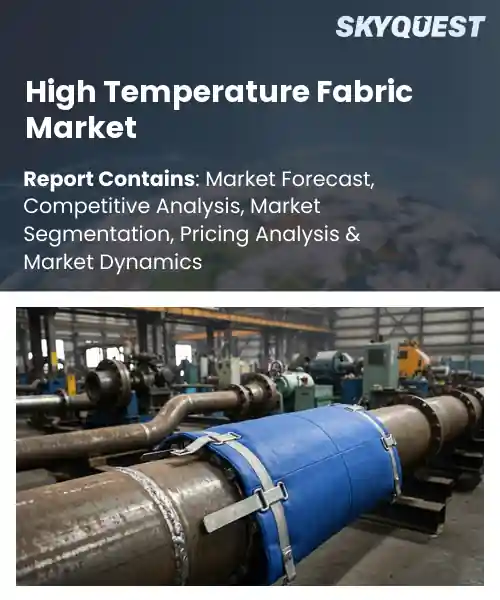
High Temperature Fabric Market
Report ID: SQMIG20I2712
Report ID: SQMIG20I2712
[email protected]
USA +1 351-333-4748
Report ID:
SQMIG20I2712 |
Region:
Global |
Published Date: February, 2026
Pages:
157
|Tables:
128
|Figures:
77


Global High Temperature Fabric Market size was valued at USD 3.3 Billion in 2024 and is poised to grow from USD 3.52 Billion in 2025 to USD 5.92 Billion by 2033, growing at a CAGR of 6.7% during the forecast period (2026-2033).
The primary driver of the high temperature fabric industry is accelerating demand for thermal protection across industrial sectors, driven by rising safety regulations and expansion of high-heat applications. High temperature fabrics include materials such as aramids, aluminized fabrics, and ceramic-based composites used for insulation, protective apparel, and furnace liners. This market matters because it reduces injury, extends equipment life, and increases process efficiency in environments exceeding 200°C.
The sector evolved from asbestos substitutes to engineered fiber blends after regulatory bans and technological advances, exemplified by the adoption of Nomex in firefighting gear and ceramic fabrics in aerospace protection systems. Building on that evolution, the pivotal factor driving global market expansion is technological innovation in fiber chemistry and coatings, as improved heat tolerance and lower weight convert niche products into mainstream solutions. As companies develop ceramic weaves and high-tenacity aramid blends that withstand higher temperatures with less bulk, end users in aerospace apply ceramic fabrics for thermal shields and energy firms swap heavier insulation in furnaces, which boosts procurement and justifies more R&D. Consequently, manufacturers scale production, unit costs fall, and regions such as APAC, with rising petrochemical and manufacturing capacity, seize high temperature fabric market share while aftermarket and retrofit opportunities grow.
How is IoT Enhancing Performance Monitoring in the High Temperature Fabric Market?
IoT is improving performance monitoring in the high temperature fabric market by embedding temperature and strain sensors into fabrics and by using external thermal sensing linked to cloud analytics. Key aspects include continuous real time telemetry, edge processing to filter noise, and analytics that translate raw signals into actionable alerts. The current state shows growing adoption in industrial and protective applications where fabric integrity matters.
Contextually, this market is driven by demand for safer workplaces and longer lasting insulation in harsh environments. Examples include textile sensors in protective garments and low power wide area networking for remote furnace insulation monitoring, which enable predictive maintenance and faster quality control.
Market snapshot - (2026-2033)
Global Market Size
USD 3.3 Billion
Largest Segment
Fiberglass Fabrics
Fastest Growth
Specialty Polymer Fabrics
Growth Rate
6.7% CAGR
To get more insights on this market click here to Request a Free Sample Report
Global high temperature fabric market is segmented into fabric type, end use industries, application, distribution channel and region. Based on fabric type, the market is segmented into fiberglass fabrics, silica fabrics, specialty polymer fabrics, asbestos fabrics, blended fabrics and others. Based on end use industries, the market is segmented into aerospace & defense, industrial & manufacturing, oil & gas, energy & power, automotive, construction and others. Based on application, the market is segmented into protective clothing, insulation, filtration, aerospace & automotive components, steel and iron foundry and others. Based on distribution channel, the market is segmented into direct sales, distributors, online retailers and others. Based on region, the market is segmented into North America, Europe, Asia Pacific, Latin America and Middle East & Africa.
As per high temperature fabric market outlook, Fiberglass Fabrics segment dominates because its combination of thermal stability, mechanical robustness and cost efficientproduction makes it the default choice for many heat intensive applications. Its predictable performance under prolonged high temperature exposure reduces product risk and simplifies qualification for industrial users, prompting designers to specify it for insulation, filtration and composite reinforcement. This procurement momentum encourages manufacturers to optimize processing and supply chains around fiberglass based offerings.
As per high temperature fabric market forecast, However, Specialty Polymer Fabrics is emerging as the most rapidly expanding area due to material innovations that deliver lighter weight, greater flexibility and improved chemical resistance for demanding uses. Growing adoption in advanced protective apparel and select aerospace components, together with regulatory preference for non-asbestos solutions and continuous material R and D, fosters new applications and supplier investment that accelerates future market opportunities.
As per high temperature fabric market analysis, the protective clothing segment has been the market leader since the requirements for safety as well as the standards requiredin workplaces dictate that manufacturers must use high-temperature ammunition, such as high-temperature textiles. End users of thermal risk environments are particularly focused on ensuring the fabric used to protect them has been certified, which means that all textile producers are refining and changing their processes to create textiles that comply to the protocols of their workplace. As a result of the focus on providing validated protection to users, there is a consistent demand for advanced high-temperature fabrics across multiple industries.
The insulation segment is currently experiencing the highest high temperature fabric market growth due to industries beginning to use smaller, more efficient thermal barriers used for insulating equipment and piping used in energy intensive industries. The continued advancements in the development of durable, effective thermal fabric for use in laminated textiles in addition to the integration of laminated fabrics with aerogel and engineered finishes, have expanded the application of thermal insulation textiles to new and retrofit applications. The energy-efficient movement and continued demand for modular insulation solutions have provided an opportunity for textile manufacturers to create their own unique forms of insulation fabrics that will enable suppliers to bring innovative thermal fabric-based solutions to the marketplace.
To get detailed segments analysis, Request a Free Sample Report
As per high temperature fabric market regional outlook, the Asia Pacific region will be a significant contributor to the market. There are excellent collaboration and synergyamong regional producers who possess expertise in both material science and the automotive, electronics, and heavy industries they service. This establishes and accelerates the opportunities to leverage high temperature textiles in thermal insulation applications, protective clothing, and reinforcements in composite materials.
The high temperature fabric market in Japan is benefiting from advanced materials-related R&D in the country, as well as the proximity to many high-precision manufacturers based in the Denso region. High temperature fabrics produced in Japan are built around meeting the needs of the automotive and electronics industries by offering technology that is based on performance, strict quality standards, and the ability to develop custom-made solutions for the specific needs of their customers. Collaboration between research institutions and manufacturers is essential in facilitating the continued development of high-performance high-temperature textile fibers and fabric architectures suitable for multitude of applications.
The high temperature fabric market in South Korea will continue to demonstrate consistent growth attributed to the close relationships between fabric producers and heavy industry end-use markets (i.e. shipbuilding and consumer electronics). Emphasis on rapid prototyping, material innovation and process automation will enable increased technical development and availability of specialized high-temperature textiles. Additionally, companies will continue to establish functional finishes, performance-testing tools, and increase supply chain flexibility in providing customized solutions for industrial and export markets, while also fostering relationships with technology developers and manufacturers to accelerate the acceptance of this technology.
As per high temperature fabric market regional forecast, the North America region is experiencing a surge in growth as a result of the combination of high levels of required products from the aerospace, defense, oil and gas and industrial safety industries, as well as a greater focus on superior performance of high performance materials and supplier qualification. Companies located in the region benefit from their highly technical engineering skills; extensive testing facilities; and proximity to end users. As a result of these advantages, companies in the North American market are able to provide custom, high temperature textile solutions to their customers.
The high temperature fabric market in the U.S. has strong potential because of a well-developed industrial base, a high level of demand in the aerospace and defense sectors, and excellent research capabilities within the U.S. Supplier firms focus their efforts on sourcing superior materials, developing stringent certification processes and coordinating with manufacturers of composite materials to provide high temperature fabrics for use in protective clothing and insulating materials. Additionally, the demand for high temperature fabrics for use in protective clothing and insulating materials supports the development of specialized finishes and durability tests for certain types of high temperature fabrics.
The high temperature fabric market in Canada is driven by the combined demands of the energy, mining and manufacturing sectors, as well as by the need to develop high durability, weather resistant fabrics. In general, Canadian manufacturers focus on producing high temperature fabrics that are durable, have excellent heat insulating properties, and meet industry standards for safety and environmental compliance. Manufacturers that are part of the North American supply chain typically collaborate with one another to help ensure that their products meet export quality standards prior to being shipped to customers located in other countries. Niche manufacturers within the Canadian high temperature fabric market provide custom technical textiles for the protection of equipment and for the safety of workers and strive to source and produce their products in compliance with sustainable practices.
As per high temperature fabric industry analysis, through a combination of new advances in materials and stringent regulations as well as cooperation between industry clusters and companies in their respective regions; Europe is continuing to build its position as a leader in manufacturing. European manufacturers are focused on producing only the best performing products using environmentally friendly processes. In doing so, they have aligned themselves with industry's rigorous product design, development and certification requirements for their customers in the automotive, aerospace, and industrial sectors. By collaborating with companies across borders, such as textile manufacturers, research institutes and equipment manufacturers; European manufacturers have developed a new way for them to rapidly adopt new types of advanced high temperature textiles used in applications including insulation, composites and protective clothing. Companies are investing in new ways to test their products, with an eye toward recyclability and niche industrial applications; these strategies are helping to create a distinct identity for the European market.
Germany is experiencing an increase in demand for high temperature fabric due to its long-standing reputation for precision engineering and its ability to align itself with supply chains in both automotive and industrial machinery. While there has been a trend toward using high-performance material, companies within Germany are also focusing on being able to meet their customers' high-volume requirements in process control and integration with composite manufacturing.
UK is supported by the excellent research capability, engineering consultancy and close relationship to defence and aerospace suppliers. Companies focus on material innovation, rapid prototyping and the specialist testing service they provide to meet certification requirements; they focus on integrating design and providing tailored solutions for use in composites, protective clothing and industrial thermal insulation applications. Working in collaboration between universities, industry and users helps to accelerate commercialization of and develop capability for complex technical textiles.
France combines a long tradition of textile craftsmanship with continuing focus on the development of new composites and protective materials for aerospace and industrial applications. Companies place emphasis on the development of advanced fibres, the use of coating technology, and the provision of customized finishes to meet very demanding practical operating conditions. Close collaboration with research organisations helps in the transfer of prototype into production. The market supports niche suppliers providing high quality, certified solutions and value-added services to their specific end-use sectors.
To know more about the market opportunities by region and country, click here to
Buy The Complete Report
Industrial and Energy Sector Demand
High-temperature advanced textile materials are more and more frequently being identified as the best solution in industrial and energy applications where long-term exposure to extreme heat and corrosive environments requires reliable protective materials. End users in the power generation, oil and gas, and heavy manufacturing sectors desire fabrics that will maintain their structural integrity and provide thermal insulation over time, thereby leading suppliers to place an emphasis on high-performance composite fabrics and refractory textiles. As demand for these products remains strong, companies are continually developing and commercializing new products, scaling up specialized production processes, and investing in material qualification and certification to comply with the rigorous operating requirements within these industrial sectors.
Innovations in Material Technology
Innovations in fiber chemistry, weaving techniques, and composite layering have improved the thermal performance and durability of high-temperature advanced textiles, allowing them to be critically useful in environments previously thought unusable. The adoption of new ceramic fibers, new coatings, hybrid construction techniques, and other innovations provide enhanced protection against oxidation and thermal shock, as well as increased resistance to wear, which collectively increase confidence in these materials among specifiers and end-users. Breakthroughs in these materials will drive future growth of the market by expanding the size of the available market, shortening the qualification cycles for new products, and promoting suppliers to invest in scalable manufacturing and applications-specific customization.
High Production and Raw Material Costs
The high cost of specialized fibers and advanced coatings combined with the energy-intensive process used to manufacture high temperature fabrics creates a major obstacle to the widespread adoption of these materials, especially among cost-conscious end users. Manufacturers are forced to work with tight margins to balance performance specifications with competitive prices, making it more difficult for them to scale production and invest in new manufacturing capabilities. Furthermore, higher prices for final products limit the ability of smaller companies and those operating on tighter budgets to access these materials, thereby limiting the overall growth of the market and encouraging customers to seek lower-cost alternatives.
Supply Chain and Capacity Limitations
The fragmentation of supply chains and limited production capacity for specialty high temperature textiles can create delays in delivering products on time and create inconsistency in quality, which undermines customer confidence and slows down the time it takes to award contracts. Buyers of textiles are also vulnerable to potential disruptions due to logistics problems or setbacks with regional manufacturers, since they are dependent upon a limited number of suppliers who provide the critical raw materials and coatings for textiles. In addition, these capacity limitations will prevent manufacturers from being able to respond quickly when there is a surge in demand, thus delaying project timelines and making it less attractive for uses that require time-sensitive textiles to consider adopting this form of technology.
Request Free Customization of this report to help us to meet your business objectives.
Competitive landscape in the global high temperature fabric market centers on consolidation certification driven competition and rapid product differentiation. Mergers and acquisitions and targeted partnerships are used to secure specialty coatings and defence approvals. For example a 2024 U.S. capacity acquisition and a 2024 DuPont partnership accelerated access to coated PTFE and nanocoating technology. Suppliers also push proprietary PTFE and high silica innovations to differentiate.
Material Innovation Driving Performance: The focus of manufacturers is to develop new types of fibers or composite materials that provide improved insulation against heat, less weight, and help meet multiple needs. By working together with material suppliers and product developers, new lab creations are getting to the market quicker as large-scale products to meet the challenging needs of high-performance applications, such as industrial insulation, protective clothing, or filtering at very hightemperatures. The ability to adapt manufacturing processes to change quickly results in the ability to produce new formulations and to combine with advanced coatings to create unique material characteristics that meet strict operational specifications while extending the life of the material and reducing the costs of maintaining the material.
Sustainability and Circular Economy: Sustainability and the circular economy are driving the requirement for recyclable, virtually low-emission high-temperature fabrics, and reuse strategies for end-of-life materials in all cases due to regulatory pressures and business commitments. The high temperature fabric market trend toward reusable materials has led designers and manufacturers to use modular designs, consistent fiber types, and chemical-free finishes to make it easy to recycle products and reduce their environmental impact while maintaining thermal performance. Companies working together across the supply chain are focusing on traceable supply chains and certification to help ensure that they comply with applicable rules and regulations and will be welcomed in the market. This will allow sustainable products to be marketed as premium products, build solid working relationships with suppliers, and invest in closed-loop manufacturing services to support additional sustainability processes at the end of the product life.
SkyQuest’s ABIRAW (Advanced Business Intelligence, Research & Analysis Wing) is our Business Information Services team that Collects, Collates, Correlates, and Analyses the Data collected by means of Primary Exploratory Research backed by robust Secondary Desk research.
As per SkyQuest analysis, the global high temperature fabric market is being driven primarily by rising safety regulations and expanding high-heat applications as a key driver, with technological innovation in fiber chemistry and coatings serving as a second driver that is enabling lighter, higher-performance materials for insulation and protective apparel. High production and raw material costs are creating a major limitation in terms of being able to adapt and expand the market. Manufacturing capacity and end user demand for products is causing Asia Pacific region to dominate. Fibreglass fabrics continue to dominate due to the combination of thermal stability, mechanical strength, cost-effectiveness, and consistent support for continuous growth of the market.
| Report Metric | Details |
|---|---|
| Market size value in 2024 | USD 3.3 Billion |
| Market size value in 2033 | USD 5.92 Billion |
| Growth Rate | 6.7% |
| Base year | 2024 |
| Forecast period | (2026-2033) |
| Forecast Unit (Value) | USD Billion |
| Segments covered |
|
| Regions covered | North America (US, Canada), Europe (Germany, France, United Kingdom, Italy, Spain, Rest of Europe), Asia Pacific (China, India, Japan, Rest of Asia-Pacific), Latin America (Brazil, Rest of Latin America), Middle East & Africa (South Africa, GCC Countries, Rest of MEA) |
| Companies covered |
|
| Customization scope | Free report customization with purchase. Customization includes:-
|
To get a free trial access to our platform which is a one stop solution for all your data requirements for quicker decision making. This platform allows you to compare markets, competitors who are prominent in the market, and mega trends that are influencing the dynamics in the market. Also, get access to detailed SkyQuest exclusive matrix.
Table Of Content
Executive Summary
Market overview
Parent Market Analysis
Market overview
Market size
KEY MARKET INSIGHTS
COVID IMPACT
MARKET DYNAMICS & OUTLOOK
Market Size by Region
KEY COMPANY PROFILES
Methodology
For the High Temperature Fabric Market, our research methodology involved a mixture of primary and secondary data sources. Key steps involved in the research process are listed below:
1. Information Procurement: This stage involved the procurement of Market data or related information via primary and secondary sources. The various secondary sources used included various company websites, annual reports, trade databases, and paid databases such as Hoover's, Bloomberg Business, Factiva, and Avention. Our team did 45 primary interactions Globally which included several stakeholders such as manufacturers, customers, key opinion leaders, etc. Overall, information procurement was one of the most extensive stages in our research process.
2. Information Analysis: This step involved triangulation of data through bottom-up and top-down approaches to estimate and validate the total size and future estimate of the High Temperature Fabric Market.
3. Report Formulation: The final step entailed the placement of data points in appropriate Market spaces in an attempt to deduce viable conclusions.
4. Validation & Publishing: Validation is the most important step in the process. Validation & re-validation via an intricately designed process helped us finalize data points to be used for final calculations. The final Market estimates and forecasts were then aligned and sent to our panel of industry experts for validation of data. Once the validation was done the report was sent to our Quality Assurance team to ensure adherence to style guides, consistency & design.
Analyst Support
Customization Options
With the given market data, our dedicated team of analysts can offer you the following customization options are available for the High Temperature Fabric Market:
Product Analysis: Product matrix, which offers a detailed comparison of the product portfolio of companies.
Regional Analysis: Further analysis of the High Temperature Fabric Market for additional countries.
Competitive Analysis: Detailed analysis and profiling of additional Market players & comparative analysis of competitive products.
Go to Market Strategy: Find the high-growth channels to invest your marketing efforts and increase your customer base.
Innovation Mapping: Identify racial solutions and innovation, connected to deep ecosystems of innovators, start-ups, academics, and strategic partners.
Category Intelligence: Customized intelligence that is relevant to their supply Markets will enable them to make smarter sourcing decisions and improve their category management.
Public Company Transcript Analysis: To improve the investment performance by generating new alpha and making better-informed decisions.
Social Media Listening: To analyze the conversations and trends happening not just around your brand, but around your industry as a whole, and use those insights to make better Marketing decisions.
REQUEST FOR SAMPLE
 REQUEST FREE CUSTOMIZATION
Global High Temperature Fabric Market size was valued at USD 3.3 Billion in 2024 and is poised to grow from USD 3.52 Billion in 2025 to USD 5.92 Billion by 2033, growing at a CAGR of 6.7% during the forecast period (2026-2033).
Competitive landscape in the global high temperature fabric market centers on consolidation certification driven competition and rapid product differentiation. Mergers and acquisitions and targeted partnerships are used to secure specialty coatings and defence approvals. For example a 2024 U.S. capacity acquisition and a 2024 DuPont partnership accelerated access to coated PTFE and nanocoating technology. Suppliers also push proprietary PTFE and high silica innovations to differentiate. 'DuPont', '3M', 'PPG Industries', 'Saint-Gobain', 'Honeywell', 'Solvay', 'Teijin', 'Continental', 'Mid-Mountain Materials', 'Thermolon', 'Shandong Binson', 'Mermet', 'Lydall', 'Baltex', 'SGL Carbon', 'Krempel GmbH', 'Zolon Tech', 'GKD', 'BGF Industries', 'W.L. Gore & Associates'
Advanced high temperature fabrics are increasingly specified in industrial and energy applications where prolonged exposure to extreme heat and corrosive environments necessitates reliable protective materials. End users in power generation, oil and gas, and heavy manufacturing seek fabrics that maintain structural integrity and thermal insulation, prompting suppliers to prioritize high-performance composites and refractory textiles. This persistent demand fosters ongoing product development and commercialization efforts, encourages scale-up of specialized production processes, and motivates investments in material qualification and certifications to meet stringent operational requirements across these industries.
Material Innovation Driving Performance: Manufacturers are prioritizing novel fiber chemistries and composite architectures to improve thermal resilience, weight reduction, and multi-functional performance. Collaborative research and development between material suppliers and users is accelerating translation of lab innovations into scalable products tailored for demanding applications such as industrial insulation, protective apparel, and high temperature filtration. Emphasis on process adaptability enables faster formulation changes and integration with advanced coatings, enabling differentiated material properties that meet stringent operational requirements while extending service life and easing maintenance burdens.
As per high temperature fabric market regional outlook, the Asia Pacific region will be a significant contributor to the market.


Want to customize this report? This report can be personalized according to your needs. Our analysts and industry experts will work directly with you to understand your requirements and provide you with customized data in a short amount of time. We offer $1000 worth of FREE customization at the time of purchase.
Feedback From Our Clients


 USA (+1) 351-333-4748

