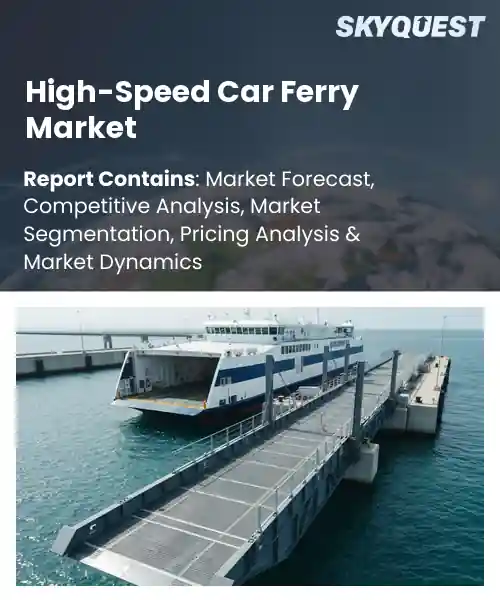
High-Speed Car Ferry Market
Report ID: SQMIG20T2061
Report ID: SQMIG20T2061
[email protected]
USA +1 351-333-4748
Report ID:
SQMIG20T2061 |
Region:
Global |
Published Date: July, 2026
Pages:
157
|Tables:
144
|Figures:
78


Global High-Speed Car Ferry Market size was valued at USD 842.6 Million in 2024 and is poised to grow from USD 891.47 Million in 2025 to USD 1399.56 Million by 2033, growing at a CAGR of 5.8% during the forecast period (2026-2033).
The global high‑speed car ferry market comprises vessels capable of transporting automobiles across medium sea lanes at speeds exceeding 30 knots, thereby reducing travel time compared with ferries. Consequently, the market has progressed from niche services to a component of regional transport infrastructures.
The dominant growth catalyst is the integration of advanced propulsion and digital navigation systems, which lower operating costs and enhance service reliability. By replacing diesel engines with electric‑hybrid or LNG units, operators such as Finnlines have reported fuel‑consumption reductions of up to 25 percent, translating into lower ticket prices and frequency on routes like Helsinki‑Stockholm. Real‑time traffic‑management platforms enable precise docking schedules, attracting logistics firms that previously preferred inland rail corridors. Consequently, the market opens opportunities for manufacturers of lightweight composite hulls and for ports investing in shore‑side charging, creating a cycle of efficiency gains and expanded route networks.
How is AI-driven automation improving efficiency in the high‑speed car ferry market?
AI‑driven automation is reshaping high‑speed car ferries by streamlining vessel navigation, optimizing fuel consumption and enhancing crew scheduling. Machine‑learning models process real‑time weather, sea‑state and traffic data to plot the most efficient routes, reducing idle time and wear on engines. Predictive maintenance algorithms alert technicians before components fail, keeping vessels on schedule and cutting costly downtime. Automated ticketing and boarding systems match passenger flow with vehicle loading, shortening turnaround at ports. Together these technologies create smoother operations, lower operating costs and a more reliable service that attracts both commuters and tourists, strengthening the market’s growth trajectory.
Seastreak in April 2026, launched an AI‑optimized routing platform that dynamically adjusts sail plans, cutting fuel use and improving on‑time performance, a clear example of automation boosting efficiency in the high‑speed car ferry sector.
Market snapshot - (2026-2033)
Global Market Size
USD 842.6 Million
Largest Segment
Diesel
Fastest Growth
Hybrid & Electric
Growth Rate
5.8% CAGR
To get more insights on this market click here to Request a Free Sample Report
Global high-speed car ferry market is segmented by propulsion type, hull material, capacity, end user, application and region. Based on propulsion type, the market is segmented into Diesel, Gas Turbine and Hybrid & Electric. Based on hull material, the market is segmented into Aluminum, Steel and Composite. Based on capacity, the market is segmented into Passenger Only, Passenger & Vehicle and Freight Vehicle. Based on end user, the market is segmented into Commercial Operators, Government and Defense. Based on application, the market is segmented into Inter-Island Transport, Coastal Transport and Cross-Border Transport. Based on region, the market is segmented into North America, Europe, Asia Pacific, Latin America and Middle East & Africa.
Hybrid & electric segment leads with large high-speed car ferry market share because operators seek to lower fuel consumption while meeting stricter emission standards. The ability to combine battery storage with efficient engines gives vessels higher acceleration and quieter operation, which suits short duration, high frequency routes. Additionally, the technology aligns with sustainability goals and attracts passengers willing to pay for greener travel, reinforcing its central role in market development across fleet strategies and future planning initiatives.
As per high-speed car ferry market outlook, diesel segment is witnessing the strongest growth momentum because recent advances in low sulfur fuel formulations and turbocharged engine designs have improved efficiency and reduced emissions. These improvements make diesel attractive for longer routes where battery weight constraints are critical, spurring new vessel orders and expanding market reach globally.
As per high-speed car ferry market forecast, aluminum segment dominates because its light weight dramatically improves fuel efficiency and allows higher speeds, which are essential for high speed ferry services. The material’s corrosion resistance reduces maintenance cycles, extending vessel uptime and lowering operating costs. Moreover, aluminum’s recyclability aligns with environmental commitments, making it attractive to operators focused on sustainable brand positioning and long term asset value across route networks, supporting competitive differentiation and future fleet modernization initiatives.
Meanwhile, composite segment emerges as the key high growth area because breakthroughs in carbon fiber manufacturing have lowered costs while delivering strength to weight ratios. This enables designers to create light hulls that achieve speeds with minimal energy draw, attracting operators seeking to capture market share and meet regulatory standards.
To get detailed segments analysis, Request a Free Sample Report
Europe’s dominance drives from a confluence of mature maritime infrastructure, a dense network of short sea routes, and strong policy support for sustainable transport. Leading shipyards deliver cutting‑edge vessel designs that emphasize speed, fuel efficiency and low emissions. Integrated transport strategies link high‑speed ferries with rail and road corridors, enhancing multimodal connectivity across the continent. Robust tourism demand, especially in coastal and island destinations, fuels frequent service schedules. Moreover, the European Union’s emphasis on green mobility and substantial investment in research and development encourage continuous innovation, positioning the region as a benchmark for operational excellence and technological advancement in the high‑speed car ferry sector.
As per high-speed car ferry market regional outlook, Germany benefits from world‑class engineering expertise and shipbuilding clusters that prioritize advanced propulsion systems. The country’s strategic location between the North Sea and the Baltic Sea creates natural corridors for rapid vehicle transport. Strong logistics hubs support seamless integration with road and rail networks, while environmental regulations drive adoption of low‑emission technologies. Collaborative projects between industry and research institutions further enhance vessel performance and operational efficiency.
As per high-speed car ferry market regional forecast, United Kingdom leverages its island geography and historic ferry corridors that connect the mainland with neighboring islands. A supportive regulatory environment encourages investment in hybrid and electric vessels, aligning with national sustainability goals. Tourism hotspots and business travel generate consistent passenger and vehicle volumes, justifying high‑frequency services. Ongoing innovation in vessel design and port infrastructure enables faster turnaround times and improved service reliability.
France is reinforced by a blend of Mediterranean and Atlantic access points that serve popular holiday destinations and commercial routes. The nation’s shipyards contribute expertise in building high‑performance ferries, while coastal regions benefit from strong tourism demand. Integration with national rail and highway networks facilitates smooth multimodal journeys. Environmental commitments promote the adoption of greener propulsion solutions, enhancing the market’s appeal to eco‑conscious travelers.
Asia Pacific region experiences rapid expansion due to its fragmented geography, rising middle‑class mobility, and proactive government policies encouraging modern maritime solutions. Nations with advanced shipbuilding capabilities introduce increasingly efficient vessels that meet stringent environmental standards. Growing tourism among island chains and coastal cities creates a steady demand for swift vehicle transport. Investment in port modernization and digital ticketing platforms improves passenger experience, while regional trade agreements foster cross‑border ferry services. Collectively, these factors position Asia Pacific as a dynamic arena for high‑speed car ferry growth.
Japan thrives on the country’s archipelagic layout, which necessitates swift links between major islands. Advanced marine engineering firms develop vessels that combine speed with cutting‑edge fuel‑saving technologies. Strong governmental backing supports the deployment of eco‑friendly ferries, aligning with national sustainability targets. High tourist inflows to coastal attractions and robust domestic travel habits sustain frequent service schedules. Continuous R&D investment ensures that vessels remain at the forefront of performance and environmental compliance.
South Korea is propelled by world‑leading shipbuilding expertise and a growing appetite for rapid inter‑city connections across its extensive coastline. Emerging demand for efficient vehicle transport complements national initiatives aimed at reducing road congestion and emissions. The industry focuses on integrating hybrid propulsion and digital navigation systems to enhance service reliability. Strategic collaborations between port authorities and private operators facilitate the launch of new routes that cater to both tourism and commerce.
North America strengthens its position through strategic investments in coastal and inland ferry corridors that alleviate roadway congestion and support economic activity. Emphasis on sustainable propulsion technologies aligns with broader environmental objectives, encouraging the adoption of hybrid and electric vessels. Public‑private partnerships accelerate the development of modern terminals equipped with passenger‑friendly amenities. The region’s extensive shoreline offers diverse opportunities for high‑speed services that connect major metropolitan areas, tourism hubs and remote communities, thereby expanding market relevance and resilience.
United States leverages an expansive coastline that includes bustling east‑coast, gulf and west‑coast ports. Growing interest in alternatives to road travel drives investment in fast ferry projects that link urban centers with neighboring islands and coastal towns. Emphasis on green technology encourages operators to adopt low‑emission vessels, enhancing public perception. Collaborative efforts between federal agencies and private firms streamline regulatory approvals, fostering a conducive environment for fleet modernization and route expansion.
Canada is shaped by a vast network of lakes, rivers and coastal waterways that connect remote settlements with larger urban hubs. Commitment to environmental stewardship promotes the use of clean propulsion systems and efficient vessel designs. Partnerships with Indigenous communities ensure that ferry services respect local priorities while improving accessibility. Investment in port upgrades and the integration of advanced ticketing solutions enhance the overall travel experience, supporting sustained growth in the sector.
To know more about the market opportunities by region and country, click here to
Buy The Complete Report
Growing Demand for Rapid Commutes
Environmental Regulations Driving Green Fleets
High Capital Investment Requirements
Limited Port Infrastructure Compatibility
Request Free Customization of this report to help us to meet your business objectives.
The competitive landscape is shaped by operators leveraging strategic M&A to expand route networks, forming joint ventures with port authorities to secure docking rights, and investing in hydrofoil and catamaran technologies that cut crossing times. Recent partnerships between ferry firms and electric propulsion specialists illustrate a clear shift toward sustainable high‑speed services, while acquisitions of niche regional carriers consolidate market share and enhance fleet capabilities.
SkyQuest’s ABIRAW (Advanced Business Intelligence, Research & Analysis Wing) is our Business Information Services team that Collects, Collates, Correlates, and Analyses the Data collected by means of Primary Exploratory Research backed by robust Secondary Desk research.
As per SkyQuest analysis, the market is being propelled primarily by a growing demand for rapid commutes that pushes operators to expand high‑speed car ferry routes and invest in faster vessels, while a second driver comes from tightening environmental regulations that force fleets toward hybrid and electric propulsion to meet emission targets. The dominant region is Europe where mature ports, strong policy support and dense coastal networks sustain leadership, and the hybrid & electric propulsion segment leads in product adoption because it offers fuel savings and greener travel. However, the high capital investment required for new hulls and power‑train systems remains a restraint that limits entry and slows fleet expansion.
| Report Metric | Details |
|---|---|
| Market size value in 2024 | USD 842.6 Million |
| Market size value in 2033 | USD 1399.56 Million |
| Growth Rate | 5.8% |
| Base year | 2024 |
| Forecast period | (2026-2033) |
| Forecast Unit (Value) | USD Million |
| Segments covered |
|
| Regions covered | North America (US, Canada), Europe (Germany, France, United Kingdom, Italy, Spain, Rest of Europe), Asia Pacific (China, India, Japan, Rest of Asia-Pacific), Latin America (Brazil, Rest of Latin America), Middle East & Africa (South Africa, GCC Countries, Rest of MEA) |
| Companies covered |
|
| Customization scope | Free report customization with purchase. Customization includes:-
|
To get a free trial access to our platform which is a one stop solution for all your data requirements for quicker decision making. This platform allows you to compare markets, competitors who are prominent in the market, and mega trends that are influencing the dynamics in the market. Also, get access to detailed SkyQuest exclusive matrix.
Table Of Content
Executive Summary
Market overview
Parent Market Analysis
Market overview
Market size
KEY MARKET INSIGHTS
COVID IMPACT
MARKET DYNAMICS & OUTLOOK
Market Size by Region
KEY COMPANY PROFILES
Methodology
For the High-Speed Car Ferry Market, our research methodology involved a mixture of primary and secondary data sources. Key steps involved in the research process are listed below:
1. Information Procurement: This stage involved the procurement of Market data or related information via primary and secondary sources. The various secondary sources used included various company websites, annual reports, trade databases, and paid databases such as Hoover's, Bloomberg Business, Factiva, and Avention. Our team did 45 primary interactions Globally which included several stakeholders such as manufacturers, customers, key opinion leaders, etc. Overall, information procurement was one of the most extensive stages in our research process.
2. Information Analysis: This step involved triangulation of data through bottom-up and top-down approaches to estimate and validate the total size and future estimate of the High-Speed Car Ferry Market.
3. Report Formulation: The final step entailed the placement of data points in appropriate Market spaces in an attempt to deduce viable conclusions.
4. Validation & Publishing: Validation is the most important step in the process. Validation & re-validation via an intricately designed process helped us finalize data points to be used for final calculations. The final Market estimates and forecasts were then aligned and sent to our panel of industry experts for validation of data. Once the validation was done the report was sent to our Quality Assurance team to ensure adherence to style guides, consistency & design.
Analyst Support
Customization Options
With the given market data, our dedicated team of analysts can offer you the following customization options are available for the High-Speed Car Ferry Market:
Product Analysis: Product matrix, which offers a detailed comparison of the product portfolio of companies.
Regional Analysis: Further analysis of the High-Speed Car Ferry Market for additional countries.
Competitive Analysis: Detailed analysis and profiling of additional Market players & comparative analysis of competitive products.
Go to Market Strategy: Find the high-growth channels to invest your marketing efforts and increase your customer base.
Innovation Mapping: Identify racial solutions and innovation, connected to deep ecosystems of innovators, start-ups, academics, and strategic partners.
Category Intelligence: Customized intelligence that is relevant to their supply Markets will enable them to make smarter sourcing decisions and improve their category management.
Public Company Transcript Analysis: To improve the investment performance by generating new alpha and making better-informed decisions.
Social Media Listening: To analyze the conversations and trends happening not just around your brand, but around your industry as a whole, and use those insights to make better Marketing decisions.
REQUEST FOR SAMPLE
 REQUEST FREE CUSTOMIZATION
Global High-Speed Car Ferry Market size was valued at USD 842.6 Million in 2024 and is poised to grow from USD 891.47 Million in 2025 to USD 1399.56 Million by 2033, growing at a CAGR of 5.8% during the forecast period (2026-2033).
The competitive landscape is shaped by operators leveraging strategic M&A to expand route networks, forming joint ventures with port authorities to secure docking rights, and investing in hydrofoil and catamaran technologies that cut crossing times. Recent partnerships between ferry firms and electric propulsion specialists illustrate a clear shift toward sustainable high‑speed services, while acquisitions of niche regional carriers consolidate market share and enhance fleet capabilities. 'Incat Tasmania Pty Ltd', 'Austal Limited', 'Damen Shipyards Group', 'Fincantieri S.p.A.', 'Meyer Werft GmbH & Co. KG', 'Strategic Marine Pte. Ltd.', 'Nichols Brothers Boat Builders', 'Gladding-Hearn Shipbuilding, Duclos Corporation', 'Metal Shark Boats', 'Marine Alutech Oy Ab', 'Swede Ship Marine AB', 'PT Lundin Industry Invest', 'Hyundai Heavy Industries Co., Ltd.', 'China State Shipbuilding Corporation Limited', 'Mitsubishi Heavy Industries, Ltd.', 'Naval Group', 'BAE Systems plc', 'Vigor Industrial LLC', 'Bollinger Shipyards LLC', 'Derecktor Shipyards'
The surge in consumer preference for time‑efficient intercity travel encourages operators to expand high‑speed car ferry services, linking major economic hubs across short sea routes. This shift reduces reliance on congested road networks and aligns with a growing desire for seamless door‑to‑door journeys, prompting investment in advanced vessels capable of sustaining elevated speeds. Consequently, market participants experience heightened demand that fuels network extensions and service frequency enhancements, directly supporting overall market expansion and encourages collaboration among regional transport authorities to integrate ferry schedules with public transit options.
Sustainable Propulsion Adoption: Operators are increasingly integrating hybrid and electric propulsion systems into high‑speed car ferries to meet stricter environmental regulations and growing passenger expectations for greener travel. This shift is driven by advances in battery density, fuel‑cell reliability, and the availability of renewable marine fuels, allowing vessels to reduce emissions while maintaining performance. Shipbuilders respond by offering modular power‑train options that can be retrofitted, creating new revenue streams and positioning fleets as leaders in sustainable maritime mobility in the global transport ecosystem.
Why does Europe Dominate the Global High-Speed Car Ferry Market? |@12


Want to customize this report? This report can be personalized according to your needs. Our analysts and industry experts will work directly with you to understand your requirements and provide you with customized data in a short amount of time. We offer $1000 worth of FREE customization at the time of purchase.
Feedback From Our Clients


 USA (+1) 351-333-4748

