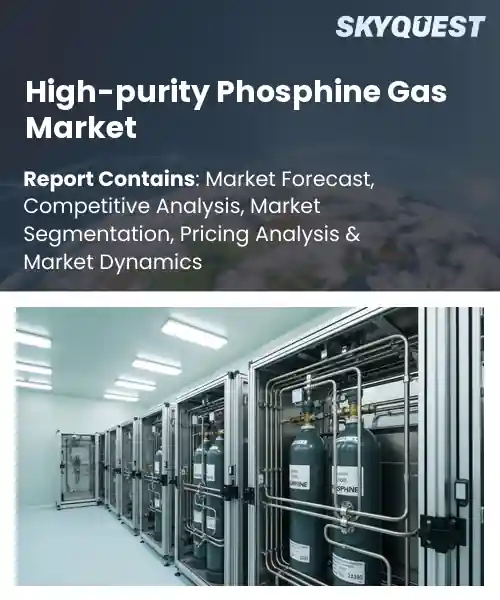
High-purity Phosphine Gas Market
Report ID: SQMIG15D2024
Report ID: SQMIG15D2024
[email protected]
USA +1 351-333-4748
Report ID:
SQMIG15D2024 |
Region:
Global |
Published Date: February, 2026
Pages:
157
|Tables:
114
|Figures:
77


Global High-Purity Phosphine Gas Market size was valued at USD 621 Million in 2024 and is poised to grow from USD 655.15 Million in 2025 to USD 1005.46 Million by 2033, growing at a CAGR of 5.5% during the forecast period (2026-2033).
Surging demand from advanced semiconductor fabrication, rising complexity of device architectures, growing adoption of GaN LEDs and wide bandgap power semiconductors, and expansion of 5G infrastructure and power electronics are driving demand for high-purity phosphine gas.
The rapid evolution of semiconductor processing techniques such as MOCVD for GaN LEDs and power devices is also creating an increasing demand for phosphine consumption per wafer, while tightening impurity tolerance requirements. Besides, the rising demand for energy-efficient devices, 5G infrastructure, and investments in advanced chip fabrication facilities are fueling market growth. An increase in the use of specialized gas delivery systems, cylinderless packaging, leak detection solutions, and analytical validation services is further improving the reliability of high-purity phosphine supply chains. Growing demand for advanced semiconductor manufacturing coupled with increasing emphasis on atomic-scale doping and contamination control is expected to primarily drive high-purity phosphine gas market growth.
On the contrary, stringent safety regulations due to the highly toxic and flammable nature of phosphine gas, high costs associated with ultra-high purity production and specialized storage infrastructure, and strict regulatory compliance requirements are anticipated to slow down high-purity phosphine gas market penetration going forward.
How is AI Improving Quality Control High-purity Phosphine Gas Production?
In terms of quality control in high-purity phosphine gas industry, AI is helping to improve this process by using normal patterns for chromatogram and sensor output and recognizing small deviations before they cause problems with the final product. Machine learning is also helping manufacturers use the data provided by online gas analyzers, point-of-use sensors, and other plant data to help speed root cause analysis and predictive maintenance. Additionally, digital twin technology is helping to simulate the purification process and adjust the process conditions to maintain steady impurity levels.
Market snapshot - (2026-2033)
Global Market Size
USD 621.0 Million
Largest Segment
Semiconductor Manufacturing
Fastest Growth
Semiconductor Manufacturing
Growth Rate
5.5% CAGR
To get more insights on this market click here to Request a Free Sample Report
Global high-purity phosphine gas market is segmented by application type, purity levels, delivery method, end-user sector, and region. Based on application type, the market is segmented into semiconductor manufacturing, industrial applications, and phosphine-based pharmaceuticals. Based on purity levels, the market is segmented into 99.9% purity and 99.5% purity. Based on end-user sector, the market is segmented into industrial sector and residential sector. Based on region, the market is segmented into North America, Europe, Asia Pacific, Latin America, and Middle East & Africa.
The semiconductor manufacturing segment is slated to account for a massive chunk of the global high-purity phosphine gas market share going forward. The semiconductor industry establishes its need for high-purity phosphine gas because the substance functions as both a controlled doping material and an essential component for advanced epitaxy methods used in next-generation semiconductor devices. Precision fabrication needs create a push for ultra-clean supply chains and delivery formats for manufacturers, resulting in close supplier relationships and procurement planning. These quality-focused needs create high barriers to entry for new companies, resulting in concentration among existing companies focused on serving the microelectronics industry.
However, the industrial applications segment is emerging as the fastest growing segment as per this high-purity phosphine gas industry analysis. This diversification of use is creating new market access for the chemical, allowing for new contractual relationships to emerge, thereby accelerating the growth of the market for its suppliers.
The 99.9% purity segment is forecasted to spearhead the global high-purity phosphine gas market revenue generation in the long run. Cutting edge processes and sensitive semiconductor and pharmaceutical applications demand the lowest permissible impurity profiles, which helps this segment to hold sway over others. The resulting premium positioning supports differentiated service models, dedicated production lines and traceable quality controls, which in turn secure long term contracts and reinforce technical barriers that favor providers able to guarantee consistent ultra high purity delivery.
However, 99.5% purity is witnessing the strongest growth momentum because many industrial applications accept slightly lower purity in exchange for lower cost and greater availability. The practical value of this solution helps providers to expand their operations through simplified production systems while delivering multiple delivery options that enable them to reach more customers and achieve faster product adoption in various manufacturing and processing applications.
To get detailed segments analysis, Request a Free Sample Report
The presence of semiconductor and electronic devices production facilities that require ultra-clean specialty gases and associated services is contributing to the consolidation of the position of this region. The close proximity of gas companies to high-tech production facilities enables faster qualification times and facilitates the development of customized purity levels and associated logistics that minimize contamination risks. Collaborative relationships between gas companies and customers have enabled faster technology transfer and the design of customized cylinder and delivery systems. Continued investment in localized production, quality control laboratories and compliance with regulations, contributes to the Asia Pacific region’s leadership position, while ongoing supplier consolidation and a culture of operational proficiency will continue to support the depth and resiliency of this market.
Rigorous quality expectations from semiconductor and electronics manufacturers are primarily shaping high-purity phosphine gas adoption in Japan. Local suppliers are known for their quality control, on-site analytical services, and close collaboration with equipment suppliers to simplify the process. Good technical service infrastructure, coupled with regulatory requirements, and a technically skilled workforce help to ensure reliability and enhance supplier credibility for high-purity specialty gas users.
Presence of integrated semiconductor manufacturers requiring dependable supply of ultra-pure specialty gases is driving sustained demand for high-purity phosphine gas in the country. Good relationships between gas suppliers and equipment vendors facilitate smooth integration of delivery systems. Focus on manufacturing uptime and purity, combined with logistical flexibility, is key to supplier selection and sophistication in the high-purity phosphine gas market in South Korea.
Investments in semiconductor manufacturing, high R&D activity, and the emphasis on the robustness of the supply chain are influencing the high-purity phosphine gas market in North America. Organizations in the region are making themselves stand out against their competitors based on their ability to carry out complex analysis, their high quality control standards, and their capability to produce delivery methods with high quality qualifications. Strong working relationships between gas producers, equipment manufacturers, and end-users encourage quicker adoption of specialty gas solutions as well as customized contamination control plans. Ultimately, long term service commitments and technical partnerships are implemented to allow companies to capture both growing industrial demand and specialized applications for ultra-pure chemicals.
Presence of a diversified industrial base with emphasis on semiconductor manufacturing is driving up the demand for high-purity phosphine gas across the United States. The suppliers use strict qualification standards together with on-site technical assistance and their strong logistics capabilities to support fabrication facilities. High-purity phosphine gas vendors and end users are working closely to develop contamination control systems together with customized delivery systems which meet their particular process needs.
Presence of top research centers and proximity to regional fabrication clusters are shaping the sales of high-purity phosphine gas across Canada going forward. Suppliers are committed to strict purity qualification, flexible delivery schedules, and cooperation in qualification to meet process requirements. Environmental responsibility and safety awareness are also important factors in handling and transportation of high-purity phosphine gas. Emphasis on service commitment, laboratory support, and transportation relationships are key factors deciding procurement of high-purity phosphine gas in the country.
Presence of advanced manufacturing clusters, regulatory rigor, and supplier innovation focused on purity assurance are shaping high-purity phosphine gas adoption in European countries. European suppliers have adopted total quality management systems, centralized analytical laboratories, and joint development programs with commercial and research users to address their challenge of meeting very stringent contamination requirements while delivering quality products. Further, investments made by suppliers in developing customized delivery systems, developing leak-tight connection systems, and improving waste management practices are reflective of high environmental and safety standards. The manufacturers of gas have also benefited from strategic consolidations and partnerships with equipment suppliers to deliver solutions to complex applications.
The combination of solid industrial engineering skills and established manufacturing industry connections has created more work opportunities for high-purity phosphine gas in Germany. The organization focuses on establishing quality systems together with its local analysis capabilities and engineering services to achieve compatibility with advanced industrial equipment. The company secures continuous industrial and research center supplies through its dedication to safety and environmental protection and logistical operations. The relationship between suppliers and end users together with the expertise of their technical staff creates a complex system for delivering high-purity phosphine gas.
The United Kingdom experiences continuous high-purity phosphine gas demand because of its strong research ecosystem and industrial research facilities. The process requires specific purity standards to be established while suppliers need to meet the established requirements and provide immediate technical support. The handling and transport of high purity phosphine gas are influenced by regulations and safety requirements. Joint development with users and aftercare services are key drivers of high purity phosphine gas supplier reputations and high reliability demands.
A robust chemical and research infrastructure that supports specialty gas production is shaping high-purity phosphine gas demand outlook in France. Suppliers in the industry ensure high-quality analysis, tailored purity requirements, and joint qualification with the customer. Organizations in the country handle product disposal and product handling according to established environmental and safety regulations. Close proximity to industrial centers and logistical hubs enables the efficient delivery process of high-purity phosphine gas.
To know more about the market opportunities by region and country, click here to
Buy The Complete Report
Expanding Semiconductor Production Capacity
Growing Need For LED And Displays
Stringent Safety And Handling Requirements
Challenges In Ensuring Consistent Purity
Request Free Customization of this report to help us to meet your business objectives.
Competition in the global high purity phosphine market is tightening as incumbent electronic gas suppliers pursue targeted M&A, product upgrades and strategic spin offs to secure fabs. Demand from advanced semiconductor nodes is driving suppliers to offer guaranteed traceability and on site support. Examples include recent product launches by Linde and acquisitions and R and D intensification among specialty chemical and gas groups.
In February 2026, Entegris highlighted expansion of its Advanced Purity Solutions capabilities and operational readiness to support ultra-high purity gas purification and delivery for semiconductor manufacturers, reaffirming investments in purification technologies and manufacturing capacity to meet stringent contamination control requirements across advanced device production and accelerate customer qualification programs to shorten adoption timelines.
In June 2025, Air Liquide signed a long term gas supply agreement and committed to build and operate an ultra high purity carrier gas production facility in Singapore. This move positions Air Liquide to offer advanced carrier gas solutions and localized supply reliability for semiconductor fabs while integrating energy efficient and digitalized operations.
In April 2025, Linde, an industrial gas supplier announced an agreement to expand supply of ultra-high purity process and specialty gases to Samsung’s Pyeongtaek semiconductor complex, committing to additional onsite infrastructure and long-term supply partnerships to support advanced node production while emphasizing quality control and integrated onsite service models and capabilities.
SkyQuest’s ABIRAW (Advanced Business Intelligence, Research & Analysis Wing) is our Business Information Services team that Collects, Collates, Correlates, and Analyses the Data collected by means of Primary Exploratory Research backed by robust Secondary Desk research.
As per SkyQuest analysis, surging demand from advanced semiconductor fabrication and rising complexity of device architectures are anticipated to drive the demand for high-purity phosphine gas going forward. However, stringent safety regulations associated with the highly toxic nature of phosphine and high costs of ultra-high purity production are slated to slow down the adoption of high-purity phosphine gas in the future. Asia Pacific is set to lead demand for high-purity phosphine gas on account of its well-established semiconductor manufacturing sector and growing investment trends in advanced chip fabrication plants. Development of specialized gas delivery systems and integration of advanced analytical monitoring technologies are anticipated to be key trends driving the high-purity phosphine gas industry over the coming years.
| Report Metric | Details |
|---|---|
| Market size value in 2024 | USD 621.0 Million |
| Market size value in 2033 | USD 1005.46 Million |
| Growth Rate | 5.5% |
| Base year | 2024 |
| Forecast period | (2026-2033) |
| Forecast Unit (Value) | USD Million |
| Segments covered |
|
| Regions covered | North America (US, Canada), Europe (Germany, France, United Kingdom, Italy, Spain, Rest of Europe), Asia Pacific (China, India, Japan, Rest of Asia-Pacific), Latin America (Brazil, Rest of Latin America), Middle East & Africa (South Africa, GCC Countries, Rest of MEA) |
| Companies covered |
|
| Customization scope | Free report customization with purchase. Customization includes:-
|
To get a free trial access to our platform which is a one stop solution for all your data requirements for quicker decision making. This platform allows you to compare markets, competitors who are prominent in the market, and mega trends that are influencing the dynamics in the market. Also, get access to detailed SkyQuest exclusive matrix.
Table Of Content
Executive Summary
Market overview
Parent Market Analysis
Market overview
Market size
KEY MARKET INSIGHTS
COVID IMPACT
MARKET DYNAMICS & OUTLOOK
Market Size by Region
KEY COMPANY PROFILES
Methodology
For the High-purity Phosphine Gas Market, our research methodology involved a mixture of primary and secondary data sources. Key steps involved in the research process are listed below:
1. Information Procurement: This stage involved the procurement of Market data or related information via primary and secondary sources. The various secondary sources used included various company websites, annual reports, trade databases, and paid databases such as Hoover's, Bloomberg Business, Factiva, and Avention. Our team did 45 primary interactions Globally which included several stakeholders such as manufacturers, customers, key opinion leaders, etc. Overall, information procurement was one of the most extensive stages in our research process.
2. Information Analysis: This step involved triangulation of data through bottom-up and top-down approaches to estimate and validate the total size and future estimate of the High-purity Phosphine Gas Market.
3. Report Formulation: The final step entailed the placement of data points in appropriate Market spaces in an attempt to deduce viable conclusions.
4. Validation & Publishing: Validation is the most important step in the process. Validation & re-validation via an intricately designed process helped us finalize data points to be used for final calculations. The final Market estimates and forecasts were then aligned and sent to our panel of industry experts for validation of data. Once the validation was done the report was sent to our Quality Assurance team to ensure adherence to style guides, consistency & design.
Analyst Support
Customization Options
With the given market data, our dedicated team of analysts can offer you the following customization options are available for the High-purity Phosphine Gas Market:
Product Analysis: Product matrix, which offers a detailed comparison of the product portfolio of companies.
Regional Analysis: Further analysis of the High-purity Phosphine Gas Market for additional countries.
Competitive Analysis: Detailed analysis and profiling of additional Market players & comparative analysis of competitive products.
Go to Market Strategy: Find the high-growth channels to invest your marketing efforts and increase your customer base.
Innovation Mapping: Identify racial solutions and innovation, connected to deep ecosystems of innovators, start-ups, academics, and strategic partners.
Category Intelligence: Customized intelligence that is relevant to their supply Markets will enable them to make smarter sourcing decisions and improve their category management.
Public Company Transcript Analysis: To improve the investment performance by generating new alpha and making better-informed decisions.
Social Media Listening: To analyze the conversations and trends happening not just around your brand, but around your industry as a whole, and use those insights to make better Marketing decisions.
REQUEST FOR SAMPLE
 REQUEST FREE CUSTOMIZATION
Global High-Purity Phosphine Gas Market size was valued at USD 621.0 Million in 2024 and is poised to grow from USD 655.15 Million in 2025 to USD 1005.46 Million by 2033, growing at a CAGR of 5.5% during the forecast period (2026-2033).
Competition in the global high purity phosphine market is tightening as incumbent electronic gas suppliers pursue targeted M&A, product upgrades and strategic spin offs to secure fabs. Demand from advanced semiconductor nodes is driving suppliers to offer guaranteed traceability and on site support. Examples include recent product launches by Linde and acquisitions and R and D intensification among specialty chemical and gas groups. 'Air Products and Chemicals, Inc.', 'Praxair Technology, Inc.', 'Linde plc', 'Gazechim Group', 'Matheson Tri-Gas, Inc.', 'Hubei Jiahua Chemical Co., Ltd.', 'Merck KGaA', 'American Gas Products', 'Tokyo Gas Co., Ltd.', 'Hangzhou Zhongheng Chemical Co., Ltd.', 'DOW Chemical Company', 'Anhui Huayi Chemical Co., Ltd.', 'Shandong Fengyuan Chemical Co., Ltd.', 'Chemplex Industries, Inc.', 'The Linde Group', 'Zhongtian Technology Co., Ltd.', 'Jiangsu Huachang Chemical Co., Ltd.', 'Jiangsu Feiteng Chemical Co., Ltd.', 'Air Liquide S.A.', 'KMG Chemicals, Inc.'
high purity phosphine is essential for controlled doping processes in semiconductor fabrication, and as fabs increase capacity the requirement for reliable, ultra clean gas feedstocks grows. Manufacturers prioritize gases that enable consistent electrical characteristics and minimal contamination, so demand for certified, high purity phosphine rises. This creates opportunities for suppliers to expand specialized production, invest in purification technologies, and build long term contracts with chipmakers. The resulting alignment of supplier capabilities with fab expectations supports market expansion by reinforcing procurement preferences for premium gas grades.
Semiconductor Yield Optimization: Demand from advanced semiconductor fabrication is driving emphasis on ultra high purity phosphine as manufacturers seek greater process control and defect reduction. Suppliers are adapting by offering tighter impurity specifications, tailored delivery systems and enhanced quality management to align with fab qualification needs. This trend prioritizes reliability and traceability across the supply chain, encouraging long term technical collaborations between gas providers and chipmakers to co develop supply protocols that support next generation device performance and yield stability.
The presence of semiconductor and electronic devices production facilities that require ultra-clean specialty gases and associated services is contributing to the consolidation of the position of the Asia Pacific region.


Want to customize this report? This report can be personalized according to your needs. Our analysts and industry experts will work directly with you to understand your requirements and provide you with customized data in a short amount of time. We offer $1000 worth of FREE customization at the time of purchase.
Feedback From Our Clients


 USA (+1) 351-333-4748

