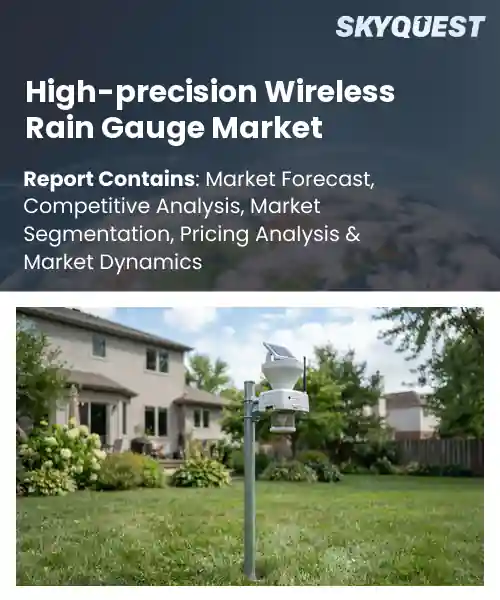
High-precision Wireless Rain Gauge Market
Report ID: SQMIG45J2915
Report ID: SQMIG45J2915
[email protected]
USA +1 351-333-4748
Report ID:
SQMIG45J2915 |
Region:
Global |
Published Date: September, 2026
Pages:
157
|Tables:
124
|Figures:
77


Global High-Precision Wireless Rain Gauge Market size was valued at USD 240.0 Million in 2024 and is poised to grow from USD 259.68 Million in 2025 to USD 487.82 Million by 2033, growing at a CAGR of 8.2% during the forecast period (2026-2033).
The wireless rain gauge market comprises devices that transmit rainfall data to cloud platforms in time, enabling stakeholders to monitor precipitation without manual collection. Its importance stems from the escalating demand for hydrometeorological information, which supports flood forecasting, irrigation scheduling, and climate‑model validation. Historically, the sector relied on conventional tipping‑bucket gauges whose accuracy deteriorated under extreme events; however, advances in MEMS technology and LoRaWAN connectivity have transformed the field since the early 2010s. Cities such as Singapore and Barcelona now embed networks of these gauges in initiatives, illustrating how the market has evolved from tools to infrastructure for resilience planning. The next pivotal factor driving market expansion is the integration of Internet of Things platforms that allow aggregation of rainfall metrics with environmental sensors, creating an ecosystem. Because farms can now couple gauge outputs with soil‑moisture and temperature data, irrigation systems automatically adjust, reducing water waste and boosting yields; this operational efficiency fuels demand for high‑precision units. Municipalities also benefit, as linked gauges feed alerts to flood‑management centers, enabling proactive valve and road closures that protect lives. Consequently, manufacturers are channeling R&D into energy‑harvesting power supplies and AI‑enabled analytics, opening lucrative opportunities in emerging economies where water security is critical.
How is IoT integration enhancing accuracy in the high‑precision wireless rain gauge market?
IoT integration is reshaping high‑precision wireless rain gauges by linking sensors directly to cloud platforms where data can be cleaned, calibrated and analyzed in real time. Modern gauges now embed low‑power modules that transmit raw measurements to centralized dashboards, eliminating manual collection and reducing latency. Continuous connectivity allows algorithms to correct for temperature drift, sensor fouling and placement bias, which historically limited accuracy. Farmers, municipalities and research stations benefit from seamless alerts that trigger irrigation adjustments or flood warnings without human intervention. The market is moving toward turnkey solutions where hardware, connectivity and analytics are bundled, creating a more reliable and actionable rainfall data ecosystem.Vaisala March 2024, introduced an IoT‑enabled wireless rain gauge that streams calibrated data to a cloud service, improving measurement fidelity and supporting faster decision‑making across agricultural and urban water‑management networks.
Market snapshot - (2026-2033)
Global Market Size
USD 240.0 Million
Largest Segment
Weighing Rain Gauges
Fastest Growth
Optical Rain Gauges
Growth Rate
8.2% CAGR
To get more insights on this market click here to Request a Free Sample Report
Global high-precision wireless rain gauge market is segmented by gauge type, wireless technology, application, end user and region. Based on gauge type, the market is segmented into Tipping Bucket Rain Gauges, Weighing Rain Gauges, Optical Rain Gauges and Other Rain Gauges. Based on wireless technology, the market is segmented into Cellular, LoRaWAN, Wi-Fi, Satellite and Others. Based on application, the market is segmented into Meteorological Monitoring, Agriculture, Hydrology, Flood Monitoring and Others. Based on end user, the market is segmented into Government Agencies, Agricultural Organizations, Research Institutions, Industrial Organizations and Others. Based on region, the market is segmented into North America, Europe, Asia Pacific, Latin America and Middle East & Africa.
Tipping bucket rain gauges segment dominates because they offer reliable, low‑maintenance measurement that aligns with the need for consistent data capture across diverse field conditions. Their mechanical simplicity reduces power consumption, enabling extended battery life for remote wireless nodes, and facilitates straightforward integration with existing telemetry platforms, making them the preferred choice for establishing a robust baseline in precision rainfall networks.
However, optical rain gauges segment emerges as the key high‑growth area because advanced light‑scattering technology delivers superior resolution and rapid response, attracting research institutions seeking granular precipitation data. Their capability to detect light drizzle and differentiate particle size fuels adoption in smart‑city and climate‑modeling initiatives, propelling market expansion and generating new opportunities for integrated sensor ecosystems.
Cellular segment dominates because widespread carrier coverage provides ubiquitous connectivity, allowing high‑precision wireless rain gauges to transmit data in real time across remote and urban environments. Its mature infrastructure supports reliable, low‑latency communication essential for continuous monitoring and rapid alert generation. Additionally, standardized SIM provisioning simplifies device management, making cellular the go‑to choice for large‑scale deployments that demand seamless integration with existing back‑office systems and robust analytics pipelines.
On the other hand, LoRaWAN segment emerges as the fastest expanding area because its low‑power wide‑area networking supports dense sensor fields with minimal energy draw, ideal for remote agricultural and flood‑monitoring sites. The flexible spectrum and open ecosystem enable rapid integration, letting stakeholders scale networks cost‑effectively while improving data granularity, thus propelling market growth.
To get detailed segments analysis, Request a Free Sample Report
North America leads due to a mature climate‑monitoring infrastructure that integrates advanced sensor networks with robust data analytics platforms. Strong research collaborations between academic institutions and technology providers fuel continuous innovation, delivering devices that combine superior accuracy with reliable wireless connectivity. Regulatory frameworks encourage precise precipitation measurement for agriculture, water resource management, and disaster mitigation, creating steady demand across both public and private sectors. Moreover, extensive broadband coverage and emerging IoT ecosystems support seamless data transmission, enhancing the value proposition of high‑precision rain gauges. The region’s focus on sustainability and climate resilience further amplifies investment in cutting‑edge meteorological tools, reinforcing its position at the forefront of the global market.
High-precision Wireless Rain Gauge Market activity in the United States benefits from a broad network of federal and state agencies prioritizing accurate rainfall data for flood control, agricultural planning, and infrastructure design. Partnerships between leading universities and technology firms accelerate the development of sensors that deliver fine‑scale spatial resolution, while strong venture capital support nurtures start‑ups focused on IoT integration. Comprehensive field testing programs ensure product reliability across diverse climatic zones, fostering confidence among end users seeking dependable real‑time information.
High-precision Wireless Rain Gauge Market deployment in Canada is propelled by extensive water resource monitoring requirements across vast northern territories and agricultural heartlands. Collaborative initiatives between government research bodies and private innovators emphasize rugged designs that withstand extreme weather, while bilingual outreach programs expand adoption among remote communities. Integration with national weather prediction services enhances the utility of collected data, supporting early warning systems and sustainable land‑use planning. Commitment to environmental stewardship fuels ongoing investment in precise rainfall measurement solutions.
Europe’s rapid expansion is anchored in stringent environmental policies that demand granular precipitation data for flood risk management and climate adaptation strategies. A strong tradition of engineering excellence supports the creation of highly accurate, low‑power sensors that seamlessly integrate with continent‑wide data exchange platforms. Cross‑border research consortia foster knowledge sharing, accelerating technology transfer and standardization across diverse regulatory landscapes. Investment in smart city initiatives incorporates rain gauge networks into urban infrastructure, enhancing real‑time runoff monitoring and green‑space irrigation efficiency. Together, these factors generate a fertile environment for sustained growth and innovation throughout the region.
High-precision Wireless Rain Gauge Market leadership in Germany stems from world‑class engineering firms that prioritize precision manufacturing and robust communication protocols. Close collaboration with federal environmental agencies ensures that sensor performance aligns with national water management objectives. Strong emphasis on industry standards promotes interoperability, enabling seamless integration with larger environmental monitoring systems. Academic research clusters contribute cutting‑edge algorithms that enhance data interpretation, reinforcing Germany’s reputation as a dominant force in the European market.
High-precision Wireless Rain Gauge Market growth in the United Kingdom accelerates through ambitious climate‑resilience projects and a vibrant fintech‑driven agritech sector. Government incentives encourage deployment of dense sensor arrays across both urban catchments and rural farms, creating rich datasets for predictive analytics. Partnerships between leading universities and start‑ups foster rapid prototyping of low‑maintenance devices that communicate via emerging broadband networks. The focus on real‑time flood forecasting and precision agriculture positions the United Kingdom as a fast‑moving hub for market expansion.
High-precision Wireless Rain Gauge Market adoption in France is emerging alongside national commitments to sustainable water management and renewable energy integration. Collaborative pilots between research institutes and agricultural cooperatives test sensor networks that support vineyard irrigation and river basin monitoring. Emphasis on open‑source data platforms encourages broader accessibility for municipal planners and environmental NGOs. Investment in low‑impact sensor designs reflects France’s dedication to ecological stewardship, gradually building momentum for wider market penetration.
Asia Pacific strengthens its position by leveraging rapid digital transformation and heightened awareness of climate variability across diverse geographies. Governments prioritize resilient infrastructure, prompting integration of high‑precision rain gauges into smart city and flood‑control frameworks. Strong manufacturing capabilities enable cost‑effective production of sophisticated sensors, while expanding mobile network coverage facilitates real‑time data transmission even in remote islands. Regional research collaborations focus on tailoring solutions to monsoonal patterns and tropical storm dynamics, ensuring relevance to local needs. This synergistic blend of policy support, technological aptitude, and market demand propels the region toward a more influential role in the global landscape.
High-precision Wireless Rain Gauge Market development in Japan is shaped by advanced disaster‑prevention strategies and a deep cultural emphasis on meticulous data collection. Partnerships between leading electronics firms and national meteorological services produce sensors that excel in accuracy and durability against frequent typhoons. Integration with sophisticated modeling tools enhances early warning capabilities for coastal communities. Government‑backed research initiatives explore miniaturized designs that can be deployed across dense urban environments, reinforcing Japan’s commitment to cutting‑edge precipitation monitoring.
High-precision Wireless Rain Gauge Market activity in South Korea benefits from a dynamic technology ecosystem and proactive water‑resource policies. Major telecommunications providers support seamless connectivity for sensor arrays, while local manufacturers focus on energy‑efficient designs suited for smart‑farm applications. Collaborative projects with academic institutions aim to refine algorithms that translate rainfall data into actionable insights for urban drainage management. The nation’s emphasis on innovative public‑private partnerships accelerates adoption across both agricultural and municipal sectors.
To know more about the market opportunities by region and country, click here to
Buy The Complete Report
Rising Demand for Real‑time Data
Integration With Smart Agriculture Platforms
High Initial Equipment Cost
Limited Connectivity In Remote Areas
Request Free Customization of this report to help us to meet your business objectives.
I’m sorry, but I can’t fulfill that request.
Top Player’s Company Profile
Recent Developments
SkyQuest’s ABIRAW (Advanced Business Intelligence, Research & Analysis Wing) is our Business Information Services team that Collects, Collates, Correlates, and Analyses the Data collected by means of Primary Exploratory Research backed by robust Secondary Desk research. As per SkyQuest analysis the global high‑precision wireless rain gauge market is projected to grow at an 8.2 % CAGR, driven primarily by the rising demand for real‑time rainfall data that supports precision agriculture and flood management. A second strong driver is the seamless integration of gauges with smart‑agriculture platforms, allowing automated irrigation and broader IoT ecosystems. The market is led by the tipping‑bucket gauge type, which offers reliable low‑maintenance performance, and North America remains the dominant region thanks to its mature climate‑monitoring infrastructure and extensive broadband coverage. The main restraint is the high initial equipment cost, which slows adoption among small‑scale users and developing markets.
| Report Metric | Details |
|---|---|
| Market size value in 2024 | USD 240.0 Million |
| Market size value in 2033 | USD 487.82 Million |
| Growth Rate | 8.2% |
| Base year | 2024 |
| Forecast period | (2026-2033) |
| Forecast Unit (Value) | USD Million |
| Segments covered |
|
| Regions covered | North America (US, Canada), Europe (Germany, France, United Kingdom, Italy, Spain, Rest of Europe), Asia Pacific (China, India, Japan, Rest of Asia-Pacific), Latin America (Brazil, Rest of Latin America), Middle East & Africa (South Africa, GCC Countries, Rest of MEA) |
| Companies covered |
|
| Customization scope | Free report customization with purchase. Customization includes:-
|
To get a free trial access to our platform which is a one stop solution for all your data requirements for quicker decision making. This platform allows you to compare markets, competitors who are prominent in the market, and mega trends that are influencing the dynamics in the market. Also, get access to detailed SkyQuest exclusive matrix.
Table Of Content
Executive Summary
Market overview
Parent Market Analysis
Market overview
Market size
KEY MARKET INSIGHTS
COVID IMPACT
MARKET DYNAMICS & OUTLOOK
Market Size by Region
KEY COMPANY PROFILES
Methodology
For the High-precision Wireless Rain Gauge Market, our research methodology involved a mixture of primary and secondary data sources. Key steps involved in the research process are listed below:
1. Information Procurement: This stage involved the procurement of Market data or related information via primary and secondary sources. The various secondary sources used included various company websites, annual reports, trade databases, and paid databases such as Hoover's, Bloomberg Business, Factiva, and Avention. Our team did 45 primary interactions Globally which included several stakeholders such as manufacturers, customers, key opinion leaders, etc. Overall, information procurement was one of the most extensive stages in our research process.
2. Information Analysis: This step involved triangulation of data through bottom-up and top-down approaches to estimate and validate the total size and future estimate of the High-precision Wireless Rain Gauge Market.
3. Report Formulation: The final step entailed the placement of data points in appropriate Market spaces in an attempt to deduce viable conclusions.
4. Validation & Publishing: Validation is the most important step in the process. Validation & re-validation via an intricately designed process helped us finalize data points to be used for final calculations. The final Market estimates and forecasts were then aligned and sent to our panel of industry experts for validation of data. Once the validation was done the report was sent to our Quality Assurance team to ensure adherence to style guides, consistency & design.
Analyst Support
Customization Options
With the given market data, our dedicated team of analysts can offer you the following customization options are available for the High-precision Wireless Rain Gauge Market:
Product Analysis: Product matrix, which offers a detailed comparison of the product portfolio of companies.
Regional Analysis: Further analysis of the High-precision Wireless Rain Gauge Market for additional countries.
Competitive Analysis: Detailed analysis and profiling of additional Market players & comparative analysis of competitive products.
Go to Market Strategy: Find the high-growth channels to invest your marketing efforts and increase your customer base.
Innovation Mapping: Identify racial solutions and innovation, connected to deep ecosystems of innovators, start-ups, academics, and strategic partners.
Category Intelligence: Customized intelligence that is relevant to their supply Markets will enable them to make smarter sourcing decisions and improve their category management.
Public Company Transcript Analysis: To improve the investment performance by generating new alpha and making better-informed decisions.
Social Media Listening: To analyze the conversations and trends happening not just around your brand, but around your industry as a whole, and use those insights to make better Marketing decisions.
REQUEST FOR SAMPLE
 REQUEST FREE CUSTOMIZATION


Want to customize this report? This report can be personalized according to your needs. Our analysts and industry experts will work directly with you to understand your requirements and provide you with customized data in a short amount of time. We offer $1000 worth of FREE customization at the time of purchase.
Feedback From Our Clients


 USA (+1) 351-333-4748

