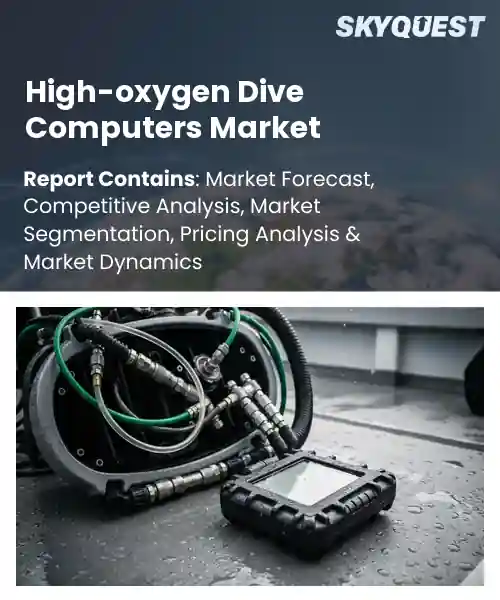
High-oxygen Dive Computers Market
Report ID: SQMIG25J2298
Report ID: SQMIG25J2298
[email protected]
USA +1 351-333-4748
Report ID:
SQMIG25J2298 |
Region:
Global |
Published Date: August, 2026
Pages:
157
|Tables:
116
|Figures:
77


Global High-Oxygen Dive Computers Market size was valued at USD 318.7 Million in 2024 and is poised to grow from USD 342.92 Million in 2025 to USD 616.16 Million by 2033, growing at a CAGR of 7.6% during the forecast period (2026-2033).
The high‑oxygen dive computers industry revolves around devices that measure pressures of oxygen in mixed‑gas breathing loops, allowing technical divers to safely extend bottom time on nitrox and trimix blends. Its relevance stems from the rising popularity of recreational and commercial dive operations that demand precise gas management to avoid hypoxia or oxygen toxicity.
Regulatory pressure on nitrogen exposure and the expanding renewable sector act as a catalyst for market growth because tighter dive‑time limits push operators toward nitrox mixes that lower inert gas load. This shift forces dive service providers to equip personnel with high‑oxygen computers that track oxygen fraction, mitigating decompression risk while preserving productivity. Deployments illustrate the effect: wind farms in North Sea require technicians to log O2 levels for dive, and data feed maintenance platforms that schedule work windows efficiently. Consequently, manufacturers are investing in connectivity and analytics, creating revenue beyond hardware and encouraging partnerships with training schools and insurers.
How is AI enhancing performance monitoring in the high‑oxygen dive computers market?
AI is reshaping performance monitoring in high oxygen dive computers by embedding intelligent algorithms that continuously interpret sensor data from pressure, oxygen levels, and depth. These systems learn a diver’s profile and predict potential risks, delivering real time alerts before thresholds are reached. Machine learning models also adjust decompression calculations on the fly, improving safety without manual input. Cloud linked platforms enable remote diagnostics, allowing manufacturers to refine firmware based on aggregated usage patterns. As the market seeks more reliable equipment for demanding environments, AI driven consoles provide a seamless blend of precision and user friendly feedback, driving adoption among professional and recreational divers alike.
Suunto announced its high oxygen Nautic dive computer in March 2025, integrating AI to continuously calibrate oxygen sensor readings and adjust performance metrics in real time. This innovation shortens dive planning cycles and enhances safety, reinforcing market growth through smarter monitoring technology.
Market snapshot - (2026-2033)
Global Market Size
USD 318.7 Million
Largest Segment
Console-Mounted
Fastest Growth
Wrist-Mounted
Growth Rate
7.6% CAGR
To get more insights on this market click here to Request a Free Sample Report
Global high-oxygen dive computers market is segmented by product type, diving mode, connectivity, end user and region. Based on product type, the market is segmented into Wrist-Mounted and Console-Mounted. Based on diving mode, the market is segmented into Recreational Diving, Technical Diving and Rebreather Diving. Based on connectivity, the market is segmented into Bluetooth, Wireless Air Integration and USB. Based on end user, the market is segmented into Professional Divers, Recreational Divers and Dive Training Centers. Based on region, the market is segmented into North America, Europe, Asia Pacific, Latin America and Middle East & Africa.
Wrist‑mounted segment dominates with large high-oxygen dive computers market share because divers prioritize compactness and immediate accessibility during high‑oxygen operations. The ergonomic design places critical readouts at eye level, reducing glance time and enhancing safety. Integration of advanced sensor suites into a single wrist unit simplifies equipment load, which is especially valuable in environments with limited space. Consequently, manufacturers invest heavily in miniaturization, driving broader adoption across both recreational and professional circles throughout the industry for divers.
As per high-oxygen dive computers market outlook, console‑mounted is witnessing the strongest growth because modular configurations allow for extensive battery packs and redundant sensor arrays, meeting the rigorous demands of extended technical dives. Emerging research institutions favor this form factor for experimental setups, accelerating innovation cycles and expanding the market’s high‑oxygen capabilities in the global arena.
As per high-oxygen dive computers market forecast, bluetooth segment dominates because it enables seamless real‑time transmission of dive profiles to mobile devices, allowing immediate post‑dive analysis and cloud backup. Divers appreciate the convenience of wireless syncing without surfacing, which reduces procedural interruptions. The technology also supports firmware updates over the air, extending device lifespan and fostering user confidence. These advantages stimulate broader acceptance among both hobbyists and professional operators, reinforcing market momentum for high‑oxygen applications worldwide.
Meanwhile, USB is experiencing rapid expansion because it provides reliable direct data transfer for forensic review and compliance documentation. Training facilities rely on wired connectivity to guarantee uploads during certification drills, and manufacturers are integrating ports to accommodate richer sensor datasets. This practicality fuels adoption pathways and enriches the ecosystem.
To get detailed segments analysis, Request a Free Sample Report
North America leads the market through a confluence of advanced research ecosystems, strong professional diving communities, and a robust regulatory framework that emphasizes safety and precision. Extensive collaboration between technology firms, academic institutions, and dive equipment manufacturers fosters continuous innovation in sensor accuracy and user interface design. The region’s deep‑rooted culture of recreational and commercial diving drives demand for high‑performance devices, while established supply chains ensure timely delivery of sophisticated components. Moreover, a proactive approach to standards development and certification reinforces confidence among end users, reinforcing the market’s attractive proposition for both new entrants and established players seeking to leverage high‑oxygen technologies.
As per high-oxygen dive computers market regional outlook, United States benefits from a vibrant ecosystem of diving schools, deep‑sea research programs, and a large base of recreational divers who demand cutting‑edge technology. Strong support from federal and private research initiatives encourages refinement of algorithmic safety features, while a competitive retail environment accelerates product turnover and adoption of the latest innovations.
As per high-oxygen dive computers market regional forecast, Canada is shaped by a well‑established cold‑water diving community and extensive offshore exploration activities that require reliable oxygen monitoring. Close collaboration between marine technology firms and academic research centers promotes the integration of robust hardware capable of handling harsh environmental conditions, reinforcing the market’s reputation for durability and precision.
Europe’s expansion is propelled by a sophisticated blend of stringent safety regulations, a deep‑seated passion for marine exploration, and significant investment in underwater research infrastructure. The region’s emphasis on environmental stewardship encourages the development of devices that enhance diver safety while minimizing ecological impact. Strong cross‑border collaboration among manufacturers, certification bodies, and diving associations fosters standardized innovation, allowing technologies to diffuse rapidly across member states. Additionally, an active community of technical divers and growing popularity of technical diving disciplines fuel demand for highly reliable, user‑friendly high‑oxygen solutions, positioning Europe as a pivotal growth engine for the market.
Germany is anchored by a robust engineering tradition and a substantial network of professional diving services. Close ties between precision engineering firms and specialized dive training centers promote the creation of highly accurate oxygen sensors and intuitive user interfaces, reinforcing Germany’s status as a market leader.
United Kingdom experiences rapid growth due to a thriving community of technical divers and a proactive regulatory environment that prioritizes safety innovation. Collaborative projects between universities and dive equipment manufacturers accelerate the adoption of advanced data analytics and real‑time monitoring features.
France is emerging through strong support for marine research initiatives and a growing interest in recreational technical diving. Partnerships between coastal research institutes and boutique technology firms foster the development of compact, high‑performance devices tailored to the specific needs of French divers.
Asia Pacific is advancing its market position by leveraging a dynamic blend of technological ambition, expanding underwater tourism, and strategic government backing for marine research. Nations within the region are investing heavily in next‑generation sensor technologies and seamless integration with mobile platforms, reflecting a broader shift toward digitized diving experiences. The rise of specialized dive training academies and increasing participation in deep‑sea exploration projects generate demand for reliable high‑oxygen monitoring solutions. Additionally, cross‑border collaborations among manufacturers and research institutions accelerate knowledge transfer, enabling rapid iteration of safety‑critical features that resonate with a growing base of both professional and recreational divers.
Japan benefits from a strong culture of precision manufacturing and a well‑established technical diving community. Integration of cutting‑edge electronics with compact design philosophies results in devices that marry reliability with user‑friendly operation, meeting the exacting standards of Japanese divers.
South Korea is driven by a vibrant tech sector and increasing participation in offshore research programs. Collaboration between semiconductor firms and dive equipment producers yields highly responsive oxygen monitoring solutions that cater to both commercial and enthusiast segments.
To know more about the market opportunities by region and country, click here to
Buy The Complete Report
Rising Recreational Diving Participation
Advancements in Sensor Technology
High Initial Equipment Cost
Stringent Regulatory Certification Requirements
Request Free Customization of this report to help us to meet your business objectives.
The competitive landscape of the high‑oxygen dive computers industry is shaped by intense rivalry among established manufacturers and emerging innovators, with companies leveraging M&A to broaden sensor portfolios, forming partnerships with dive training agencies to embed proprietary algorithms, and accelerating tech innovation through integration of AI‑driven decompression models and wireless data syncing, all aimed at capturing divers seeking safer high‑oxygen operations.
SkyQuest’s ABIRAW (Advanced Business Intelligence, Research & Analysis Wing) is our Business Information Services team that Collects, Collates, Correlates, and Analyses the Data collected by means of Primary Exploratory Research backed by robust Secondary Desk research.
As per SkyQuest analysis, the growth of the global high‑oxygen dive computers market growth is being propelled primarily by rising recreational diving participation which pushes divers toward advanced safety gear, while advancements in sensor technology serve as a second driver by delivering more accurate oxygen readings and seamless connectivity. The market’s restraint comes from the high initial equipment cost that limits adoption among price‑sensitive hobbyists. North America remains the dominant region due to its strong research ecosystem, robust professional diving community and supportive regulatory framework. Within product categories, wrist‑mounted devices dominate the user experience because of their compactness and immediate accessibility, though console‑mounted units are gaining momentum. The global high-oxygen dive computers market is moving toward more advanced, multi-gas and technically capable dive computers, supported by growing interest in technical diving, deeper recreational diving and improved underwater safety.
| Report Metric | Details |
|---|---|
| Market size value in 2024 | USD 318.7 Million |
| Market size value in 2033 | USD 616.16 Million |
| Growth Rate | 7.6% |
| Base year | 2024 |
| Forecast period | (2026-2033) |
| Forecast Unit (Value) | USD Million |
| Segments covered |
|
| Regions covered | North America (US, Canada), Europe (Germany, France, United Kingdom, Italy, Spain, Rest of Europe), Asia Pacific (China, India, Japan, Rest of Asia-Pacific), Latin America (Brazil, Rest of Latin America), Middle East & Africa (South Africa, GCC Countries, Rest of MEA) |
| Companies covered |
|
| Customization scope | Free report customization with purchase. Customization includes:-
|
To get a free trial access to our platform which is a one stop solution for all your data requirements for quicker decision making. This platform allows you to compare markets, competitors who are prominent in the market, and mega trends that are influencing the dynamics in the market. Also, get access to detailed SkyQuest exclusive matrix.
Table Of Content
Executive Summary
Market overview
Parent Market Analysis
Market overview
Market size
KEY MARKET INSIGHTS
COVID IMPACT
MARKET DYNAMICS & OUTLOOK
Market Size by Region
KEY COMPANY PROFILES
Methodology
For the High-oxygen Dive Computers Market, our research methodology involved a mixture of primary and secondary data sources. Key steps involved in the research process are listed below:
1. Information Procurement: This stage involved the procurement of Market data or related information via primary and secondary sources. The various secondary sources used included various company websites, annual reports, trade databases, and paid databases such as Hoover's, Bloomberg Business, Factiva, and Avention. Our team did 45 primary interactions Globally which included several stakeholders such as manufacturers, customers, key opinion leaders, etc. Overall, information procurement was one of the most extensive stages in our research process.
2. Information Analysis: This step involved triangulation of data through bottom-up and top-down approaches to estimate and validate the total size and future estimate of the High-oxygen Dive Computers Market.
3. Report Formulation: The final step entailed the placement of data points in appropriate Market spaces in an attempt to deduce viable conclusions.
4. Validation & Publishing: Validation is the most important step in the process. Validation & re-validation via an intricately designed process helped us finalize data points to be used for final calculations. The final Market estimates and forecasts were then aligned and sent to our panel of industry experts for validation of data. Once the validation was done the report was sent to our Quality Assurance team to ensure adherence to style guides, consistency & design.
Analyst Support
Customization Options
With the given market data, our dedicated team of analysts can offer you the following customization options are available for the High-oxygen Dive Computers Market:
Product Analysis: Product matrix, which offers a detailed comparison of the product portfolio of companies.
Regional Analysis: Further analysis of the High-oxygen Dive Computers Market for additional countries.
Competitive Analysis: Detailed analysis and profiling of additional Market players & comparative analysis of competitive products.
Go to Market Strategy: Find the high-growth channels to invest your marketing efforts and increase your customer base.
Innovation Mapping: Identify racial solutions and innovation, connected to deep ecosystems of innovators, start-ups, academics, and strategic partners.
Category Intelligence: Customized intelligence that is relevant to their supply Markets will enable them to make smarter sourcing decisions and improve their category management.
Public Company Transcript Analysis: To improve the investment performance by generating new alpha and making better-informed decisions.
Social Media Listening: To analyze the conversations and trends happening not just around your brand, but around your industry as a whole, and use those insights to make better Marketing decisions.
REQUEST FOR SAMPLE
 REQUEST FREE CUSTOMIZATION
Global High-Oxygen Dive Computers Market size was valued at USD 318.7 Million in 2024 and is poised to grow from USD 342.92 Million in 2025 to USD 616.16 Million by 2033, growing at a CAGR of 7.6% during the forecast period (2026-2033).
The competitive landscape of the high‑oxygen dive computer market is shaped by intense rivalry among established manufacturers and emerging innovators, with companies leveraging M&A to broaden sensor portfolios, forming partnerships with dive training agencies to embed proprietary algorithms, and accelerating tech innovation through integration of AI‑driven decompression models and wireless data syncing, all aimed at capturing divers seeking safer high‑oxygen operations. 'Shearwater Research Inc.', 'Garmin Ltd.', 'Suunto Oy', 'Aqualung Group', 'Scubapro', 'Mares S.p.A.', 'Oceanic Worldwide', 'Apeks Marine Equipment Ltd.', 'Ratio Computers', 'SEAC Sub S.p.A.', 'Cressi S.p.A.', 'Deep6 Gear', 'Heinrichs Weikamp GmbH', 'OSTC Dive Computers', 'Dive Rite', 'Genesis Scuba', 'Sherwood Scuba', 'TUSA', 'Atomic Aquatics', 'Beuchat International S.A.'
The growing popularity of recreational diving encourages divers to invest in advanced safety equipment, prompting demand for high‑oxygen dive computers that offer extended bottom‑time calculations and enhanced decompression monitoring. Divers seek reliable devices that reduce the risk of oxygen toxicity, and manufacturers respond by integrating user‑friendly interfaces and robust data‑logging features. Consequently, the market experiences sustained expansion as new entrants and seasoned divers alike prioritize sophisticated dive management tools to support longer and deeper dives. The added safety features also boost confidence among divers.
Integrated Sensor Fusion: Manufacturers are embedding advanced multi‑sensor arrays that combine pressure, temperature, and dissolved oxygen measurements into a single streamlined unit. This convergence reduces user workload, improves data reliability, and enables real‑time predictive analytics that anticipate gas depletion scenarios. Diversifying sensor inputs also supports broader diving environments, from technical rebreather operations to recreational tours. The resulting devices deliver a more intuitive user experience, fostering greater confidence among divers and encouraging broader adoption across training programs and commercial applications through continued industry collaboration.
Why does North America Dominate the Global High-oxygen Dive Computers Market? |@12


Want to customize this report? This report can be personalized according to your needs. Our analysts and industry experts will work directly with you to understand your requirements and provide you with customized data in a short amount of time. We offer $1000 worth of FREE customization at the time of purchase.
Feedback From Our Clients


 USA (+1) 351-333-4748

