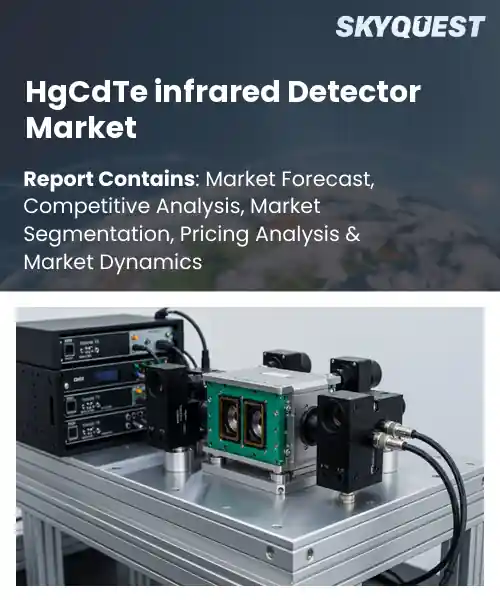
HgCdTe infrared Detector Market
Report ID: SQMIG45N2195
Report ID: SQMIG45N2195
[email protected]
USA +1 351-333-4748
Report ID:
SQMIG45N2195 |
Region:
Global |
Published Date: March, 2026
Pages:
157
|Tables:
121
|Figures:
77


Global HgCdTe Infrared Detector Market size was valued at USD 1.4 Billion in 2024 and is poised to grow from USD 1.5 Billion in 2025 to USD 2.68 Billion by 2033, growing at a CAGR of 7.5% during the forecast period (2026-2033).
Growing demand for advanced thermal imaging, increasing adoption in defense and aerospace applications, rising investments in infrared sensing technologies, advancements in detector performance, and expanding use in industrial and scientific applications are driving sales of HgCdTe infrared detectors.
High HgCdTe infrared detector demand from defense and scientific sectors, increased manufacturing capabilities, and growing R&D investments are estimated to create a new business scope in the future. Growing demand for high-performance infrared sensing solutions across defense, aerospace, and scientific sectors coupled with increasing focus on surveillance, security, and environmental monitoring are expected to primarily drive HgCdTe infrared detector market growth. Advances in epitaxial techniques, such as molecular beam epitaxy, have improved wafer yield rates and reduced pixel size, facilitating the broader application of HgCdTe-based detectors.
These developments are helping system manufacturers to utilize more efficient and increased focal plane array sizes in airborne Intelligence, Surveillance, and Reconnaissance systems, space-based surveillance systems, as well as gas detection in the petrochemical industry. Therefore, the rise in government procurements is creating economies of scale, attracting private investors, as well as creating new opportunities.
On the contrary, high production costs, complex manufacturing processes, material toxicity concerns, export regulations, and supply chain constraints are projected to hamper HgCdTe infrared detector market penetration across the forecast period.
How is AI Improving HgCdTe Infrared Detector Performance and Efficiency?
AI is helping improve HgCdTe-based infrared detectors by integrating device design, data processing, and manufacturing. At the device level, machine learning is assisting in reducing image noises, correcting pixel irregularities, and dynamically adjusting read-out parameters in real-time to enhance image quality and device sensitivity. At the manufacturing level, computer vision and anomaly detection are helping increase inspection speeds and detect problems early in the process, as well as optimizing various stages like epitaxy and bump bonding to minimize losses. Predictive analytics is also helping increase equipment availability and decrease testing time.
Market snapshot - 2026-2033
Global Market Size
USD 1.4 Billion
Largest Segment
Photovoltaic Detectors
Fastest Growth
Photovoltaic Detectors
Growth Rate
7.5% CAGR
To get more insights on this market click here to Request a Free Sample Report
The HgCdTe infrared detector market is segmented by detector type, form factor, application area, end user, and region. Based on detector type, the market is segmented into photoconductive detectors and photovoltaic detectors. Based on form factor, the market is segmented into single element and array detectors. Based on application area, the market is segmented into surveillance systems, missile guidance, quality control, thermal imaging, imaging systems, spectroscopy, and others. Based on end user, the market is segmented into healthcare, commercial, consumer electronics, government, and others. Based on region, the market is segmented into North America, Europe, Asia Pacific, Latin America, and Middle East & Africa.
The array detectors segment is estimated to spearhead the global HgCdTe infrared detector market revenue generation in the future. High resolution focal plane architectures that meet the imaging and surveillance demand are central to the HgCdTe infrared detectors thereby cementing the dominance of this segment. The compatibility of these sensors with readout integrated circuits and system level integration makes them popular in various applications, such as thermal imaging, missile guidance, and spectroscopy. The scale of their production and the improvement in their manufacturing processes also reduce their complexity, making more original equipment manufacturers design systems around them.
However, single element detectors are the most rapidly expanding segment as per this HgCdTe infrared detector market forecast. The compact form suits portable spectroscopy, handheld thermal cameras, and simple point sensing, which creates new business scope. Advances in packaging and power consumption make it easier to incorporate this technology, which has led to its use in industrial quality control and consumer-level thermal modules, as well as new specialized applications.
The photovoltaic detectors segment is projected to account for the largest global HgCdTe infrared detector market share going forward. Intrinsic low noise and high signal fidelity addresses the stringent sensitivity and speed requirements of HgCdTe infrared detector to cement this segment’s hold. Their linear behavior under different working conditions makes them popular choices for focal plane array applications, imaging systems, and defense applications. Ongoing improvements in the uniformity of the materials and wafer processing techniques ensure the reliability and yield of the devices, which in turn increases the adoption rates.
However, photoconductive detectors are being seen as the fastest-growing segment, driven by the ability to expand the spectral response and cool the detectors for special-purpose sensing. Their application in niche spectroscopy, the evolution of readout technology to increase sensitivity, and the requirements of industrial and research users to tailor the wavelength response will drive the commercialization of tailored HgCdTe detectors.
To get detailed segments analysis, Request a Free Sample Report
Advanced research ecosystems, established defense procurement channels, and a robust commercial semiconductor infrastructure helps this region lead HgCdTe infrared detector demand. North America possesses a concentration of expertise and capability in the design of devices, the growth of the materials used to fabricate these devices, and how to integrate a complete focal plane array, which allows for the quick transition of laboratory-created innovations into useable systems. Furthermore, the availability of aftermarket support and service networks for these systems provides an assurance of the life and operational capability of the product in aerospace, defense, and industrial applications.
The presence of highly skilled technicians, along with the facilities available in the region, enables the region to provide a high degree of sophistication in the products offered, which has made the region the leader in the provision of high-performance infrared detection solutions. The integrated supply chain, along with the intellectual property regime, has helped the region maintain its position as the hub in the development of HgCdTe infrared detector technology.
Presence of leading research institutions, defense integrators, and specialized manufacturers are helping the United States lead HgCdTe infrared detector innovation. Significant after-sales engineering and integration capabilities are available to provide tailored solutions to meet complex operational requirements. Commercial applications also benefit from established testing and calibration infrastructures. Joint programs with research centers and industry help to quickly exploit novel detector configurations. Robust expertise in epitaxial material deposition and detector packaging also creates new business scope.
Close academic industry partnerships and niche manufacturing strengths support HgCdTe infrared detector sales in Canada. Developers use the test facilities and access to the supply chain to offer bespoke modules to the customer. Emphasis on quality assurance and system reliability is the hallmark of the market and allows Canada to offer complementary technology and integration support to the program. Prioritization of precision engineering and system characterization is also boosting R&D investments.
Concentrated investment in advanced electronics, expanding satellite and aerospace activities, and growing industrial adoption of thermal imaging are positioning this region as a highly opportune one. Additionally, many of these applications are being accelerated through the establishment of strategic partnerships with many global technology companies to aid in the transfer of technology capabilities. Governments continue to support local technological capabilities and to improve testing infrastructures to assist in the commercialization of solutions developed within their respective countries.
In addition to having highly-skilled engineering teams, competitive manufacturing capabilities, and strong partnerships between universities and companies, the region is well-positioned to see many new application opportunities as well as a growing participation in the global supply chain system. Collaborations between public and private research sectors is also boosting the R&D of high-quality materials and engineering infrared detectors across Asia Pacific going forward.
Advanced materials research, precision manufacturing, and strong electronics supply chains make Japan an opportune market for HgCdTe infrared detector vendors. Local companies are focused on the development of miniaturized detector arrays and reliable packaging solutions for the aerospace and industrial sectors. Emphasis on rigorous testing and quality control helps to enhance the export potential of novel HgCdTe infrared detectors in the long run. Partnerships between academic and industrial sectors helps to enhance the performance and integration of infrared detectors and imagers.
Robust semiconductor manufacturing capabilities and government support for advanced sensing technologies boosts HgCdTe infrared detector demand in South Korea. Close association with system integrators helps in delivering specialized solutions for military, automotive safety, and industrial applications. Surge in demand for quick prototyping, production, and integrating infrared detectors with image sensor electronics and processing modules is also creating new business scope through 2033.
Coordinated research initiatives, strengthened manufacturing capabilities, and strategic partnerships are shaping HgCdTe infrared detector adoption in Europe. Cross-border collaboration has fostered a greater pool of technical expertise with respect to device processing, epitaxial growth, and system integration, reducing fragmentation and enhancing competitiveness. Increased emphasis on modular detector architectures and interoperability with European system integrators will facilitate the adoption of multi-vendor platforms. Moreover, conducive policy conditions and joint testing platforms will help to drive the commercialization of new versions of such detectors, thus enabling European suppliers to offer differentiated products to meet the complex needs of end-users. Investments in dedicated fabrication plants, quality control, and certification procedures have facilitated the development of reliable detectors for aerospace, scientific, and industrial applications.
Precision engineering firms and advanced optics suppliers that emphasize high performance detector assemblies shape market growth in Germany. HgCdTe infrared detectors made with stringent quality management and ruggedization are preferred by end users in the country. Integration with image sensors helps suppliers cater to niche global projects while keeping the focus on reliability and customization needs.
Robust optics research centers and system integrators that translate detector innovations into operational platforms are governing HgCdTe infrared detector demand in the country. HgCdTe infrared detector companies in the United Kingdom utilize partnerships between sectors to encourage modular infrared detector designs and export partnerships. High emphasis on characterization and working closely with end-users to develop solutions for defense, maritime surveillance, and scientific applications is also gaining traction.
Presence of leading research laboratories and specialized component manufacturers focused on detector material science support HgCdTe infrared detector sales in France. Joint research activities between national research centers and industrial partners contribute significantly to the development of epitaxial growth technologies and customized detector assemblies. Integration support and partnerships with European system integration companies help in extending detector technology applications globally.
To know more about the market opportunities by region and country, click here to
Buy The Complete Report
Rising Demand In Defense Applications
Advanced HgCdTe detectors are increasingly being deployed in defense and surveillance applications because of the high sensitivity and spectral performance. This provides clearer target detection even in different environmental conditions. This requirement for HgCdTe detectors creates investment opportunities in the development and incorporation of these detectors, which drives suppliers to offer high-performance detectors and fosters partnerships between suppliers and defense contractors. As defense programs focus on the performance of detectors, the purchasing and design trends for HgCdTe technology expand the business opportunities for suppliers, which supports the global HgCdTe infrared detector market outlook.
Growth In Industrial Sensing
HgCdTe detectors have proved useful in various industrial sensing applications, where the sensitivity to temperature differentials and shortwave infrared is important. Their performance characteristics ensure that the manufacturer is able to sense even the slightest temperature differentials and variations in materials, which is the main reason why the detectors are being used by system integrators to ensure improved automation. As the demand for these detectors increases among various industries, the suppliers are encouraged to expand their production capacity to ensure the product is tailored to meet the requirements, thus promoting the detectors.
High Manufacturing Complexity
The fabrication of HgCdTe-based detectors is a complex process, which includes crystal growth, material composition, and packaging, thereby adding to the complexity of fabrication and hence the time required for their production. Such complexities in fabrication act as a barrier to the scalability of HgCdTe-based detector supply, which is further compounded by the fact that these processes demand specialized equipment and personnel, thereby limiting the number of potential suppliers in this domain. Such complexities in fabrication processes add to the difficulty in meeting the demand for these high-end infrared detectors, despite the constant demand for these devices.
Stringent Certification And Compliance
Regulatory issues, such as those faced with respect to materials, safety, and trade, also contribute to the complexities that are faced by the manufacturers and suppliers of HgCdTe detectors. Serving different regional markets and ensuring compliance to different certification requirements also contribute to time-to-market complexities and operational complexities, especially for those who are operating in different countries. Environmental and handling issues faced with respect to different materials also contribute to the complexities faced by the manufacturers of HgCdTe detectors, limiting the flexibility that is available with respect to the operational strategy, and hence impacting the growth prospects through a constraint on the speed and scope of operation.
Request Free Customization of this report to help us to meet your business objectives.
Competitive dynamics in the global HgCdTe infrared detector market are driven by consolidation, technology races for high operating temperature detectors, and supply chain partnerships. Major M&A and mergers such as Teledyne’s acquisition of FLIR and the Sofradir ULIS merger into Lynred illustrate consolidation, while product-level innovation exemplified by Teledyne FLIR’s Neutrino HOT MWIR modules shows vendors pursuing integrated HOT MCT offerings to win systems contracts.
Apsidal: Established in 2019, their main objective is to provide photonics manufacturing and optical subsystem engineering to support space and sensing programs including infrared payloads. The United States-based startup is listed in the 2024 ISAM state of play as a 2019 photonics and manufacturing technology company active in computing and photonics manufacturing for space applications, positioning to support detector assembly and payload integration for mid infrared instrumentation.
Expanding Commercial Applications
Integration And Miniaturization
SkyQuest’s ABIRAW (Advanced Business Intelligence, Research & Analysis Wing) is our Business Information Services team that Collects, Collates, Correlates, and Analyses the Data collected by means of Primary Exploratory Research backed by robust Secondary Desk research.
As per SkyQuest analysis, rising demand for high-performance infrared sensing in defense and aerospace, increasing adoption in industrial and scientific applications, and growing investments in advanced imaging technologies are anticipated to drive the demand for HgCdTe infrared detectors going forward. However, high production costs, complex manufacturing processes, material toxicity concerns, and export restrictions are slated to slow down the adoption of HgCdTe infrared detectors in the future. North America is slated to spearhead the demand for HgCdTe infrared detectors owing to strong defense spending, presence of leading technology providers, and robust research infrastructure. Advancements in epitaxial manufacturing techniques and integration of AI-driven image processing and calibration solutions are anticipated to be key trends driving the HgCdTe infrared detector industry going forward.
| Report Metric | Details |
|---|---|
| Market size value in 2024 | USD 1.4 Billion |
| Market size value in 2033 | USD 2.68 Billion |
| Growth Rate | 7.5% |
| Base year | 2024 |
| Forecast period | 2026-2033 |
| Forecast Unit (Value) | USD Billion |
| Segments covered |
|
| Regions covered | North America (US, Canada), Europe (Germany, France, United Kingdom, Italy, Spain, Rest of Europe), Asia Pacific (China, India, Japan, Rest of Asia-Pacific), Latin America (Brazil, Rest of Latin America), Middle East & Africa (South Africa, GCC Countries, Rest of MEA) |
| Companies covered |
|
| Customization scope | Free report customization with purchase. Customization includes:-
|
To get a free trial access to our platform which is a one stop solution for all your data requirements for quicker decision making. This platform allows you to compare markets, competitors who are prominent in the market, and mega trends that are influencing the dynamics in the market. Also, get access to detailed SkyQuest exclusive matrix.
Table Of Content
Executive Summary
Market overview
Parent Market Analysis
Market overview
Market size
KEY MARKET INSIGHTS
COVID IMPACT
MARKET DYNAMICS & OUTLOOK
Market Size by Region
KEY COMPANY PROFILES
Methodology
For the HgCdTe infrared Detector Market, our research methodology involved a mixture of primary and secondary data sources. Key steps involved in the research process are listed below:
1. Information Procurement: This stage involved the procurement of Market data or related information via primary and secondary sources. The various secondary sources used included various company websites, annual reports, trade databases, and paid databases such as Hoover's, Bloomberg Business, Factiva, and Avention. Our team did 45 primary interactions Globally which included several stakeholders such as manufacturers, customers, key opinion leaders, etc. Overall, information procurement was one of the most extensive stages in our research process.
2. Information Analysis: This step involved triangulation of data through bottom-up and top-down approaches to estimate and validate the total size and future estimate of the HgCdTe infrared Detector Market.
3. Report Formulation: The final step entailed the placement of data points in appropriate Market spaces in an attempt to deduce viable conclusions.
4. Validation & Publishing: Validation is the most important step in the process. Validation & re-validation via an intricately designed process helped us finalize data points to be used for final calculations. The final Market estimates and forecasts were then aligned and sent to our panel of industry experts for validation of data. Once the validation was done the report was sent to our Quality Assurance team to ensure adherence to style guides, consistency & design.
Analyst Support
Customization Options
With the given market data, our dedicated team of analysts can offer you the following customization options are available for the HgCdTe infrared Detector Market:
Product Analysis: Product matrix, which offers a detailed comparison of the product portfolio of companies.
Regional Analysis: Further analysis of the HgCdTe infrared Detector Market for additional countries.
Competitive Analysis: Detailed analysis and profiling of additional Market players & comparative analysis of competitive products.
Go to Market Strategy: Find the high-growth channels to invest your marketing efforts and increase your customer base.
Innovation Mapping: Identify racial solutions and innovation, connected to deep ecosystems of innovators, start-ups, academics, and strategic partners.
Category Intelligence: Customized intelligence that is relevant to their supply Markets will enable them to make smarter sourcing decisions and improve their category management.
Public Company Transcript Analysis: To improve the investment performance by generating new alpha and making better-informed decisions.
Social Media Listening: To analyze the conversations and trends happening not just around your brand, but around your industry as a whole, and use those insights to make better Marketing decisions.
REQUEST FOR SAMPLE
 REQUEST FREE CUSTOMIZATION
Global Hgcdte Infrared Detector Market size was valued at USD 1.4 Billion in 2024 and is poised to grow from USD 1.5 Billion in 2025 to USD 2.68 Billion by 2033, growing at a CAGR of 7.5% during the forecast period (2026-2033).
Key vendors in the HgCdTe Infrared Detector Market include Teledyne Technologies, Raytheon Technologies, L3Harris Technologies, Leonardo DRS, Hamamatsu Photonics, FLIR Systems, Lynred, Northrop Grumman, Excelitas Technologies, and VIGO System, competing through advanced infrared sensing technologies, defense contracts, and continuous R&D innovation.
The key driver of the HgCdTe infrared Detector Market is the increasing demand for advanced infrared sensing in defense, aerospace, and surveillance applications, supported by the need for high-performance imaging, night vision capabilities, and enhanced target detection systems.
The key market trend in the HgCdTe Infrared Detector Market is the continuous advancement in detector technologies, focusing on improved sensitivity, faster response times, and enhanced thermal imaging performance, along with increasing integration into automotive, healthcare, and consumer electronics applications.
North America accounted for the largest share in the HgCdTe Infrared Detector Market, driven by strong defense spending, advanced aerospace programs, and high adoption of infrared imaging technologies across military and security applications.


Want to customize this report? This report can be personalized according to your needs. Our analysts and industry experts will work directly with you to understand your requirements and provide you with customized data in a short amount of time. We offer $1000 worth of FREE customization at the time of purchase.
Feedback From Our Clients


 USA (+1) 351-333-4748

