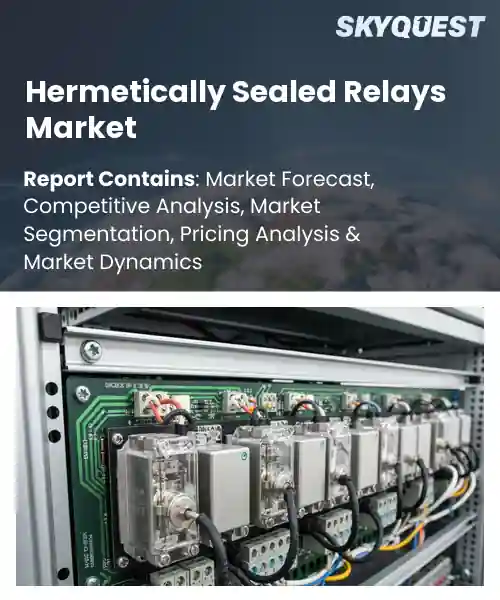
Hermetically Sealed Relays Market
Report ID: SQMIG20D2803
Report ID: SQMIG20D2803
[email protected]
USA +1 351-333-4748
Report ID:
SQMIG20D2803 |
Region:
Global |
Published Date: August, 2026
Pages:
157
|Tables:
119
|Figures:
77


Global Hermetically Sealed Relays Market size was valued at USD 742.5 Million in 2024 and is poised to grow from USD 789.28 Million in 2025 to USD 1286.75 Million by 2033, growing at a CAGR of 6.3% during the forecast period (2026-2033).
The hermetically sealed relays market includes of devices, which are used for the isolation of electrical circuits inside an enclosure and to protect the contacts from moisture, dust and corrosive gasses. This protection is crucial in aerospace, defense and renewable-energy systems where reliability is paramount. Modern automotive electrification and offshore wind farms have accelerated adoption with sealed relays that remove maintenance cycles and extend service intervals. So the sector has moved from being niche military suppliers to a diversified industry with tier-1 manufacturers.
The global hermetically sealed relays market is being driven by the boom in electric‑vehicle EV adoption. Dozens of relays are used in each vehicle to manage battery management, charging control and safety isolation. EV powertrains can be exposed to extreme temperature swings and road salt, so designers need sealed relays to avoid premature failure that could lead to costly recalls. This requirement is driving demand not only for auto production, but also for retrofits in fleets converting to emission operations. And consequently, relay manufacturers are investing in designs and collaborating with automotive OEMs to access sources of revenue beyond the traditional aerospace and industrial segments.
How is AI-driven Automation Influencing The Hermetically Sealed Relays Market?
The hermetically sealed relays market is undergoing a transformation with AI-driven automation streamlining design, production and after-sale support. Machine learning algorithms can now predict material fatigue and generate optimized coil geometries, helping engineers shorten development cycles. Robotic assembly lines in manufacturing with visual inspection algorithms can detect defects that the human eye might not catch, thus improving overall reliability. Predictive maintenance platforms analyze sensor data from installed relays and trigger service actions before failures occur. This is especially valuable in aerospace and industrial applications where downtime is costly. These capabilities are consistent with the steady growth of the market and the increasing demand for high performance, long life components.
Market snapshot - (2026-2033)
Global Market Size
USD 742.5 Million
Largest Segment
Electromechanical Relays
Fastest Growth
RF Relays
Growth Rate
6.3% CAGR
To get more insights on this market click here to Request a Free Sample Report
Global hermetically sealed relays market is segmented by relay type, contact configuration, application, end user and region. Based on relay type, the market is segmented into Reed Relays, Electromechanical Relays, High Voltage Relays and RF Relays. Based on contact configuration, the market is segmented into SPST, SPDT and DPDT. Based on application, the market is segmented into Aerospace & Defense, Medical Equipment, Telecommunications and Industrial Automation. Based on end user, the market is segmented into Aerospace, Healthcare and Electronics Manufacturers. Based on region, the market is segmented into North America, Europe, Asia Pacific, Latin America and Middle East & Africa.
Reed Relays segment dominates because their miniature form factor and inherent hermetic sealing align perfectly with the space‑constrained, high‑reliability requirements of critical systems. The glass envelope protects contacts from corrosion, delivering long life cycles without maintenance. Designers favor this technology for its rapid response and low power consumption, which simplifies integration and reduces overall system weight, reinforcing its market leadership across aerospace, defense, and medical platforms, where failure is intolerable.
However, RF Relays segment is witnessing the strongest growth momentum as 5G infrastructure and satellite communications demand high‑frequency switching with uncompromised isolation. The ability to operate reliably under extreme temperature swings expands usage in emerging aerospace telemetry and defense radar, prompting manufacturers to invest heavily in miniaturized RF designs that drive market expansion.
DPDT segment leads because its dual‑pole capability enables simultaneous control of multiple circuits within a single hermetically sealed package, reducing space and weight penalties. This architecture simplifies wiring complexity for redundant safety systems, offering built‑in fault tolerance that is essential for mission‑critical aerospace and industrial automation applications. The integrated design also lowers assembly time and improves overall reliability. Consequently, OEMs prioritize DPDT solutions to meet stringent certification standards and reduce lifecycle costs.
Meanwhile, SPDT segment is emerging as the key high‑growth area thanks to its simplicity and adaptability for compact designs in telecommunications and consumer electronics. Its single‑throw, double‑throw flexibility supports modular architectures that can be easily reconfigured as network standards evolve, driving rapid adoption and encouraging manufacturers to develop new hermetic packaging solutions that broaden market reach.
To get detailed segments analysis, Request a Free Sample Report
Asia Pacific leads the Hermetically Sealed Relays market because the region combines deep engineering expertise with large‑scale production capacity. The presence of world‑class electronics and automotive manufacturers creates continuous demand for high‑reliability switching components. Robust research institutions and close collaboration between component makers and end‑users accelerate innovation in sealing technologies. Competitive labor costs and well‑developed supply chains enable cost‑effective manufacturing while preserving stringent quality standards. Government initiatives that emphasize advanced manufacturing and export growth further reinforce the region’s attractiveness. Additionally, the strategic focus on aerospace, defense, and renewable energy applications drives sustained adoption of hermetically sealed solutions across the region. The convergence of these factors positions Asia Pacific as the primary hub for both innovation and volume production, allowing regional firms to set industry benchmarks and serve global customers with confidence.
Hermetically Sealed Relays Market in Japan benefits from a longstanding reputation for precision engineering and a dense network of high‑tech manufacturers. The automotive and aerospace sectors demand reliable switching components, encouraging local suppliers to refine sealing techniques. Close collaboration between universities and industrial firms fuels continuous improvement in materials and design. Export‑oriented production combined with stringent quality certifications reinforces Japan’s role as a trusted source for mission‑critical applications worldwide globally.
Hermetically Sealed Relays Market in South Korea is driven by a strong electronics ecosystem and investment in semiconductor fabrication. Power management and telecommunications equipment rely heavily on sealed relay technology to ensure durability under harsh conditions. Government support for manufacturing encourages local producers to adopt innovative sealing materials and automated assembly processes. As global OEMs seek reliable sourcing, South Korea’s reputation for technology deployment enhances its appeal in critical sectors.
The North American market experiences rapid expansion due to its concentration of aerospace, defense, and industrial automation leaders that demand highly reliable switching solutions. A culture of stringent safety standards pushes manufacturers to adopt hermetically sealed designs that guarantee performance in extreme environments. Strong investment in research and development by both private firms and academic institutions fuels continuous improvements in material science and miniaturization. The presence of major equipment integrators creates a robust ecosystem where component suppliers receive immediate feedback, accelerating product refinement. Additionally, an emphasis on energy efficiency and renewable technologies opens new applications for sealed relays in power conversion and grid infrastructure. This collaborative environment also cultivates a skilled workforce capable of addressing emerging reliability challenges across diverse sectors.
Hermetically Sealed Relays Market in the United States draws strength from an aerospace supply chain and a robust defense procurement ecosystem. Manufacturers integrate sealed relays into avionics, satellite systems, and industrial equipment. Research programs between laboratories and industry accelerate adoption of advanced sealing materials. A focus on reliability standards and testing protocols ensures components meet mission requirements, reinforcing the United States as a primary source for high‑integrity switching solutions worldwide.
Hermetically Sealed Relays Market in Canada benefits from a focus on renewable energy infrastructure and an expanding aerospace maintenance sector. Demand for sealed switching devices rises with projects that require reliability under cold climate conditions. Initiatives between universities and specialized manufacturers foster development of sealing compounds suited for harsh environments. Emphasis on compliance with international safety standards positions Canada as a trustworthy provider of reliable relay solutions for critical applications.
Europe strengthens its position in the Hermetically Sealed Relays market through a combination of rigorous engineering heritage, collaborative standards bodies, and a focus on sustainability. Leading automotive and rail manufacturers demand sealed solutions that can endure long service lifetimes while meeting strict environmental regulations. Cross‑border research consortia enable shared expertise in material science and miniaturization, accelerating product evolution. The presence of precision component manufacturers ensures high‑quality production aligned with demanding aerospace and defense specifications. Furthermore, European policy incentives for low‑carbon technologies drive adoption of sealed relays in power conversion and smart grid applications. By integrating advanced engineering practices with a commitment to eco‑efficiency, Europe continues to raise the benchmark for reliability and performance on a global scale. This collaborative environment also cultivates a skilled workforce capable of addressing emerging reliability challenges across diverse sectors.
Hermetically Sealed Relays Market in Germany is anchored by a tradition of precision engineering and a strong automotive supply base. Manufacturers integrate sealed relays into engine control units and industrial automation systems. Joint research projects with technical universities advance sealing material durability and compact design. Commitment to stringent quality certifications ensures components satisfy rigorous automotive and aerospace standards, reinforcing Germany’s reputation as a reliable source for mission‑critical switching devices worldwide.
Hermetically Sealed Relays Market in the United Kingdom draws on an aerospace heritage and a growing renewable energy sector. Suppliers provide sealed relays for satellite communication, defense avionics, and offshore wind turbine control systems. Collaborative programs between research institutes and manufacturers focus on reducing footprint while enhancing sealing performance. Alignment with rigorous European safety directives ensures that British components meet the high reliability expectations of both domestic and international customers.
Hermetically Sealed Relays Market in France benefits from strong governmental support for manufacturing and an aerospace cluster. French firms supply sealed relays to aircraft engine control, high‑speed rail signaling, and hydrogen energy projects. Partnerships with national research agencies drive material innovation and miniaturization techniques that improve reliability under thermal cycles. Commitment to stringent European certification frameworks positions France as a trusted provider of robust relay solutions for critical infrastructure worldwide.
To know more about the market opportunities by region and country, click here to
Buy The Complete Report
Increasing Demand for Compact Designs
Growth in Renewable Energy Infrastructure
Higher Cost Compared To Standard Relays
Stringent Certification Requirements
Request Free Customization of this report to help us to meet your business objectives.
The competitive landscape of the Global Hermetically Sealed Relays Market is shaped by intensified rivalry among specialized manufacturers, with firms accelerating technology adoption and forging strategic alliances to secure niche applications in aerospace, defense, and renewable energy. Recent M&A activity and joint development agreements have enabled rapid integration of IoT‑enabled smart relay capabilities, while aggressive R&D investments drive miniaturization and higher hermetic reliability, directly influencing market share shifts.
SkyQuest’s ABIRAW (Advanced Business Intelligence, Research & Analysis Wing) is our Business Information Services team that Collects, Collates, Correlates, and Analyses the Data collected by means of Primary Exploratory Research backed by robust Secondary Desk research.
As per SkyQuest analysis, the global hermetically sealed relays market is being propelled by the rising demand for compact electronic designs that require reliable, space‑saving switching, while the higher cost of sealed solutions compared with standard relays acts as a notable restraint. Asia Pacific leads the market due to its strong manufacturing base and extensive automotive and aerospace demand, and reed relays dominate the segment landscape because of their miniature form factor and inherent hermetic sealing. A second major driver is the rapid expansion of renewable‑energy infrastructure, which fuels the need for durable relays that can endure harsh environmental conditions.
| Report Metric | Details |
|---|---|
| Market size value in 2024 | USD 742.5 Million |
| Market size value in 2033 | USD 1286.75 Million |
| Growth Rate | 6.3% |
| Base year | 2024 |
| Forecast period | (2026-2033) |
| Forecast Unit (Value) | USD Million |
| Segments covered |
|
| Regions covered | North America (US, Canada), Europe (Germany, France, United Kingdom, Italy, Spain, Rest of Europe), Asia Pacific (China, India, Japan, Rest of Asia-Pacific), Latin America (Brazil, Rest of Latin America), Middle East & Africa (South Africa, GCC Countries, Rest of MEA) |
| Companies covered |
|
| Customization scope | Free report customization with purchase. Customization includes:-
|
To get a free trial access to our platform which is a one stop solution for all your data requirements for quicker decision making. This platform allows you to compare markets, competitors who are prominent in the market, and mega trends that are influencing the dynamics in the market. Also, get access to detailed SkyQuest exclusive matrix.
Table Of Content
Executive Summary
Market overview
Parent Market Analysis
Market overview
Market size
KEY MARKET INSIGHTS
COVID IMPACT
MARKET DYNAMICS & OUTLOOK
Market Size by Region
KEY COMPANY PROFILES
Methodology
For the Hermetically Sealed Relays Market, our research methodology involved a mixture of primary and secondary data sources. Key steps involved in the research process are listed below:
1. Information Procurement: This stage involved the procurement of Market data or related information via primary and secondary sources. The various secondary sources used included various company websites, annual reports, trade databases, and paid databases such as Hoover's, Bloomberg Business, Factiva, and Avention. Our team did 45 primary interactions Globally which included several stakeholders such as manufacturers, customers, key opinion leaders, etc. Overall, information procurement was one of the most extensive stages in our research process.
2. Information Analysis: This step involved triangulation of data through bottom-up and top-down approaches to estimate and validate the total size and future estimate of the Hermetically Sealed Relays Market.
3. Report Formulation: The final step entailed the placement of data points in appropriate Market spaces in an attempt to deduce viable conclusions.
4. Validation & Publishing: Validation is the most important step in the process. Validation & re-validation via an intricately designed process helped us finalize data points to be used for final calculations. The final Market estimates and forecasts were then aligned and sent to our panel of industry experts for validation of data. Once the validation was done the report was sent to our Quality Assurance team to ensure adherence to style guides, consistency & design.
Analyst Support
Customization Options
With the given market data, our dedicated team of analysts can offer you the following customization options are available for the Hermetically Sealed Relays Market:
Product Analysis: Product matrix, which offers a detailed comparison of the product portfolio of companies.
Regional Analysis: Further analysis of the Hermetically Sealed Relays Market for additional countries.
Competitive Analysis: Detailed analysis and profiling of additional Market players & comparative analysis of competitive products.
Go to Market Strategy: Find the high-growth channels to invest your marketing efforts and increase your customer base.
Innovation Mapping: Identify racial solutions and innovation, connected to deep ecosystems of innovators, start-ups, academics, and strategic partners.
Category Intelligence: Customized intelligence that is relevant to their supply Markets will enable them to make smarter sourcing decisions and improve their category management.
Public Company Transcript Analysis: To improve the investment performance by generating new alpha and making better-informed decisions.
Social Media Listening: To analyze the conversations and trends happening not just around your brand, but around your industry as a whole, and use those insights to make better Marketing decisions.
REQUEST FOR SAMPLE
 REQUEST FREE CUSTOMIZATION
Global Hermetically Sealed Relays Market size was valued at USD 742.5 Million in 2024 and is poised to grow from USD 789.28 Million in 2025 to USD 1286.75 Million by 2033, growing at a CAGR of 6.3% during the forecast period (2026-2033).
The competitive landscape of the Global Hermetically Sealed Relays Market is shaped by intensified rivalry among specialized manufacturers, with firms accelerating technology adoption and forging strategic alliances to secure niche applications in aerospace, defense, and renewable energy. Recent M&A activity and joint development agreements have enabled rapid integration of IoT‑enabled smart relay capabilities, while aggressive R&D investments drive miniaturization and higher hermetic reliability, directly influencing market share shifts. 'TE Connectivity Ltd.', 'Sensata Technologies Holding plc', 'Omron Corporation', 'Panasonic Holdings Corporation', 'Fujitsu Limited', 'Standex International Corporation', 'Littelfuse, Inc.', 'Schneider Electric SE', 'Picker Components', 'American Zettler, Inc.', 'Electro-Mech Components, Inc.', 'Coto Technology', 'Xiamen Hongfa Electroacoustic Co., Ltd.', 'Song Chuan Precision Co., Ltd.', 'Radiall S.A.', 'Phoenix Contact GmbH & Co. KG', 'Siemens AG', 'Eaton Corporation plc', 'Dare Electronics, Inc.', 'NTE Electronics, Inc.'
The industry is experiencing heightened demand for compact electronic assemblies, prompting manufacturers to adopt hermetically sealed relays that provide reliable performance within reduced form factors. These relays enable designers to integrate critical switching functions without compromising durability, thereby supporting broader product miniaturization trends across consumer and industrial sectors. As system architects prioritize space efficiency, the preference for sealed solutions accelerates component selection, fostering market expansion through broader application penetration and sustained innovation cycles. This shift also encourages suppliers to invest in advanced sealing technologies, further reinforcing market momentum.
Rapid Adoption In Evs: Automakers are integrating hermetically sealed relays into electric vehicle powertrain architectures to safeguard critical control signals against moisture, vibration, and temperature extremes. This shift is driven by the need for higher reliability in high‑voltage battery management systems and fast‑charging modules. Engineers favor sealed designs because they reduce maintenance intervals and eliminate failure points common in conventional relays. Consequently, suppliers are re‑engineering product lines to meet automotive‑grade standards, accelerating adoption across both premium and mass‑market EV platforms worldwide in the industry.
Why does Asia Pacific Dominate the Global Hermetically Sealed Relays Market? |@12


Want to customize this report? This report can be personalized according to your needs. Our analysts and industry experts will work directly with you to understand your requirements and provide you with customized data in a short amount of time. We offer $1000 worth of FREE customization at the time of purchase.
Feedback From Our Clients


 USA (+1) 351-333-4748

