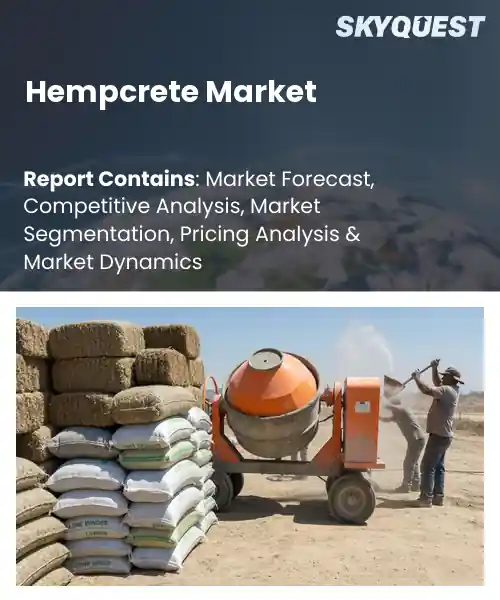
Hempcrete Market
Report ID: SQMIG15F2387
Report ID: SQMIG15F2387
[email protected]
USA +1 351-333-4748
Report ID:
SQMIG15F2387 |
Region:
Global |
Published Date: June, 2026
Pages:
157
|Tables:
174
|Figures:
79


Global Hempcrete Market size was valued at USD 487.3 Million in 2024 and is poised to grow from USD 569.17 Million in 2025 to USD 1971.44 Million by 2033, growing at a CAGR of 16.8% during the forecast period (2026-2033).
The hempcrete industry is made up of a sustainable building material consisting of the wood part of hemp stalks along with the use of lime binder and water. The attractiveness of the material stems from its capacity to store carbon in plant fibers and provide insulation against heat, fire, and moisture control. Initially, this industry developed in Europe in the 1980s as a solution for the housing industry when building regulations were becoming stricter. In countries like France and Germany, subsidies were issued by the government to construct buildings, thereby motivating companies to manufacture products on a large scale.
The major driver of growth in the hempcrete industry is the need for construction, which necessitates the sourcing of materials that will lower the amount of embodied carbon. The hemp plant can sequester CO₂ while growing, making hempcrete an example of a negative carbon wall material due to its lime binder absorbing carbon back for decades. With the adoption of energy standards in municipalities, more people have been specifying hempcrete in retrofits and new constructions, like the retrofitting of St. James School in London in 2022 and an eco-housing community in Portland in 2023.
How is AI-driven Automation Influencing Sustainable Hempcrete Production Efficiency?
The development of hempcrete production through artificial intelligence includes incorporating sensor technology, machine learning, and robot mixing systems. Monitoring temperature, moisture content, and carbonation in real time help manufacturers to adjust the mixture ratio for less wastage and faster curing times. Machine learning systems predict the correct composition of the components depending on the local climate and quality of the input materials, thereby saving energy. This technology also simplifies logistics because automated feeding systems increase speed and reduce the involvement of manpower. Overall, these innovations ensure that hempcrete is increasingly able to compete with conventional building materials due to its rapid development.
Market snapshot - (2026-2033)
Global Market Size
USD 487.3 Million
Largest Segment
Fastest Growth
Growth Rate
16.8% CAGR
To get more insights on this market click here to Request a Free Sample Report
Global hempcrete market is segmented by product type, application, end use sector, binder type, construction type, distribution channel and region. Based on product type, no specific sub-segments were identified. Based on application, no specific sub-segments were identified. Based on end use sector, no specific sub-segments were identified. Based on binder type, no specific sub-segments were identified. Based on construction type, no specific sub-segments were identified. Based on distributionchannel, no specific sub-segments were identified. Based on region, the market is segmented into North America, Europe, Asia Pacific, Latin America and Middle East & Africa.
The block segment is more prominent since the natural load carrying capability of hempcrete corresponds to that of masonry, enabling constructors to easily substitute regular bricks without any major design changes. This similarity makes it possible for architects and contractors to embrace blocks as the dominant shape factor, easing supply and handling on-site. In addition, the block shape favors quick erection, less labor, and easy incorporation into an existing system, thereby making it dominant in the market of hempcrete.
On the other hand, panel segment becomes the fastest growing segment due to the designers’ attempts at using thin prefabricated panels to ensure effective insulation and architectural flexibility. Improved manufacturing techniques keep on reducing weight and enhancing surface finish to attract developers who require sustainable fast-track construction solutions.
Wall infill is the dominant sector due to the fact that hempcrete is an excellent thermal mass and breathable material. Therefore, it is a good choice for infilling cavities. The builders love this material because it helps regulate the climate in the room while keeping moisture out, which is what building codes have always required. In addition, its ease of mixing on-site and suitability to conventional framing methods further cement wall infill as the main application for hempcrete.
However, roof insulation is the sector growing because architects need to get R-value materials for roofs. Hempcrete is a lightweight and hygroscopic material and therefore easy to install and maintain. Rewarding carbon-negative roofing policies make this segment the driver of the expansion of the usage of hempcrete.
To get detailed segments analysis, Request a Free Sample Report
The European region is advantaged by having a rich history of use of natural building materials, coupled with regulatory systems that promote the development of green buildings, in addition to research organizations that conduct studies regarding hemp cultivation and development of materials. Policy incentives from member countries promote sustainable sourcing of materials, while well-developed supply chain networks promote the constant supply of industrial hemp fibers and lime materials. Market consciousness regarding the environmental performance of materials promotes demand for hempcrete in residential constructions, while architectural companies adopt the use of hempcrete because of its thermal properties and fire-resistance qualities.
Hempcrete Market in Germany has been driven by green building codes and proactively embracing the concept of circular economy. German construction companies have begun incorporating hempcrete into energy-efficient housing thanks to collaboration between research partners and improvements in mix design for increased durability. Instruments of policy favoring low-embodied carbon materials also support this trend, along with an existing agricultural system producing quality hemp straw.
Hempcrete Market UK benefits from the commitment of the government towards zero net targets as well as the retrofitting of timber frames. Cooperation within the industry between builders, architects, and hemp producers fosters knowledge transfer as well as pilots of this material due to its insulation qualities. Public procurement practices emphasizing sustainable construction materials also contribute to the adoption of hempcrete in new constructions.
Market for Hempcrete in France relies on cultural preference for natural materials and regional cooperation among hemp cooperatives. Regulatory authorities in France promote low carbon construction, thus recommending architects to use hempcrete because of its breathing ability and moisture control. Jointly conducted research by agriculturalists and builders improves methods of production of hempcrete, while urban regeneration projects employ this material.
In North America, the intersection of climate-sensitive building codes, increased consumer interest in green housing, and increased industrial hemp production drives rapid expansion of the market. Policy changes that break down hurdles for growing hemp have resulted in access to a consistent supply of raw material, while builders leverage the high thermal mass capabilities of hempcrete in order to comply with energy-efficient requirements. Universities and trade associations work together to test the performance of products, giving developers and investors greater confidence. Moreover, a large number of pilot programs demonstrate economical and resilient building practices.
Market for Hempcrete in the United States is catalyzed by forward-looking state incentives that encourage low carbon building techniques, as well as by the emergence of a vast network of hemp farms that ensure a steady stream of hemp fibers. Architecture firms are exploring hempcrete in both new constructions and renovations, stressing the permeability aspect of this material. The dissemination of knowledge through seminars and certification schemes ensures that contractors have the necessary skills to use hempcrete, as documented in research publications.
Market of Hempcrete in Canada is aided by government efforts towards the use of renewable building materials and by the climatic conditions that make growing of hemp possible in several provinces. Partnerships between agronomists and builders ease the supply chain by ensuring quality fibers and lime mixes. Certifications on green buildings are becoming more accommodating of hempcrete, which has prompted more developments to adopt it in their multi-family buildings projects.
Hempcrete is gaining ground in Asia Pacific through research investment, governmental policies encouraging green buildings, and the adaptation of hemp farming to various climates. Architects in the region include the use of hempcrete in high-density urban construction projects to combat the problem of heat islands and improve indoor air quality. Collaboration between agricultural departments and innovators of building materials makes it possible to come up with mixed designs suited for local conditions, thus eliminating the need for importing building materials. Also, the need for resilient building materials against climate change encourages dialogue in policy-making that sees hempcrete as an alternative to concrete.
Japanese Hempcrete Market is influenced by the cultural inclination towards achieving harmony with nature and regulatory encouragement towards sustainable building techniques. Joint research efforts of construction companies and universities lead to the development of hempcrete blends that meet seismic requirements, while experimental buildings highlight the advantages of using hempcrete for thermal comfort. The government’s financial assistance towards using renewable building materials is encouraging architects to use hempcrete in building construction.
Hempcrete Market of South Korea moves forward due to government programs aimed at promoting sustainable development and innovative materials. Scientific institutions concentrate their work on improving the properties of hempcrete when used under humid weather conditions. The cooperation with domestic producers of hemp provides a stable supply chain, whereas the design competition emphasizes aesthetic properties of this material.
To know more about the market opportunities by region and country, click here to
Buy The Complete Report
Increasing Awareness of Sustainable Building
The trend of eco-friendly construction is becoming prevalent among consumers and developers, and the biodegradable nature of hempcrete fits well with such a perception. The ability of hempcrete to absorb carbon dioxide, act as a good insulator, and decrease greenhouse gases during the construction process makes it a promising substitute for other traditional construction materials. This increased environmental awareness makes architects, and other stakeholders include hempcrete in their designs and portfolios, thereby generating more demand for the material, increasing production and distribution channels.
Regulatory Support for Low‑Carbon Materials
Building codes, which encourage low-carbon construction practices, are being adopted around the world. There is also an encouragement for the use of sustainable construction materials through various incentives in most areas. This makes hempcrete a beneficiary of the favorable policies since the policies facilitate easier approval, provide tax credits, and even subsidies to help minimize project costs. This not only makes the adoption of hempcrete easier for developers but also creates more confidence in their projects. The industry is benefiting from the momentum created by such policies.
High Initial Cost of Hempcrete
The major obstacle to the extensive use of hempcrete is the higher initial cost of the materials relative to conventional concrete, primarily because of small-scale production and unique processing needs. The developer should set aside extra finances for budgeting, which might discourage initiatives that are highly financially sensitive. Cost consciousness often causes parties to opt for less costly alternatives, particularly in competitive environments. As such, market penetration is inhibited by the struggle of increasing the production capacity of the product while maintaining cost efficiency.
Limited Technical Knowledge Among Contractors
Another important restriction arises due to the lack of professional experience of contractors and builders related to the proper preparation of the mixture, installation methods, and properties of hempcrete. Being unprepared for using the new technology, specialists might find it difficult to provide a uniform product, which is why there will be questions about its durability and conformity with construction requirements. Such problems make it harder for the owner of the project to make the choice in favor of innovative material.
Request Free Customization of this report to help us to meet your business objectives.
Competition in the hempcrete industry is high due to the engagement of companies in strategic mergers and partnerships in order to ensure raw materials availability, improve the quality of products, and expand their geography. Joint activities of material inventors and contractors focus on achieving faster realization of low-carbon construction projects; research of bio-composites contributes to the differentiation of products.
Circular Construction Momentum: Construction sector players have been giving importance to circular practices to find materials that can be sourced, processed, and recycled with reduced waste. The low carbon footprint, raw material base of hempcrete, and its possibility of being reclaimed or composted make this material a fit in the concept of circularity, hence encouraging specification by architects and developers to achieve green certification. With the start of recognition of life-cycle achievements, businesses are adopting this material in their overall circular strategy.
Policy Incentives Accelerating Adoption: Governments around the world are incorporating hempcrete into their climate change strategies through the provision of financial inducements, expediting permits, and research grants to overcome the constraints of developers. These government tools not only help developers overcome immediate financial hurdles but send a clear message regarding long-term regulatory assistance, hence enabling investors to invest in those projects which can benefit from the carbon-sucking capabilities of hempcrete. With changing criteria of public procurement to favor reduced embodied carbon emissions, the material gets a boost in its acceptance.
SkyQuest’s ABIRAW (Advanced Business Intelligence, Research & Analysis Wing) is our Business Information Services team that Collects, Collates, Correlates, and Analyses the Data collected by means of Primary Exploratory Research backed by robust Secondary Desk research.
As per SkyQuest analysis, the market for hempcrete all over the world is growing at an enormous pace due to increased awareness about sustainability in buildings and hence the use of materials which are renewable and carbon neutral. Another major factor driving the market is the existence of favorable regulations which favor low-carbon buildings and hence make it easier for the construction of such buildings. Europe is by far the leading region in this market due to its rich history of natural building along with favorable regulations and efficient supply chain networks. The increase in knowledge about the environmental performance of sustainable construction materials has prompted the use of hempcrete in residential buildings. The good insulating properties, fire-resistant nature, and minimal effect on the environment make architects, contractors, and developers interested in using this material in modern constructions. With the ever-increasing demands for efficient and environmentally friendly construction options, the importance of hempcrete in sustainable constructions is set to grow in the future.
| Report Metric | Details |
|---|---|
| Market size value in 2024 | USD 487.3 Million |
| Market size value in 2033 | USD 1971.44 Million |
| Growth Rate | 16.8% |
| Base year | 2024 |
| Forecast period | (2026-2033) |
| Forecast Unit (Value) | USD Million |
| Segments covered |
|
| Regions covered | North America (US, Canada), Europe (Germany, France, United Kingdom, Italy, Spain, Rest of Europe), Asia Pacific (China, India, Japan, Rest of Asia-Pacific), Latin America (Brazil, Rest of Latin America), Middle East & Africa (South Africa, GCC Countries, Rest of MEA) |
| Companies covered |
|
| Customization scope | Free report customization with purchase. Customization includes:-
|
To get a free trial access to our platform which is a one stop solution for all your data requirements for quicker decision making. This platform allows you to compare markets, competitors who are prominent in the market, and mega trends that are influencing the dynamics in the market. Also, get access to detailed SkyQuest exclusive matrix.
Table Of Content
Executive Summary
Market overview
Parent Market Analysis
Market overview
Market size
KEY MARKET INSIGHTS
COVID IMPACT
MARKET DYNAMICS & OUTLOOK
Market Size by Region
KEY COMPANY PROFILES
Methodology
For the Hempcrete Market, our research methodology involved a mixture of primary and secondary data sources. Key steps involved in the research process are listed below:
1. Information Procurement: This stage involved the procurement of Market data or related information via primary and secondary sources. The various secondary sources used included various company websites, annual reports, trade databases, and paid databases such as Hoover's, Bloomberg Business, Factiva, and Avention. Our team did 45 primary interactions Globally which included several stakeholders such as manufacturers, customers, key opinion leaders, etc. Overall, information procurement was one of the most extensive stages in our research process.
2. Information Analysis: This step involved triangulation of data through bottom-up and top-down approaches to estimate and validate the total size and future estimate of the Hempcrete Market.
3. Report Formulation: The final step entailed the placement of data points in appropriate Market spaces in an attempt to deduce viable conclusions.
4. Validation & Publishing: Validation is the most important step in the process. Validation & re-validation via an intricately designed process helped us finalize data points to be used for final calculations. The final Market estimates and forecasts were then aligned and sent to our panel of industry experts for validation of data. Once the validation was done the report was sent to our Quality Assurance team to ensure adherence to style guides, consistency & design.
Analyst Support
Customization Options
With the given market data, our dedicated team of analysts can offer you the following customization options are available for the Hempcrete Market:
Product Analysis: Product matrix, which offers a detailed comparison of the product portfolio of companies.
Regional Analysis: Further analysis of the Hempcrete Market for additional countries.
Competitive Analysis: Detailed analysis and profiling of additional Market players & comparative analysis of competitive products.
Go to Market Strategy: Find the high-growth channels to invest your marketing efforts and increase your customer base.
Innovation Mapping: Identify racial solutions and innovation, connected to deep ecosystems of innovators, start-ups, academics, and strategic partners.
Category Intelligence: Customized intelligence that is relevant to their supply Markets will enable them to make smarter sourcing decisions and improve their category management.
Public Company Transcript Analysis: To improve the investment performance by generating new alpha and making better-informed decisions.
Social Media Listening: To analyze the conversations and trends happening not just around your brand, but around your industry as a whole, and use those insights to make better Marketing decisions.
REQUEST FOR SAMPLE
 REQUEST FREE CUSTOMIZATION
Global Hempcrete Market size was valued at USD 487.3 Million in 2024 and is poised to grow from USD 569.17 Million in 2025 to USD 1971.44 Million by 2033, growing at a CAGR of 16.8% during the forecast period (2026-2033).
The hempcrete market is characterized by intense rivalry as firms pursue strategic mergers, joint ventures, and technology integration to secure raw material supply, enhance product performance, and expand geographic reach. Recent collaborations between material innovators and construction firms aim to accelerate low‑carbon building solutions, while investments in bio‑composite research drive product differentiation. 'IsoHemp SA', 'JustBioFiber Structural Solutions Corp.', 'American Lime Technology LLC', 'Hempitecture Inc.', 'HempFlax Group B.V.', 'Dun Agro Hemp Group', 'Ty-Mawr Lime Ltd.', 'Lhoist Group', 'HempEco Systems Ltd.', 'UK Hempcrete Ltd.', 'Hemp Building Company Ltd.', 'Chanvribat SAS', 'Biofib Isolation', 'Hemp Technologies Global', 'IND Hemp LLC', 'Nature Fibres International', 'Canobi AgTech Inc.', 'HempBLOCK International', 'Naturally Advanced Technologies Inc.', 'Von Hanf GmbH'
Consumers and developers are increasingly prioritizing eco‑friendly construction, and hempcrete’s renewable composition aligns with this mindset. Its ability to store carbon, provide natural insulation, and reduce overall building emissions positions it as an attractive alternative to conventional materials. This heightened environmental consciousness encourages architects to specify hempcrete in project specifications, while investors seek portfolios that demonstrate sustainability. Consequently, market participants experience stronger demand, prompting expanded production capacity and broader distribution networks, which collectively sustain market expansion across multiple regions globally.
Circular Construction Momentum: The construction industry is increasingly prioritizing circularity, seeking materials that can be sourced, manufactured, and reclaimed with minimal waste. Hempcrete’s low embodied carbon, renewable raw material base, and ability to be reclaimed or composted align with this ethos, prompting architects and developers to specify it for green certifications. As regulatory frameworks begin to reward life‑cycle performance, companies are integrating hempcrete into broader circular strategies, driving market adoption beyond niche eco‑projects toward mainstream building programmes globally today rapidly.
Why does Europe Dominate the Global Hempcrete Market? |@12


Want to customize this report? This report can be personalized according to your needs. Our analysts and industry experts will work directly with you to understand your requirements and provide you with customized data in a short amount of time. We offer $1000 worth of FREE customization at the time of purchase.
Feedback From Our Clients


 USA (+1) 351-333-4748

