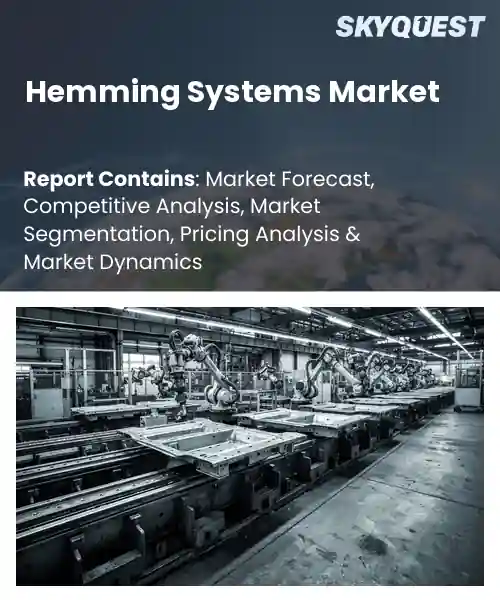
Hemming Systems Market
Report ID: SQMIG20F2035
Report ID: SQMIG20F2035
[email protected]
USA +1 351-333-4748
Report ID:
SQMIG20F2035 |
Region:
Global |
Published Date: February, 2026
Pages:
157
|Tables:
179
|Figures:
79


Global Hemming Systems Market size was valued at USD 456.7 Million in 2024 and is poised to grow from USD 481.36 Million in 2025 to USD 733.16 Million by 2033, growing at a CAGR of 5.4% during the forecast period (2026-2033).
The primary driver of the global hemming systems market is the automotive industry’s push toward higher build quality and lightweight construction, which has elevated hemming from a manual finishing step to a strategically automated joining process. Hemming systems encompass machines and cells used to fold and join outer and inner metal panels most commonly doors, hoods and trunks into a seamless edge that ensures corrosion resistance, aesthetic uniformity and crash performance. Over the last two decades manufacturers shifted from hydraulic presses to servo-driven robot-assisted hemming lines to meet tighter tolerances; for example, European OEMs adopted hemming cells to support aluminum door production.
A key trend driving the global hemming systems sector growth is the combined effect of automation and changing sheet-metal chemistry, which forces manufacturers to invest in precision equipment. OEMs are now using aluminum instead of steel along with ultra-high-strength grades to reduce the overall weight of vehicles. As a result of this, traditional hemming methods can no longer be utilized, leading to the use of servo-electric presses combined with robot-assisted hemmer heads for the purpose of reducing cycle time and the amount of rework. The technological improvement of these two new processes provides tangible benefits: reduced scrap rates, increased strength in lap seams, and reduced takt times that allow assembly plants to produce higher volumes at consistent quality.
How is AI Enhancing Quality Control in the Hemming Systems Market?
AI is reshaping quality control in hemming systems by combining machine vision sensor fusion and machine learning to inspect seams detect surface anomalies and adjust forming forces in real time. Current implementations place trained vision models at the line to flag subtle creases and feed immediate feedback to robot controllers while analytics predict tool wear and prompt preventive maintenance. The market context is automotive demand for tighter closure tolerances and lower rework which drives tier one suppliers to adopt edge AI for faster decisions and continuous in line inspection. Examples include vision spotting fold defects force sensing that tunes pressure and analytics that extend tool life.
In June 2025, ABB showcased integrated AI enabled vision and automation for body in white applications relevant to hemming. This development supports faster inline defect detection and adaptive process control which reduces rework and helps suppliers scale quality assured production.
Market snapshot - (2026-2033)
Global Market Size
USD 456.7 Million
Largest Segment
Mechanical Hemming Systems
Fastest Growth
Robotic Hemming Cells
Growth Rate
5.4% CAGR
To get more insights on this market click here to Request a Free Sample Report
Global hemming systems market is segmented by product type, component, application, end-use industry, mode of operation, distribution channel and region. Based on product type, the market is segmented into mechanical hemming systems, hydraulic hemming systems, servo-driven hemming systems, robotic hemming cells and manual hemming tools. Based on component, the market is segmented into presses & drive units, tooling & dies, control systems & software, sensors & safety equipment and accessories.
Based on application, the market is segmented into automotive outer panels, appliance panels, aerospace components, metal furniture & cabinets and other metal fabrication. Based on end-use industry, the market is segmented into automotive, consumer appliances, aerospace & defense, construction & architecture and others. Based on mode of operation, the market is segmented into fully automatic systems, semi-automatic systems and manual systems. Based on distribution channel, the market is segmented into direct OEM sales, distributors & dealers and system integrators. Based on region, the market is segmented into North America, Europe, Asia Pacific, Latin America and Middle East & Africa.
Based on the global hemming systems market growth, servo-driven hemming systems segment dominates because it delivers high positional accuracy and repeatable force profiles that directly improve panel quality and reduce rework. The ability to accurately control motion allows for precision application to intricate outer panels. If these pressures can be applied using digital control and energy-efficient systems, they will reduce operation costs and simplify the process of incorporating them into production processes. Because of this, OEMs are using more advanced motion control systems to meet the tighter tolerances required in today’s vehicles and appliances at manufacturing.
However, robotic hemming cells are emerging as the most rapidly expanding area because they offer flexibility for mixed model production and can handle complex geometries. Due to the modularity and integration of inspection and material handling with hemming, integrators can supply turnkey automation reducing the speed at which businesses begin using automation. This also allows integrators to create more opportunities for customization, aftermarket services and increased sales revenue through after-sales support, etc.
Control systems & software segment leads because it orchestrates the precision timing, motion profiles, and closed loop feedback essential for repeatable hemming cycles, enabling consistent joint quality. Newer technologies are enabling recipe management, diagnostics, and connection to higher-level manufacturing execution systems, which allow for reduced downtime and improved scalability within the manufacturing process. This control technology is critical for process optimization, facilitates the integration of press and robot systems, and provides suppliers with differentiators through digital services.
Meanwhile, sensors & safety equipment are emerging as the most rapidly expanding area because vision and force sensors enable inline quality inspection and adaptive hemming while enhanced safety systems address workplace compliance. Real-time sensing and predictive maintenance capabilities create retrofit opportunities and stimulate demand for smarter, safety-compliant hemming installations.
To get detailed segments analysis, Request a Free Sample Report
As per the global hemming systems market share, Asia Pacific dominates the global market due to a concentrated automotive manufacturing base, strong local supply chains, and advanced metalworking capabilities. OEMs and tier suppliers in the region favor integrated hemming solutions that improve production flexibility and enable lightweighting strategies in vehicle assemblies.
High levels of automation adoption, close collaboration between equipment makers and end users, and a dense network of tooling and component suppliers accelerate deployment. Being close to a central location for key parts and materials reduces the amount of time required to fulfill orders and allows for immediate support in making modifications to an engineering outline. Therefore, this will help to sustain the region as being the hub for developing and marketing new types of hemming systems.
Hemming systems market in Japan benefits from a mature automotive and manufacturing ecosystem that emphasizes precision, quality, and automation. Regional (domestic) original equipment manufacturers (OEMs) and suppliers establish partnerships with equipment manufacturers in developing compact, high-precision hemming cells specifically tailored for complex body panels. The robust electronics/robotics sectors provide for better system integration and help with providing advanced control capabilities. Additionally, the established tooling knowledge base supports both rapid prototypes and customization of tooling needed to manufacture vehicle parts.
Hemming systems market in South Korea is driven by an agile automotive supply chain and strong emphasis on integration of digital controls and lightweight assembly techniques. Hemming systems manufacturers focus on creating smaller, higher volume production systems capable of supporting rapid changeovers and export-based manufacturing, where tight supplier relationships with equipment manufacturers typically result in customized solutions specific to each application. Additionally, there is a strong engineering workforce and support for commissioning, adjustments, and ongoing operational improvements.
Based on global hemming systems regional forecast, Europe is experiencing rapid expansion in the hemming systems market driven by a convergence of vehicle architecture change, regulatory emphasis on efficiency and safety, and strong local automotive engineering capabilities. Advanced hemming solutions are pursued by OEMs throughout the region in order to bring together advanced material applications and complex multi-material interface joints. Large, developed manufacturing resources (suppliers) and modular manufacturing philosophies support rapid, scalable installation of automated hemming cells to existing production lines. By investing in robotic automation, precision tooling and monitoring of processes, as well as combining collaborative research and development programs between manufacturers and equipment suppliers; the rate of adoption has been increased.
Hemming systems market in Germany is anchored by a dense concentration of OEMs and tier suppliers that demand high precision, repeatable hemming processes for complex body architectures. German manufacturers emphasize robust, modular hemming cells that integrate seamlessly with high throughput assembly lines and stringent quality controls. Working closely together in developing equipment as well as through their respective development centres (engineer) allows equipment manufacturers to create custom built product more quickly.
Hemming systems market in United Kingdom is characterized by a growing focus on flexible manufacturing and specialist vehicle programs that favor adaptable hemming solutions. Equipment manufacturers partner with engineering consultancies and component suppliers to provide compact systems that are configurable for mixed quantities of goods produced simultaneously. Together, a lively innovation ecosystem and robust support networks will facilitate the rapid adoption of these technologies in a wide variety of manufacturing environments.
Hemming systems market in France is witnessing notable momentum driven by modernization of assembly lines, increasing use of lightweight and multimaterial structures, and stronger collaboration between OEMs and suppliers. Manufacturers are searching for compact hemming cells that can handle different types of panel sizes and shapes, including those used in electric vehicle programs. Growing demand for quality assurance and local service capabilities is driving increased adoption among automotive manufacturers in manufacturing clusters.
As per global hemming systems regional outlook, North America is strengthening its position in the hemming systems market through a combination of renewed manufacturing investments, emphasis on automation, and close collaboration between OEMs and system integrators. The regional produce manufacturers focus on flexible hem solutions that meet the many different car architectures/vehicle platforms and the varying material combinations such as advanced high strength steel (AHSS) and aluminum.
Investments into digital process controls, remote diagnostics, and flexible tooling enable a faster commissioning process and reduced downtime. There is a growing ecosystem of automation experts, tooling suppliers, and service providers to offer fast, local customisation and quick response times on changes in production. Improved aftermarket support and training offerings are helping to enhance adoption and long term operational performance.
Hemming systems market in United States is driven by a concentration of large OEMs and suppliers seeking robust, scalable hemming solutions that support mixed production profiles. The growth of lightweight structures and electrification drives the use of adaptable hemming cells using an advanced level of control and diagnostic ability in the market. Automation integrators and tooling companies have an established presence, providing the customer with the option of custom solutions and local support.
Hemming systems market in Canada reflects a focus on flexible, serviceable hemming systems that support domestic vehicle assembly and supplier facilities. Manufacturers focus on providing systems that will accommodate multiple panel designs and material combinations while maintaining traceability of quality. Being located near to North American supply chains and being able to work closely with local automation experts facilitates the ability to customize efficiently and provide good aftermarket support. A commitment to investment in skills development and service networks will enhance the likelihood of successful commissioning and long-term operation at a customer's location.
To know more about the market opportunities by region and country, click here to
Buy The Complete Report
Rising Demand For Apparel Automation
Hemming systems streamline edge finishing processes in garment manufacturing, enabling consistent stitch quality and faster throughput which reduces dependence on skilled manual labor and shortens production cycles. Manufacturers are able to enlarge their capacities through the standardization of their hems without a corresponding increase in staff size; react more rapidly to fashion changes; and achieve consistent product quality within each batch due to enhanced efficiency enabled by automation. These benefits of efficiency derived from automating are compelling reasons for many large and small manufacturers who wish to maximize their efficiencies, minimize their unit costs through process consistency, and fulfill retailers’ requests for on-time delivery of high-quality garments.
Technological Advances In Machinery
Hemming system technologies are growing due to ongoing advancements made to the machine's design, machine control systems, and the way materials are handled. In the future, hemming systems will have even more capabilities, including but not limited to; increased accuracy, increased flexibility, improved ease of integration with existing manufacturing processes, and continued innovation (such as programmable stitch patterns, modular tooling, user-friendly interfaces). Due to these improvements, the time to set up a new product or a different product has decreased significantly. Additionally, the ability to switch quickly between multiple brands increases the appeal of this technology for manufacturers who produce many different products.
High Initial Capital Requirements
Modern hemming systems' high initial investment (for purchase or customization) and integration into existing production lines are often a barrier to smaller manufacturers and those working on narrow profit margins because they are so high. The added costs for operator training, tool, and facility modifications increase this financial barrier and complicate capital allocation. When companies place a premium on flexible or short-run production, decisions are often delayed to wait for manual labor or multi-use machinery, which slows down the timing of technology adoption and slows overall market growth.
Skilled Labor Shortages Persist
A shortage of technicians and operators trained specifically to program, maintain, and troubleshoot advanced hemming equipment constrains deployment in facilities that lack in house expertise. To achieve consistent operation from complex modern-day SCMs (Supply Chain Management) as well as to reduce potential. To develop an operational risk modality, the complexity of modern SCMS may necessitate an increased level of both skill and manual processes. For this reason, Organizations may avoid the implementation of SCM processes or new equipment due to the workforce limitations, are subsequently preventing manufacturers from implementing these newly developed SCMS.
Request Free Customization of this report to help us to meet your business objectives.
The competitive landscape for global hemming systems market outlook is driven by consolidation among established bodyshop suppliers, targeted acquisitions to secure tooling expertise, and partnerships that push automation and AI into closure and textile handling workflows. Tier one M&A and facility expansions, plus alliances between robot makers and deep tech startups, are accelerating rollouts of robotic roller hemming and AI-driven process controls.
SkyQuest’s ABIRAW (Advanced Business Intelligence, Research & Analysis Wing) is our Business Information Services team that Collects, Collates, Correlates, and Analyses the Data collected by means of Primary Exploratory Research backed by robust Secondary Desk research.
As per SkyQuest analysis, the global hemming systems industry is primarily driven by the automotive industry's push for higher build quality and lightweight construction, which elevates hemming to a strategic automated joining process. A second significant driver is increasing automation coupled with changing sheet-metal chemistry, prompting investments in servo-electric presses and robot-guided cells for precision and lower rework. High initial capital investments can keep smaller manufacturers from growing as quickly as their larger competitors. The Asia Pacific region is especially prominent in the industry because it contains a very large number of auto industry supply chains. Servo-driven Hemming systems allow for greater flexibility, high-level positional accuracy and repeatable force profiles, as well as the ability to integrate digitally into the new manufacturing environment.
| Report Metric | Details |
|---|---|
| Market size value in 2024 | USD 456.7 Million |
| Market size value in 2033 | USD 733.16 Million |
| Growth Rate | 5.4% |
| Base year | 2024 |
| Forecast period | (2026-2033) |
| Forecast Unit (Value) | USD Million |
| Segments covered |
|
| Regions covered | North America (US, Canada), Europe (Germany, France, United Kingdom, Italy, Spain, Rest of Europe), Asia Pacific (China, India, Japan, Rest of Asia-Pacific), Latin America (Brazil, Rest of Latin America), Middle East & Africa (South Africa, GCC Countries, Rest of MEA) |
| Companies covered |
|
| Customization scope | Free report customization with purchase. Customization includes:-
|
To get a free trial access to our platform which is a one stop solution for all your data requirements for quicker decision making. This platform allows you to compare markets, competitors who are prominent in the market, and mega trends that are influencing the dynamics in the market. Also, get access to detailed SkyQuest exclusive matrix.
Table Of Content
Executive Summary
Market overview
Parent Market Analysis
Market overview
Market size
KEY MARKET INSIGHTS
COVID IMPACT
MARKET DYNAMICS & OUTLOOK
Market Size by Region
KEY COMPANY PROFILES
Methodology
For the Hemming Systems Market, our research methodology involved a mixture of primary and secondary data sources. Key steps involved in the research process are listed below:
1. Information Procurement: This stage involved the procurement of Market data or related information via primary and secondary sources. The various secondary sources used included various company websites, annual reports, trade databases, and paid databases such as Hoover's, Bloomberg Business, Factiva, and Avention. Our team did 45 primary interactions Globally which included several stakeholders such as manufacturers, customers, key opinion leaders, etc. Overall, information procurement was one of the most extensive stages in our research process.
2. Information Analysis: This step involved triangulation of data through bottom-up and top-down approaches to estimate and validate the total size and future estimate of the Hemming Systems Market.
3. Report Formulation: The final step entailed the placement of data points in appropriate Market spaces in an attempt to deduce viable conclusions.
4. Validation & Publishing: Validation is the most important step in the process. Validation & re-validation via an intricately designed process helped us finalize data points to be used for final calculations. The final Market estimates and forecasts were then aligned and sent to our panel of industry experts for validation of data. Once the validation was done the report was sent to our Quality Assurance team to ensure adherence to style guides, consistency & design.
Analyst Support
Customization Options
With the given market data, our dedicated team of analysts can offer you the following customization options are available for the Hemming Systems Market:
Product Analysis: Product matrix, which offers a detailed comparison of the product portfolio of companies.
Regional Analysis: Further analysis of the Hemming Systems Market for additional countries.
Competitive Analysis: Detailed analysis and profiling of additional Market players & comparative analysis of competitive products.
Go to Market Strategy: Find the high-growth channels to invest your marketing efforts and increase your customer base.
Innovation Mapping: Identify racial solutions and innovation, connected to deep ecosystems of innovators, start-ups, academics, and strategic partners.
Category Intelligence: Customized intelligence that is relevant to their supply Markets will enable them to make smarter sourcing decisions and improve their category management.
Public Company Transcript Analysis: To improve the investment performance by generating new alpha and making better-informed decisions.
Social Media Listening: To analyze the conversations and trends happening not just around your brand, but around your industry as a whole, and use those insights to make better Marketing decisions.
REQUEST FOR SAMPLE
 REQUEST FREE CUSTOMIZATION
Global Hemming Systems Market size was valued at USD 456.7 Million in 2024 and is poised to grow from USD 481.36 Million in 2025 to USD 733.16 Million by 2033, growing at a CAGR of 5.4% during the forecast period (2026-2033).
The competitive landscape for global hemming systems is driven by consolidation among established bodyshop suppliers, targeted acquisitions to secure tooling expertise, and partnerships that push automation and AI into closure and textile handling workflows. Tier one M&A and facility expansions, plus alliances between robot makers and deep tech startups, are accelerating rollouts of robotic roller hemming and AI-driven process controls. 'APTIV', 'WABCO Holdings', 'Continental AG', 'Robert Bosch GmbH', 'DENSO Corporation', 'Johnson Controls', 'ZF Friedrichshafen AG', 'Valeo SA', 'Delphi Technologies', 'Magna International Inc.', 'TI Fluid Systems', 'BorgWarner Inc.', 'Gentex Corporation', 'Advanex Inc.', 'Hitachi Automotive Systems', 'NSK Ltd.', 'Faurecia', 'Infineon Technologies', 'Schaeffler AG', 'Parker Hannifin Corporation'
Hemming systems streamline edge finishing processes in garment manufacturing, enabling consistent stitch quality and faster throughput which reduces dependence on skilled manual labor and shortens production cycles. By standardizing hem operations, manufacturers can increase capacity without proportionally increasing workforce size, respond more quickly to changing styles, and maintain uniform quality across batches. This automation driven efficiency supports adoption among large and small producers seeking to optimize operations, lower unit costs through process consistency, and better meet retailer demands for timely, high quality apparel deliveries.
Digital Factory Integration: Manufacturers are integrating digital technologies into hemming systems to enable real time monitoring, adaptive control and predictive upkeep. Networked sensors, machine learning and open communication standards streamline process variability, support rapid changeovers and facilitate remote diagnostics. This fosters closer collaboration between OEMs and suppliers, shorter development cycles and greater production flexibility. The result is enhanced quality consistency, reduced downtime and capability for highly customized runs, positioning hemming equipment as a connected element within smart factory initiatives and enhanced digital traceability.
As per the global hemming systems market share, Asia Pacific dominates the global market due to a concentrated automotive manufacturing base, strong local supply chains, and advanced metalworking capabilities.


Want to customize this report? This report can be personalized according to your needs. Our analysts and industry experts will work directly with you to understand your requirements and provide you with customized data in a short amount of time. We offer $1000 worth of FREE customization at the time of purchase.
Feedback From Our Clients


 USA (+1) 351-333-4748

