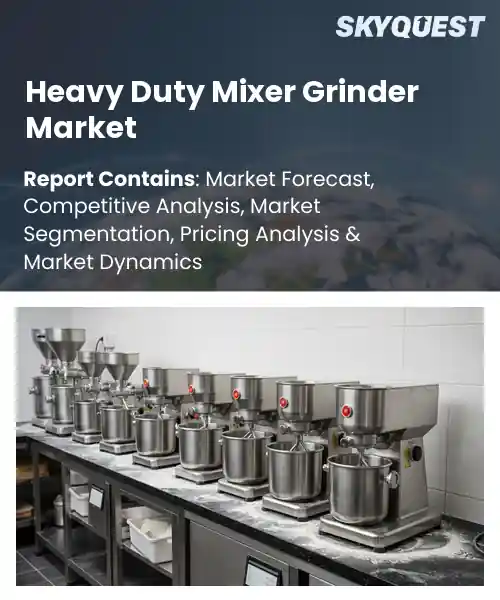
Heavy Duty Mixer Grinder Market
Report ID: SQMIG25H2124
Report ID: SQMIG25H2124
[email protected]
USA +1 351-333-4748
Report ID:
SQMIG25H2124 |
Region:
Global |
Published Date: July, 2026
Pages:
157
|Tables:
144
|Figures:
78


Global Heavy Duty Mixer Grinder Market size was valued at USD 4.59 Billion in 2024 and is poised to grow from USD 4.9 Billion in 2025 to USD 8.23 Billion by 2033, growing at a CAGR of 6.7% during the forecast period (2026-2033).
Heavy‑duty mixer grinders form a niche segment of kitchen appliances designed to process large volumes of ingredients quickly, catering to commercial eateries, institutional kitchens, and households. The market’s relevance stems from rising demand for faster food preparation and consistent texture, especially in regions where street food and bulk catering dominate.
Recent examples include Indian manufacturers launching 2‑liter capacity models for hotel chains, illustrating how scale and durability have become purchase criteria. A key factor reshaping the global heavy‑duty mixer grinder market is the acceleration of food‑service digitisation, which pushes manufacturers to embed controls and IoT connectivity for predictive maintenance. Because operators can now monitor motor load and jar wear in real time, downtime diminishes, leading to lower operating costs and higher throughput. This cause‑effect chain motivates hospitality chains to upgrade equipment, as illustrated by a multinational hotel group that reduced cleaning cycles by 30 % after integrating a monitoring platform. Consequently, vendors that offer integrated software suites gain an edge, opening lucrative opportunities in economies where restaurant expansion fuels demand for appliances.
How is AI-driven automation influencing product performance in the heavy duty mixer grinder market?
AI‑driven automation is reshaping heavy duty mixer grinders by embedding smart sensors that monitor motor load, blade speed and temperature in real time. These sensors feed data into adaptive algorithms that automatically adjust power output to maintain consistent grinding performance while preventing overload. The result is smoother blends, longer motor life and reduced energy consumption. Manufacturers are integrating predictive maintenance alerts, so service teams can intervene before failures occur, enhancing reliability for commercial kitchens and industrial users. This blend of connectivity and self‑optimising control is making the appliances more responsive to varied ingredient textures and volume demands, positioning them as intelligent workhorses in the market.
In July 2025, a leading mixer grinder maker launched a model with AI‑controlled torque management, demonstrating how automation can boost efficiency and support the market’s growth trajectory.
Market snapshot - (2026-2033)
Global Market Size
USD 4.59 Billion
Largest Segment
Commercial Mixer Grinders
Fastest Growth
Industrial Mixer Grinders
Growth Rate
6.7% CAGR
To get more insights on this market click here to Request a Free Sample Report
Global heavy duty mixer grinder market is segmented by product type, material, operation, blade type, application and region. Based on product type, the market is segmented into Commercial Mixer Grinders, Industrial Mixer Grinders and Others. Based on material, the market is segmented into Stainless Steel, Plastic and Aluminum. Based on operation, the market is segmented into Automatic and Semi-Automatic. Based on blade type, the market is segmented into Wet Grinding Blades, Dry Grinding Blades and Multipurpose Blades. Based on application, the market is segmented into Restaurants & Hotels, Food Processing, Catering Services and Household. Based on region, the market is segmented into North America, Europe, Asia Pacific, Latin America and Middle East & Africa.
Stainless steel segment dominates with large heavy duty mixer grinder market share because its durability and resistance to corrosion meet the rigorous demands of commercial kitchens, ensuring long service life and consistent performance under continuous operation. The material’s hygiene attributes align with food safety standards, encouraging manufacturers to prioritize stainless steel bodies, which in turn drives buyer confidence and loyalty across the heavy duty mixer grinder market throughout supply chains and supports the overall equipment reliability agenda.
As per heavy duty mixer grinder market outlook, aluminum segment is witnessing the strongest growth momentum because its lightweight nature reduces energy consumption and simplifies installation in high volume processing lines, appealing to operators seeking efficiency gains. Emerging design innovations that enhance strength while keeping costs low are expanding its adoption, creating new opportunities for market expansion.
As per heavy duty mixer grinder market forecast, semi automatic operation segment leads because it balances operator control with efficiency, allowing skilled staff to fine tune grinding parameters while reducing fatigue during use. This flexibility meets diverse recipe requirements across commercial kitchens and food processing units, fostering trust among users who value precision and adaptability. Consequently manufacturers emphasize ergonomic designs and intuitive interfaces, reinforcing the segment’s prominence as a core solution for operational reliability in the heavy duty mixer grinder market.
Meanwhile, automatic operation segment is emerging as the key high growth area because advancements in sensor technology and programmable controls enable hands free processing, reducing labor costs and enhancing safety in high throughput environments. This automation aligns with broader industry trends toward smart factories, prompting rapid adoption and stimulating product innovation across the heavy duty mixer grinder market.
To get detailed segments analysis, Request a Free Sample Report
Asia Pacific shows a confluence of manufacturing expertise, deep culinary tradition, and expanding middle‑class consumption that fuels robust demand for heavy duty mixer grinders. The region benefits from cost‑effective production hubs, extensive component supply networks, and a culture of frequent home‑cooking that values durable, high‑performance appliances. Consumers prioritize reliability and multifunctionality, prompting local manufacturers to invest in advanced engineering and ergonomic design. Coupled with strong distribution channels and a growing preference for premium kitchen solutions, these factors reinforce Asia Pacific’s leadership in the global landscape.
As per heavy duty mixer grinder market regional outlook, Japan is shaped by a discerning consumer base that values precision engineering and long‑lasting performance. Domestic manufacturers emphasize compact yet powerful designs that align with limited kitchen space, while integrating sophisticated safety features. Retail networks prioritize after‑sales service, reinforcing brand loyalty. Innovation in energy efficiency and quiet operation resonates with environmentally conscious households, sustaining a steady demand for premium models.
As per heavy duty mixer grinder market regional forecast, South Korea reflects rapid urbanization and a thriving food‑service sector that drives demand for robust, multifunctional units. Local producers focus on sleek aesthetics combined with high torque capabilities, catering to modern kitchen trends. Strong emphasis on smart connectivity and user‑friendly interfaces appeals to tech‑savvy consumers. An efficient supply chain and proactive marketing through e‑commerce platforms further amplify market penetration across residential and commercial segments.
European expansion is propelled by heightened consumer expectations for quality, sustainability, and culinary versatility. Regulatory emphasis on energy efficiency encourages manufacturers to incorporate low‑consumption motors and recyclable materials. A sophisticated retail environment supports premium positioning, while growing interest in home‑cooking and gourmet experimentation fuels demand for multifunctional appliances. Cross‑border trade within the region facilitates technology transfer and standardization, enhancing product availability. Additionally, a focus on smart integration and ergonomic design aligns with the continent’s pursuit of innovative, user‑centric kitchen solutions, accelerating market momentum.
Germany is anchored by a reputation for engineering excellence and rigorous quality standards. Consumers favor robust, high‑precision devices that deliver consistent performance for both domestic and professional use. Local manufacturers prioritize durable construction and adherence to safety certifications, fostering strong brand confidence. Integrated supply chains and a well‑established distribution network ensure widespread accessibility, reinforcing Germany’s dominant position in the European landscape.
United Kingdom is experiencing swift growth driven by a resurgence in home cooking and an appetite for versatile kitchen tools. Buyers seek appliances that combine power with compactness, suitable for varied culinary styles. Retail channels emphasize experiential demonstrations, highlighting multifunctional capabilities. Manufacturers respond with innovations focused on noise reduction and intuitive controls, resonating with consumers prioritizing convenience and modern design.
France is emerging as a niche segment within a broader appetite for culinary exploration. French consumers appreciate devices that blend performance with aesthetic appeal, reflecting the country’s gastronomic heritage. Manufacturers adapt by offering models that support fine grinding and elegant presentation, aligning with refined cooking practices. Growing distribution through specialty retailers and an increasing focus on sustainable production bolster market awareness and adoption.
North America reinforces its market standing through a blend of large‑scale consumer adoption, innovation focus, and extensive retail reach. Manufacturers cater to a culture that values convenience, durability, and integration with smart home ecosystems, delivering appliances equipped with programmable functions and robust safety mechanisms. The United States leads with aggressive product development that emphasizes high torque and user‑friendly interfaces, while Canadian markets respond to health‑oriented cooking trends by promoting versatile, low‑oil grinding solutions. Strategic partnerships with major retailers and online platforms expand distribution, and a commitment to sustainable material usage aligns with evolving consumer preferences, collectively advancing the region’s influence in the global arena.
As per heavy duty mixer grinder industry analysis, United States thrives on a demand for powerful, multifunctional appliances that support diverse culinary practices. Consumers prioritize durability and advanced features such as preset speeds and digital controls. Major manufacturers leverage extensive retail networks and digital marketing to reach a broad audience. Emphasis on energy‑saving technology and compliance with safety standards further strengthens market confidence and drives continued expansion.
Canada reflects an increasing focus on health‑conscious cooking and environmentally responsible products. Buyers favor models that deliver efficient performance with minimal noise and energy consumption. Domestic suppliers collaborate closely with retailers to provide comprehensive after‑sales support, enhancing consumer trust. The market’s growth is supported by rising interest in home‑based meal preparation and a cultural shift toward sustainable kitchen solutions.
To know more about the market opportunities by region and country, click here to
Buy The Complete Report
Increasing Urban Cooking Demand
Advancements In Motor Efficiency
High Initial Equipment Cost
Limited Power Infrastructure
Request Free Customization of this report to help us to meet your business objectives.
The global heavy duty mixer grinder industry is shaped by intense rivalry among established manufacturers and fast‑growing D2C entrants, driving accelerated product innovation and strategic financing. Companies are leveraging M&A to acquire niche technology, forming distribution partnerships to broaden reach, and investing in smart‑appliance features to differentiate in a price‑sensitive segment.
SkyQuest’s ABIRAW (Advanced Business Intelligence, Research & Analysis Wing) is our Business Information Services team that Collects, Collates, Correlates, and Analyses the Data collected by means of Primary Exploratory Research backed by robust Secondary Desk research.
As per SkyQuest analysis, the heavy duty mixer grinder market growth is being propelled primarily by rising urban cooking demand, which pushes households and food‑service outlets to seek robust, multi‑function appliances, while a second strong driver is the integration of smart automation and AI‑enabled controls that improve efficiency and reduce downtime. The stainless‑steel material segment remains the market leader because of its durability and hygiene benefits. Asia Pacific dominates the landscape, benefiting from cost‑effective production and a culture of frequent cooking. However, high initial equipment cost restrains adoption among price‑sensitive small businesses and low‑income families, tempering overall growth. This pressure also encourages manufacturers to explore eco‑friendly material alternatives, further shaping future product development. The global heavy duty mixer grinder market trend driven by increasing demand for high-performance kitchen appliances across residential, commercial, and food service applications.
| Report Metric | Details |
|---|---|
| Market size value in 2024 | USD 4.59 Billion |
| Market size value in 2033 | USD 8.23 Billion |
| Growth Rate | 6.7% |
| Base year | 2024 |
| Forecast period | (2026-2033) |
| Forecast Unit (Value) | USD Billion |
| Segments covered |
|
| Regions covered | North America (US, Canada), Europe (Germany, France, United Kingdom, Italy, Spain, Rest of Europe), Asia Pacific (China, India, Japan, Rest of Asia-Pacific), Latin America (Brazil, Rest of Latin America), Middle East & Africa (South Africa, GCC Countries, Rest of MEA) |
| Companies covered |
|
| Customization scope | Free report customization with purchase. Customization includes:-
|
To get a free trial access to our platform which is a one stop solution for all your data requirements for quicker decision making. This platform allows you to compare markets, competitors who are prominent in the market, and mega trends that are influencing the dynamics in the market. Also, get access to detailed SkyQuest exclusive matrix.
Table Of Content
Executive Summary
Market overview
Parent Market Analysis
Market overview
Market size
KEY MARKET INSIGHTS
COVID IMPACT
MARKET DYNAMICS & OUTLOOK
Market Size by Region
KEY COMPANY PROFILES
Methodology
For the Heavy Duty Mixer Grinder Market, our research methodology involved a mixture of primary and secondary data sources. Key steps involved in the research process are listed below:
1. Information Procurement: This stage involved the procurement of Market data or related information via primary and secondary sources. The various secondary sources used included various company websites, annual reports, trade databases, and paid databases such as Hoover's, Bloomberg Business, Factiva, and Avention. Our team did 45 primary interactions Globally which included several stakeholders such as manufacturers, customers, key opinion leaders, etc. Overall, information procurement was one of the most extensive stages in our research process.
2. Information Analysis: This step involved triangulation of data through bottom-up and top-down approaches to estimate and validate the total size and future estimate of the Heavy Duty Mixer Grinder Market.
3. Report Formulation: The final step entailed the placement of data points in appropriate Market spaces in an attempt to deduce viable conclusions.
4. Validation & Publishing: Validation is the most important step in the process. Validation & re-validation via an intricately designed process helped us finalize data points to be used for final calculations. The final Market estimates and forecasts were then aligned and sent to our panel of industry experts for validation of data. Once the validation was done the report was sent to our Quality Assurance team to ensure adherence to style guides, consistency & design.
Analyst Support
Customization Options
With the given market data, our dedicated team of analysts can offer you the following customization options are available for the Heavy Duty Mixer Grinder Market:
Product Analysis: Product matrix, which offers a detailed comparison of the product portfolio of companies.
Regional Analysis: Further analysis of the Heavy Duty Mixer Grinder Market for additional countries.
Competitive Analysis: Detailed analysis and profiling of additional Market players & comparative analysis of competitive products.
Go to Market Strategy: Find the high-growth channels to invest your marketing efforts and increase your customer base.
Innovation Mapping: Identify racial solutions and innovation, connected to deep ecosystems of innovators, start-ups, academics, and strategic partners.
Category Intelligence: Customized intelligence that is relevant to their supply Markets will enable them to make smarter sourcing decisions and improve their category management.
Public Company Transcript Analysis: To improve the investment performance by generating new alpha and making better-informed decisions.
Social Media Listening: To analyze the conversations and trends happening not just around your brand, but around your industry as a whole, and use those insights to make better Marketing decisions.
REQUEST FOR SAMPLE
 REQUEST FREE CUSTOMIZATION
Global Heavy Duty Mixer Grinder Market size was valued at USD 4.59 Billion in 2024 and is poised to grow from USD 4.9 Billion in 2025 to USD 8.23 Billion by 2033, growing at a CAGR of 6.7% during the forecast period (2026-2033).
The Global Heavy Duty Mixer Grinder market is shaped by intense rivalry among established manufacturers and fast‑growing D2C entrants, driving accelerated product innovation and strategic financing. Companies are leveraging M&A to acquire niche technology, forming distribution partnerships to broaden reach, and investing in smart‑appliance features to differentiate in a price‑sensitive segment. 'Philips N.V.', 'Bosch Hausgeräte GmbH', 'Panasonic Corporation', 'Kenwood Ltd.', 'Braun GmbH', 'Presto Products Company LLC', 'Hamilton Beach Brands Inc.', 'KitchenAid (Whirlpool)', 'Mixer & Grinder Works', 'VitaMix Corporation', 'Waring Commercial', 'Robot Coupe', 'Hobart Corporation', 'Dito Electrolux', 'Magimix', 'Ankarsrum Industries AB', 'Cuisinart', 'DeLonghi Group', 'Mandarin India Hospitality Pvt. Ltd.', 'Sunflame Enterprises Pvt. Ltd.'
Growing urban populations are reshaping household cooking habits, leading consumers to favor versatile appliances that can prepare multiple dishes quickly, and heavy‑duty mixer grinders meet this need by offering robust performance and durability suitable for frequent use. The convenience of rapid grinding, chopping, and blending reduces preparation time, encouraging busy families and professionals to rely on these machines for daily meal preparation, thereby expanding demand across residential and commercial kitchens alike, and supports growth of food‑service outlets seeking reliable processing equipment.
Smart Automation Integration: Manufacturers are embedding IoT sensors and AI-driven controls into heavy‑duty mixer grinders to enable remote monitoring, predictive maintenance, and adaptive speed regulation. This connectivity allows operators to optimize energy consumption, reduce downtime, and tailor processing parameters to varying raw material characteristics. As industrial kitchens and food‑processing plants seek higher efficiency and data‑driven decision making, smart‑enabled equipment is becoming a differentiator, driving demand for integrated software platforms alongside traditional hardware offerings that support firmware updates and scalable analytics across production lines.
Why does Asia Pacific Dominate the Global Heavy Duty Mixer Grinder Market? |@12


Want to customize this report? This report can be personalized according to your needs. Our analysts and industry experts will work directly with you to understand your requirements and provide you with customized data in a short amount of time. We offer $1000 worth of FREE customization at the time of purchase.
Feedback From Our Clients


 USA (+1) 351-333-4748

