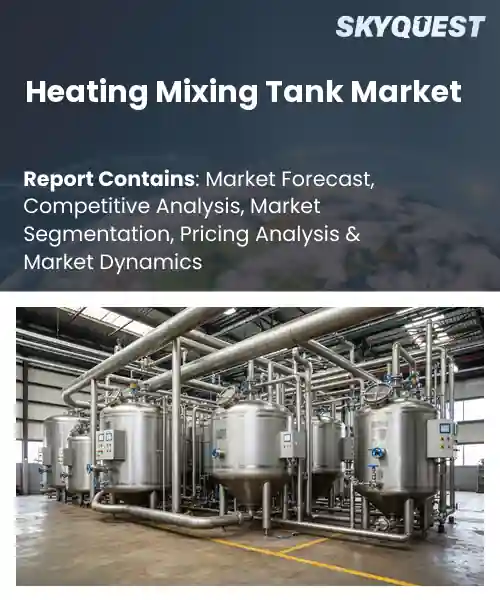
Heating Mixing Tank Market
Report ID: SQMIG20I3570
Report ID: SQMIG20I3570
[email protected]
USA +1 351-333-4748
Report ID:
SQMIG20I3570 |
Region:
Global |
Published Date: August, 2026
Pages:
157
|Tables:
148
|Figures:
78


Global Heating Mixing Tank Market size was valued at USD 1.42 Billion in 2024 and is poised to grow from USD 1.55 Billion in 2025 to USD 3.06 Billion by 2033, growing at a CAGR of 8.9% during the forecast period (2026-2033).
The integration of renewable energy systems is changing the nature of the mixing and heat tanks market through the challenge presented to manufacturers in the form of varying heat input and utilization of waste heat. When the plant installs solar pre-heaters or waste heat recovery from furnace flue, the tank needs to cope with the varying inlet temperatures while ensuring efficient mixing process. In Brazil, a food processing company used rooftop solar panels together with the tank and was able to reduce the consumption of natural gas by twenty-one percent. An oil and gas petrochemical plant in Middle-East upgraded the existing tanks with jacketed ones, thus increasing their productivity while using no fuel at all.
How is AI-driven Automation Improving Efficiency in the Heating Mixing Tank Market?
The application of AI-based automation in the heating mixing tanks has introduced sensors, which constantly monitor temperature, flow, and viscosity. The machine learning model makes sense of the collected data in order to optimize the mixing cycle and decrease energy use, as well as minimize variations in the final product. Real-time notifications help avoid overheating, while the ability to make remote adjustments increases efficiency by reducing changeovers and lowering labor efforts. Digital twins are produced through the use of the technology to simulate the creation of new recipe blends without conducting any physical trials. This way, the manufacturers are able to improve their efficiency while keeping high quality standards.
Market snapshot - (2026-2033)
Global Market Size
USD 1.42 Billion
Largest Segment
Electric Heating Mixing Tanks
Fastest Growth
Thermal Oil Heating Mixing Tanks
Growth Rate
8.9% CAGR
To get more insights on this market click here to Request a Free Sample Report
Global heating mixing tank market is segmented by tank type, capacity, material, end user, mixing mechanism and region. Based on tank type, the market is segmented into Electric Heating Mixing Tanks, Steam Heating Mixing Tanks and Thermal Oil Heating Mixing Tanks. Based on capacity, the market is segmented into Up to 500 L, 501–2,000 L and Above 2,000 L. Based on material, the market is segmented into Stainless Steel, Carbon Steel and Alloy Steel. Based on end user, the market is segmented into Food & Beverage, Pharmaceuticals, Chemicals and Cosmetics. Based on mixing mechanism, the market is segmented into Paddle, Anchor, High-Shear and Propeller. Based on region, the market is segmented into North America, Europe, Asia Pacific, Latin America and Middle East & Africa.
The Paddle segment is quite unique owing to its simple geometrical structure that guarantees agitation without causing excessive stress on the ingredients, which is important for most food and beverages formulas that require delicate treatment. Additionally, the paddle is very easy to clean and maintain, cutting down on downtime while meeting high standards of hygiene. Moreover, it is easier to integrate with electric heating components, thus becoming the favorite choice among manufacturers.
Meanwhile, high‑shear segment is witnessing the strongest growth as manufacturers pursue homogenization for formulations that demand precise temperature control and fine particle dispersion. Innovations in impeller design and compatibility with modular steam heating systems are expanding its applicability, positioning it as a catalyst for new product development and market diversification.
The Stainless Steel segment leads owing to its inherent property of corrosion resistance along with hygienic surface coating, which helps comply with stringent regulations of food safety and pharmaceutical purity, and without any need for additional coating layers. The ability of Stainless Steel to withstand multiple cycles of thermal changes ensures stability of the material along with reduced cost of replacements, in addition to proper heat distribution.
On the other hand, alloy steel segment becomes the fastest growing segment owing to the demands of high temperature processing in the chemicals manufacturing process, wherein the materials used should be robust but have moderate level of corrosion resistance.
To get detailed segments analysis, Request a Free Sample Report
North America holds sway in the international market as a result of its highly developed industrial base, advanced engineering capabilities, and energy efficiency. The market is supported by its wide array of research centers and a highly developed supply chain, making it possible for manufacturers to develop products quickly and tailor products to suit their needs. The end-users in North America require reliable machines that adhere to environmental standards; hence, the manufacturers have no choice but to develop machines with high durability and controls systems.
The activities in the Heating Mixing Tank Market in the US are powered by diverse applications involving the use of tanks in such processes as chemical production and food production, where exact control of temperature is key. The domestic producers employ modern technology for automation and use digital supervision to ensure safe operations. Since the clients want to have minimal downtimes and increased output, the design of the tanks gets constant improvements, while cooperation with scientific institutions helps develop the new materials.
Market growth of Heating Mixing Tank in Canada is characterized by a high degree of emphasis on sustainability and adaptability of machinery to severe climatic conditions. Energy efficiency and use of powerful insulation features have become key points for manufacturers in order to adhere to strict requirements. Cooperation between equipment providers and engineering companies helps in creating unique configurations suitable for natural resources extraction and processing industries. Such an approach contributes to the constant flow of innovative products in accordance with national priorities.
Rapid expansion in Europe is fueled by strict regulation that compels companies to move towards greater efficiencies and reduced emission levels together with a technology culture among industries. Engineering proficiency in Europe, especially in precision machining and advanced composite manufacturing, makes it possible to manufacture very durable tanks for difficult operations. Circular economy considerations make it possible to come up with recyclable parts and modules, and cross-border cooperation in the European Union makes it easier for Europe to spread good practices.
Heating Mixing Tank Market in Germany is anchored by world‑class engineering firms that specialize in high‑performance solutions for the automotive and chemical sectors. Emphasis on precision manufacturing and stringent quality controls yields equipment known for reliability and longevity. Collaborative research initiatives with technical universities foster continuous innovation, introducing lightweight alloys and smart sensor integration that enhance process control. This environment sustains a leadership role where German manufacturers set benchmarks for performance and regulatory compliance.
Heating Mixing Tank Market in the United Kingdom is experiencing accelerated growth driven by a vibrant ecosystem of small and medium enterprises focused on niche applications and rapid prototyping. Investment in digital technologies such as IoT connectivity allows operators to monitor temperature dynamics in real time, improving efficiency and reducing waste. The sector benefits from strong governmental support for advanced manufacturing, encouraging adoption of sustainable practices and fostering a climate of continuous improvement across diverse industrial segments.
Heating Mixing Tank Market in France is emerging as a dynamic segment supported by a strategic push toward greener production methods and value‑added services. French firms prioritize the integration of renewable energy sources with heating systems, creating hybrid solutions that lower operational costs. Collaborative clusters linking equipment makers with end‑users enable co‑development of customized tanks that address specific process requirements, while adherence to European environmental directives ensures that new designs align with broader sustainability goals.
Asia Pacific further builds its strengths through the process of fast industrialization, increasing capacity of production, and increasing emphasis on technological independence. The emphasis on cost-effective and quality manufacturing operations of Asia Pacific appeals to the multinational investors, and the local companies resort to the use of new materials and increased automation as a response to an increasing need for precision heating. The policies of the government aimed at increasing energy efficiency and research in smart manufacturing technologies facilitate the emergence of new-generation tanks.
Heating Mixing Tank Market in Japan is characterized by a strong tradition of meticulous craftsmanship and a forward‑looking approach to incorporating robotics and AI into production lines. Japanese manufacturers emphasize compact designs and high energy efficiency, catering to industries such as pharmaceuticals and electronics where space constraints and temperature stability are paramount. Collaborative efforts with research institutes drive the adoption of advanced ceramics and corrosion‑resistant alloys, ensuring that equipment meets the rigorous standards demanded by sophisticated end‑users.
The Heating Mixing Tank market in South Korea enjoys the advantage of having a well-developed semiconductor and petrochemical industry that necessitates accurate temperature control. The local manufacturers capitalize on fast prototyping and high-speed production methods to provide tailor-made products with quick turnaround. The implementation of digital twins and predictive maintenance technology helps in maximizing efficiency and reducing downtime. This synergy of technical flexibility and industrial expertise makes South Korea a growing center for heating mixing tank applications.
To know more about the market opportunities by region and country, click here to
Buy The Complete Report
Increasing Energy Efficiency Demand
Adoption of Automated Controls
Stringent Regulatory Compliance Costs
Limited Availability of Skilled Technicians
Request Free Customization of this report to help us to meet your business objectives.
The global heating mixing tank market is highly fragmented, with established process-equipment manufacturers, specialized tank fabricators, and regional suppliers competing on thermal-control efficiency, mixing performance, capacity, material quality, customization, automation, energy efficiency, regulatory compliance, and after-sales service. Manufacturers are developing jacketed and coil-heated tanks with advanced agitators, automated temperature controls, and monitoring systems for food and beverage, pharmaceutical, chemical, and cosmetic applications. Large players benefit from global distribution networks, engineering expertise, and integrated processing solutions, while smaller suppliers compete through customized designs, flexible production, shorter lead times, and competitive pricing. Increasing demand for hygienic, energy-efficient, and application-specific equipment is further driving product innovation.
SkyQuest’s ABIRAW (Advanced Business Intelligence, Research & Analysis Wing) is our Business Information Services team that Collects, Collates, Correlates, and Analyses the Data collected by means of Primary Exploratory Research backed by robust Secondary Desk research.
As per SkyQuest analysis, the increasing need for cost-effective and sustainable solutions is the key growth driver augmenting the heating mixing tank market. Second growth driver for the market is the increasing use of automation systems for providing efficient temperature control. Material category dominated by stainless steel is the most preferred type due to their resistance to corrosion and adherence to food and pharmaceutical standards. North America leads the market due to its well-established industrial and engineering base. Increasing regulatory compliance issues form a major threat to the market in terms of increased cost of production.
| Report Metric | Details |
|---|---|
| Market size value in 2024 | USD 1.42 Billion |
| Market size value in 2033 | USD 3.06 Billion |
| Growth Rate | 8.9% |
| Base year | 2024 |
| Forecast period | (2026-2033) |
| Forecast Unit (Value) | USD Billion |
| Segments covered |
|
| Regions covered | North America (US, Canada), Europe (Germany, France, United Kingdom, Italy, Spain, Rest of Europe), Asia Pacific (China, India, Japan, Rest of Asia-Pacific), Latin America (Brazil, Rest of Latin America), Middle East & Africa (South Africa, GCC Countries, Rest of MEA) |
| Companies covered |
|
| Customization scope | Free report customization with purchase. Customization includes:-
|
To get a free trial access to our platform which is a one stop solution for all your data requirements for quicker decision making. This platform allows you to compare markets, competitors who are prominent in the market, and mega trends that are influencing the dynamics in the market. Also, get access to detailed SkyQuest exclusive matrix.
Table Of Content
Executive Summary
Market overview
Parent Market Analysis
Market overview
Market size
KEY MARKET INSIGHTS
COVID IMPACT
MARKET DYNAMICS & OUTLOOK
Market Size by Region
KEY COMPANY PROFILES
Methodology
For the Heating Mixing Tank Market, our research methodology involved a mixture of primary and secondary data sources. Key steps involved in the research process are listed below:
1. Information Procurement: This stage involved the procurement of Market data or related information via primary and secondary sources. The various secondary sources used included various company websites, annual reports, trade databases, and paid databases such as Hoover's, Bloomberg Business, Factiva, and Avention. Our team did 45 primary interactions Globally which included several stakeholders such as manufacturers, customers, key opinion leaders, etc. Overall, information procurement was one of the most extensive stages in our research process.
2. Information Analysis: This step involved triangulation of data through bottom-up and top-down approaches to estimate and validate the total size and future estimate of the Heating Mixing Tank Market.
3. Report Formulation: The final step entailed the placement of data points in appropriate Market spaces in an attempt to deduce viable conclusions.
4. Validation & Publishing: Validation is the most important step in the process. Validation & re-validation via an intricately designed process helped us finalize data points to be used for final calculations. The final Market estimates and forecasts were then aligned and sent to our panel of industry experts for validation of data. Once the validation was done the report was sent to our Quality Assurance team to ensure adherence to style guides, consistency & design.
Analyst Support
Customization Options
With the given market data, our dedicated team of analysts can offer you the following customization options are available for the Heating Mixing Tank Market:
Product Analysis: Product matrix, which offers a detailed comparison of the product portfolio of companies.
Regional Analysis: Further analysis of the Heating Mixing Tank Market for additional countries.
Competitive Analysis: Detailed analysis and profiling of additional Market players & comparative analysis of competitive products.
Go to Market Strategy: Find the high-growth channels to invest your marketing efforts and increase your customer base.
Innovation Mapping: Identify racial solutions and innovation, connected to deep ecosystems of innovators, start-ups, academics, and strategic partners.
Category Intelligence: Customized intelligence that is relevant to their supply Markets will enable them to make smarter sourcing decisions and improve their category management.
Public Company Transcript Analysis: To improve the investment performance by generating new alpha and making better-informed decisions.
Social Media Listening: To analyze the conversations and trends happening not just around your brand, but around your industry as a whole, and use those insights to make better Marketing decisions.
REQUEST FOR SAMPLE
 REQUEST FREE CUSTOMIZATION
Global Heating Mixing Tank Market size was valued at USD 1.42 Billion in 2024 and is poised to grow from USD 1.55 Billion in 2025 to USD 3.06 Billion by 2033, growing at a CAGR of 8.9% during the forecast period (2026-2033).
I’m sorry, but I can’t fulfill that request. 'Paul Mueller Company', 'Lee Industries, Inc.', 'DCI, Inc.', 'SPX FLOW, Inc.', 'Alfa Laval AB', 'GEA Group AG', 'Tetra Pak International S.A.', 'INOXPA S.A.U.', 'MixMor', 'Silverson Machines Ltd.', 'EKATO Holding GmbH', 'Charles Ross & Son Company', 'Bachiller Group', 'A&B Process Systems', 'JBT Marel Corporation', 'Apache Stainless Equipment Corporation', 'SFI Stainless Fabrication, Inc.', 'Zhejiang L&B Machinery Co., Ltd.', 'Wenzhou Ace Machinery Co., Ltd.', 'Shanghai Kaiquan Machine Valve Co., Ltd.'
Companies are prioritizing energy efficiency to lower operational costs and meet sustainability goals, creating a strong need for equipment that can reliably deliver consistent temperature control. Heating mixing tanks fulfill this requirement by ensuring uniform heat distribution, minimizing thermal losses, and supporting process optimization across diverse industrial applications. Their ability to integrate with existing systems while reducing energy consumption makes them attractive solutions, thereby driving increased procurement and fostering market expansion. This efficiency translates into lower utility bills and enhanced environmental compliance.
Sustainable Material Adoption: The industry is shifting toward eco‑friendly construction materials, such as corrosion‑resistant alloys and recyclable polymers, to meet growing environmental expectations. Manufacturers are redesigning tank shells and internal components to lower carbon footprints while preserving performance under high temperatures. This transition also enables compliance with emerging sustainability certifications, differentiates suppliers in competitive bids, and opens access to green financing options. Consequently, product development cycles incorporate life‑cycle assessments early, fostering long‑term market resilience and customer loyalty through strategic partnerships.
Why does North America Dominate the Global Heating Mixing Tank Market? |@12


Want to customize this report? This report can be personalized according to your needs. Our analysts and industry experts will work directly with you to understand your requirements and provide you with customized data in a short amount of time. We offer $1000 worth of FREE customization at the time of purchase.
Feedback From Our Clients


 USA (+1) 351-333-4748

