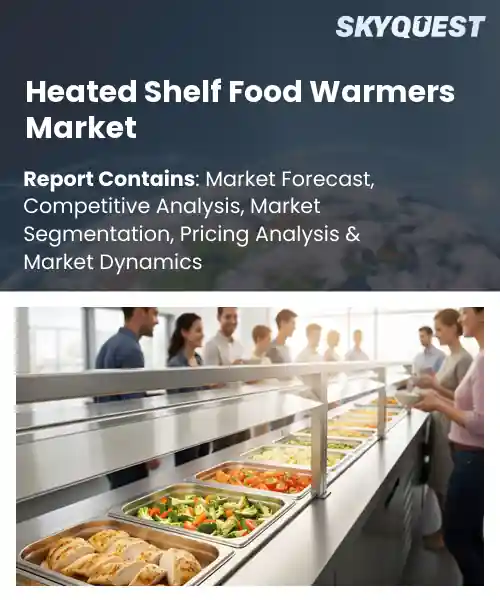
Heated Shelf Food Warmers Market
Report ID: SQMIG25H2109
Report ID: SQMIG25H2109
[email protected]
USA +1 351-333-4748
Report ID:
SQMIG25H2109 |
Region:
Global |
Published Date: June, 2026
Pages:
157
|Tables:
176
|Figures:
79


Global Heated Shelf Food Warmers Market size was valued at USD 751.1 Million in 2024 and is poised to grow from USD 789.41 Million in 2025 to USD 1175.23 Million by 2033, growing at a CAGR of 5.1% during the forecast period (2026-2033).
The heated shelf food warmer market comprises appliances that maintain prepared dishes at safe serving temperatures on display units, a segment essential to hospitality and catering. Its relevance stems from stringent food‑safety regulations and consumer expectations for hot meals, prompting operators to replace refrigeration with temperature‑controlled shelving.
Modern examples include touchscreen‑managed units in airport terminals and self‑serve cafeterias, illustrating how the technology has evolved from simple electric trays to integrated IoT‑enabled platforms. The dominant growth catalyst for the global heated shelf food warmers market is the rising demand for on‑premise dining that marries speed with safety, prompting restaurants to adopt units that maintain meals at 60‑70 °C without manual reheating. This need forces manufacturers to embed sensors, cloud analytics, and energy‑saving controls, opening a secondary market for service contracts and software upgrades. When fast‑casual chains synchronize digital orders with shelf temperature, dishes arrive hot, compliance improves, waste declines and profit margins rise. As middle‑class consumption expands in regions such as Southeast Asia, suppliers offering localized certification and multilingual interfaces encounter strong expansion opportunities.
How is IoT integration improving temperature control in the heated shelf food warmers market?
IoT-enabled heated shelf food warmers continuously track internal temperatures and feed real-time data to cloud platforms, where algorithms then adjust heating components to maintain ideal warmth. The closed loop control minimizes temperature drift and avoids over-cooking, extending product shelf-life and boosting customer safety. Today, manufacturers are building in wireless modules that permit remote diagnostics, letting service teams anticipate maintenance needs before things break. The market is reacting to the need for smarter appliances that deliver energy efficiency and precise thermal management, and IoT-enabled warmers are attractive to foodservice operators seeking consistent quality at lower operating costs.
In March 2026, ThermoShelf launched an IoT-enabled heating system that improves temperature stability for its whole product line, spurring the broader use of connected warmers and boosting market growth.
Market snapshot - (2026-2033)
Global Market Size
USD 751.1 Million
Largest Segment
Countertop Heated Shelf Warmers
Fastest Growth
Merchandising Heated Shelf Warmers
Growth Rate
5.1% CAGR
To get more insights on this market click here to Request a Free Sample Report
Global heated shelf food warmers market is segmented by product type, technology, application, installation type, temperature control, distribution channel and region. Based on product type, the market is segmented into Countertop Heated Shelf Warmers, Built-In Heated Shelf Warmers, Multi-Tier Heated Shelf Warmers, Merchandising Heated Shelf Warmers and Others. Based on technology, the market is segmented into Electric Heated Shelf Warmers, Infrared Heated Shelf Warmers, Ceramic Heating Technology and Others. Based on application, the market is segmented into Restaurants, Quick Service Restaurants (QSRs), Hotels, Convenience Stores, Cafeterias & Institutional Foodservice and Others. Based on installation type, the market is segmented into Freestanding and Built-In. Based on temperature control, the market is segmented into Manual Temperature Control and Digital Temperature Control. Based on distribution channel, the market is segmented into Direct Sales, Foodservice Equipment Dealers, E-commerce and Others. Based on region, the market is segmented into North America, Europe, Asia Pacific, Latin America and Middle East & Africa.
Countertop heated shelf warmers segment dominates with large heated shelf food warmers market share because they offer plug in convenience and require minimal structural alteration, fitting seamlessly into high turnover service areas. Their compact footprint aligns with constrained kitchen layouts, while the low upfront investment accelerates adoption among small and mid size operators. This ease of deployment, combined with reliable temperature consistency, drives preference across foodservice settings, cementing their leading position in the heated shelf food warmers expanding global market.
As per heated shelf food warmers market forecast, multi tier heated shelf warmers are witnessing the strongest growth momentum because they enable temperature control of diverse product lines within a single footprint. Their layered design meets rising demand for menu variety and visual merchandising, prompting operators to invest in equipment that maximizes display area while preserving product quality.
Electric heated shelf warmers segment leads because they rely on well established resistive elements that deliver uniform heat distribution with straightforward wiring, simplifying integration into existing electrical infrastructure. Their proven reliability reduces maintenance concerns, while the cost effective nature of electric components appeals to budget conscious operators. Consequently, the ease of service, predictable performance, and low total cost of ownership sustain their prominent role across the heated shelf food warmers expanding global market.
As per heated shelf food warmers market forecast, infrared heated shelf warmers are emerging as a growth area because they use radiant energy to heat from the shelf surface, reducing preheating time and energy waste. This efficiency aligns with sustainability goals, while the heat response enhances turnover, prompting operators to adopt infrared technology for advantage.
To get detailed segments analysis, Request a Free Sample Report
North America is the largest market owing to the presence of well-established foodservice ecosystems, significant penetration of modern temperature control technology, and high consumer demand for safe, ready-to-eat items. The region has built distribution channels connecting producers to retail chains, catering services and institutional kitchens. Ongoing product development with major investments in research and development, focusing on energy efficiency and easy-to-use designs. Regulatory regulations for food safety increase market confidence and the existence of major equipment producers guarantees a continuous supply of innovative solutions. Together these characteristics form a resilient environment which continues to support the region’s dominant position.
As per heated shelf food warmers market regional outlook, United States is shaped by a diverse foodservice landscape that ranges from large‑scale institutional cafeterias to fast‑growing specialty restaurants. Manufacturers respond to demand for compact, precise warming solutions that meet strict hygiene standards. Collaboration between equipment suppliers and culinary schools fosters early adoption of emerging technologies, while a focus on energy‑efficient designs aligns with sustainability goals across the industry.
As per heated shelf food warmers market regional forecast, Canada reflects a strong emphasis on food safety within both commercial and institutional sectors. Supplier networks prioritize reliable, easily serviced units that accommodate the climatic variations across the country. Partnerships with hospitality training programs encourage uptake of modern warming equipment, and consumer expectations for high‑quality ready meals drive ongoing interest in efficient temperature‑control devices.
European heated shelf food warmers market is growing at a fast pace, as harmonized regulatory standards promote standardized food‑safety measures throughout member countries, which drives manufacturers to cater to a large, united market. Consumer preference for convenient, high quality ready meals is driving demand across retail and hospitality channels. The development of low consumption warming units with high energy efficiency and sustainability is emphasized, in line with regional environmental objectives. Innovation clusters in important economies speed up smart temperature control features, and collaborative research activities enhance information sharing. Integrated supply chains and a sophisticated logistics infrastructure shorten time-to-market further, enabling newer solutions to reach different clients quickly and supporting the region’s growth trajectory.
As per heated shelf food warmers industry analysis, Germany benefits from a highly engineered manufacturing base and a tradition of precision equipment design. Industry clusters around major industrial regions encourage close cooperation between component suppliers and system integrators, fostering rapid product iteration. Stringent national food‑safety guidelines drive adoption of advanced warming controls, while sustainability policies motivate energy‑saving designs. The extensive catering network, ranging from large institutional kitchens to boutique eateries, sustains steady demand for reliable warming solutions.
United Kingdom experiences fast growth as foodservice operators seek flexible warming solutions that support a dynamic menu landscape. Emerging interest in contactless and digitally monitored equipment aligns with the region’s broader tech‑driven hospitality trend. Regulatory emphasis on food‑borne illness prevention encourages deployment of temperature‑accurate devices, and a strong focus on reducing carbon footprints promotes energy‑efficient models. Collaborative initiatives between universities and manufacturers accelerate the rollout of next‑generation warming technologies.
France is emerging alongside a vibrant culinary culture that values quality and convenience. Growing demand from casual dining venues and supermarket ready‑meal sections stimulates interest in compact, easy‑to‑maintain warming units. National food‑safety directives emphasize precise temperature control, encouraging adoption of modern equipment. Environmental awareness drives preference for low‑energy solutions, and governmental support for innovation grants aids local manufacturers in developing tailored warming technologies that meet market expectations.
Asia Pacific reinforces its role in the heated shelf food warmers market through a confluence of expanding foodservice sectors, rising consumer demand for convenient meal options, and rapid adoption of smart manufacturing practices. Nations within the region invest heavily in compact, energy‑efficient warming solutions that suit space‑limited kitchen environments typical of urban eateries. Close ties between equipment makers and technology firms enable integration of IoT‑enabled temperature monitoring, enhancing operational oversight. Local production capabilities reduce lead times and allow customization for diverse culinary traditions. Growing awareness of food‑safety standards and government initiatives supporting advanced food‑processing equipment further accelerate market penetration, positioning the region as a vibrant hub for both consumption and innovation.
Japan reflects a cultural emphasis on precision and quality within food preparation. Manufacturers prioritize compact, high‑accuracy warming units that align with the limited kitchen spaces of urban restaurants and convenience stores. Integration of advanced sensor technology enables real‑time temperature tracking, meeting strict hygiene expectations. Collaboration between equipment suppliers and culinary institutes drives early adoption of innovative designs, while a strong focus on energy conservation supports the development of low‑power warming solutions tailored to the market’s sustainability goals.
South Korea benefits from a fast‑moving hospitality scene that values quick service and technology integration. Local producers emphasize sleek, user‑friendly devices equipped with smart connectivity features that streamline temperature management. Governmental support for smart kitchen initiatives encourages the incorporation of data‑driven controls, enhancing food safety compliance. The prevalence of high‑density dining formats, such as food courts and delivery‑centric kitchens, fuels demand for reliable, space‑efficient warming equipment, reinforcing the country’s growing influence within the regional market.
To know more about the market opportunities by region and country, click here to
Buy The Complete Report
Rising Hospitality Demand
Advancements In Heating Technology
High Initial Capital Investment
Regulatory Compliance Challenges
Request Free Customization of this report to help us to meet your business objectives.
The heated shelf food warmers industry is shaped by intense competition among manufacturers that are accelerating product innovation, expanding distribution networks, and pursuing strategic acquisitions to broaden their technology portfolios. Recent M&A activity includes a leading equipment supplier acquiring a niche thermal control firm to integrate smart temperature monitoring, while another major player formed a partnership with a logistics provider to embed shelf warmers into cold-chain solutions, enhancing end‑user convenience and operational efficiency.
SkyQuest’s ABIRAW (Advanced Business Intelligence, Research & Analysis Wing) is our Business Information Services team that Collects, Collates, Correlates, and Analyses the Data collected by means of Primary Exploratory Research backed by robust Secondary Desk research.
As per SkyQuest analysis, the heated shelf food warmers market growth is propelled primarily by rising hospitality demand, which pushes restaurants and hotels to adopt heated shelf warmers for faster, safe service, while the high initial capital investment remains a notable restraint limiting uptake among smaller operators. North America continues to dominate due to its mature food‑service ecosystem and strong regulatory support. Countertop heated shelf warmers hold the largest share because of their plug‑and‑play convenience for tight kitchen spaces. A second driver is the rapid integration of IoT technology that enhances temperature precision, enables predictive maintenance and lowers energy costs, further encouraging adoption across the sector. The global heated shelf food warmers market trend driven by the expanding foodservice industry, increasing demand for ready-to-eat meals, and growing adoption of food holding and warming equipment in restaurants, hotels, cafeterias, convenience stores and quick-service restaurants (QSRs).
| Report Metric | Details |
|---|---|
| Market size value in 2024 | USD 751.1 Million |
| Market size value in 2033 | USD 1175.23 Million |
| Growth Rate | 5.1% |
| Base year | 2024 |
| Forecast period | (2026-2033) |
| Forecast Unit (Value) | USD Million |
| Segments covered |
|
| Regions covered | North America (US, Canada), Europe (Germany, France, United Kingdom, Italy, Spain, Rest of Europe), Asia Pacific (China, India, Japan, Rest of Asia-Pacific), Latin America (Brazil, Rest of Latin America), Middle East & Africa (South Africa, GCC Countries, Rest of MEA) |
| Companies covered |
|
| Customization scope | Free report customization with purchase. Customization includes:-
|
To get a free trial access to our platform which is a one stop solution for all your data requirements for quicker decision making. This platform allows you to compare markets, competitors who are prominent in the market, and mega trends that are influencing the dynamics in the market. Also, get access to detailed SkyQuest exclusive matrix.
Table Of Content
Executive Summary
Market overview
Parent Market Analysis
Market overview
Market size
KEY MARKET INSIGHTS
COVID IMPACT
MARKET DYNAMICS & OUTLOOK
Market Size by Region
KEY COMPANY PROFILES
Methodology
For the Heated Shelf Food Warmers Market, our research methodology involved a mixture of primary and secondary data sources. Key steps involved in the research process are listed below:
1. Information Procurement: This stage involved the procurement of Market data or related information via primary and secondary sources. The various secondary sources used included various company websites, annual reports, trade databases, and paid databases such as Hoover's, Bloomberg Business, Factiva, and Avention. Our team did 45 primary interactions Globally which included several stakeholders such as manufacturers, customers, key opinion leaders, etc. Overall, information procurement was one of the most extensive stages in our research process.
2. Information Analysis: This step involved triangulation of data through bottom-up and top-down approaches to estimate and validate the total size and future estimate of the Heated Shelf Food Warmers Market.
3. Report Formulation: The final step entailed the placement of data points in appropriate Market spaces in an attempt to deduce viable conclusions.
4. Validation & Publishing: Validation is the most important step in the process. Validation & re-validation via an intricately designed process helped us finalize data points to be used for final calculations. The final Market estimates and forecasts were then aligned and sent to our panel of industry experts for validation of data. Once the validation was done the report was sent to our Quality Assurance team to ensure adherence to style guides, consistency & design.
Analyst Support
Customization Options
With the given market data, our dedicated team of analysts can offer you the following customization options are available for the Heated Shelf Food Warmers Market:
Product Analysis: Product matrix, which offers a detailed comparison of the product portfolio of companies.
Regional Analysis: Further analysis of the Heated Shelf Food Warmers Market for additional countries.
Competitive Analysis: Detailed analysis and profiling of additional Market players & comparative analysis of competitive products.
Go to Market Strategy: Find the high-growth channels to invest your marketing efforts and increase your customer base.
Innovation Mapping: Identify racial solutions and innovation, connected to deep ecosystems of innovators, start-ups, academics, and strategic partners.
Category Intelligence: Customized intelligence that is relevant to their supply Markets will enable them to make smarter sourcing decisions and improve their category management.
Public Company Transcript Analysis: To improve the investment performance by generating new alpha and making better-informed decisions.
Social Media Listening: To analyze the conversations and trends happening not just around your brand, but around your industry as a whole, and use those insights to make better Marketing decisions.
REQUEST FOR SAMPLE
 REQUEST FREE CUSTOMIZATION
Global Heated Shelf Food Warmers Market size was valued at USD 751.1 Million in 2024 and is poised to grow from USD 789.41 Million in 2025 to USD 1175.23 Million by 2033, growing at a CAGR of 5.1% during the forecast period (2026-2033).
The heated shelf food warmer market is shaped by intense competition among manufacturers that are accelerating product innovation, expanding distribution networks, and pursuing strategic acquisitions to broaden their technology portfolios. Recent M&A activity includes a leading equipment supplier acquiring a niche thermal control firm to integrate smart temperature monitoring, while another major player formed a partnership with a logistics provider to embed shelf warmers into cold-chain solutions, enhancing end‑user convenience and operational efficiency. 'Hatco Corporation', 'The Middleby Corporation', 'Ali Group', 'APW Wyott', 'Wells Manufacturing', 'Duke Manufacturing', 'Vollrath Company', 'Star Manufacturing', 'Nemco Food Equipment', 'Alto-Shaam', 'FWE (Food Warming Equipment Company)', 'Winholt Equipment Group', 'Adcraft (Admiral Craft Equipment)', 'Parry Catering Equipment', 'Lincat', 'Burkett Restaurant Equipment', 'Carter-Hoffmann', 'BKI Worldwide', 'Merco Holding Cabinets', 'Toastmaster'
The growing need for ready‑to‑serve meals in hotels, restaurants, and catering services drives adoption of heated shelf food warmers, as establishments seek to maintain food quality while reducing service time. By providing consistent temperature control, these devices enable venues to extend menu offerings, improve customer satisfaction, and optimize labor efficiency. Consequently, operators increasingly view warmers as essential equipment for supporting high‑volume service environments, which stimulates market expansion across commercial foodservice sectors. The reliability and energy efficiency of modern units also align with sustainability goals, encouraging further integration into kitchen workflows.
Smart Connectivity Integration: Manufacturers are embedding IoT sensors and cloud‑based monitoring into heated shelf food warmers, enabling real‑time temperature control, predictive maintenance alerts, and remote performance analytics. This connectivity allows operators to optimize energy usage, quickly address equipment faults, and ensure consistent food safety standards across multiple locations. As supply‑chain visibility becomes a competitive differentiator, vendors offering seamless integration with existing restaurant management platforms gain market traction, while end‑users appreciate the reduced downtime and enhanced operational transparency through data‑driven insights and agile response.
Why does North America Dominate the Global Heated Shelf Food Warmers Market? |@12


Want to customize this report? This report can be personalized according to your needs. Our analysts and industry experts will work directly with you to understand your requirements and provide you with customized data in a short amount of time. We offer $1000 worth of FREE customization at the time of purchase.
Feedback From Our Clients


 USA (+1) 351-333-4748

