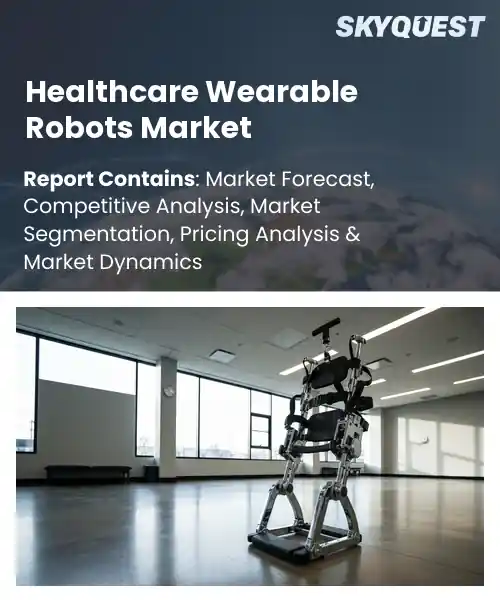
Healthcare Wearable Robots Market
Report ID: SQMIG35A3687
Report ID: SQMIG35A3687
[email protected]
USA +1 351-333-4748
Report ID:
SQMIG35A3687 |
Region:
Global |
Published Date: June, 2026
Pages:
157
|Tables:
181
|Figures:
79


Global Healthcare Wearable Robots Market size was valued at USD 400 Million in 2024 and is poised to grow from USD 520 Million in 2025 to USD 3980 Million by 2033, growing at a CAGR of 29.08% during the forecast period (2026-2033).
One factor that is driving global healthcare wearable robots market growth is the increasing number of people with chronic diseases and the increase in demand for support for rehabilitation and mobility as they age. Among the different forms of healthcare wearable robots are exoskeletons, soft wearables, and sensors built into clothing, all of which provide gait assistance, strength augmentation to lift heavy items, and physiological signal monitoring. All these types of devices benefit caregivers, shorten hospital stays for patients, and allow for in-home therapy for patients; therefore they are important because they make patients' lives easier and help caregivers provide better care. The transition from laboratory prototypes to commercially available products has been driven by improvements in material sciences, energy density of batteries, and advances in machine learning; examples include powered gait training systems for stroke survivors and lumbar supports for manual workers.
Improved accuracy of sensors can monitor patients more accurately and provide adaptive assistance to reduce the risk of falling and provide personalized rehabilitation, providing a second driver of growth in the global healthcare wearable robots market. As sensors and artificial intelligence become more integrated, manufacturers are developing cloud connected exosuits that monitor patients' gait patterns and adjust the assistance levels they provide based on their needs. The end result is that postoperative patients recover more quickly and return to normal functioning sooner than they would have without wearable technology. Finally, reimbursement policies that allow for in-home therapy will continue to increase adoption of wearable robots in patient's homes because more insurers will cover devices that will decrease readmission rates for patients. Consequently hospitals and elder care providers invest in remote monitoring pilots, creating scale economies that lower unit costs and broaden market reach globally.
How is AI Improving Patient Outcomes In The Healthcare Wearable Robots Market?
Healthcare AI is enhancing patient results in the field of wearable robotics by integrating adaptive control, individualized treatment and on-going observation. Included in these components is the fusion of sensors to capture both movement and intent; utilizing machine learning for optimal levels of assistance that are specific to the needs of the individual patient; and using predictive analytics to identify risks early on in the treatment process. The current phase reflects the multitude of clinical studies and device enhancements being made as a result of the feedback from actual users. Market conditions are creating opportunities for companies that manufacture rehabilitation devices to partner with rehabilitation facilities to harmonize data with the rehabilitation process.
There are clinical trials of both well-known as well as newer exoskeletons being conducted in order to provide assistance that is both responsive and comfortable, thereby creating greater interest and leading to more successful outcomes. Lifeward May 2026 provided additional clinical data regarding ReWalk showing that AI plays a role in enabling personalized treatment and observations through rehabilitation which will ultimately improve momentum regarding clinician confidence and assist in preparing for a larger adoption by the market.
Market snapshot - (2026-2033)
Global Market Size
USD 0.4 Billion
Largest Segment
Exoskeleton Robots
Fastest Growth
Soft Wearable Robots
Growth Rate
29.08% CAGR
To get more insights on this market click here to Request a Free Sample Report
Global healthcare wearable robots market is segmented by by product type, by technology, by application, by end user, by mobility type, by distribution channel and region. Based on by product type, the market is segmented into Exoskeleton Robots, Assistive Wearable Robots, Rehabilitation Wearable Robots, Powered Orthotic Devices, Soft Wearable Robots and Others. Based on by technology, the market is segmented into Powered Wearable Robots, Passive Wearable Robots, AI-enabled Wearable Robots and Sensor-integrated Wearable Robots. Based on by application, the market is segmented into Rehabilitation Therapy, Mobility Assistance, Elderly Care Assistance, Post-stroke Rehabilitation, Spinal Cord Injury Rehabilitation, Neurological Disorder Assistance and Others. Based on by end user, the market is segmented into Hospitals, Rehabilitation Centers, Homecare Settings, Elderly Care Facilities, Military & Defense Healthcare and Others. Based on by mobility type, the market is segmented into Stationary Wearable Robots and Mobile Wearable Robots. Based on by distribution channel, the market is segmented into Direct Sales, Medical Device Distributors and Online Sales. Based on region, the market is segmented into North America, Europe, Asia Pacific, Latin America and Middle East & Africa.
The exoskeleton robot segment is currently in the lead of the market because it can provide to people with tangible clinical improvements in gait and load bearing support relative to other devices, thereby promoting wider adoption by institutions that deliver therapy and mobility programs to individuals who have had an injury or disabling event. The strength of the mechanical architecture associated with exoskeleton robots assures clinicians that they can deliver high intensity, repeatable training sessions and will therefore seek to procure and/ or invest in exoskeleton robots for long term use. The exoskeleton robot market is strengthened by its growing integration into clinical workflows and by improving both the existing (reimbursement) discussions with payers for procedural reimbursement and by creating new discussions regarding developing evidence of successful outcomes achieved when using exoskeleton robots for restoring complex mobility.
Conversely, Soft Wearable Robots have exhibited rapid market expansion because of their use of compliant materials that allow for a more comfortable and everyday wearable experience and thus have created opportunities to use Soft Wearable Robots in homecare and assisted living settings. The advancements in soft actuators and textile integration are being leveraged by Soft Wearable Robot manufacturers to develop consumer-friendly use cases that create opportunities for scalability of remote monitoring and continuous therapy.
The AI-based Wearable Robots category dominates the market due to the use of artificial intelligence layers that provide a way to create personalized and adaptive control strategies for enhancing therapy precision and patient engagement in both clinical and non-clinical settings. Indicators for machine learning help create an estimated adjustment of assistance and objective measuring of outcomes, as well as increasing clinician trust and attracting funding for further advanced trialing through evidence pipelines to provide rich-data-based evidence for regulatory and payer discussions around AI-enabled devices and connecting the devices to the next era of commercialization and clinical acceptance.
By contrast, Sensor-integrated Wearable Robots are rapidly growing in popularity. This is due to the continued miniaturization of sensors, which provides more accurate monitoring and closed loop control throughout the entire care continuum path. Additionally, having seamless integration with telehealth and analytics expects to accelerate clinical validation and developer adoption because of expanded opportunities to develop new service delivery models that promote commercialization.
To get detailed segments analysis, Request a Free Sample Report
The combination of highly developed clinical infrastructure, highly concentrated medical technology expertise, and strong commercial ecosystem make North America a leader in the field of rehabilitative technologies. Research hospitals and rehabilitation centers located in close proximity to one another provide ample opportunities for ongoing clinical validation and quick adoption of new technologies. There are multiple avenues for gaining venture and private investment to grow and bring products to market, as well as established regulatory avenues and reimbursement pathways to support product entry into the market. There are digital health platforms being integrated into the overall ecosystem of care and strong manufacturing and supply chain systems that support North America's position as a leader in the deployment of wearable robotic devices throughout continuum of care, and collaboration among industry, clinicians, and academia.
The healthcare wearable robots market is strongly supported by an extensive innovation network featuring prominent medical institutions, specialized rehabilitation clinics, and top medical technology companies. Medical practitioners and research organizations work together to create devices and test them in the real-world, promoting clinical acceptance of their use. With the financial means to commercialize products and establish large-scale production, coupled with integration into hospital work processes through electronic health record systems, we see the USA continuing to be the leading market for commercialization and innovation.
The healthcare wearable robots market in Canada is influenced by an overarching public healthcare model promoting the adoption of evidence-based practices and pilot studies conducted throughout several provinces. Strong partnerships between universities, research hospitals, and technology incubators support the development of new technologies as well as testing at the clinical level. Through government-funded innovation programs and collaborative funding institutions provide opportunities for companies from around the globe to collaborate together within Canada. Primarily due to the emphasis placed on community and remote service delivery applications and focus on increasing the patient's ability to influence their outcome, Canada will be seen as an ideal test-bed for wearable robotic solutions capable of supporting the public health system.
Europe is experiencing rapid expansion driven by advanced engineering capabilities, strong clinical research networks, and policy initiatives that prioritize ageing care and rehabilitation. Regional harmonization of regulatory standards and supportive public procurement practices lower barriers for pan European rollout. Established medical device manufacturers and a growing cohort of specialized startups leverage industrial robotics know how to create clinically oriented wearable systems. Cross border collaborations between hospitals, academic centers, and industry accelerate multicenter validation, while attention to patient safety, usability, and reimbursement models fosters broader clinical uptake across both hospital and community care environments.
Healthcare Wearable Robots Market in Germany is underpinned by a strong manufacturing tradition and deep expertise in engineering and industrial robotics. Clinical networks and specialized rehabilitation centers facilitate robust clinical evaluation and adoption. Collaboration between research institutes and industry accelerates product refinement, while domestic manufacturing capabilities support quality control and supply reliability. A health system receptive to technologically advanced rehabilitation solutions provides pathways for integration into clinical practice, reinforcing Germany role as a leading hub for development and deployment.
Healthcare Wearable Robots Market in United Kingdom benefits from a dynamic innovation landscape that combines prominent research hospitals, technology incubators, and active startup communities. National health services and private providers engage in pilot programs and clinical evaluations that promote rapid adoption. Strong digital health capabilities and collaborations between academic centers and industry enable integration of wearable robotics into broader care pathways. A supportive investment climate and focus on pragmatic, scaled trials position United Kingdom as a fast growing market within the European context.
Healthcare Wearable Robots Market in France is emerging through coordinated efforts between public hospitals, research laboratories, and growing medtech startups. National initiatives emphasize rehabilitation and eldercare applications, fostering pilot deployments and clinical collaborations. Manufacturing clusters and engineering expertise support development of user focused devices, while hospital procurement and evaluation mechanisms enable pathway to clinical use. Emphasis on patient centered design and multi stakeholder partnerships contributes to gradual expansion and increasing visibility within the regional market.
Asia Pacific is strengthening its position through a blend of strong electronics and robotics manufacturing, growing R and D investment, and proactive government support for medical technology adoption. Regional firms leverage cost efficient production and systems integration capabilities to bring scalable solutions to market, while academic and clinical collaborations enhance localization of device design and usability. Increasing clinical demand for rehabilitation and assistive technologies, coupled with expansion of smart hospital initiatives and digital health platforms, stimulates pilots and partnerships with global players. Focus on export oriented strategies and regional regulatory harmonization further supports broader market emergence.
Healthcare Wearable Robots Market in Japan draws on a longstanding leadership in robotics and precision manufacturing, with a targeted emphasis on assistive and rehabilitation technologies for ageing populations. Close collaboration between manufacturers, research institutions, and clinical centers drives rigorous safety and usability testing. Established industrial capabilities enable high quality production, while clinical integration efforts focus on long term care and hospital based rehabilitation, supporting steady adoption and refinement of wearable robotic systems within domestic healthcare settings.
Healthcare Wearable Robots Market in South Korea benefits from synergy between advanced electronics industries, agile startups, and strong government innovation programs. Integration with digital health ecosystems and smart hospital initiatives facilitates rapid testing and deployment. Partnerships between conglomerates and specialized medtech firms support scalability and international outreach, while focus on user experience and connectivity with mobile platforms enhances patient engagement. Manufacturing strengths and export orientation help position South Korea as a competitive regional supplier of wearable robotic solutions.
To know more about the market opportunities by region and country, click here to
Buy The Complete Report
Increasing Need For Rehabilitation
Advances In Sensor Technology
Uncertain Reimbursement Policies
Complex Regulatory Approval Processes
Request Free Customization of this report to help us to meet your business objectives.
The competitive landscape for global healthcare wearable robots is shaped by consolidation, clinical validation, and product differentiation driven by reimbursement pressures. Large incumbents pursue acquisitions and distribution deals, exemplified by Ottobock acquiring SuitX, while regional players extend clinical reach through clinic and service acquisitions, as seen in Fourier Intelligence’s purchase of a rehab provider. Startups target tech differentiation with soft exosuits and hospital trials to capture clinical adoption.
SkyQuest’s ABIRAW (Advanced Business Intelligence, Research & Analysis Wing) is our Business Information Services team that Collects, Collates, Correlates, and Analyses the Data collected by means of Primary Exploratory Research backed by robust Secondary Desk research.
As per SkyQuest analysis, the global healthcare wearable robots market is poised for rapid expansion driven primarily by an aging population and rising chronic disease prevalence that increase demand for mobility and rehabilitation support, and further accelerated by advances in sensor accuracy and AI-enabled personalization that enable adaptive, data-driven therapy. Exoskeleton robots remain the dominant segment due to provable clinical benefits for gait and load-bearing training, while North America leads regionally due to strong clinical infrastructure, funding, and reimbursement pathways. Adoption is, however, constrained by uncertain reimbursement policies which slow provider procurement and scale-up despite clear clinical value. Home-based therapy models and telehealth integration further increase device utility by reducing caregiver burden and shortening hospital stays.
| Report Metric | Details |
|---|---|
| Market size value in 2024 | USD 0.4 Billion |
| Market size value in 2033 | USD 3.98 Billion |
| Growth Rate | 29.08% |
| Base year | 2024 |
| Forecast period | (2026-2033) |
| Forecast Unit (Value) | USD Billion |
| Segments covered |
|
| Regions covered | North America (US, Canada), Europe (Germany, France, United Kingdom, Italy, Spain, Rest of Europe), Asia Pacific (China, India, Japan, Rest of Asia-Pacific), Latin America (Brazil, Rest of Latin America), Middle East & Africa (South Africa, GCC Countries, Rest of MEA) |
| Companies covered |
|
| Customization scope | Free report customization with purchase. Customization includes:-
|
To get a free trial access to our platform which is a one stop solution for all your data requirements for quicker decision making. This platform allows you to compare markets, competitors who are prominent in the market, and mega trends that are influencing the dynamics in the market. Also, get access to detailed SkyQuest exclusive matrix.
Table Of Content
Executive Summary
Market overview
Parent Market Analysis
Market overview
Market size
KEY MARKET INSIGHTS
COVID IMPACT
MARKET DYNAMICS & OUTLOOK
Market Size by Region
KEY COMPANY PROFILES
Methodology
For the Healthcare Wearable Robots Market, our research methodology involved a mixture of primary and secondary data sources. Key steps involved in the research process are listed below:
1. Information Procurement: This stage involved the procurement of Market data or related information via primary and secondary sources. The various secondary sources used included various company websites, annual reports, trade databases, and paid databases such as Hoover's, Bloomberg Business, Factiva, and Avention. Our team did 45 primary interactions Globally which included several stakeholders such as manufacturers, customers, key opinion leaders, etc. Overall, information procurement was one of the most extensive stages in our research process.
2. Information Analysis: This step involved triangulation of data through bottom-up and top-down approaches to estimate and validate the total size and future estimate of the Healthcare Wearable Robots Market.
3. Report Formulation: The final step entailed the placement of data points in appropriate Market spaces in an attempt to deduce viable conclusions.
4. Validation & Publishing: Validation is the most important step in the process. Validation & re-validation via an intricately designed process helped us finalize data points to be used for final calculations. The final Market estimates and forecasts were then aligned and sent to our panel of industry experts for validation of data. Once the validation was done the report was sent to our Quality Assurance team to ensure adherence to style guides, consistency & design.
Analyst Support
Customization Options
With the given market data, our dedicated team of analysts can offer you the following customization options are available for the Healthcare Wearable Robots Market:
Product Analysis: Product matrix, which offers a detailed comparison of the product portfolio of companies.
Regional Analysis: Further analysis of the Healthcare Wearable Robots Market for additional countries.
Competitive Analysis: Detailed analysis and profiling of additional Market players & comparative analysis of competitive products.
Go to Market Strategy: Find the high-growth channels to invest your marketing efforts and increase your customer base.
Innovation Mapping: Identify racial solutions and innovation, connected to deep ecosystems of innovators, start-ups, academics, and strategic partners.
Category Intelligence: Customized intelligence that is relevant to their supply Markets will enable them to make smarter sourcing decisions and improve their category management.
Public Company Transcript Analysis: To improve the investment performance by generating new alpha and making better-informed decisions.
Social Media Listening: To analyze the conversations and trends happening not just around your brand, but around your industry as a whole, and use those insights to make better Marketing decisions.
REQUEST FOR SAMPLE
 REQUEST FREE CUSTOMIZATION
Global Healthcare Wearable Robots Market size was valued at USD 0.4 Billion in 2024 and is poised to grow from USD 0.52 Billion in 2025 to USD 3.98 Billion by 2033, growing at a CAGR of 29.08% during the forecast period (2026-2033).
The competitive landscape for global healthcare wearable robots is shaped by consolidation, clinical validation, and product differentiation driven by reimbursement pressures. Large incumbents pursue acquisitions and distribution deals, exemplified by Ottobock acquiring SuitX, while regional players extend clinical reach through clinic and service acquisitions, as seen in Fourier Intelligence’s purchase of a rehab provider. Startups target tech differentiation with soft exosuits and hospital trials to capture clinical adoption. 'Ekso Bionics', 'ReWalk Robotics', 'CYBERDYNE', 'Hocoma', 'Bionik Laboratories', 'SuitX', 'Parker Hannifin', 'Mitsubishi Heavy Industries', 'Samsung Electronics', 'Honda Motor', 'Ottobock', 'Wandercraft', 'Fourier Intelligence', 'Comau', 'DIH Medical', 'Rex Bionics', 'MyoSwiss', 'MediTouch', 'Hyundai Motor Group', 'Sarcos Technology and Robotics'
Widespread and persistent demand for rehabilitation services has encouraged healthcare providers to adopt wearable robots as tools to improve mobility, support repetitive therapeutic exercises, and enable continuity of care outside clinical settings. Clinicians value devices that enhance patient engagement and allow personalized therapy plans, which in turn fosters procurement and integration into rehabilitation programs. This sustained clinical interest drives manufacturers to refine usability and clinical effectiveness, expanding product portfolios and stimulating partnerships between technology developers and healthcare institutions focused on improving functional recovery.
Integration With Telehealth Platforms: Growing interoperability between wearable robotic systems and remote care platforms is enabling continuous monitoring, remote adjustments, and collaborative care pathways that extend clinical oversight beyond traditional settings. This convergence supports seamless data exchange with electronic records, teleconsultations, and virtual rehabilitation sessions, improving care coordination and patient adherence. Manufacturers focus on connectivity and secure cloud services to enable scalable deployment. Clinicians and families can tailor therapy remotely, while patients receive more convenient support, accelerating adoption across home and clinic care environments.
Why does North America Dominate the Global Healthcare Wearable Robots Market? |@12


Want to customize this report? This report can be personalized according to your needs. Our analysts and industry experts will work directly with you to understand your requirements and provide you with customized data in a short amount of time. We offer $1000 worth of FREE customization at the time of purchase.
Feedback From Our Clients


 USA (+1) 351-333-4748

