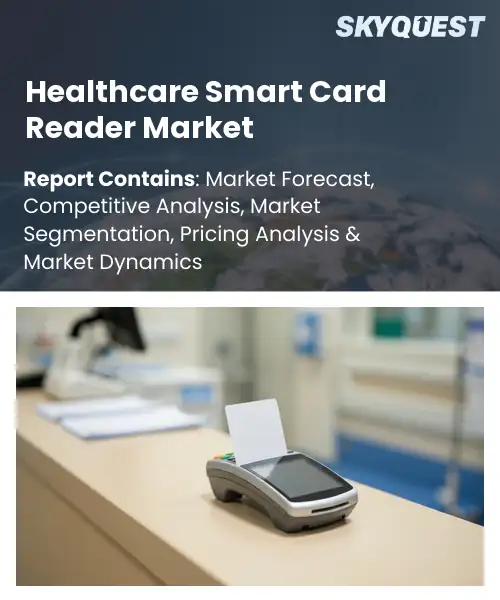
Healthcare Smart Card Reader Market
Report ID: SQMIG45I2401
Report ID: SQMIG45I2401
[email protected]
USA +1 351-333-4748
Report ID:
SQMIG45I2401 |
Region:
Global |
Published Date: June, 2026
Pages:
157
|Tables:
90
|Figures:
76


Global Healthcare Smart Card Reader Market size was valued at USD 1.6 Billion in 2024 and is poised to grow from USD 1.82 Billion in 2025 to USD 5.12 Billion by 2033, growing at a CAGR of 13.8% during the forecast period (2026-2033).
The main drivers of the healthcare smart card reader market are securing patient identification as well as easy access to health records from various care providers. This technology is used for reading chips installed in patient cards and the credentials of care providers. It allows not only authentication but also encrypted information exchange, which improves accuracy and reduces fraud in this area. In the smart card reader market, there are vendors who provide hardware products, as well as software companies that offer their solutions for middleware and integration with existing IT infrastructure in hospitals and other facilities.
The role of standards and regulations proves essential to driving global demand, compelling health institutions to use authentication tools that comply with industry standards for security. The result is that the adoption of national eIDs and mandatory certification of EHR connectors compels hospitals to purchase smart card readers that are compatible with ISO and PKI, thereby allowing the identification of the patient's identity, the management of consent, and the tracking of access activity. This leads to lower rates of billing fraud at pharmacies, faster processing times in hospital emergency rooms in the event of presentation of an identity card, and even cross-border services within the EU.
How is AI Transforming the Healthcare Smart Card Reader Market?
AI is transforming the landscape of the healthcare smart card reader market, transitioning from basic authentication to an advanced level of intelligent entry and identification solutions. Some features are secure on-device processing for identity and authentication, biometric comparison that dynamically adjusts based on the specific setting, and anomaly recognition that detects any suspicious actions. At present, there is an evolution toward using AI at the edge, as well as secure element technology that preserves patient confidentiality while accelerating clinicians' work processes. These changes increase the interoperability between smart card readers and electronic medical records and improve the efficiency of clinicians' work.Manufacturers develop new contactless readers and secure elements, which makes the deployment process much easier and appropriate for clinical settings.NXP and GE HealthCare, January 2026, announced a partnership on edge AI in acute care and demonstrated how the combination of edge AI and secure elements allows creating efficient and clinically aware smart card readers.
Market snapshot - (2026-2033)
Global Market Size
USD 1.6 Billion
Largest Segment
Contact Smart Card Readers
Fastest Growth
Contactless Smart Card Readers
Growth Rate
13.8% CAGR
To get more insights on this market click here to Request a Free Sample Report
Global healthcare smart card reader market is segmented by product type, technology, end-user and region. Based on product type, the market is segmented into Contact Smart Card Readers, Contactless Smart Card Readers and Dual Interface Readers. Based on technology, the market is segmented into Smart Card Readers with Display and Smart Card Readers without Display. Based on end-user, the market is segmented into Hospitals, Diagnostic Centers, Pharmacies and Others. Based on region, the market is segmented into North America, Europe, Asia Pacific, Latin America and Middle East & Africa.
Contactless Smart Card Readers hold the largest share of the market due to the emphasis placed on quick authentication by healthcare facilities in order to ensure the safety of the patients and maintain proper standards of infection control. It is convenient since it minimizes the time spent during the transaction process making registration and dispensation of medicine easier, thus promoting system integrators and EHR providers to incorporate contactless technology. Mobile credentials and NFC cards offer high levels of compatibility and minimize physical wear, thus offering an easy process.
On the other hand, Dual Interface Readers have proven to be among the fastest-growing segments within the industry. This is since dual interface readers support both contact and contactless technology hence accommodating different credentials.
The Hospitals segment takes the lead because big hospitals tend to concentrate on their patient admissions, medications management and access control in specific areas within their premises. IT departments and procurement cycles at hospitals will drive the preference of using smart card readers compatible with health information technology systems including electronic health records and clinical decision support as well as badge systems for hospital staff. Patient safety considerations along with the need for credentials access are factors behind the need for durable equipment, which helps build vendor market leadership through long-term engagements.
In contrast, the Diagnostic Centers are currently experiencing the strongest growth due to growing demand for patient identity security and quick test results due to increasing networking activities within these centers. Demand for small size equipment is driving innovations from vendors and creating procurement cycles that bring more commercial opportunities.
To get detailed segments analysis, Request a Free Sample Report
The North American market emerges as the biggest player in terms of healthcare smart card readers as it has a well-developed system of healthcare infrastructure along with advanced integration of electronic health records, early adoption of digital identity and other factors like high regulatory focus on security and privacy of information, use of various payment and access management tools, and wide-scale deployment of interconnected devices. The presence of a number of vendors who collaborate with clinical institutes and insurance companies makes it easier to create customized solutions. High importance attached to cybersecurity standards and a tough competitive landscape further stimulate procurement and implementation processes. There is no doubt that support of telemedicine and requirements for secure patient-oriented credentials ensure further momentum. Close cooperation between technology vendors and clinical research centers also facilitates the process.
Healthcare Smart Card Reader Market – United States is supported by established clinical network capabilities, high penetration of interoperable electronic healthcare system solutions, and robust procurement processes for providers and payers. Collaborations between vendors and hospitals, along with an emphasis on meeting high security requirements, generate the need for reliable readers. Attention to point-of-care identification, compatibility with identity management systems, and support for multiple credentials contribute to deployment in ambulatory care facilities.
Key drivers within Healthcare Smart Card Reader Market Canada include a wide range of procurement processes from both public and private segments that focus on ensuring integration and conformity with privacy regulations. Requirements for procuring healthcare smart card readers are dictated by initiatives designed to ensure patient identity authentication and security of electronic medical records within provincial networks. Vendors cooperate with integrators and local partners to customize reader designs and authentication processes for various healthcare facilities.
The European market’s growth is based on the trend towards a consolidation of public sector activities in the direction of ensuring secure patient ID cards and digital health strategy. Cooperation between the national health programs and procurement programs encourages adopting the standardized smart card readers compatible with regional data protection legislation and clinical workflows. Availability of technology providers with certified solutions, alongside cooperation within healthcare organizations and stakeholders, facilitates widespread adoption. The industry momentum is driven by a focus on integrating smart card readers with national health portals, EHRs, and pharmacy solutions, while pilot implementations are already demonstrating success in different environments. Regulatory compliance among other markets and investment into patient ID management facilitate an environment favorable to interoperable solutions, while customization makes hospital and community care implementations more appealing.
The German market for Healthcare Smart Card Reader market is distinguished by an advanced nationwide health IT infrastructure and an importance of secure electronic records of patients and stringent requirements for data security. Deployment is based on federal-level initiatives and collaboration of vendors and healthcare organizations. Preference is shown to reader devices with certification and compatibility with software platforms used for practice management and hospital management.
United Kingdom Healthcare Smart Card Reader Market is positively influenced by its proactive national digital health initiatives, robust healthcare IT spending, and a committed vendor ecosystem. The public health bodies and integrated care organizations deploy highly interoperable and user-friendly smart card readers that aid in their work flows and patient authentication processes. Coordination between technology incubation centers, systems integration specialists, and healthcare IT firms expedites pilot projects.
The Healthcare Smart Card Reader Market in France is characterized by a centrally organized health care system with an emphasis on health IT applications and compliance with patient data protection standards. The dynamics of product uptake are dependent on their incorporation with regional EMR and pharmacy systems. Manufacturers develop their products in consideration of local language and workflow issues, participating in local government procurement processes and regional health authorities' decision-making processes.
Asia Pacific is leveraging its position through the national drive towards digital health modernization, local manufacturing capabilities, and an increase in demand for secure patient identification in various healthcare environments. Various countries have a strong focus on incorporating smart card reader technology into their respective national identification systems, hospital IT systems, and telemedicine networks, providing extensive interoperability and efficient identification and authentication processes. Manufacturers capitalize on low-cost production methods, tailored products to suit varying needs and working together with system integrators to address any linguistic barriers. Cybersecurity solutions, pilot implementations with public health institutions and cooperation with international standard-setting organizations are other key factors that will contribute to the maturing process of the market, which will ultimately drive adoption in both urban hospitals and growing community health institutions.
Japan Healthcare Smart Card Reader Market Trends & Analysis include adoption of modern technologies in the healthcare sector, the country’s reputation for manufacturing products, and emphasis on integrating solutions with hospital information systems. The need for a reliable solution that is also of high quality and compatible with the identification process in the country has led companies to focus on developing robust hardware and secure firmware.
South Korean Healthcare Smart Card Reader Market enjoys advantages of high digitalization rate, strong electronics manufacturing capabilities, and government backing for secure identification solutions. The key focus of healthcare providers includes integration of smart card reader with national health programs, hospital IT infrastructure, and mobile apps. The use of local suppliers by vendors results in provision of flexible and economical solutions offering advanced security capabilities. Cooperation between technology companies and clinical institutions helps implement pilot projects.
To know more about the market opportunities by region and country, click here to
Buy The Complete Report
Increasing Focus on Interoperability
Interoperability is being encouraged by healthcare professionals and their administrators in order to ensure smooth transmission of data for patients across systems and care settings. The ability of smart card readers to provide a secureaccess to card-based credentials makes them valuable tools to simplify processes and minimize administrative workload. In addition, due to the use of multiple protocols and connection with electronic health record systems and identity management tools, smart card readers turn into critical elements of interoperable solutions.
Growing Adoption of Electronic Records
Increased adoption of EHR systems raises the need for effective authentication and access controls in clinical settings. Smart card readers offer a concrete way to authenticate clinicians' and patients' identities, allowing them controlled access to their electronic data, which ensures confidentiality and complies with regulatory requirements. The use of the token provides an alternative to software-based authentication and minimizes the dependency on shared passwords. With more hospitals focusing on managing their electronic records securely, the acquisition of compatible smart card readers is on the rise.
High Integration Complexity with Legacy Systems
Healthcare facilities typically have a range of proprietary systems which are not optimized for modern smart card authentication, resulting in serious problems for implementing card readers in the organization. A lot of custom coding and testing is needed to make sure the reader integrates smoothly into the system. This results in lengthy project timelines and higher costs. All of these problems discourage some healthcare providers from adopting card readers quickly due to the risks outweighing the advantages and choosing less troublesome methods instead.
Concerns About Data Privacy Compliance
The apprehensiveness that stakeholders may have over the storing and access of confidential medical records using the card-based method could be attributed to fears that the confidentiality of information could be breached and difficulties in meeting different regulatory requirements. The fears over the ownership of information, managing consent, and the securing of the contents on the cards may lead to the reluctance to adopt such a system, leading to preferences being made for authentication procedures that are more secure.
Request Free Customization of this report to help us to meet your business objectives.
Competitive environment in global healthcare smart card readers depends on industry mergers and technological advancements among players. Big industry players acquire smaller firms in order to build a robust digital identity stack, while incumbents roll out mobile and Bluetooth readers to get contracts from enterprises. Case in point is the merger between Thales and Gemalto in order to build an expanded digital identity stack, while Identiv launches its Bluetooth-based portable smart card reader solution to target the mobile authentication market.
Standards Driven Interoperability: Healthcare organizations and vendors are coming into agreement on shared communication protocols and formats that will allow interoperability between different systems. This will eliminate any issues that arise with smart card readers as it makes it easier to integrate them with EHRs and billing platforms as well as patient identification systems. Vendors tend to focus on following open standards as a way to guarantee compatibility and safeguard investments, while providers stress the importance of certification and conformance tests.
Contactless and Mobile Integration: Contactless mobile enabled smart card reader demand is increasing owing to the importance of user convenience, infection prevention and ease in processing by healthcare organizations. The manufacturers consider ergonomics and mobility, which makes the process easy for different patients and the staff. Touchless smart card readers that also pair with smartphones or other wearable devices are making the process more efficient and minimizing training requirements for the staff.
SkyQuest’s ABIRAW (Advanced Business Intelligence, Research & Analysis Wing) is our Business Information Services team that Collects, Collates, Correlates, and Analyses the Data collected by means of Primary Exploratory Research backed by robust Secondary Desk research.
As per SkyQuest analysis, drivers for the worldwide smart card reader market in healthcare sector include interoperability regulations that force vendors to implement secure, standard-based authentication devices, providing identity validation and security benefits, with the other major driving factor being the rising trend toward using EHR systems, which creates the need for physical authentication. The highest adoption rates have been seen in the region of North America owing to the advanced infrastructure and stringent privacy standards in place there. The contactless type of smart card readers accounts for a majority of products due to speed, hygiene, and compatibility with mobile IDs.
| Report Metric | Details |
|---|---|
| Market size value in 2024 | USD 1.6 Billion |
| Market size value in 2033 | USD 5.12 Billion |
| Growth Rate | 13.8% |
| Base year | 2024 |
| Forecast period | (2026-2033) |
| Forecast Unit (Value) | USD Billion |
| Segments covered |
|
| Regions covered | North America (US, Canada), Europe (Germany, France, United Kingdom, Italy, Spain, Rest of Europe), Asia Pacific (China, India, Japan, Rest of Asia-Pacific), Latin America (Brazil, Rest of Latin America), Middle East & Africa (South Africa, GCC Countries, Rest of MEA) |
| Companies covered |
|
| Customization scope | Free report customization with purchase. Customization includes:-
|
To get a free trial access to our platform which is a one stop solution for all your data requirements for quicker decision making. This platform allows you to compare markets, competitors who are prominent in the market, and mega trends that are influencing the dynamics in the market. Also, get access to detailed SkyQuest exclusive matrix.
Table Of Content
Executive Summary
Market overview
Parent Market Analysis
Market overview
Market size
KEY MARKET INSIGHTS
COVID IMPACT
MARKET DYNAMICS & OUTLOOK
Market Size by Region
KEY COMPANY PROFILES
Methodology
For the Healthcare Smart Card Reader Market, our research methodology involved a mixture of primary and secondary data sources. Key steps involved in the research process are listed below:
1. Information Procurement: This stage involved the procurement of Market data or related information via primary and secondary sources. The various secondary sources used included various company websites, annual reports, trade databases, and paid databases such as Hoover's, Bloomberg Business, Factiva, and Avention. Our team did 45 primary interactions Globally which included several stakeholders such as manufacturers, customers, key opinion leaders, etc. Overall, information procurement was one of the most extensive stages in our research process.
2. Information Analysis: This step involved triangulation of data through bottom-up and top-down approaches to estimate and validate the total size and future estimate of the Healthcare Smart Card Reader Market.
3. Report Formulation: The final step entailed the placement of data points in appropriate Market spaces in an attempt to deduce viable conclusions.
4. Validation & Publishing: Validation is the most important step in the process. Validation & re-validation via an intricately designed process helped us finalize data points to be used for final calculations. The final Market estimates and forecasts were then aligned and sent to our panel of industry experts for validation of data. Once the validation was done the report was sent to our Quality Assurance team to ensure adherence to style guides, consistency & design.
Analyst Support
Customization Options
With the given market data, our dedicated team of analysts can offer you the following customization options are available for the Healthcare Smart Card Reader Market:
Product Analysis: Product matrix, which offers a detailed comparison of the product portfolio of companies.
Regional Analysis: Further analysis of the Healthcare Smart Card Reader Market for additional countries.
Competitive Analysis: Detailed analysis and profiling of additional Market players & comparative analysis of competitive products.
Go to Market Strategy: Find the high-growth channels to invest your marketing efforts and increase your customer base.
Innovation Mapping: Identify racial solutions and innovation, connected to deep ecosystems of innovators, start-ups, academics, and strategic partners.
Category Intelligence: Customized intelligence that is relevant to their supply Markets will enable them to make smarter sourcing decisions and improve their category management.
Public Company Transcript Analysis: To improve the investment performance by generating new alpha and making better-informed decisions.
Social Media Listening: To analyze the conversations and trends happening not just around your brand, but around your industry as a whole, and use those insights to make better Marketing decisions.
REQUEST FOR SAMPLE
 REQUEST FREE CUSTOMIZATION
Global Healthcare Smart Card Reader Market size was valued at USD 1.6 Billion in 2024 and is poised to grow from USD 1.82 Billion in 2025 to USD 5.12 Billion by 2033, growing at a CAGR of 13.8% during the forecast period (2026-2033).
The competitive landscape in the global healthcare smart card reader market is shaped by consolidation and product innovation, with large vendors using acquisitions to secure digital identity stacks and incumbents launching mobile and Bluetooth readers to win enterprise contracts. Strategic examples include Thales integrating Gemalto to broaden digital identity offerings and Identiv introducing a portable Bluetooth smart card reader to capture mobile authentication use cases, while healthcare platforms add card reader integrations to their stacks. 'Atos', 'Giesecke+Devrient', 'Thales Group', 'IDEMIA', 'Infineon Technologies', 'NXP Semiconductors', 'STMicroelectronics', 'Renesas Electronics', 'CardLogix Corporation', 'HID Global', 'Entrust', 'Eastcompeace Technology', 'Goldpac Group', 'CPI Card Group', 'Valid', 'Zetes', 'Feitian Technologies', 'Watchdata', 'Gemalto', 'Oberthur'
Healthcare providers and administrators are emphasizing interoperability to enable seamless exchange of patient data across systems and care settings. Smart card readers facilitate secure, standardized access to card based credentials and enable consistent identity verification, thereby simplifying workflows and reducing administrative burden. By supporting multiple protocols and integrating with electronic health records and identity management platforms, smart card readers become essential components in interoperable architectures. This alignment with interoperability priorities encourages procurement and deployment, as organizations seek technologies that promote coordinated care and efficient information sharing.
Standards Driven Interoperability: Healthcare institutions and vendors are aligning around common communication protocols and data formats to enable exchange among diverse systems. This alignment reduces friction for smart card readers by simplifying integration with electronic health records, billing platforms and patient identity management. Vendors prioritize adherence to open standards to ensure device compatibility and protect investments, while service providers emphasize certification and conformance testing. Such ecosystem level standardization fosters adoption by lowering barriers and enabling scalable cross institution workflows that enhance operational efficiency.
Why does North America Dominate the Global Healthcare Smart Card Reader Market? |@12


Want to customize this report? This report can be personalized according to your needs. Our analysts and industry experts will work directly with you to understand your requirements and provide you with customized data in a short amount of time. We offer $1000 worth of FREE customization at the time of purchase.
Feedback From Our Clients


 USA (+1) 351-333-4748

