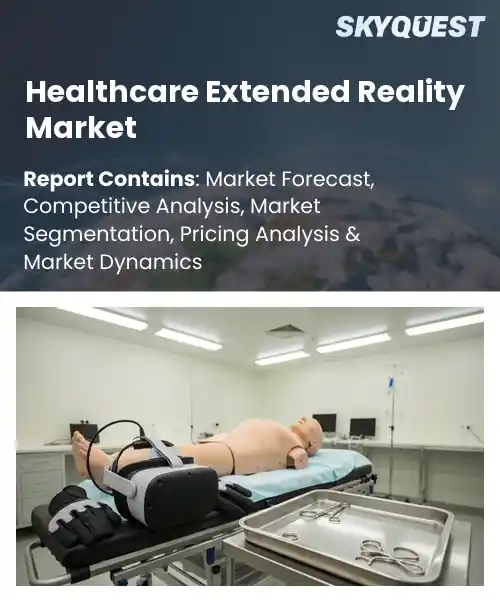
Healthcare Extended Reality Market
Report ID: SQMIG35A3355
Report ID: SQMIG35A3355
[email protected]
USA +1 351-333-4748
Report ID:
SQMIG35A3355 |
Region:
Global |
Published Date: April, 2026
Pages:
157
|Tables:
118
|Figures:
77


Global Healthcare Extended Reality Market size was valued at USD 11.18 Billion in 2024 and is poised to grow from USD 14.85 Billion in 2025 to USD 11.5 Billion by 2033, growing at a CAGR of 32.8% during the forecast period (2026-2033).
Healthcare extended reality (XR) encompasses virtual, augmented and mixed reality technologies applied across clinical education, surgical planning, rehabilitation, and it matters because immersive experiences can accelerate skill acquisition and improve outcomes while reducing costs and risk. The primary driver is the convergence of higher fidelity headsets, real time imaging integration and software platforms that together enable realistic simulation and in procedure guidance. Adoption accelerated from basic desktop simulations to live mixed reality overlays through pilot programs at academic medical centers; Microsoft HoloLens has been used for anatomy teaching and Osso VR supports surgical training, demonstrating improvements in proficiency and workflow.The decisive growth factor is clinical integration, where XR platforms connect to imaging, electronic records and live operating room feeds, and this linkage creates measurable clinical value that attracts providers and payers. When intraoperative overlays align with CT or MRI, surgeons perform more precise resections and fewer complications, so hospitals invest in equipment and training. Similarly, remote proctoring systems that stream procedures enable specialist mentoring across geographies, which expands service availability and generates new revenue models. Rehabilitation and pain management programs leveraging VR reduce length of stay and narcotic use, producing cost savings that catalyze reimbursement discussions and wider deployment.
How is AI improving clinical outcomes in the healthcare extended reality market?
AI is improving clinical outcomes in the healthcare extended reality market by combining intelligent data processing with immersive visualization. Key aspects include AI driven image segmentation that turns scans into interactive three dimensional models real time decision support that overlays guidance during procedures and adaptive therapy that personalizes rehabilitation and exposure therapy. The current state shows pilots moving into clinical workflows as vendors integrate AI models with XR headsets for surgical training intraoperative navigation and remote therapy. Examples include immersive surgical simulators AR guided interventions and virtual rehabilitation programs that make care more precise and more engaging for patients and clinicians.Medivis December 2025, received FDA clearance for an AR cranial navigation platform that uses imaging fusion and AI to present critical anatomy in the surgeon field of view. This innovation reduces cognitive load and streamlines intraoperative workflows which supports market growth and improves clinical efficiency.
Market snapshot - (2026-2033)
Global Market Size
USD 11.18 Billion
Largest Segment
Augmented Reality (AR) for Medical Visualization
Fastest Growth
Mixed Reality (MR) for Training
Growth Rate
32.8% CAGR
To get more insights on this market click here to Request a Free Sample Report
Global healthcare extended reality market is segmented by technology framework, application vertical, component layer, end-user and region. Based on technology framework, the market is segmented into Virtual Reality (VR) for Surgery/Therapy, Augmented Reality (AR) for Medical Visualization and Mixed Reality (MR) for Training. Based on application vertical, the market is segmented into Medical Training & Education (Simulations), Surgical Planning & Navigation, Patient Rehabilitation & Pain Management and Mental Health Therapy & PTSD Treatment. Based on component layer, the market is segmented into XR Hardware (Headsets/Smart Glasses), Medical XR Software & Content Platforms and Integration & Consulting Services. Based on end-user, the market is segmented into Hospitals & Specialized Surgery Centers, Medical Schools & Academic Institutions and Pharmaceutical & Biotech R&D. Based on region, the market is segmented into North America, Europe, Asia Pacific, Latin America and Middle East & Africa.
Virtual Reality (VR) for Surgery/Therapy segment dominates because immersive preoperative rehearsal and therapeutic immersion directly translate into observable clinical benefits, driving adoption among surgeons and therapists. Clinical validation and alignment with established training curricula create pull from hospitals and academic centers, while mature vendor ecosystems supply integrated imaging and simulation tools. This combination of proven efficacy, workflow fit, and vendor readiness reduces adoption friction and entrenches VR as a practical clinical solution.
However, Mixed Reality (MR) for Training is the fastest growing sub-segment as blended immersive environments enable hands-on procedural practice with contextual overlays and remote collaboration. Advances in spatial mapping, improving affordability, and rising demand for scalable realistic training drive investment and open adoption pathways among clinical educators and simulation providers.
Medical XR Software & Content Platforms segment leads because robust clinical content and interoperable platforms create the value layer for XR deployment, enabling standardized simulations, validated therapy protocols, and image integration that clinicians trust. Platform providers aggregate developer ecosystems, manage regulatory and clinical validation processes, and deliver analytics and workflow integration, which reduces implementation complexity for providers and accelerates enterprise procurement and recurring software-driven revenue models.
Conversely, XR Hardware (Headsets/Smart Glasses) is the fastest growing sub-segment as ergonomic clinical grade devices improve comfort and sensor fidelity, making bedside and intraoperative use practical. Supply chain scale and OEM partnerships lower unit costs while tighter hardware and software integration unlocks new medical use cases, catalyzing purchasing by institutions and stimulating ecosystem investment in clinical applications.
To get detailed segments analysis, Request a Free Sample Report
North America leads the global healthcare extended reality market due to concentration of advanced clinical institutions, deep technology ecosystems, and strong private investment in immersive solutions. Integration of extended reality into medical training, surgical planning, and therapeutic applications is reinforced by collaborative networks between academic centers, startups, and established medical device manufacturers. Regulatory frameworks that support clinical validation and reimbursement pathways allow accelerated adoption in hospital systems and specialty clinics. Robust developer communities and accessible venture capital facilitate rapid prototyping and scale up of platforms tailored to clinician workflows. High awareness among healthcare practitioners and early generation of clinical evidence further consolidate regional leadership, making North America a focal point for innovation, partnerships, and commercialization of immersive healthcare technologies. Extensive academic collaboration fuels continued refinement.
Healthcare Extended Reality Market in United States is characterized by dense concentration of medical centers, universities, and immersive technology companies collaborating to produce clinical solutions. Emphasis on surgical simulation, interventional planning, and rehabilitation therapies drives development cycles. Strong clinical trial activity and partnership models enable translation of prototypes into hospital workflows, while commercial incubators and system innovation units create pathways for procurement, clinician training and deployment across clinical care environments.
Healthcare Extended Reality Market in Canada benefits from public health systems, academic networks, and innovation funding that support clinical pilots and adoption. Focus areas include surgical education, mental health therapies, and remote rehabilitation delivered through immersive platforms. Ties between universities and regional health authorities facilitate evidence generation and clinician training, while startups partner with hospitals to refine user experience and interoperability for clinical use across provincial care settings and deployment.
Europe is experiencing rapid expansion in healthcare extended reality through a blend of strong clinical research institutions, supportive public funding mechanisms, and growing commercial interest in patient centric applications. Cross border academic collaborations and pan regional consortia accelerate validation of immersive tools for surgical training, mental health treatment, and rehabilitation. National healthcare systems in key markets emphasize digital transformation, creating procurement pathways for proven solutions. A diverse landscape of established medical device firms and agile technology startups enables translation from pilot projects to broader clinical use. Emphasis on data protection and clinical conformity fosters trust among clinicians and patients, while localized language adaptation and training programs help overcome adoption barriers, positioning Europe as a dynamic and practical market for extended reality in healthcare.
Healthcare Extended Reality Market in Germany benefits from medical research centers, engineering expertise, and established medical technology manufacturers that drive clinical product development. Integration with hospital information systems and adherence to clinical standards supports procurement by university hospitals and clinics. Collaborative initiatives between industry, researchers, and technical universities enable advanced surgical planning tools and simulation platforms, reinforcing Germany role as a center for high quality immersive healthcare solutions and deployment.
Healthcare Extended Reality Market in United Kingdom benefits from innovation hubs, clinical research institutions, and health system initiatives that prioritize digital tools for education and therapy. Startups collaborate with hospitals and centers to pilot immersive solutions in surgical training and mental health care. Focus on clinician engagement, localized content, and commercial partnerships enables translation from pilot projects to clinical adoption, positioning United Kingdom as an environment for extended reality applications.
Healthcare Extended Reality Market in France is emerging through collaboration among academic hospitals, technology clusters, and public innovation programs that support clinical pilots and localized content. Emphasis on therapeutic applications, rehabilitation, and clinician training drives early adoption in hospital networks and clinics. Startups partnering with medical firms focus on user experience and regulatory alignment, while attention to cultural adaptation and language support aids patient engagement and scaling across care pathways.
Asia Pacific is strengthening its role in healthcare extended reality through concentrated investment in advanced hardware, growing clinical research, and active commercialization pathways led by technology companies and medical equipment manufacturers. Markets in the region combine strong engineering capabilities with healthcare system modernization efforts, enabling integration of immersive tools into clinical workflows and telehealth solutions. Cross sector collaboration between universities, industry, and healthcare providers accelerates localization and regulatory alignment, while focus on use cases such as surgical assistance, rehabilitation, and mental health care drives practical deployment. Increasing availability of regional developer talent and manufacturing capacity supports cost effective production and tailored solutions, positioning Asia Pacific as a key source of both technological innovation and scaled clinical implementation. Strategic partnerships with global vendors and regional health systems further enhance market readiness and cross border deployment.
Healthcare Extended Reality Market in Japan benefits from strong electronics manufacturing, research institutions, and close collaboration between device makers and hospitals to develop clinician focused solutions. Emphasis on surgical assistance, simulation training, and rehabilitation technologies aligns with clinical priorities. Established companies invest in clinical validation and integration with hospital workflows, while academic partnerships support pilot studies and workforce training, enabling Japan to advance interoperable extended reality offerings for healthcare providers.
Healthcare Extended Reality Market in South Korea is propelled by strong electronics expertise, agile technology firms, and collaboration between hospitals and software developers to create immersive applications. Use cases include surgical visualization, telemedicine integration, and neurologic rehabilitation delivered through immersive platforms. Innovation clusters and private sector partnerships foster prototype testing and clinician training, while focus on interface design and language support improves patient acceptance and clinical integration across healthcare networks.
To know more about the market opportunities by region and country, click here to
Buy The Complete Report
Growing Adoption Of Immersive Training
Advancements In Visualization Technologies
High Costs Of Implementation
Regulatory And Privacy Concerns
Request Free Customization of this report to help us to meet your business objectives.
The competitive landscape for global healthcare extended reality is dynamic, driven by rivalry among specialized XR education and therapy vendors and by provider demand for scalable simulation and remote rehabilitation. Companies pursue inorganic moves and strategic alliances to differentiate, for example GIGXR’s acquisition of Pearson mixed reality assets and its 2024 collaboration with CAE Healthcare, while clinical startups win grants and NHS partnerships to accelerate validation and deployment.
Top Player’s Company Profile
Recent Developments
SkyQuest’s ABIRAW (Advanced Business Intelligence, Research & Analysis Wing) is our Business Information Services team that Collects, Collates, Correlates, and Analyses the Data collected by means of Primary Exploratory Research backed by robust Secondary Desk research. As per SkyQuest analysis, the global healthcare extended reality market is rapidly advancing, driven primarily by clinical integration that links XR platforms to imaging and records to deliver measurable intraoperative and training value and secondarily by advancements in visualization technologies improving fidelity and usability. Adoption is strongest in North America where academic centers, venture funding, and clinical evidence converge, and virtual reality for surgery and therapy remains the dominant segment due to clear clinical benefits and established training pathways. However, high implementation costs pose a significant restraint, limiting uptake among smaller providers. Overall, XR’s ability to improve skills, reduce risk, and enable remote mentoring underpins sustained industry momentum.
| Report Metric | Details |
|---|---|
| Market size value in 2024 | USD 11.18 Billion |
| Market size value in 2033 | USD 11.5 Billion |
| Growth Rate | 32.8% |
| Base year | 2024 |
| Forecast period | (2026-2033) |
| Forecast Unit (Value) | USD Billion |
| Segments covered |
|
| Regions covered | North America (US, Canada), Europe (Germany, France, United Kingdom, Italy, Spain, Rest of Europe), Asia Pacific (China, India, Japan, Rest of Asia-Pacific), Latin America (Brazil, Rest of Latin America), Middle East & Africa (South Africa, GCC Countries, Rest of MEA) |
| Companies covered |
|
| Customization scope | Free report customization with purchase. Customization includes:-
|
To get a free trial access to our platform which is a one stop solution for all your data requirements for quicker decision making. This platform allows you to compare markets, competitors who are prominent in the market, and mega trends that are influencing the dynamics in the market. Also, get access to detailed SkyQuest exclusive matrix.
Table Of Content
Executive Summary
Market overview
Parent Market Analysis
Market overview
Market size
KEY MARKET INSIGHTS
COVID IMPACT
MARKET DYNAMICS & OUTLOOK
Market Size by Region
KEY COMPANY PROFILES
Methodology
For the Healthcare Extended Reality Market, our research methodology involved a mixture of primary and secondary data sources. Key steps involved in the research process are listed below:
1. Information Procurement: This stage involved the procurement of Market data or related information via primary and secondary sources. The various secondary sources used included various company websites, annual reports, trade databases, and paid databases such as Hoover's, Bloomberg Business, Factiva, and Avention. Our team did 45 primary interactions Globally which included several stakeholders such as manufacturers, customers, key opinion leaders, etc. Overall, information procurement was one of the most extensive stages in our research process.
2. Information Analysis: This step involved triangulation of data through bottom-up and top-down approaches to estimate and validate the total size and future estimate of the Healthcare Extended Reality Market.
3. Report Formulation: The final step entailed the placement of data points in appropriate Market spaces in an attempt to deduce viable conclusions.
4. Validation & Publishing: Validation is the most important step in the process. Validation & re-validation via an intricately designed process helped us finalize data points to be used for final calculations. The final Market estimates and forecasts were then aligned and sent to our panel of industry experts for validation of data. Once the validation was done the report was sent to our Quality Assurance team to ensure adherence to style guides, consistency & design.
Analyst Support
Customization Options
With the given market data, our dedicated team of analysts can offer you the following customization options are available for the Healthcare Extended Reality Market:
Product Analysis: Product matrix, which offers a detailed comparison of the product portfolio of companies.
Regional Analysis: Further analysis of the Healthcare Extended Reality Market for additional countries.
Competitive Analysis: Detailed analysis and profiling of additional Market players & comparative analysis of competitive products.
Go to Market Strategy: Find the high-growth channels to invest your marketing efforts and increase your customer base.
Innovation Mapping: Identify racial solutions and innovation, connected to deep ecosystems of innovators, start-ups, academics, and strategic partners.
Category Intelligence: Customized intelligence that is relevant to their supply Markets will enable them to make smarter sourcing decisions and improve their category management.
Public Company Transcript Analysis: To improve the investment performance by generating new alpha and making better-informed decisions.
Social Media Listening: To analyze the conversations and trends happening not just around your brand, but around your industry as a whole, and use those insights to make better Marketing decisions.
REQUEST FOR SAMPLE
 REQUEST FREE CUSTOMIZATION


Want to customize this report? This report can be personalized according to your needs. Our analysts and industry experts will work directly with you to understand your requirements and provide you with customized data in a short amount of time. We offer $1000 worth of FREE customization at the time of purchase.
Feedback From Our Clients


 USA (+1) 351-333-4748

