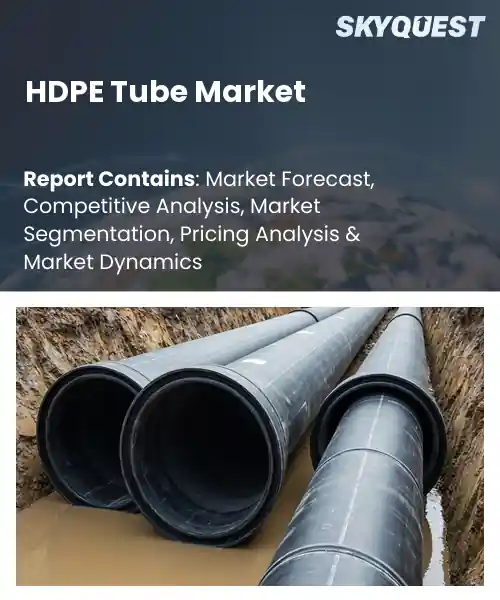
HDPE Tube Market
Report ID: SQMIG20G2115
Report ID: SQMIG20G2115
[email protected]
USA +1 351-333-4748
Report ID:
SQMIG20G2115 |
Region:
Global |
Published Date: March, 2026
Pages:
157
|Tables:
177
|Figures:
79


Global HDPE Tube Market size was valued at USD 12.4 Billion in 2024 and is poised to grow from USD 13.18 Billion in 2025 to USD 21.49 Billion by 2033, growing at a CAGR of 6.3% during the forecast period (2026-2033).
A continued demand for long-lasting, non-corrosive pipes that may be safely used to deliver water, gas or other liquids has driven the HDPE tube industry toward the transformation of these thermoplastics into a strategic material. Utility companies and agricultural suppliers have increasingly selected HDPE over metal and PVC pipe for their long-term installations because of their flexibility and ability to be joined using fusion welding techniques that greatly reduce the opportunity of leaks.
The HDPE tube market developed from small, irrigation applications to larger projects in the municipal and energy sectors as technology advanced, production increased, and resin formulations improved. Examples of this transformation include the expansion of irrigation systems and trenchless water main replacement projects that have benefited from the reduced maintenance required with the use of HDPE tubing.
With HDPE tubing technology continuing to be used more frequently, the primary factor driving growth in the global HDPE tube market is the technology that continues to improve resin chemistry and fusion welding methods. Increased pressure ratings and dependable heat-fusible joints have reduced the risk of accidents and reduced the cost to operate utility pipelines by replacing old steel pipelines with HDPE tubing. Therefore, as utility companies renovate their distribution systems, they will continue to encourage manufacturers to add extrusion capacity and benefit from economies of scale as a result.
The continued growth of trenchless installation techniques will reduce surface disruption and expand the adoption of HDPE by municipalities, thereby providing opportunities for retrofit projects and new HDPE installations in developing regions of the world.
How is IoT Enhancing Lifecycle Monitoring in the HDPE Tube Market?
With the use of telemetry and analytics, IoT is changing how lifecycle monitoring is performed within the HDPE tube industry by connecting sensors throughout the manufacturing process until an asset reaches its end of life. Some examples of this are using embedded or clamp-on sensors to monitor pressure, temperature, and strain; processing edge data locally; and utilizing cloud platforms for trend analysis and predictive maintenance. In the current market, pilot programs have been initiated, and suppliers are designing products that emphasize sensor compatibility in municipal water systems, irrigation, and industrial piping systems. The benefit of this is improved leak detection, more informed decisions on rehabilitation of pipe systems, and increased value of the pipe material and systems through the increase of on-going condition-based care.
Borealis announced the new HDPE and LLDPE products specifically optimized for drip irrigation and recyclable materials that have increased resistance to stress cracking. Also, using these new products has increased the reliability of the operation of embedded sensors, thereby providing more accurate lifecycle monitoring, resulting in improved operational efficiencies and prolonged service life of the assets.
Market snapshot - (2026-2033)
Global Market Size
USD 12.4 Billion
Largest Segment
HDPE Rigid Tubes
Fastest Growth
Multi-Layer HDPE Tubes
Growth Rate
6.3% CAGR
To get more insights on this market click here to Request a Free Sample Report
Global HDPE tube market is segmented into product type, end-use industry, application, size / diameter, production method, distribution channel and region. Based on product type, the market is segmented into HDPE rigid tubes, HDPE flexible tubes, multi-layer HDPE tubes and co-extruded HDPE tubes. Based on end-use industry, the market is segmented into oil & gas, water & wastewater, chemical processing, food & beverage, pharmaceuticals & healthcare, agriculture & irrigation and other end-users. Based on application, the market is segmented into fluid transfer & piping, conduit & cable protection, industrial process tubing, packaging & dispensing and specialty tubing uses. Based on size / diameter, the market is segmented into small diameter (<25 mm), medium diameter (25–100 mm) and large diameter (>100 mm). Based on production method, the market is segmented into extruded HDPE tubes and co-extruded / multi-layer HDPE tubes. based on distribution channel, the market is segmented into direct OEM sales, distributors & dealers and online retail. Based on region, the market is segmented into North America, Europe, Asia Pacific, Latin America and Middle East & Africa.
The dominant HDPE rigid tubes segment exists due to their natural stiffness and load-bearing capabilities, which enable them to be used as the default option in critical pressure piping and long-run installations. Established chemical resistance and low permeability, as well as compatibility with standard fusion joining, allow for the creation of reliable networks with long lifetimes and minimal maintenance risks. The extensive familiarity with and acceptance of this material by the industry and regulators leads to its high specification preference. The use of large volumes of HDPE being extruded as well as the well-established supply chains supporting heavy-duty infrastructure applications will continue to maintain the dominance of this segment.
The most rapidly growing segment of the market is the HDPE flexible tubes segment. The ability of this subset of tubing to be bendable and lightweight allows for faster installation in tight spaces or during trenchless repairs. Acceptance of flexible tubing is growing rapidly in both irrigation and conduit applications, and new advancements in the polymers that comprise the tubing have significantly increased their pressure capability and opened previously unutilized markets for small-bore tubing.
The distributors and dealers segment dominates with HDPE tube market share because they have very large inventories, provide a large geographical distribution, and have relationships with installers that allow them to supply technical assistance and have product availability for many varieties of applications for HDPE tubes. They help reduce project downtime and make it simple to procurement through the management of inventory variety assortments, cutting to length, and rapid delivery of replacements. By connecting the manufacturers to contractors and utility companies, Distributors and dealers facilitate specification adoption, aggregate demand across small purchase orders, and provide aftermarket service support to strengthen the resiliency of the distributors and dealers, as well as their market penetration.
Online retail has been growing the fastest due to online platforms providing a simplified ordering process and rapid delivery to a diverse array of purchasers. The use of supplier portals and market reduces the friction involved with the procurement of niche products or low-valued purchase orders through just-in-time sourcing. This digital HDPE tube market trend is accelerating access, data-driven inventory management, and new buyer engagement models.
To get detailed segments analysis, Request a Free Sample Report
The Asia Pacific region is benefiting from the existence of an integrated manufacturing ecosystem, as well as the proximity of supply chains for the related raw materials and a large downstream industry concentration that utilizes HDPE tubing. Investments in advanced polymer processing facilities combined with local building and agricultural infrastructure and the adaptation of design have resulted in both scale and innovation. Long-term OEM relationships in the end use sectors of water management, industrial fluid transfer and consumer appliances provide predictable demand and product diversification opportunities.
As per the HDPE tube market regional outlook, Japan is characterized by high technology in the material as well as strict quality requirements from manufacturers and downstream industries. Driving the demand for HDPE tubes in Japan is the use of these tubes for precision applications within the electronics manufacturing, water treatment, and building utility industries where there is a strong commitment to producing high-quality products that comply with governing regulations.
As per the HDPE tube market regional forecast, South Korea has a manufacturing ecosystem that has focused on maximizing efficiency, operating with the latest innovation in materials, and integrating with the manufacture of heavy industrial products and municipal infrastructure projects. The local suppliers place a high priority on their ability to produce significant quantities of product with the support of the engineering firms they work with to adapt the tube specifications for the use in industrial fluid handling and municipal water systems. There is a focus on the use of automation in processes and ensuring the quality of the product being produced leads to successful competitive advantages, and the exporting of the product can leverage regional networks and service capabilities to provide installation and service capabilities for the user when needed.
As per the HDPE tube industry analysis, in North America, the expansion is supported by coordinated investment in infrastructure rehabilitation, utility modernization, and industrial strategic applications where HDPE tubing is utilized for its durability and flexibility. The market development is the result of alliances between suppliers and engineering contractors, resulting in specification-based solutions for water distribution systems, gas transit systems, and industrial process fluid systems. Emphasis on lifecycle performance, ease of installation, and compatibility with trenchless technology have elevated the status of HDPE as the material of choice when specifying products for the project.
In the USA, the HDPE tube market is influenced by infrastructure renewal and the need for durable utility solutions, which results in suppliers focusing on maximizing the reliability and installation efficiency of their systems. Coordination between manufacturers, engineering firms, and contractors encourages specification alignment and efficient implementation of products by delivery. Suppliers have developed tailored products and service models that incorporate consideration of trenchless installation methods and lifecycle management into the project planning process.
In the Canada HDPE tube market, infrastructure needs vary by region. Supplier emphasis is placed on supplying robust materials and logistics that accommodate remote and urban project sites, as well as providing training and support for proper installation and use. Collaborative efforts between manufacturers and local authorities assist with specification of alignment and project acceptance.
Through a focus on regulatory alignment, technical standardization and investment in developing products for specific applications, Europe is strengthening its involvement in the high-density polyethylene (HDPE) tubing sector. The emphasis for manufacturers producing tubing is on material properties, recycling capability and security of supply chain to assist them in meeting strict infrastructure and industrial needs. Manufacturers are cooperating with equipment suppliers, engineering consultants and public authorities to help ensure that specifications are harmonized and that projects can be delivered efficiently. The focus placed on high-quality fabrication processes, training for installation and service provides a greater degree of confidence to those using the systems.
The Germany HDPE tube market is centred around a combination of precision manufacturing techniques, strict technical regulations, and collaboration between the industrial end users of these products and the suppliers who manufacture them. Product demand is focused in the areas of industrial process piping; municipal water supply infrastructure; and specialized construction applications, where the quality and durability of the HDPE tubing product are critical. The local manufacturers of HDPE tubing products are emphasizing the use of certified production processes; traceability; and after-sales support for their products. The close relationships that exist between local manufacturers and the engineering consultation community facilitate the design of products around specifications and the integration of those products into complex systems with a requirement for sustainable performance over an extended period.
The United Kingdom HDPE tube market is shaped by urban renewal, modernizing utilities and a supply of contracting services orientation. There is also a focus on rapid delivery, trenchless construction methods, and durable jointing solutions to enable use in densely populated urban environments and difficult ground conditions. Manufacturers provide customize product portfolios and installer training programs; cooperation with regulators, as well as testing organizations, fosters compliance with standards and operational integrity of products used in municipal and industrial applications.
The HDPE tube market in France is impacted by resilience in infrastructure, municipal water management systems, and requirements for industrial processes. Producers strive for material quality, ease of installation, and service that accommodates logistics of the project. Collaboration between engineering firms and agencies supports specification clarity; consequently, HDPE tubes are being adopted more widely throughout complex projects. There are installer training and certification initiatives to establish and maintain installer competency and product differentiation addressing corrosion resistance and flexibility needs that are required based on demand for HDPE tubes in urban and industrial settings.
To know more about the market opportunities by region and country, click here to
Buy The Complete Report
Growing Demand in Flexible Packaging
Manufacturers are tending to favour HDPE tubes for their various benefits when used in many flexible packaging applications, including their chemical resistance, lightweight, and design properties that allow for protection and presentation of a wide range of products. The use of HDPE tubes allows for effective filling of products with various types of closures and long shelf life for consumer, personal care, and household products, thus driving specification from brand owners and converters who wish to use reliable packaging formats. The ability to process HDPE with great versatility provides the flexibility to make rapid tooling changes and customize producing tubes to encourage greater usage across industries that require durable and aesthetically flexible packaging.
Expansion of Medical Tubing
The purity, ability to be sterilized, and biocompatibility of HDPE tubes are helping to increase their specification in medical and healthcare devices due to their proven and reliable characteristics for reducing risk of contamination and safe delivery of fluids. As a result of predictable performance of HDPE during sterility testing and very low leachability of additives, clinicians and manufacturers of medical devices are using HDPE tubing for various applications such as fluid delivery, diagnostics, and testing laboratories. This promotes confidence among purchasing and developmental teams in healthcare and leads to a much larger range of HDPE tubing being included in product offerings and thereby promoting increased cooperation between resin manufacturers and manufacturers of medical device components.
Raw Material Price Volatility
Supply chain challenges related to feedstock availability and resin pricing create uncertainty in procurement. This makes it challenging for manufacturers to schedule production, establish stable margins, and commit to investments in expanding capacity and specialized tooling for HDPE tube production. With uncertainty about pass-through costs, buyers may not want to lock into long-term contracts, which results in shorter planning horizons and more conservative production scheduling. Manufacturers lose the incentive to pursue new product development and/or customization, which slows the rate of adoption of new applications and limits the HDPE tube market growth potential until the stabilization of pricing trends.
Limited Recycling Infrastructure Development
Manufacturers also experience institutional pressure to invest in collection and redesign initiatives to enhance recyclability. As a result of this incentive structure, manufacturers may be less likely to use HDPE tubing in applications emphasizing the recovery of post-consumer products, which fragments demand. This pressure diverts manufacturers' funds away from core production growth and restricts overall market expansion.
Request Free Customization of this report to help us to meet your business objectives.
A large number of petrochemical and packaging firms dominate the HDPE market as the competitive environment in the global HDPE tube market consists of an extremely consolidated market with large petrochemicals and packaging companies leading with substantial production capabilities and integrated supply chains. Leading market participants include LyondellBasell, ExxonMobil, Dow Chemical, INEOS, ALPLA Group, etc., who have an extensive production capability for resin, leading expertise in the various processing of polymers, as well as growing numbers of investments in the circular economy (notably recycled HDPE (rHDPE)). Vertical integration, economies of scale, and continuous innovation in high-performance and sustainable products keep the major players in the HDPE market ahead of their competitors.
SkyQuest’s ABIRAW (Advanced Business Intelligence, Research & Analysis Wing) is our Business Information Services team that Collects, Collates, Correlates, and Analyses the Data collected by means of Primary Exploratory Research backed by robust Secondary Desk research.
As per SkyQuest analysis, a key driver is sustaining demand for durable, corrosion‑resistant piping across water, gas and industrial infrastructure, which favors HDPE over metal and PVC. A second driver is technological improvement in resin chemistry and fusion techniques that raise pressure ratings and cut lifecycle costs. A restraint is raw material price volatility that complicates procurement and margins for manufacturers. The dominating region is Asia Pacific, supported by integrated manufacturing, proximity to feedstock, and strong downstream demand. The dominating segment is HDPE rigid tubes, which lead due to stiffness, pressure capability and regulatory acceptance across critical infrastructure applications and growing municipal adoption.
| Report Metric | Details |
|---|---|
| Market size value in 2024 | USD 12.4 Billion |
| Market size value in 2033 | USD 21.49 Billion |
| Growth Rate | 6.3% |
| Base year | 2024 |
| Forecast period | (2026-2033) |
| Forecast Unit (Value) | USD Billion |
| Segments covered |
|
| Regions covered | North America (US, Canada), Europe (Germany, France, United Kingdom, Italy, Spain, Rest of Europe), Asia Pacific (China, India, Japan, Rest of Asia-Pacific), Latin America (Brazil, Rest of Latin America), Middle East & Africa (South Africa, GCC Countries, Rest of MEA) |
| Companies covered |
|
| Customization scope | Free report customization with purchase. Customization includes:-
|
To get a free trial access to our platform which is a one stop solution for all your data requirements for quicker decision making. This platform allows you to compare markets, competitors who are prominent in the market, and mega trends that are influencing the dynamics in the market. Also, get access to detailed SkyQuest exclusive matrix.
Table Of Content
Executive Summary
Market overview
Parent Market Analysis
Market overview
Market size
KEY MARKET INSIGHTS
COVID IMPACT
MARKET DYNAMICS & OUTLOOK
Market Size by Region
KEY COMPANY PROFILES
Methodology
For the HDPE Tube Market, our research methodology involved a mixture of primary and secondary data sources. Key steps involved in the research process are listed below:
1. Information Procurement: This stage involved the procurement of Market data or related information via primary and secondary sources. The various secondary sources used included various company websites, annual reports, trade databases, and paid databases such as Hoover's, Bloomberg Business, Factiva, and Avention. Our team did 45 primary interactions Globally which included several stakeholders such as manufacturers, customers, key opinion leaders, etc. Overall, information procurement was one of the most extensive stages in our research process.
2. Information Analysis: This step involved triangulation of data through bottom-up and top-down approaches to estimate and validate the total size and future estimate of the HDPE Tube Market.
3. Report Formulation: The final step entailed the placement of data points in appropriate Market spaces in an attempt to deduce viable conclusions.
4. Validation & Publishing: Validation is the most important step in the process. Validation & re-validation via an intricately designed process helped us finalize data points to be used for final calculations. The final Market estimates and forecasts were then aligned and sent to our panel of industry experts for validation of data. Once the validation was done the report was sent to our Quality Assurance team to ensure adherence to style guides, consistency & design.
Analyst Support
Customization Options
With the given market data, our dedicated team of analysts can offer you the following customization options are available for the HDPE Tube Market:
Product Analysis: Product matrix, which offers a detailed comparison of the product portfolio of companies.
Regional Analysis: Further analysis of the HDPE Tube Market for additional countries.
Competitive Analysis: Detailed analysis and profiling of additional Market players & comparative analysis of competitive products.
Go to Market Strategy: Find the high-growth channels to invest your marketing efforts and increase your customer base.
Innovation Mapping: Identify racial solutions and innovation, connected to deep ecosystems of innovators, start-ups, academics, and strategic partners.
Category Intelligence: Customized intelligence that is relevant to their supply Markets will enable them to make smarter sourcing decisions and improve their category management.
Public Company Transcript Analysis: To improve the investment performance by generating new alpha and making better-informed decisions.
Social Media Listening: To analyze the conversations and trends happening not just around your brand, but around your industry as a whole, and use those insights to make better Marketing decisions.
REQUEST FOR SAMPLE
 REQUEST FREE CUSTOMIZATION
Global Hdpe Tube Market size was valued at USD 12.4 Billion in 2024 and is poised to grow from USD 13.18 Billion in 2025 to USD 21.49 Billion by 2033, growing at a CAGR of 6.3% during the forecast period (2026-2033).
Competition in the global HDPE tube market is driven by capacity builds, sustainability partnerships, and product differentiation. Petchem expansions increase polyethylene feedstock while producers partner with advanced recyclers to secure PCR resin, and system vendors push engineered HDPE solutions such as conductive double wall piping to capture industrial and fuel distribution contracts. I could not verify two real startups founded in or after 2019 that specifically manufacture HDPE tubes. Do you want me to proceed with option 1, listing smaller established pipe manufacturers founded before 2019, or option 2, listing post-2019 verified startups active in recycled HDPE feedstock and piping-adjacent solutions? Reply 1 or 2 and I will produce the exact two bullet points per your format. 'Advanced Drainage Systems', 'hiney Enterprises', 'PipeFlo', 'Ply Gem', 'Secor', 'WL Gore & Associates', 'ULINE', 'FlexPVC', 'Nyloplast', 'Custom Pipe & Products', 'National Pipe & Plastics', 'High Industries', 'PolyOne', 'Agru America', 'Royal Building Products', 'Aetna Plastic', 'Murdock', 'ConGlobal Industries', 'JM Eagle', 'Hancor'
HDPE tubes are increasingly preferred in flexible packaging applications because their combination of chemical resistance, lightweight nature, and design adaptability supports diverse product protection and presentation needs. Manufacturers find that tube formats allow efficient filling, varied closures, and extended shelf stability for consumer goods, personal care, and household products, which drives specification by brand owners and converters seeking reliable packaging formats. The material’s processing versatility enables rapid tooling changes and customization, encouraging wider adoption across industries that prioritize durability and aesthetic flexibility.
Circular Design Adoption: Manufacturers are integrating circular principles into product development to reduce environmental impact and meet buyer expectations. Focus is shifting to long life tube designs, material selection that facilitates reuse, and partnerships for take back programs. Suppliers emphasize traceability, certification, and material transparency to support corporate sustainability agendas. This movement encourages collaboration across value chains to redesign sourcing and end of life handling, fostering brand differentiation and securing procurement from environmentally conscious customers while aligning with regulatory sustainability frameworks globally effectively.
Why does Asia Pacific Dominate the Global HDPE Tube Market? |@12


Want to customize this report? This report can be personalized according to your needs. Our analysts and industry experts will work directly with you to understand your requirements and provide you with customized data in a short amount of time. We offer $1000 worth of FREE customization at the time of purchase.
Feedback From Our Clients


 USA (+1) 351-333-4748

