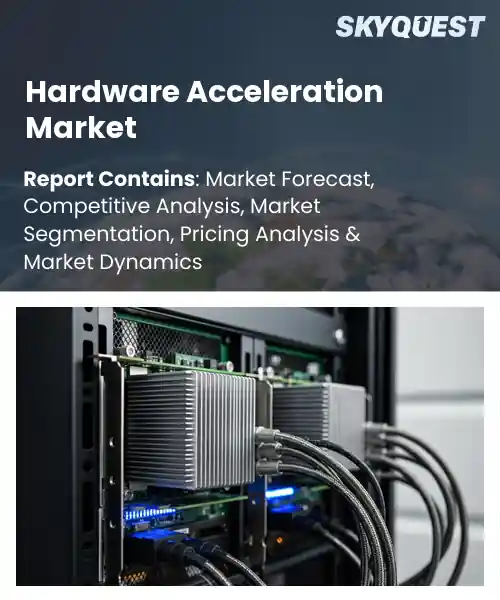
Hardware Acceleration Market
Report ID: SQMIG45N2167
Report ID: SQMIG45N2167
[email protected]
USA +1 351-333-4748
Report ID:
SQMIG45N2167 |
Region:
Global |
Published Date: February, 2026
Pages:
157
|Tables:
124
|Figures:
77


Global Hardware Acceleration Market size was valued at USD 6.3 Billion in 2024 and is poised to grow from USD 9.29 Billion in 2025 to USD 208.19 Billion by 2033, growing at a CAGR of 47.5% during the forecast period (2026-2033).
Growing demand for high-performance computing, rising adoption of artificial intelligence and machine learning, expansion of cloud data centers, increasing real-time analytics needs, and proliferation of edge computing are driving sales of hardware acceleration solutions.
Specialized processors like GPUs, FPGAs, and ASICs, which accelerate specific tasks by optimizing compute efficiency and memory bandwidth, are also considered to be a part of the hardware acceleration industry. Exponential growth in computationally intensive workloads such as deep learning, real-time inference, algorithmic trading, and genomics is expected to primarily drive hardware acceleration market growth. Based on the trend of moving towards specialized silicon, the convergence of mature software frameworks and ecosystem support is also identified as a major growth driver for hardware acceleration companies. As more developers optimize workloads for accelerators, demand expands for heterogeneous architectures, purpose-built ASICs, and adaptable FPGAs, fostering vendor partnerships, ecosystem standardization, and new edge-to-cloud revenue models.
Conversely, factors like high development and deployment costs, rapid technological obsolescence, integration complexity with legacy infrastructure, and supply chain challenges for advanced semiconductor manufacturing are expected to decelerate hardware acceleration market penetration during the forecast period.
AI is transforming the hardware acceleration industry by emphasizing the need for specialized computing. Power-optimized solutions are also emerging as essential, as companies and hyperscalers aim to reduce the cost of operation without compromising performance. Companies are co-designing hardware and software to meet strict latency and throughput requirements. This has led to new form factors ranging from advanced GPUs to wafer-scale processors and domain-specific chips.
Market snapshot - 2026-2033
Global Market Size
USD 6.3 Billion
Largest Segment
Processing Unit
Fastest Growth
Type of Accelerator
Growth Rate
47.5% CAGR
To get more insights on this market click here to Request a Free Sample Report
Global hardware acceleration market is segmented by type, application, end user industry, deployment mode, and region. Based on type, the market is segmented into processing unit and type of accelerator. Based on application, the market is segmented into AI & deep learning, computer graphics, and security & data processing. Based on end user industry, the market is segmented into IT & telecom, healthcare, automotive, BFSI, retail, hospitality, logistics, energy, media & entertainment, aerospace & defense, and industrial manufacturing. Based on deployment mode, the market is segmented into on-premises, cloud-based, and hybrid. Based on region, the market is segmented into North America, Europe, Asia Pacific, Latin America, and Middle East & Africa.
The AI & deep learning segment is slated to account for the highest global hardware acceleration market share in the future. Expansion of hyperscale data centers, cloud platforms, and enterprise AI deployments are helping this segment maintain its dominance going forward. Need for advanced GPUs, TPUs, and AI-specific ASICs in AI applications is also reinforcing the dominance of this segment.
The security and data processing segment is slated to expand at a robust CAGR as per this hardware acceleration industry analysis. The increasing need for cybersecurity and regulatory compliance is driving the adoption of hardware acceleration solutions in security and data processing applications.
The cloud-based segment is estimated to spearhead the global hardware acceleration market revenue generation in the long run. Availability of GPUs, FPGAs, and AI accelerators as managed services from major cloud companies is also helping bolster the high share of this segment. The growing need for AI training, big data analytics, and real-time processing in cloud infrastructure is further fuelling the cloud deployment model.
The hybrid segment is slated to expand at a robust CAGR over the coming years. Growing emphasis of organizations to balance performance, security, and cost efficiency is creating new business scope for companies focusing on this type of deployment through 2033.
To get detailed segments analysis, Request a Free Sample Report
Presence of a developed ecosystem that tightly integrates advanced semiconductor design, deep research capabilities is primarily helping this region emerge as a dominant one for hardware acceleration vendors. Majority of hardware acceleration demand in North America is slated to stem from cloud, enterprise, and scientific computing sectors. A developed entrepreneurial environment that encourages venture capital funding and provides access to procurement cycles facilitates the rapid commercialization of new technologies. Supply chain resilience and proximity to large design houses are also expected to play a crucial role in cementing the dominance of this region, when it comes to hardware acceleration adoption across the study period.
Growing investments in semiconductor R&D and innovation coupled with the presence of leading hardware design firms are driving high demand for hardware acceleration across the country. A favorable funding ecosystem and supply chain infrastructure make the United States a safe haven for commercialization of novel hardware acceleration solutionsand technologies. Cross sector collaborations between industry and research institutions are also expanding the innovation potential of the country going forward.
Collaborative research landscape and proximity to North American supply networks are helping govern hardware acceleration adoption in Canada. System integrators and niche players are expected to invest heavily in the R&D of custom and novel hardware acceleration solutions that comply with regional requirements. Public and private research centerssupport experimentation with accelerator technologies and foster talent development.
Heavy investment to increase the production rate on semiconductor, coupled with strong government support for advanced computing projects are pushing Asia Pacific to emergeas highly opportune for hardware companies. Additionally, rapidly increasing digitization across countries such as Japan, India, China, and South Korea is helping boost hardware acceleration demand via consumer electronics and cloud services sectors. Presence of a skilled talent pool in system design coupled with regional OEMs and foundry partnerships are also expected to boost the demand for hardware acceleration technologies in the long run. Surge in adoption of edge computing and AI workloads across various sectors is also ensuring sustained business scope for hardware acceleration providers through 2033 and beyond.
High investments in precision semiconductor design and partnerships between major electronics manufacturers and research institutions are making Japan an attractive market in this region. hardware acceleration solutions that focus on reliability, low power architectures, and specialized accelerators are expected to gain prominence in the country going forward. Specific initiatives in the automotive and manufacturing industries are driving specific accelerator solutions.
Robust alignment between memory and logic design expertise is slated to shape hardware acceleration demand in South Korea. Launch of new government strategies supporting AI compute innovation are also expected to create a new business scope for hardware acceleration companies in the long run. Co investment between industry and research centers enables validation of novel architectures and reinforces the country’s stance as an innovator in Asia Pacific.
The heavy stress on the promotion of sovereign design capabilities and robust supply chains for semiconductors and advanced technologies is influencing the adoption of hardware acceleration in this region. Hardware acceleration solutions that meet European standards and expectations of energy efficiency are expected to be sold more in the future. Increased emphasis on standards, energy efficiency, and industrial digitalization is slated to boost the demand for custom and specialized hardware acceleration solutions.The stress on interoperability and regulatory clarity improves demand in various European nations. Investments in fabrication capacity expansion and targeted incentives for the same encourage localization of critical components, which also opens up new avenues of business for market players focusing on Europe.
Presence of a robust base of automotive and manufacturing OEMs and integration capabilities are expected to boost hardware acceleration adoption in the country. Partnerships between mature semiconductor firms, system integrators, and applied research institutes are also creating new innovation opportunities for hardware acceleration in Germany. Demand for hardware acceleration solutions that meet German industrial standards and expectations of reliability and energy efficiency is high.
The presence of a mature server and cloud services market and established procurement channels is having a significant impact on hardware acceleration demand in the United Kingdom. Emphasis on security, regulatory, and software-compatible stacks is making it easier to adopt hardware acceleration solutions in financial services, the public sector, and AI-driven enterprises, thereby enhancing the maturity of local accelerators. Partnerships in the United Kingdom are likely to concentrate on middleware and tooling that facilitatethe integration of hardware acceleration technologies.
Hardware Acceleration demand in France is slated to be backed by telecom, automotive, and government applications. Robust government support for tech innovation and presence of an established cosystem of semiconductor design houses and system integrators are helping position the country as an attractive one. Multi-lingual developer ecosystems and toolchains make it easier to apply to multinational companies in the European region.
To know more about the market opportunities by region and country, click here to
Buy The Complete Report
Rising Adoption of AI Accelerators
Increasing complexity of AI models and growing adoption of latency sensitive AI applications are boosting the demand for hardware acceleration solutions. Hardware acceleration companies are focusing on the R&D of novel architectures that have embed AI capabilities into chips to create new business scope. Rising investments in innovation and growing developer support for advanced hardware acceleration are also estimated to boost revenue generation in the long run.
Growing Demand for Edge Computing
Edge applications demand smaller, more power-efficient compute resources that can support real-time analytics and sensor processing, thus driving innovation in hardware accelerators tailored for the edge. The need to minimize latency and maintain bandwidth momentum fuels the move to process data closer to the edge, where accelerators facilitate equivalent performance with reduced power consumption. With application owners increasingly valuing responsiveness and privacy, the need for deployable accelerator modules fuels innovation in designs adapted for ruggedness and integration, making products more widely available.
High Development and Integration Costs
Substantial investment in research and engineering is required to integrate accelerators with the existing system. The high cost is a barrier to the deployment of hardware acceleration solutions. The barrier is especially evident in small and medium-sized enterprises, which have limited financial capabilities. The need for additional time and expertise for easy integration may also be a barrier to the adoption of new hardware acceleration solutions.
Limited Standardization and Interoperability
Absence of interoperability standards complicates integration of accelerators across diverse hardware and software ecosystems. Customers are left with uncertainty when choosing solutions that may involve custom middleware or engineering, thus increasing perceived risk and the total cost of ownership. This fragmentation is estimated to hamper the global demand for hardware acceleration products in the long run.
Request Free Customization of this report to help us to meet your business objectives.
Competition in the global hardware acceleration market is intensifying as hyperscalers and cloud providers seek energy efficient alternatives to GPU-dominated stacks. Competitors pursue aggressive tactics: strategic acquisitions to secure silicon photonics supply chains, partnerships to codevelop rack scale accelerators, and product innovation such as photonic fabric interconnects and chiplet-based inference arrays. Recent M&A and strategic funding moves are reshaping vendor positioning and go-to market alliances.
Edge Integration Momentum: As computing moves toward distributed environments, hardware accelerators become essential in multiple edge ecosystems. Development of hardware acceleration solution featuring modular designs, thermal-efficient packaging, and low latency is expected to create new business scope. This hardware accelerationindustry trend is expected to force the industry to work together and create an effective technology.
AI Accelerator Ecosystem Growth: High demand for artificial intelligence drives demand for specialized acceleration hardware. The focus is on the smooth integration of compilers, middleware, and runtime environments to make hardware acceleration deployment easier and faster in AI applications. Creating AI-specific solutions remains a key hardware acceleration market trend for the future.
SkyQuest’s ABIRAW (Advanced Business Intelligence, Research & Analysis Wing) is our Business Information Services team that Collects, Collates, Correlates, and Analyses the Data collected by means of Primary Exploratory Research backed by robust Secondary Desk research.
As per SkyQuest analysis, exponential growth in AI workloads, real-time analytics, and high-performance computing applications are anticipated to drive the demand for hardware acceleration solutions going forward. Meanwhile, high development and deployment costs and integration complexity with legacy systems are slated to slow down the adoption of hardware accelerators in the future. North America is slated to spearhead the demand for hardware acceleration owing to strong hyperscale data center presence and advanced semiconductor innovation ecosystems. Development of heterogeneous computing architectures and tighter hardware-software co-design frameworks are anticipated to be key trends driving the hardware acceleration sector over the coming years.
| Report Metric | Details |
|---|---|
| Market size value in 2024 | USD 6.3 Billion |
| Market size value in 2033 | USD 208.19 Billion |
| Growth Rate | 47.5% |
| Base year | 2024 |
| Forecast period | 2026-2033 |
| Forecast Unit (Value) | USD Billion |
| Segments covered |
|
| Regions covered | North America (US, Canada), Europe (Germany, France, United Kingdom, Italy, Spain, Rest of Europe), Asia Pacific (China, India, Japan, Rest of Asia-Pacific), Latin America (Brazil, Rest of Latin America), Middle East & Africa (South Africa, GCC Countries, Rest of MEA) |
| Companies covered |
|
| Customization scope | Free report customization with purchase. Customization includes:-
|
To get a free trial access to our platform which is a one stop solution for all your data requirements for quicker decision making. This platform allows you to compare markets, competitors who are prominent in the market, and mega trends that are influencing the dynamics in the market. Also, get access to detailed SkyQuest exclusive matrix.
Table Of Content
Executive Summary
Market overview
Parent Market Analysis
Market overview
Market size
KEY MARKET INSIGHTS
COVID IMPACT
MARKET DYNAMICS & OUTLOOK
Market Size by Region
KEY COMPANY PROFILES
Methodology
For the Hardware Acceleration Market, our research methodology involved a mixture of primary and secondary data sources. Key steps involved in the research process are listed below:
1. Information Procurement: This stage involved the procurement of Market data or related information via primary and secondary sources. The various secondary sources used included various company websites, annual reports, trade databases, and paid databases such as Hoover's, Bloomberg Business, Factiva, and Avention. Our team did 45 primary interactions Globally which included several stakeholders such as manufacturers, customers, key opinion leaders, etc. Overall, information procurement was one of the most extensive stages in our research process.
2. Information Analysis: This step involved triangulation of data through bottom-up and top-down approaches to estimate and validate the total size and future estimate of the Hardware Acceleration Market.
3. Report Formulation: The final step entailed the placement of data points in appropriate Market spaces in an attempt to deduce viable conclusions.
4. Validation & Publishing: Validation is the most important step in the process. Validation & re-validation via an intricately designed process helped us finalize data points to be used for final calculations. The final Market estimates and forecasts were then aligned and sent to our panel of industry experts for validation of data. Once the validation was done the report was sent to our Quality Assurance team to ensure adherence to style guides, consistency & design.
Analyst Support
Customization Options
With the given market data, our dedicated team of analysts can offer you the following customization options are available for the Hardware Acceleration Market:
Product Analysis: Product matrix, which offers a detailed comparison of the product portfolio of companies.
Regional Analysis: Further analysis of the Hardware Acceleration Market for additional countries.
Competitive Analysis: Detailed analysis and profiling of additional Market players & comparative analysis of competitive products.
Go to Market Strategy: Find the high-growth channels to invest your marketing efforts and increase your customer base.
Innovation Mapping: Identify racial solutions and innovation, connected to deep ecosystems of innovators, start-ups, academics, and strategic partners.
Category Intelligence: Customized intelligence that is relevant to their supply Markets will enable them to make smarter sourcing decisions and improve their category management.
Public Company Transcript Analysis: To improve the investment performance by generating new alpha and making better-informed decisions.
Social Media Listening: To analyze the conversations and trends happening not just around your brand, but around your industry as a whole, and use those insights to make better Marketing decisions.
REQUEST FOR SAMPLE
 REQUEST FREE CUSTOMIZATION
Global Hardware Acceleration Market size was valued at USD 6.3 Billion in 2024 and is poised to grow from USD 9.29 Billion in 2025 to USD 208.19 Billion by 2033, growing at a CAGR of 47.5% during the forecast period (2026-2033).
Competition in the global hardware acceleration market is intensifying as hyperscalers and cloud providers seek energy efficient alternatives to GPU-dominated stacks. Competitors pursue aggressive tactics: strategic acquisitions to secure silicon photonics supply chains, partnerships to co‑develop rack scale accelerators, and product innovation such as photonic fabric interconnects and chiplet-based inference arrays. Recent M&A and strategic funding moves are reshaping vendor positioning and go‑to‑market alliances. 'NVIDIA Corporation', 'Intel Corporation', 'Advanced Micro Devices', 'Oracle Corporation', 'Xilinx', 'Hewlett Packard Enterprise', 'Dell Technologies', 'Lenovo Group', 'IBM Corporation', 'Qualcomm', 'ARM Holdings', 'Micron Technology', 'Broadcom Inc.', 'Marvell Technology', 'Samsung Electronics', 'Grafana Labs', 'Altera Corporation', 'Achronix Semiconductor', 'Apple Inc.', 'Tesla, Inc.'
Advances in AI model complexity and the proliferation of latency sensitive applications have elevated demand for specialized hardware, prompting organizations to prioritize deployment of hardware accelerators. This demand drives vendors to innovate architectures and expand product offerings, which in turn stimulates ecosystem investment and developer support. As enterprises seek to optimize performance and energy efficiency for inference and training workloads, the adoption of accelerators creates sustained market momentum by encouraging deployment across cloud, edge, and on premises environments, reinforcing supplier confidence and accelerating commercialization.
North America Dominates the Global Hardware Acceleration Market


Want to customize this report? This report can be personalized according to your needs. Our analysts and industry experts will work directly with you to understand your requirements and provide you with customized data in a short amount of time. We offer $1000 worth of FREE customization at the time of purchase.
Feedback From Our Clients


 USA (+1) 351-333-4748

