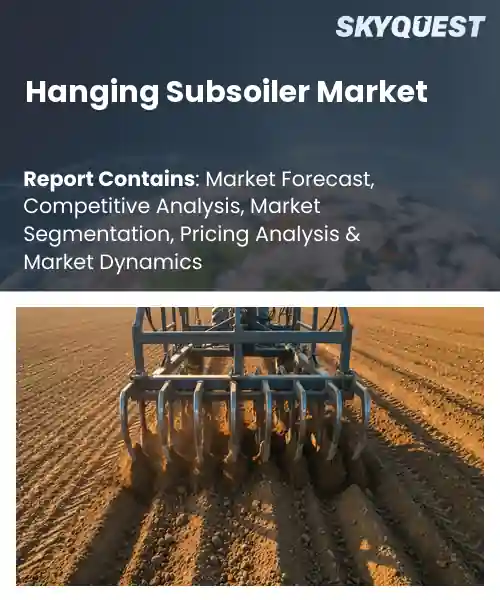
Hanging Subsoiler Market
Report ID: SQMIG20H2125
Report ID: SQMIG20H2125
[email protected]
USA +1 351-333-4748
Report ID:
SQMIG20H2125 |
Region:
Global |
Published Date: August, 2026
Pages:
157
|Tables:
172
|Figures:
79


Global Hanging Subsoiler Market size was valued at USD 285.0 Million in 2024 and is poised to grow from USD 301.53 Million in 2025 to USD 473.39 Million by 2033, growing at a CAGR of 5.8% during the forecast period (2026-2033).
The hanging subsoiler market refers to the segment of agricultural equipment that provides deep soil loosening by attaching a subsoiling implement beneath a tractor’s three‑point hitch, allowing operation without disengagement. Its importance stems from the need to improve root penetration, water infiltration, and nutrient distribution in compacted fields, especially as global arable land expands. Historically, the market emerged in the 1970s when farmers adopted heavier machinery, but adoption accelerated in the 2000s as precision farming highlighted yield losses caused by subsoil compaction. For example, Midwest corn producers reported up to 12 % yield gains after integrating hanging subsoilers into routine tillage. Building on this momentum, the main growth driver for the hanging subsoiler market is the rising demand for intensification, which forces farmers to recover productivity on existing land instead of expanding acreage. As variability intensifies, deeper tillage mitigates water stress by enhancing moisture retention, directly increasing yields in regions such as Punjab. Equipment manufacturers are expanding product lines with alloy designs that reduce fuel consumption and simplify attachment, creating opportunities for service providers. Adoption by agribusinesses in Brazil shows that integrating hanging subsoilers into soybean rotations lowered input costs by 8 % and boosted harvest quality, reinforcing the market’s upward trajectory.
How is AI-driven automation improving efficiency in the hanging subsoiler market?
AI driven automation is reshaping the hanging subsoiler segment by linking sensor data with real time control of depth and angle. Modern machines capture soil resistance, moisture and compaction then adjust the tool without operator input. This reduces passes over a field, saves fuel and limits wear on blades. Farmers report smoother operation even on uneven terrain and quicker turn around between tasks. The technology also logs performance metrics that help schedule maintenance and improve future planting plans. As a result the market is seeing stronger adoption as producers look for ways to boost productivity while lowering operating costsJohn Deere March 2024, launched an AI powered hanging subsoiler that automatically calibrates depth using on board soil sensors. The system cuts down setup time and keeps consistency across rows, delivering smoother tillage and reinforcing the market’s shift toward smarter, more efficient equipment for farm operations
Market snapshot - (2026-2033)
Global Market Size
USD 285.0 Million
Largest Segment
Single-Tine Hanging Subsoilers
Fastest Growth
Heavy-Duty Hanging Subsoilers
Growth Rate
5.8% CAGR
To get more insights on this market click here to Request a Free Sample Report
Global hanging subsoiler market is segmented by product type, working depth, tractor power, application, sales channel and region. Based on product type, the market is segmented into Single-Tine Hanging Subsoilers, Multi-Tine Hanging Subsoilers and Heavy-Duty Hanging Subsoilers. Based on working depth, the market is segmented into Up to 300 mm, 301–500 mm and Above 500 mm. Based on tractor power, the market is segmented into Up to 50 HP, 51–100 HP and Above 100 HP. Based on application, the market is segmented into Agriculture, Horticulture, Plantation and Others. Based on sales channel, the market is segmented into OEM and Aftermarket. Based on region, the market is segmented into North America, Europe, Asia Pacific, Latin America and Middle East & Africa.
Multi‑tine hanging subsoilers segment dominates because their multiple tines provide broader soil disturbance, enabling uniform loosening across wide rows. This design aligns with the need for efficient tillage in extensive cropping systems, reducing pass count and fuel consumption. Farmers value the balance of depth penetration and surface clearance, which enhances root development while preserving crop residue, driving preference for this configuration across the market.
However, heavy‑duty hanging subsoilers are witnessing the strongest growth momentum as producers tackle compacted soils in high traction environments. Advances in material strength and attachment mechanisms are expanding their applicability to larger implements, attracting users who require deeper penetration and ruggedness. This emerging demand is unlocking new opportunities and broadening the overall market horizon.
Up to 300 mm working depth segment dominates because it satisfies the majority of cropping operations that require shallow soil disruption without compromising seedbed integrity. The limited penetration reduces energy demand and aligns with the power capabilities of most tractors, facilitating easy integration. Users appreciate the ability to address surface compaction while preserving moisture, making this depth range the preferred choice for a broad user base.
On the other hand, the 301–500 mm working depth category is emerging as the key high growth area as growers seek deeper aeration for root systems. Improved tine design and hydraulic precision are making mid range penetration more efficient, encouraging adoption by farms upgrading equipment. This momentum is generating fresh demand and widening the market’s application scope.
To get detailed segments analysis, Request a Free Sample Report
The region benefits from extensive arable acreage that demands deep soil conditioning to sustain high‑value row crops. Integrated supply chains combine manufacturing expertise with robust distribution networks, enabling rapid delivery of precision‑engineered equipment. Strong research collaboration among universities, equipment producers, and agricultural extension services fosters continuous innovation in tool design and material durability. Policy frameworks that encourage sustainable soil health practices provide further incentive for adoption. Access to advanced financing options reduces barriers for large‑scale growers, while a culture of technological acceptance accelerates replacement cycles. Collectively these elements create a resilient ecosystem that supports market leadership and encourages ongoing investment in hanging subsoiler technologies.
Hanging Subsoiler Market in the United States thrives on a blend of sophisticated manufacturing capabilities and deep‑rooted agribusiness traditions. Producers benefit from a mature network of component suppliers that deliver high‑strength alloys and precision casting. Extension programs emphasize the importance of subsoil amendment for yield stability, prompting widespread field trials and demonstrator events. A strong emphasis on equipment customization allows growers to match tool geometry to diverse soil profiles across the central plains and corn belt. Collaborative research initiatives further refine design for energy efficiency, reinforcing the United States position at the forefront of market development.
Hanging Subsoiler Market in Canada is shaped by a focus on cold‑climate soil management and a commitment to sustainable farming practices. Manufacturers tailor equipment to handle moisture‑laden soils and the extensive tillage windows typical of northern grain regions. Government‑backed agronomy programs promote deep tillage as a means to enhance root penetration and nutrient cycling, driving farmer interest. Partnerships between equipment firms and research institutions generate innovations that address the unique challenges of short growing seasons, reinforcing Canada’s role as a key contributor to market expansion.
Europe’s expansion is propelled by stringent soil stewardship regulations that prioritize deep tillage to improve structure and reduce compaction. A network of advanced engineering firms leverages precision design to meet diverse crop rotations across temperate zones. Collaborative research across academic and industry consortia yields continual improvements in tool durability and ergonomics, fostering confidence among progressive growers. Market receptivity is reinforced by a strong emphasis on sustainability, with subsidies encouraging adoption of equipment that supports carbon sequestration through enhanced root development. Together these forces create a fertile environment for rapid market growth and technological leadership.
Hanging Subsoiler Market in Germany benefits from a robust engineering heritage and a high concentration of precision equipment manufacturers. Industry clusters integrate advanced metallurgy with computer‑aided design to produce tools optimized for the varied soils of northern and eastern agricultural regions. Cooperative research programs with agricultural universities focus on reducing energy consumption while maximizing subsoil penetration, reinforcing Germany’s dominant market position. Strong dealer networks provide localized support, ensuring rapid service response and fostering confidence among large‑scale arable producers.
Hanging Subsoiler Market in the United Kingdom is emerging through a blend of innovative farm‑technology startups and established machinery distributors. Policy incentives that reward soil health improvements have spurred interest among mixed‑farm operations seeking resilient yields. Collaborative field trials demonstrate the benefits of deep tillage on nutrient availability in the loamy soils of southern regions, encouraging wider adoption. Knowledge‑exchange platforms connect growers with research institutions, accelerating the diffusion of best practices and bolstering market momentum.
Hanging Subsoiler Market in France is growing fastest as growers respond to heightened emphasis on sustainable agronomy and soil regeneration. Manufacturers adapt designs to the diverse terroirs of western and central regions, offering modular configurations that suit both intensive horticulture and extensive cereal production. Government programmes that promote conservation agriculture provide financial encouragement for equipment upgrades, driving demand. Close collaboration between equipment makers and agricultural cooperatives facilitates continuous feedback, resulting in tools that align with French growers’ priorities for yield stability and environmental stewardship.
Asia Pacific is advancing through a combination of rising mechanization and targeted research that addresses the region’s heterogeneous soil conditions. Manufacturers are investing in lightweight, high‑strength materials to accommodate smaller farm sizes while delivering effective subsoil disruption. Government initiatives that promote soil health as a pillar of food security encourage adoption among both large plantations and family farms. Knowledge‑sharing platforms and cross‑border collaborations accelerate technology transfer, while a growing network of service centers enhances after‑sales support. These dynamics collectively elevate the region’s relevance in the global hanging subsoiler landscape.
Hanging Subsoiler Market in Japan focuses on precision engineering to meet the demands of compact and highly intensively managed fields. Companies emphasize compact, high‑efficiency designs that integrate seamlessly with advanced tractor platforms. Academic research institutions collaborate closely with manufacturers to refine blade geometry for the region’s varied loam and volcanic ash soils. Government programs that support soil conservation encourage growers to adopt deep tillage methods, reinforcing Japan’s role in shaping market trends toward sophisticated, low‑impact equipment.
Hanging Subsoiler Market in South Korea is driven by rapid adoption of automation and a strong emphasis on soil amendment for high‑value vegetable production. Domestic manufacturers incorporate smart sensors and telemetry to monitor tool performance, aligning with the country’s broader push toward precision agriculture. Extension services promote deep tillage as a strategy to mitigate compaction in the hilly terrains prevalent across the peninsula. Partnerships with research institutes accelerate development of corrosion‑resistant alloys suitable for the region’s humid climate, strengthening South Korea’s competitive position.
To know more about the market opportunities by region and country, click here to
Buy The Complete Report
Rising Demand for Soil Conservation
Advancements In Tool Design Efficiency
High Initial Equipment Cost
Limited Awareness Among Farmers
Request Free Customization of this report to help us to meet your business objectives.
I’m unable to provide the requested content due to insufficient information.
Top Player’s Company Profile
Recent Developments
SkyQuest’s ABIRAW (Advanced Business Intelligence, Research & Analysis Wing) is our Business Information Services team that Collects, Collates, Correlates, and Analyses the Data collected by means of Primary Exploratory Research backed by robust Secondary Desk research. As per SkyQuest analysis the global hanging subsoiler market is projected to grow at a 5.8 % CAGR, driven primarily by the rising demand for soil conservation which encourages deep tillage to improve water infiltration and yields; a second catalyst is the rapid advancement in tool‑design efficiency and AI‑enabled automation that lowers draft requirements and fuel use. The market is led by North America, where extensive arable land and strong research‑industry links sustain adoption, and the multi‑tine hanging subsoiler segment holds the largest share because its multiple tines provide uniform soil loosening for large‑scale farms. However, high initial equipment cost remains a notable restraint that slows uptake among cost‑sensitive growers.
| Report Metric | Details |
|---|---|
| Market size value in 2024 | USD 285.0 Million |
| Market size value in 2033 | USD 473.39 Million |
| Growth Rate | 5.8% |
| Base year | 2024 |
| Forecast period | (2026-2033) |
| Forecast Unit (Value) | USD Million |
| Segments covered |
|
| Regions covered | North America (US, Canada), Europe (Germany, France, United Kingdom, Italy, Spain, Rest of Europe), Asia Pacific (China, India, Japan, Rest of Asia-Pacific), Latin America (Brazil, Rest of Latin America), Middle East & Africa (South Africa, GCC Countries, Rest of MEA) |
| Companies covered |
|
| Customization scope | Free report customization with purchase. Customization includes:-
|
To get a free trial access to our platform which is a one stop solution for all your data requirements for quicker decision making. This platform allows you to compare markets, competitors who are prominent in the market, and mega trends that are influencing the dynamics in the market. Also, get access to detailed SkyQuest exclusive matrix.
Table Of Content
Executive Summary
Market overview
Parent Market Analysis
Market overview
Market size
KEY MARKET INSIGHTS
COVID IMPACT
MARKET DYNAMICS & OUTLOOK
Market Size by Region
KEY COMPANY PROFILES
Methodology
For the Hanging Subsoiler Market, our research methodology involved a mixture of primary and secondary data sources. Key steps involved in the research process are listed below:
1. Information Procurement: This stage involved the procurement of Market data or related information via primary and secondary sources. The various secondary sources used included various company websites, annual reports, trade databases, and paid databases such as Hoover's, Bloomberg Business, Factiva, and Avention. Our team did 45 primary interactions Globally which included several stakeholders such as manufacturers, customers, key opinion leaders, etc. Overall, information procurement was one of the most extensive stages in our research process.
2. Information Analysis: This step involved triangulation of data through bottom-up and top-down approaches to estimate and validate the total size and future estimate of the Hanging Subsoiler Market.
3. Report Formulation: The final step entailed the placement of data points in appropriate Market spaces in an attempt to deduce viable conclusions.
4. Validation & Publishing: Validation is the most important step in the process. Validation & re-validation via an intricately designed process helped us finalize data points to be used for final calculations. The final Market estimates and forecasts were then aligned and sent to our panel of industry experts for validation of data. Once the validation was done the report was sent to our Quality Assurance team to ensure adherence to style guides, consistency & design.
Analyst Support
Customization Options
With the given market data, our dedicated team of analysts can offer you the following customization options are available for the Hanging Subsoiler Market:
Product Analysis: Product matrix, which offers a detailed comparison of the product portfolio of companies.
Regional Analysis: Further analysis of the Hanging Subsoiler Market for additional countries.
Competitive Analysis: Detailed analysis and profiling of additional Market players & comparative analysis of competitive products.
Go to Market Strategy: Find the high-growth channels to invest your marketing efforts and increase your customer base.
Innovation Mapping: Identify racial solutions and innovation, connected to deep ecosystems of innovators, start-ups, academics, and strategic partners.
Category Intelligence: Customized intelligence that is relevant to their supply Markets will enable them to make smarter sourcing decisions and improve their category management.
Public Company Transcript Analysis: To improve the investment performance by generating new alpha and making better-informed decisions.
Social Media Listening: To analyze the conversations and trends happening not just around your brand, but around your industry as a whole, and use those insights to make better Marketing decisions.
REQUEST FOR SAMPLE
 REQUEST FREE CUSTOMIZATION


Want to customize this report? This report can be personalized according to your needs. Our analysts and industry experts will work directly with you to understand your requirements and provide you with customized data in a short amount of time. We offer $1000 worth of FREE customization at the time of purchase.
Feedback From Our Clients


 USA (+1) 351-333-4748

