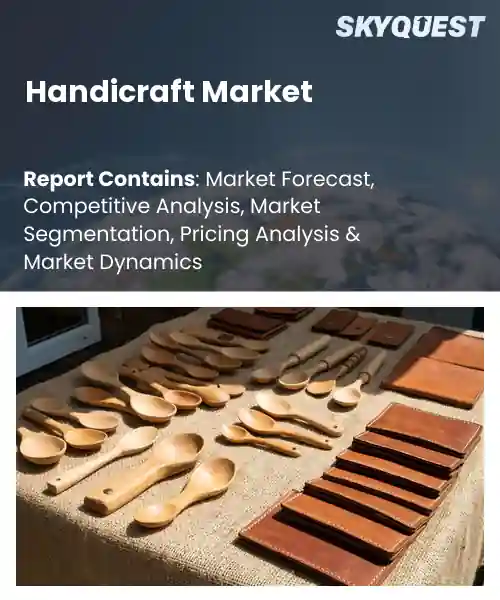
Handicraft Market
Report ID: SQMIG25K2143
Report ID: SQMIG25K2143
[email protected]
USA +1 351-333-4748
Report ID:
SQMIG25K2143 |
Region:
Global |
Published Date: February, 2026
Pages:
157
|Tables:
96
|Figures:
76


Global Handicraft Market size was valued at USD 732.1 Billion in 2024 and is poised to grow from USD 771.63 Billion in 2025 to USD 1175.27 Billion by 2033, growing at a CAGR of 5.4% during the forecast period (2026-2033).
Growing demand for authentic, sustainable, and culturally rooted products, rising appreciation for artisanal craftsmanship, expanding tourism, digitization of sales channels, and emphasis on ethical consumption are driving sales of handicrafts.
Growing consumer preference for handmade and provenance-rich products around the world, coupled with a shift toward sustainability and cultural preservation, is expected to primarily drive handicraft market growth. Defined broadly, the handicraft market encompasses handmade goods produced by local artisans who pass traditional skills and designs across generations, supporting economic inclusion and cultural continuity. The evolution from local bazaars to digital platforms has enabled artisans—from Rajasthan’s block-printed textiles to Moroccan ceramics—to access global buyers, diversify revenues, and attract impact investors. Digitization of distribution channels through platforms such as Etsy and Amazon Handmade has reduced intermediaries, expanded international reach, and improved artisan margins. Complementary support from tourism-led craft trails, ethical certification schemes, and corporate procurement programs is further creating scalable opportunities for inclusive growth.
On the contrary, price sensitivity compared to mass-produced goods, inconsistent quality standards, limited access to finance and raw materials, supply chain fragmentation, and risks of cultural imitation and commodification are anticipated to slow down handicraft market penetration in the long run.
AI is reshaping the handicraft market across design, production, and sales. Key applications include generative design for exploring patterns, image enhancement for high-quality product presentation, and AI-driven personalization for buyers. Today, many independent makers use AI to accelerate concept development while preserving the handmade finishing that defines authenticity. This shift aligns with rising buyer interest in unique, customized items, alongside stronger platform requirements around disclosure, transparency, and provenance. In practice, AI-generated mockups help artisans shorten listing times, while conversational assistants support product descriptions, pricing logic, and customer communication.
Market snapshot - 2026-2033
Global Market Size
USD 732.1 Billion
Largest Segment
Apparel & Accessories
Fastest Growth
Potteryware
Growth Rate
5.4% CAGR
To get more insights on this market click here to Request a Free Sample Report
The global handicraft market is segmented by product, distribution channel, end-user, and region. Based on product, the market is segmented into apparel & accessories, woodwork, glassware, pottery warepottery ware, metal artworks, kitchen & tableware, sculpture, fragrance & incense, and others. Based on distribution channels, the market is segmented into mass retailers, independent retailers, specialty stores, and online. Based on end-user, the market is segmented into residential and commercial. Based on region, the market is segmented into North America, Europe, Asia Pacific, Latin America and Middle East & Africa.
The independent retailers segment is forecasted to lead the global handicraft market revenue generation potential in the future. The robust presence of artisan-owned shops, cooperatives, and local boutiques across multiple parts of the world allows this segment to hold sway over others. Direct relationships between artisans and buyers enable better customization, fair pricing, and trust. Their deep presence in tourist destinations and urban cultural hubs further sustains their dominant role.
On the other hand, online channels emerge as the fastest expanding segment as per this handicraft market forecast. E-commerce platforms and social commerce allow artisans to bypass intermediaries and reach international buyers at lower costs. Advanced tools for visual merchandising, AI-assisted listings, and secure digital payments are accelerating adoption.
The residential segment is estimated to hold the largest handicraft market share going forward. High purchase of handmade décor, furnishings, textiles, and gift items from individual consumers is helping this segment maintain its dominant stance. Handcrafted products are widely used for interior decoration, gifting, and lifestyle enhancement, especially in urban homes and tourist-driven purchases
Meanwhile, the commercial segment is slated to exhibit impressive CAGR in the long run. Businesses are using handicrafts to enhance brand identity, create experiential spaces, and demonstrate sustainability commitments. Growth in hospitality, themed retail, and cultural tourism has accelerated bulk and customized orders from artisans.
To get detailed segments analysis, Request a Free Sample Report
Rich cultural heritage, deep artisan knowledge, and integrated value chains are expected to help Asia Pacific lead to the global demand for handicrafts. Traditionally, crafts like pottery, lead tos, metals, as well as paper crafts, have been popular in multiple countries such as India, China, Japan, and Indonesia. The presence of a skilled workforce across ceramics, textiles, metalwork, and paper arts industries is also contributing to the dominance of this region. Growing interest from design professionals and lifestyle brands has fostered collaborations that modernize traditional techniques without eroding authenticity also creates new business scope.
Deep artisan traditions, meticulous craftsmanship, and a strong cultural emphasis on technique and material quality are expected to help boost handicraft industry growth in Japan. High demand for handicraftsmade with authenticity and provenance has allowed sustained sales for small artisans ashandicraft vendors. Retail channels blend traditional storefronts and curated modern boutiques, which are also expected to create new opportunities in the future.
The handicraft industry in South Korea is defined by contemporary design sensibilities and adoption of heritage techniques. The collaboration of designers with craftspeople elevates traditional materials, while the use of digital channels increases its accessibility to more consumers. Organization of craft events also fosters interest in handicraft and other arts. Boutique retail and lifestyle brands are expected to lead tothe sales and procurement of handicrafts in the country going forward.
Growing consumer interest in authenticity, heritage techniques, and sustainable consumption is primarily shaping the demand for handicrafts in European countries. Europe offers exceptional design bases that prompt fresh interpretations of handicraft products through new design aesthetics. Supportive policy frameworks, craft centers, and vocational training help maintain skill pipelines in the region, thereby creating a highly opportune setting for handicraft companies going forward. Cross border cultural exchange and regional craft fairs further elevate visibility, positioning Europe as a dynamic growth arena for handcrafted goods with varied local identities and international appeal.
High consumer interest in and emphasis on precision, high quality materials, and organized artisan networks are shaping handicraft adoption in Germany. Availability of occational training and craft guilds createsa sustained skill community that facilitates creation of novel handicrafts. Institutional support from cultural organizations and trade platforms helps makers access curated retail and export channels throughoutthe country through 2033 and beyond.
Widespread adoption of online channels by handicraft makers to increase visibility is helping boost market development in the country. Presence of leading craft hubs and studios encourage designer maker collaboration and experimentation across the United Kingdom. Preference and demand for sustainable, locally made handicraft goods is expected to be high among British consumers across the forecast period. Targeted skill initiative launches for handicraft skill development are also supporting sustained market growth.
Emphasis on regional traditions, artisanal revival, and influence of strong design institutions are shaping handicraft demand in France. Combining artisanal skills with contemporary aesthetics is a major trend for handicraft companies looking to make a mark in this country. Boutique retail, ateliers open to public and collaborations with designers elevate visibility. Policy initiatives and heritage promotion help preserve techniques while enabling makers to explore premium positioning and diversified sales channels.
Sustainable business ventures, supportive ecosystems, and growing consumer demand for handmade and sustainable goods are shaping handicraft demand across North America. Moreover, there are options like internet marketing through which artisans can reach niche identities living beyond their geographical landscape. Increasing collaboration between designers, artisans, and lifestyle brands has helped elevate craft aesthetics and commercial viability for various handicraft products. Policy programs, community level funding, and curated events are also creating a new business scope for market players focused on this region.
Vibrant regional maker communities, strong craft education programs, and entrepreneurial culture that support small artisan businesses. Diverse retail channels from independent boutiques to online sales are also helping boost sales potential of handicraft companies. Moreover, partnerships with local designers assist in introducing contemporary elements, which is also forecasted to further enhance the business scope of handicraft suppliers operating in the United States.
Indigenous craft traditions and community artisans contributing to the cultural identity of Canada are helping drive consistent handicraft demand. Provincial craft councils and programs support skills training and market development, while collaborations with designers encourage contemporary interpretations. Presence of a multicultural population base is also forecasted to help generate new opportunities for handicraft suppliers focused on Canada.
To know more about the market opportunities by region and country, click here to
Buy The Complete Report
Expansion of the e-commerce industry has allowed broader consumer access to handicrafts created by artisans and small producers. Online platforms provide curated storefronts, narrative-rich product pages, and targeted discovery tools that help handicraft makers present provenance, techniques, and cultural context. This increased visibility supports brand building, sustained customer relationships, and the ability to respond to consumer preferences, which bolsters the overall handicraft market outlook as well.
Increasing consumer interest in authentic, handmade, and culturally rooted products is expanding the sales potential for Handicraft providers. Emphasis on provenance, artisanal techniques, and personalized stories is also expected to create new opportunities for market players. This consumer-driven demand fosters longer product lifecycles, repeat purchases, and curated collections that amplifyhandicraft demand in the long run.
High fragmentation of supply chains due to the presence of numerous small, geographically dispersed artisans creates challenges for handicraft vendors. Lack of coordination, standardization, and reliable fulfillment is restraining the market from attaining its full growth potential. Variability in raw material availability, differing craft techniques, and inconsistent quality control inhibit predictable production cycles and complicate integration with broader retail and logistics systems.
Lack of strong intellectual property rights protection and the prevalence of imitation handicrafts undermine the perceived value of genuine handicrafts. This acts as a disincentive for artisans as well as businesses to purchase them. Traditional designs are copied, which again leads to a situation where artisans do not have any incentives to innovate or share their special knowledge.
Request Free Customization of this report to help us to meet your business objectives.
Shift towards direct-to-consumer channels backed by an e-commerce boom is a major strategy that has changed the trajectory of all handicraft vendors. Improving supply chain flexibility and ensuring continuity despite fragmentation remains the prime focus of leadinghandicraft companies. Targeting countries with rich cultural heritage and skilled craft populations is a key opportunity as per this handicraft market analysis.
Here are some startups that are expected to digitize the handicraft industry and open up new avenues of business through 2033 and beyond.
𝐃𝐢𝐠𝐢𝐭𝐚𝐥 𝐃𝐢𝐫𝐞𝐜𝐭 𝐭𝐨 𝐂𝐨𝐧𝐬𝐮𝐦𝐞𝐫: Artisans and craft brands are focusing on opting digital direct to consudirect oels to reach global audiences without intermediaries. Booming popularity of online storefronts, social commerce and storytelling has allowed for better reach of handicrafts to consumers. Collaboration with platforms and immersive content helps translate tactile heritage into digital engagement, which reiterates the importance of this handicraft market trend through 2033.
𝐒𝐮𝐬𝐭𝐚𝐢𝐧𝐚𝐛𝐥𝐞 𝐚𝐧𝐝 𝐄𝐭𝐡𝐢𝐜𝐚𝐥 𝐂𝐫𝐚𝐟𝐭𝐢𝐧𝐠: Growing emphasis on sustainability and rising consumer awareness regarding the same are creating new opportunities for market players. Artisans and handicraftcompanies are focusing on using sustainable methods, eco-friendly materials, and ethical business models to comply with changing standards. Initiatives such as circular design, upcycling, and long-life repair narratives further bolster the importance of this handicraft industry trend.
SkyQuest’s ABIRAW (Advanced Business Intelligence, Research & Analysis Wing) is our Business Information Services team that Collects, Collates, Correlates, and Analyses the Data collected by means ofPrimary Exploratory Research backed by robust Secondary Desk research.
As per SkyQuest analysis, rising consumer demand for authentic, sustainable, and culturally rooted products is anticipated to drive the demand for handicrafts going forward. However, competition from low-cost mass-produced alternatives, limited scalability of artisanal production, and inconsistent quality standards are slated to slow down the adoption of handicrafts in the future. Asia Pacific is slated to spearhead the demand for handicrafts owing to its rich artisan base, strong cultural heritage, and expanding tourism and e-commerce ecosystems. Growth of online craft marketplaces, increasing use of AI-enabled seller tools, and rising adoption of ethical certification and provenance tracking are anticipated to be key trends driving the handicraft sector in the long run.
| Report Metric | Details |
|---|---|
| Market size value in 2024 | USD 732.1 Billion |
| Market size value in 2033 | USD 1175.27 Billion |
| Growth Rate | 5.4% |
| Base year | 2024 |
| Forecast period | 2026-2033 |
| Forecast Unit (Value) | USD Billion |
| Segments covered |
|
| Regions covered | North America (US, Canada), Europe (Germany, France, United Kingdom, Italy, Spain, Rest of Europe), Asia Pacific (China, India, Japan, Rest of Asia-Pacific), Latin America (Brazil, Rest of Latin America), Middle East & Africa (South Africa, GCC Countries, Rest of MEA) |
| Companies covered |
|
| Customization scope | Free report customization with purchase. Customization includes:-
|
To get a free trial access to our platform which is a one stop solution for all your data requirements for quicker decision making. This platform allows you to compare markets, competitors who are prominent in the market, and mega trends that are influencing the dynamics in the market. Also, get access to detailed SkyQuest exclusive matrix.
Table Of Content
Executive Summary
Market overview
Parent Market Analysis
Market overview
Market size
KEY MARKET INSIGHTS
COVID IMPACT
MARKET DYNAMICS & OUTLOOK
Market Size by Region
KEY COMPANY PROFILES
Methodology
For the Handicraft Market, our research methodology involved a mixture of primary and secondary data sources. Key steps involved in the research process are listed below:
1. Information Procurement: This stage involved the procurement of Market data or related information via primary and secondary sources. The various secondary sources used included various company websites, annual reports, trade databases, and paid databases such as Hoover's, Bloomberg Business, Factiva, and Avention. Our team did 45 primary interactions Globally which included several stakeholders such as manufacturers, customers, key opinion leaders, etc. Overall, information procurement was one of the most extensive stages in our research process.
2. Information Analysis: This step involved triangulation of data through bottom-up and top-down approaches to estimate and validate the total size and future estimate of the Handicraft Market.
3. Report Formulation: The final step entailed the placement of data points in appropriate Market spaces in an attempt to deduce viable conclusions.
4. Validation & Publishing: Validation is the most important step in the process. Validation & re-validation via an intricately designed process helped us finalize data points to be used for final calculations. The final Market estimates and forecasts were then aligned and sent to our panel of industry experts for validation of data. Once the validation was done the report was sent to our Quality Assurance team to ensure adherence to style guides, consistency & design.
Analyst Support
Customization Options
With the given market data, our dedicated team of analysts can offer you the following customization options are available for the Handicraft Market:
Product Analysis: Product matrix, which offers a detailed comparison of the product portfolio of companies.
Regional Analysis: Further analysis of the Handicraft Market for additional countries.
Competitive Analysis: Detailed analysis and profiling of additional Market players & comparative analysis of competitive products.
Go to Market Strategy: Find the high-growth channels to invest your marketing efforts and increase your customer base.
Innovation Mapping: Identify racial solutions and innovation, connected to deep ecosystems of innovators, start-ups, academics, and strategic partners.
Category Intelligence: Customized intelligence that is relevant to their supply Markets will enable them to make smarter sourcing decisions and improve their category management.
Public Company Transcript Analysis: To improve the investment performance by generating new alpha and making better-informed decisions.
Social Media Listening: To analyze the conversations and trends happening not just around your brand, but around your industry as a whole, and use those insights to make better Marketing decisions.
REQUEST FOR SAMPLE
 REQUEST FREE CUSTOMIZATION
Global Handicraft Market size was valued at USD 732.1 Billion in 2024 and is poised to grow from USD 771.63 Billion in 2025 to USD 1175.27 Billion by 2033, growing at a CAGR of 5.4% during the forecast period (2026-2033).
Competitive landscape shows active consolidation and vertical specialization as platforms use targeted acquisitions and category plays to lock in artisan supply and consumer communities, while competition is driven by channel partnerships and tech differentiation such as immersive product visualization and design tooling; concrete examples include marketplace acquisitions and D2C funding led partnerships that accelerate omnichannel rollouts and platform innovation. 'Pendleton Woolen Mills', 'Simon Pearce', 'Sheldon Ceramics', 'Jars of Dust', 'Native Crafts and Arts, Inc.', 'Peking Handicraft Inc.', 'Ten Thousand Villages', 'The India Craft House', 'Colonial Tin Works, Inc.', 'Asian Handicrafts Pvt. Ltd.', 'Creative Expressions', 'Monague Native Crafts', 'PT Harmoni Jaya Kreasi', 'PT Fuzen Decor Bali', 'Laizhou Zhonghe Arts & Crafts Co. Ltd.', 'Gangga Sukta', 'Asian Handicrafts', 'Minhou Minxing Weaving Co. Ltd.', 'Fakih Group of Companies', 'Handmade in America'
Ecommerce expansion enhances the global reach of artisans and small producers by opening direct to consumer channels that reduce intermediaries and preserve craft authenticity. Online platforms provide curated storefronts, narrative-rich product pages, and targeted discovery tools that help handicraft makers present provenance, techniques, and cultural context. This increased visibility supports brand building, sustained customer relationships, and the ability to respond to consumer preferences, encouraging artisans to scale offerings and diversify portfolios while maintaining artisanal value and identity, thereby contributing to market growth through broader market access and sustained demand.
Why does Asia Pacific Dominate the Global Handicraft Market? |@12


Want to customize this report? This report can be personalized according to your needs. Our analysts and industry experts will work directly with you to understand your requirements and provide you with customized data in a short amount of time. We offer $1000 worth of FREE customization at the time of purchase.
Feedback From Our Clients


 USA (+1) 351-333-4748

