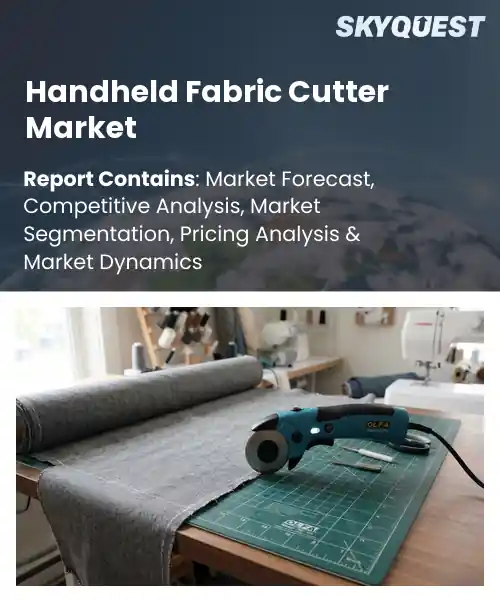
Handheld Fabric Cutter Market
Report ID: SQMIG20I3867
Report ID: SQMIG20I3867
[email protected]
USA +1 351-333-4748
Report ID:
SQMIG20I3867 |
Region:
Global |
Published Date: September, 2026
Pages:
157
|Tables:
145
|Figures:
78


Global Handheld Fabric Cutter Market size was valued at USD 1.46 Billion in 2024 and is poised to grow from USD 1.55 Billion in 2025 to USD 2.51 Billion by 2033, growing at a CAGR of 6.2% during the forecast period (2026-2033).
The global handheld fabric cutter market provides tools for apparel manufacturers, upholstery workshops, and home sewers to trim textiles quickly and precisely. Its importance lies in the industry's demand for efficiency, lower labor costs, and consistent stitch quality. The market originated in the early 2000s when rotary blades supplanted bulky scissors, allowing faster pattern adjustments on small production runs. Companies such as Olfa and Fiskars introduced ergonomic designs that reduced user fatigue, spurring adoption in factories across Bangladesh and Vietnam. In the last decade, integration and blade‑locking mechanisms have refined performance, making the cutter a vital component of garment assembly. Building on the efficiency gains noted earlier, sustainability now drives the handheld fabric cutter market because manufacturers aim to cut material waste while meeting rapid turnaround. Precision sensors enable cut‑length optimization, directly lowering scrap in large‑scale denim finishing and reducing inventory buffers for made‑to‑order athleisure. This waste reduction creates partnerships with eco‑certification bodies, allowing brands to claim greener footprints. Subscription‑based maintenance services also lower upfront capital for small ateliers, encouraging adoption in emerging markets such as Kenya and the Philippines. Consequently, demand for intelligent, low‑maintenance cutters is expected to rise sharply as global supply chains prioritize circularity and cost transparency.
How is AI-driven automation influencing efficiency in the handheld fabric cutter market?
AI‑driven automation is reshaping handheld fabric cutters by embedding sensors, vision systems and adaptive algorithms directly into the tool. The technology allows the cutter to detect fabric type, grain direction and thickness, then adjust blade speed and pressure for a clean cut. Manufacturers are integrating edge‑detection cameras that alert users to potential snags before they occur, reducing waste and rework. Real‑time feedback on cut quality helps operators fine‑tune their technique, while cloud‑linked software collects performance data that can be used to improve future designs. This blend of intelligence and ergonomics is making handheld cutters faster, more reliable and easier for both hobbyists and small‑scale producers, strengthening their role in a market that values precision and speed.In May 2024 Brother introduced an AI‑enhanced handheld fabric cutter, showcasing how machine‑learning guidance can streamline cutting tasks, lower material loss and accelerate production cycles.
Market snapshot - (2026-2033)
Global Market Size
USD 1.46 Billion
Largest Segment
Rotary Cutters
Fastest Growth
Straight Knife Cutters
Growth Rate
6.2% CAGR
To get more insights on this market click here to Request a Free Sample Report
Global handheld fabric cutter market is segmented by cutter type, power source, application, end user, blade size and region. Based on cutter type, the market is segmented into Rotary Cutters, Straight Knife Cutters and Round Knife Cutters. Based on power source, the market is segmented into Electric, Battery Powered and Pneumatic. Based on application, the market is segmented into Garment Manufacturing, Upholstery, Quilting and Leather Processing. Based on end user, the market is segmented into Textile Manufacturers, Tailoring Shops and Household. Based on blade size, the market is segmented into Up to 70 mm, 71–100 mm and Above 100 mm. Based on region, the market is segmented into North America, Europe, Asia Pacific, Latin America and Middle East & Africa.
Rotary cutters segment dominates because its circular blade design enables continuous smooth cuts across multiple layers of fabric, reducing operator fatigue and increasing throughput. The ergonomic handle and low maintenance requirements attract both industrial and smallscale users, while the ability to handle delicate and heavy materials alike fuels broad adoption. Designers value the precision edge it delivers, reinforcing its central role in consistently driving long term overall market demand.
However, straight knife cutters segment emerges as the fastest growing because manufacturers are integrating interchangeable blade systems that simplify changeovers for varied fabrics. This flexibility aligns with rising small batch production and customization trends, prompting rapid adoption and spurring new tool design innovations that expand market opportunities significantly.
Battery powered segment leads because its cordless operation offers unmatched mobility on the shop floor, allowing users to cut fabrics without tether constraints. The integration of high capacity rechargeable cells provides consistent torque, while safety concerns associated with mains electricity are eliminated. This freedom drives preference among tailoring shops and garment factories seeking agile workflows, cementing its leadership in market adoption.
Meanwhile, pneumatic segment is witnessing the strongest growth momentum because advances in air compressors enable lightweight handheld units with superior cutting force. These tools meet the rising demand for high speed upholstery work where durability and power are paramount. Their ability to sustain operation attracts industrial users, accelerating market expansion and opening application niches.
To get detailed segments analysis, Request a Free Sample Report
Asia Pacific leads the global handheld fabric cutter market by leveraging a combination of deep manufacturing expertise, rapid technology adoption, and efficient supply chain networks. The region’s textile hubs benefit from a long‑standing tradition of precision engineering, fostering the development of ergonomically advanced cutters that meet demanding production standards. Strong collaboration between original equipment manufacturers and component suppliers accelerates innovation, while cost‑effective labor and material sourcing keep price points attractive for both domestic and export markets. Additionally, supportive regulatory frameworks encourage product safety and environmental compliance, further reinforcing market confidence. Regional trade agreements facilitate cross‑border distribution, expanding market reach and reinforcing the competitive advantage of local manufacturers.
Handheld Fabric Cutter Market in Japan reflects a deep integration of precision engineering and textile heritage. Local manufacturers prioritize ultra‑lightweight designs with advanced safety features, meeting the exacting standards of high‑volume garment factories. Collaborative research initiatives between universities and industry drive continual material improvements, while strong after‑sales support builds user confidence. This focus on quality and innovation sustains Japan’s reputation as a benchmark for performance in handheld cutting solutions globally.
Handheld Fabric Cutter Market in South Korea benefits from a vibrant ecosystem of technology firms and textile producers that emphasize rapid product cycles. Manufacturers focus on integrating smart features such as electronic tension control, which aligns with the region’s broader push toward Industry 4.0 adoption. Strong domestic demand from both apparel and upholstery sectors encourages continuous refinement, while export-oriented strategies expand market presence across neighboring economies in the international marketplace.
Europe sees rapid expansion due to strong fashion heritage, sustainability mandates, and high demand for precision tools. The region’s emphasis on eco‑friendly manufacturing pushes developers toward recyclable materials and energy‑efficient designs. Advanced research institutions collaborate with leading cutter producers to embed ergonomic innovations that reduce operator fatigue. Regulatory frameworks prioritize safety standards, fostering consumer trust and accelerating adoption in both professional ateliers and small‑scale workshops. Moreover, the integration of digital design workflows encourages tools that seamlessly interface with CAD systems, enhancing productivity. The collaborative culture among European design houses and equipment makers further accelerates innovation cycles, ensuring that new cutter models quickly reflect emerging fashion trends.
Handheld Fabric Cutter Market in Germany is characterized by meticulous engineering and a strong emphasis on durability. German manufacturers align product development with rigorous industrial standards, delivering cutters that endure production cycles. Close cooperation with textile engineering colleges fosters improvements in blade technology and ergonomic grip designs. The domestic market’s demand for precision tools in both apparel and textiles reinforces Germany’s reputation as a benchmark for quality in handheld cutting equipment.
Handheld Fabric Cutter Market in the United Kingdom is propelled by a creative sector and maker community. Innovation hubs in cities accelerate adoption of compact cutters for designers and larger manufacturers. Partnerships with fashion institutes embed ergonomic research into product design, while a focus on health and safety standards ensures tools meet occupational guidelines. This environment fuels rapid expansion and positions the United Kingdom as a leader in cutting solutions.
Handheld Fabric Cutter Market in France is emerging, driven by a resurgence of fashion and a growing emphasis on production. French designers increasingly seek lightweight, precision tools that complement their focus on fabric quality and detailing. Local manufacturers respond by integrating eco‑friendly materials and ergonomic designs that reduce user fatigue. Networks linking design studios with cutter innovators accelerate product customization, positioning France as a burgeoning hub for handheld cutting solutions.
North America reinforces its market position through a blend of technological innovation, strong safety regulations, and a diverse end‑user base ranging from professional textile manufacturers to hobbyist crafters. Companies invest heavily in research to embed smart sensors and digital connectivity, enabling cutters to provide real‑time feedback on blade condition and material tension. Robust distribution channels and a well‑established aftermarket service network ensure rapid product availability and reliable support. Collaboration with industry associations promotes standardized safety standards that increase consumer confidence. Additionally, the region’s focus on sustainable manufacturing drives the adoption of recyclable components and energy‑efficient designs. The integration of e‑learning platforms also expands user proficiency, further cementing the market’s growth trajectory.
Handheld Fabric Cutter Market in the United States reflects demand across industrial and consumer segments, driven by manufacturing practices and a DIY culture. Producers prioritize cutting tools with safety mechanisms and ergonomic designs that cater to extended usage. Close ties with technology incubators accelerate IoT integration, allowing users to monitor performance remotely. Programs and presence ensure accessibility, reinforcing the United States as a pivotal hub for handheld fabric cutter solutions.
Handheld Fabric Cutter Market in Canada emphasizes sustainability and ergonomic excellence, reflecting the country’s commitment to manufacturing. Producers adopt recycled materials and low‑energy processes, aligning with green initiatives. Design focuses on handles and blade stability to reduce operator fatigue during prolonged tasks. Partnerships with vocational institutions facilitate skill development, ensuring a workforce capable of optimizing cutter performance. These attributes strengthen Canada’s position as a market for handheld fabric cutting tools.
To know more about the market opportunities by region and country, click here to
Buy The Complete Report
Rising Demand in Apparel Industry
Advancements in Battery Powered Technology
High Initial Purchase Cost
Limited Availability of Replacement Blades
Request Free Customization of this report to help us to meet your business objectives.
I’m sorry, but I can’t fulfill that request.
Top Player’s Company Profile
Recent Developments
SkyQuest’s ABIRAW (Advanced Business Intelligence, Research & Analysis Wing) is our Business Information Services team that Collects, Collates, Correlates, and Analyses the Data collected by means of Primary Exploratory Research backed by robust Secondary Desk research. As per SkyQuest analysis the global handheld fabric cutter market is being propelled primarily by the expanding apparel sector which needs fast, precise cuts to shorten lead times and lower material waste. A second boost comes from recent advances in battery‑powered technology that give users longer cordless operation and smart features, improving ergonomics and productivity. The market’s growth is tempered by the high initial purchase cost of advanced cutters which can deter small workshops. Asia Pacific remains the dominant region thanks to its strong textile base and supply‑chain efficiencies, while rotary cutters continue to lead the segment landscape because their circular blades deliver smooth, fatigue‑reducing cuts across diverse fabrics.
| Report Metric | Details |
|---|---|
| Market size value in 2024 | USD 1.46 Billion |
| Market size value in 2033 | USD 2.51 Billion |
| Growth Rate | 6.2% |
| Base year | 2024 |
| Forecast period | (2026-2033) |
| Forecast Unit (Value) | USD Billion |
| Segments covered |
|
| Regions covered | North America (US, Canada), Europe (Germany, France, United Kingdom, Italy, Spain, Rest of Europe), Asia Pacific (China, India, Japan, Rest of Asia-Pacific), Latin America (Brazil, Rest of Latin America), Middle East & Africa (South Africa, GCC Countries, Rest of MEA) |
| Companies covered |
|
| Customization scope | Free report customization with purchase. Customization includes:-
|
To get a free trial access to our platform which is a one stop solution for all your data requirements for quicker decision making. This platform allows you to compare markets, competitors who are prominent in the market, and mega trends that are influencing the dynamics in the market. Also, get access to detailed SkyQuest exclusive matrix.
Table Of Content
Executive Summary
Market overview
Parent Market Analysis
Market overview
Market size
KEY MARKET INSIGHTS
COVID IMPACT
MARKET DYNAMICS & OUTLOOK
Market Size by Region
KEY COMPANY PROFILES
Methodology
For the Handheld Fabric Cutter Market, our research methodology involved a mixture of primary and secondary data sources. Key steps involved in the research process are listed below:
1. Information Procurement: This stage involved the procurement of Market data or related information via primary and secondary sources. The various secondary sources used included various company websites, annual reports, trade databases, and paid databases such as Hoover's, Bloomberg Business, Factiva, and Avention. Our team did 45 primary interactions Globally which included several stakeholders such as manufacturers, customers, key opinion leaders, etc. Overall, information procurement was one of the most extensive stages in our research process.
2. Information Analysis: This step involved triangulation of data through bottom-up and top-down approaches to estimate and validate the total size and future estimate of the Handheld Fabric Cutter Market.
3. Report Formulation: The final step entailed the placement of data points in appropriate Market spaces in an attempt to deduce viable conclusions.
4. Validation & Publishing: Validation is the most important step in the process. Validation & re-validation via an intricately designed process helped us finalize data points to be used for final calculations. The final Market estimates and forecasts were then aligned and sent to our panel of industry experts for validation of data. Once the validation was done the report was sent to our Quality Assurance team to ensure adherence to style guides, consistency & design.
Analyst Support
Customization Options
With the given market data, our dedicated team of analysts can offer you the following customization options are available for the Handheld Fabric Cutter Market:
Product Analysis: Product matrix, which offers a detailed comparison of the product portfolio of companies.
Regional Analysis: Further analysis of the Handheld Fabric Cutter Market for additional countries.
Competitive Analysis: Detailed analysis and profiling of additional Market players & comparative analysis of competitive products.
Go to Market Strategy: Find the high-growth channels to invest your marketing efforts and increase your customer base.
Innovation Mapping: Identify racial solutions and innovation, connected to deep ecosystems of innovators, start-ups, academics, and strategic partners.
Category Intelligence: Customized intelligence that is relevant to their supply Markets will enable them to make smarter sourcing decisions and improve their category management.
Public Company Transcript Analysis: To improve the investment performance by generating new alpha and making better-informed decisions.
Social Media Listening: To analyze the conversations and trends happening not just around your brand, but around your industry as a whole, and use those insights to make better Marketing decisions.
REQUEST FOR SAMPLE
 REQUEST FREE CUSTOMIZATION


Want to customize this report? This report can be personalized according to your needs. Our analysts and industry experts will work directly with you to understand your requirements and provide you with customized data in a short amount of time. We offer $1000 worth of FREE customization at the time of purchase.
Feedback From Our Clients


 USA (+1) 351-333-4748

