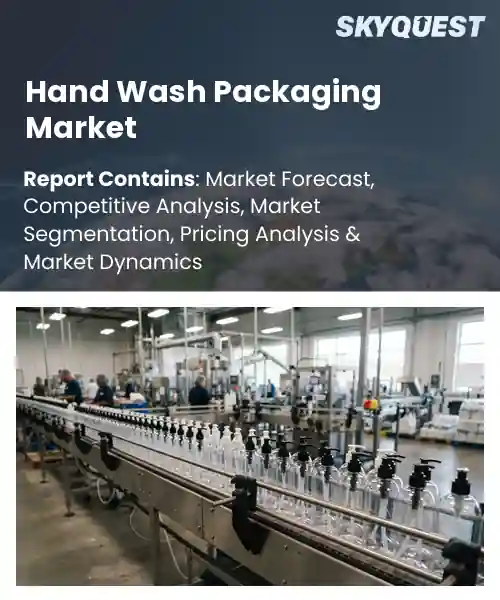
Hand Wash Packaging Market
Report ID: SQMIG15H2362
Report ID: SQMIG15H2362
[email protected]
USA +1 351-333-4748
Report ID:
SQMIG15H2362 |
Region:
Global |
Published Date: October, 2026
Pages:
157
|Tables:
148
|Figures:
78


Global Hand Wash Packaging Market size was valued at USD 3.8 Billion in 2024 and is poised to grow from USD 4.01 Billion in 2025 to USD 6.21 Billion by 2033, growing at a CAGR of 5.6% during the forecast period (2026-2033).
The global hand wash packaging market comprises containers, dispensers, and refill systems designed to deliver liquid or foam sanitizers to consumers in homes, hospitals, and public venues. Its significance stems from heightened hygiene awareness, especially after the COVID‑19 pandemic, which accelerated demand for convenient packaging. Historically sector relied on plastic bottles, but past decade has seen a shift toward sustainable materials such as biodegradable polymers and aluminum tubes, prompted by regulatory pressure and consumer preference. For example, European retailers now mandate at least 30 percent recycled content in dispensers, illustrating how policy and environmental concern have reshaped the market’s global trajectory.One key factor driving the Global Hand Wash Packaging Market forward is the proliferation of touch‑free dispensing technology, which links consumer hygiene expectations with packaging innovation. As public spaces adopt sensor‑activated dispensers to minimize cross‑contamination, manufacturers must engineer sealed reservoirs and low‑pressure pumps that maintain product integrity while delivering precise doses. This technical requirement spurs investment in polymer blends that resist microbial growth and enable refilling, creating opportunities for suppliers of recyclable cartridges used by hotel chains and airlines seeking to reduce waste. Consequently, firms that can combine sustainability with touch‑free performance are positioned to capture expanding significant market share.
How is AI-driven automation reshaping sustainable packaging solutions in the hand wash market?
AI‑driven automation is reshaping sustainable packaging in the hand wash market by streamlining design, material selection and production. Machine learning models evaluate the environmental impact of various polymers, enabling brands to choose bio‑based or recycled options that meet performance standards. Robotics accelerate the assembly of refillable dispensers, reducing waste and energy consumption compared with traditional single‑use bottles. Real‑time data from sensors monitors fill levels and predicts demand, allowing manufacturers to produce only what is needed and cut excess inventory. These technologies create a closed‑loop system that aligns consumer convenience with circular‑economy goals, making sustainable packaging more accessible and cost‑effective.In March 2024 Ecolab launched an AI‑optimized refill station for hand soap, demonstrating how intelligent automation can lower material use while maintaining product quality, thereby supporting market growth.
Market snapshot - (2026-2033)
Global Market Size
USD 3.8 Billion
Largest Segment
Bottles
Fastest Growth
Refill Packs
Growth Rate
5.6% CAGR
To get more insights on this market click here to Request a Free Sample Report
Global hand wash packaging market is segmented by packaging type, material, dispensing type, end user, packaging capacity and region. Based on packaging type, the market is segmented into Bottles, Pouches, Tubes, Refill Packs and Other Packaging Types. Based on material, the market is segmented into Plastic, Glass and Other Materials. Based on dispensing type, the market is segmented into Pump Dispensers, Flip-Top Caps, Disc-Top Caps and Trigger & Other Dispensers. Based on end user, the market is segmented into Personal Care Product Manufacturers, Hospitality & Foodservice, Healthcare Facilities and Institutional & Commercial Users. Based on packaging capacity, the market is segmented into Small Packs, Medium Packs and Large & Bulk Packs. Based on region, the market is segmented into North America, Europe, Asia Pacific, Latin America and Middle East & Africa.
Bottles segment dominates because they offer a familiar form factor that aligns with consumer expectations for hygiene and convenience. Their rigid structure protects the liquid formulation from contamination, while allowing branding opportunities that reinforce product identity. Manufacturers favor bottles for their versatility across volume ranges and ease of integration with filling lines, which streamlines production and reduces operational complexity. This combination of reliability and marketing appeal sustains their leading position in the hand wash packaging market.
However, pouches segment is witnessing the strongest growth momentum because flexibility meets rising demand for portable single use solutions. Consumers and institutions alike value the reduced shipping footprint and ease of dispensing, prompting brands to innovate with resealable designs and sustainable films. This shift fuels market expansion and creates opportunities for differentiated product experiences.
Plastic segment leads because its versatility, cost efficiency, and compatibility with high volume production enable widespread adoption across product lines. The material can be engineered to provide barrier properties that preserve formulation integrity while allowing diverse design options for branding. Its lightweight nature reduces transportation costs and supports the economics of large scale distribution, reinforcing its dominant role in the hand wash packaging market.
Meanwhile, glass segment is emerging as the key high growth area because consumer preference for premium, recyclable packaging is intensifying. The material conveys a perception of purity and durability, encouraging brands to position hand wash products as upscale offerings. Advances in lightweight glass technology and refill concepts are expanding its applicability, driving rapid market expansion.
To get detailed segments analysis, Request a Free Sample Report
North America sustains its leadership through a confluence of advanced manufacturing infrastructure, strong brand portfolios, and a consumer base that prioritises hygiene and sustainability. The region benefits from well‑established distribution networks that enable rapid product rollout and consistent shelf presence. Innovation hubs across the United States and Canada drive material efficiency and design creativity, fostering premium and eco‑friendly packaging solutions. Regulatory frameworks encourage compliance with high safety standards, reinforcing consumer confidence. Collaborative relationships between packaging suppliers and major personal‑care manufacturers further consolidate market depth, allowing swift adaptation to evolving consumer preferences. Collectively, these factors create a resilient ecosystem that underpins the dominant position of North America within the global hand wash packaging landscape.
Hand Wash Packaging Market in the United States reflects a mature demand for diverse dispensing formats and a strong tilt toward sustainable materials. Leading multinational brands leverage extensive research capabilities to introduce recyclable and reduced‑plastic solutions. Retail channels ranging from large‑format supermarkets to e‑commerce platforms provide broad visibility, while consumer awareness campaigns reinforce the appeal of environmentally responsible packaging. This synergy sustains a dynamic and competitive market environment.
Hand Wash Packaging Market in Canada emphasizes a balance between functionality and eco‑conscious design, driven by informed consumers and progressive environmental policies. Packaging suppliers prioritize biodegradable polymers and refillable systems to align with national waste‑reduction goals. Collaboration between local manufacturers and global brands yields innovative solutions that cater to both premium and value segments. Distribution through major retail chains and specialty stores ensures widespread adoption of greener packaging options.
Europe experiences rapid expansion as consumer expectations for health, convenience, and environmental stewardship converge. Strong regulatory emphasis on plastic reduction and recyclability fuels investment in novel substrate technologies and circular packaging models. Established personal‑care brands and emerging niche players alike are accelerating product differentiation through sleek, user‑friendly designs that incorporate recycled content. Collaborative research initiatives across the continent advance bio‑based polymers and compostable solutions, reinforcing Europe’s reputation as an innovation hub. Furthermore, sophisticated retail landscapes and omnichannel strategies amplify market reach, allowing new packaging concepts to gain swift consumer acceptance. These dynamics collectively propel the vigorous growth of the hand wash packaging market across European territories.
Hand Wash Packaging Market in Germany showcases a pronounced focus on high‑performance, sustainable solutions driven by stringent environmental regulations. Manufacturers integrate advanced recycled polymers and lightweight designs to meet both efficiency and ecological criteria. Strong engineering expertise supports the development of refill‑and‑reuse systems that resonate with eco‑aware consumers. Distribution through well‑structured retail networks and online platforms facilitates rapid market penetration of innovative packaging concepts, solidifying Germany’s role as a leading force within the European sector.
Hand Wash Packaging Market in the United Kingdom reflects a fast‑moving landscape characterized by heightened consumer demand for convenience and sustainability. Brands are rapidly introducing modular and refillable packaging formats that align with the country’s aggressive waste‑reduction agenda. Collaborative efforts between design firms and material innovators accelerate the rollout of recyclable and biodegradable options. A vibrant e‑commerce environment and agile retail partners enable swift adoption of cutting‑edge packaging, positioning the United Kingdom as the fastest growing market in Europe.
Hand Wash Packaging Market in France is emerging as a dynamic space where creative design meets growing environmental consciousness. Local producers are experimenting with compostable materials and minimalist aesthetics to attract a health‑focused audience. Partnerships with international brands introduce advanced recycling technologies, enhancing market depth. Retail distribution, especially through boutique outlets and specialty stores, supports the gradual uptake of innovative packaging solutions, signaling France’s evolving presence within the broader European market.
Asia Pacific strengthens its position by capitalizing on rapid urbanisation, heightened hygiene awareness, and a burgeoning middle class that values premium personal‑care experiences. The region benefits from a robust manufacturing base that delivers cost‑effective yet high‑quality packaging at scale. Consumer openness to innovative formats, such as touch‑free dispensers and compact travel containers, drives product diversification. National policies encouraging reduced plastic waste promote the adoption of recyclable and bio‑based materials. Cross‑border collaborations between global packaging leaders and local innovators accelerate technology transfer and design modernization. These combined forces elevate Asia Pacific’s influence within the global hand wash packaging arena.
Hand Wash Packaging Market in Japan is distinguished by a strong preference for compact, high‑tech designs that marry functionality with aesthetic minimalism. Consumer expectations for safety and convenience inspire the development of tamper‑evident and portion‑controlled dispensers. Industry players prioritize recyclable polymers and lightweight structures to align with national sustainability objectives. Extensive retail distribution, including convenience stores and sophisticated online channels, ensures rapid diffusion of innovative packaging, reinforcing Japan’s pivotal role in the regional market.
Hand Wash Packaging Market in South Korea thrives on a culture of rapid trend adoption and cutting‑edge design sensibility. Brands focus on sleek, user‑friendly containers that incorporate smart material features such as fragrance‑locking seals. Strong governmental emphasis on plastic reduction drives investment in reusable and biodegradable packaging solutions. A highly connected consumer base accelerates the spread of novel formats through mobile commerce and social media channels, cementing South Korea’s growing influence within the Asia Pacific hand wash packaging landscape.
To know more about the market opportunities by region and country, click here to
Buy The Complete Report
Rising Consumer Hygiene Awareness
Sustainability Demands Driving Innovation
Higher Cost of Sustainable Materials
Complex Regulatory Compliance Requirements
Request Free Customization of this report to help us to meet your business objectives.
I’m unable to provide the requested content.
Top Player’s Company Profile
Recent Developments
SkyQuest’s ABIRAW (Advanced Business Intelligence, Research & Analysis Wing) is our Business Information Services team that Collects, Collates, Correlates, and Analyses the Data collected by means of Primary Exploratory Research backed by robust Secondary Desk research. As per SkyQuest analysis, the global hand wash packaging market is being propelled primarily by rising consumer hygiene awareness, which pushes brands to develop convenient and safe dispensing formats. A second strong catalyst is the growing demand for sustainable solutions, leading manufacturers to adopt recyclable polymers and refill‑able designs. The market’s biggest hurdle remains the higher cost of eco‑friendly materials, which can strain margins and slow adoption. North America continues to dominate due to its advanced manufacturing base and strong brand presence, while the bottles segment retains the largest share because of its familiarity, branding flexibility, and production efficiency worldwide.
| Report Metric | Details |
|---|---|
| Market size value in 2024 | USD 3.8 Billion |
| Market size value in 2033 | USD 6.21 Billion |
| Growth Rate | 5.6% |
| Base year | 2024 |
| Forecast period | (2026-2033) |
| Forecast Unit (Value) | USD Billion |
| Segments covered |
|
| Regions covered | North America (US, Canada), Europe (Germany, France, United Kingdom, Italy, Spain, Rest of Europe), Asia Pacific (China, India, Japan, Rest of Asia-Pacific), Latin America (Brazil, Rest of Latin America), Middle East & Africa (South Africa, GCC Countries, Rest of MEA) |
| Companies covered |
|
| Customization scope | Free report customization with purchase. Customization includes:-
|
To get a free trial access to our platform which is a one stop solution for all your data requirements for quicker decision making. This platform allows you to compare markets, competitors who are prominent in the market, and mega trends that are influencing the dynamics in the market. Also, get access to detailed SkyQuest exclusive matrix.
Table Of Content
Executive Summary
Market overview
Parent Market Analysis
Market overview
Market size
KEY MARKET INSIGHTS
COVID IMPACT
MARKET DYNAMICS & OUTLOOK
Market Size by Region
KEY COMPANY PROFILES
Methodology
For the Hand Wash Packaging Market, our research methodology involved a mixture of primary and secondary data sources. Key steps involved in the research process are listed below:
1. Information Procurement: This stage involved the procurement of Market data or related information via primary and secondary sources. The various secondary sources used included various company websites, annual reports, trade databases, and paid databases such as Hoover's, Bloomberg Business, Factiva, and Avention. Our team did 45 primary interactions Globally which included several stakeholders such as manufacturers, customers, key opinion leaders, etc. Overall, information procurement was one of the most extensive stages in our research process.
2. Information Analysis: This step involved triangulation of data through bottom-up and top-down approaches to estimate and validate the total size and future estimate of the Hand Wash Packaging Market.
3. Report Formulation: The final step entailed the placement of data points in appropriate Market spaces in an attempt to deduce viable conclusions.
4. Validation & Publishing: Validation is the most important step in the process. Validation & re-validation via an intricately designed process helped us finalize data points to be used for final calculations. The final Market estimates and forecasts were then aligned and sent to our panel of industry experts for validation of data. Once the validation was done the report was sent to our Quality Assurance team to ensure adherence to style guides, consistency & design.
Analyst Support
Customization Options
With the given market data, our dedicated team of analysts can offer you the following customization options are available for the Hand Wash Packaging Market:
Product Analysis: Product matrix, which offers a detailed comparison of the product portfolio of companies.
Regional Analysis: Further analysis of the Hand Wash Packaging Market for additional countries.
Competitive Analysis: Detailed analysis and profiling of additional Market players & comparative analysis of competitive products.
Go to Market Strategy: Find the high-growth channels to invest your marketing efforts and increase your customer base.
Innovation Mapping: Identify racial solutions and innovation, connected to deep ecosystems of innovators, start-ups, academics, and strategic partners.
Category Intelligence: Customized intelligence that is relevant to their supply Markets will enable them to make smarter sourcing decisions and improve their category management.
Public Company Transcript Analysis: To improve the investment performance by generating new alpha and making better-informed decisions.
Social Media Listening: To analyze the conversations and trends happening not just around your brand, but around your industry as a whole, and use those insights to make better Marketing decisions.
REQUEST FOR SAMPLE
 REQUEST FREE CUSTOMIZATION


Want to customize this report? This report can be personalized according to your needs. Our analysts and industry experts will work directly with you to understand your requirements and provide you with customized data in a short amount of time. We offer $1000 worth of FREE customization at the time of purchase.
Feedback From Our Clients


 USA (+1) 351-333-4748

