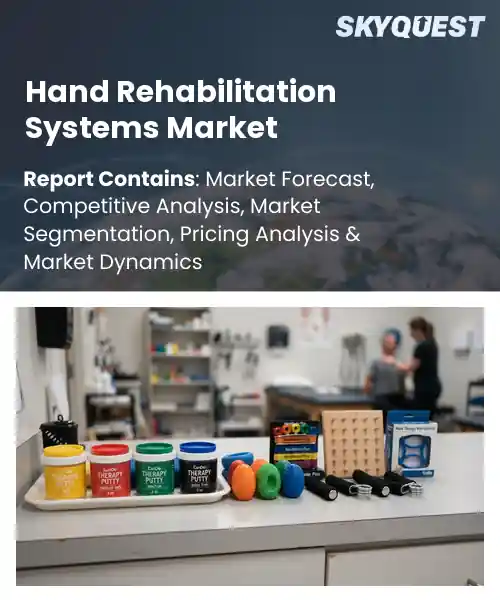
Hand Rehabilitation Systems Market
Report ID: SQMIG35A4590
Report ID: SQMIG35A4590
[email protected]
USA +1 351-333-4748
Report ID:
SQMIG35A4590 |
Region:
Global |
Published Date: September, 2026
Pages:
157
|Tables:
150
|Figures:
78


Global Hand Rehabilitation Systems Market size was valued at USD 1.96 Billion in 2024 and is poised to grow from USD 2.05 Billion in 2025 to USD 2.92 Billion by 2033, growing at a CAGR of 4.5% during the forecast period (2026-2033).
The hand rehabilitation systems market includes devices and software that help patients regain fine motor function after injury or disease. Its importance stems from the rising prevalence of neurological disorders such as stroke and the growing elderly population that demand therapy. Historically the sector began with simple splints in the 1970s, progressed to orthoses in the 1990s, and today features robotic gloves linked to cloud analytics. This evolution shows how advances in biomechanics and data science have turned a clinical tool into an industry. The primary driver behind this growth is urgent need for measurable therapy that shortens hospital stays.Building on the cost pressure highlighted earlier, the integration of artificial intelligence emerges as a decisive factor shaping market expansion. AI algorithms convert sensor streams from gloves into personalized exercise prescriptions, which accelerates patient recovery and provides clinicians with objective progress metrics. Hospitals in Europe have adopted such platforms to reduce physiotherapy sessions by twenty percent, freeing staff for complex cases. Simultaneously insurers recognize the savings generated by shorter rehabilitation cycles, prompting reimbursement policies that favor digital solutions. Consequently manufacturers invest heavily in cloud ecosystems, creating opportunities for partnerships with tele‑health providers and opening new revenue streams beyond hardware sales.
How is AI enhancing personalization in the hand rehabilitation systems market?
AI is reshaping hand rehabilitation by turning generic exercise protocols into highly individualized therapy plans. Sensors embedded in gloves or exoskeletons capture finger movement, grip force and timing, while machine learning models analyze this data to detect subtle patterns of impairment. The system then tailors resistance, range of motion targets and feedback cues to each patient’s daily performance, updating the program in real time as strength improves. This closed loop approach reduces the need for frequent therapist visits and accelerates functional recovery. As the market expands to serve stroke survivors, orthopedic injuries and age related decline, manufacturers are embedding AI to differentiate their platforms and meet the demand for data driven outcomes.Myomo announced an AI driven adaptive therapy update in August 2023, expanding its MyoPro system with real time personalization that adjusts assistance levels based on patient performance. This innovation shortens therapy cycles and strengthens market confidence in smart hand rehabilitation solutions.
Market snapshot - (2026-2033)
Global Market Size
USD 1.96 Billion
Largest Segment
Robotic Rehabilitation Systems
Fastest Growth
Exoskeleton Systems
Growth Rate
4.5% CAGR
To get more insights on this market click here to Request a Free Sample Report
Global hand rehabilitation systems market is segmented by device type, therapy type, application, portability, end-use industry and region. Based on device type, the market is segmented into Robotic Rehabilitation Systems, Exoskeleton Systems, Hand Therapy Devices, Electromechanical Systems and Others. Based on therapy type, the market is segmented into Active Rehabilitation, Passive Rehabilitation, Active-Assisted Rehabilitation and Others. Based on application, the market is segmented into Stroke Rehabilitation, Spinal Cord Injury, Traumatic Hand Injury, Neurological Disorders and Others. Based on portability, the market is segmented into Portable and Stationary. Based on end-use industry, the market is segmented into Hospitals, Rehabilitation Centers, Specialty Clinics, Home Healthcare and Others. Based on region, the market is segmented into North America, Europe, Asia Pacific, Latin America and Middle East & Africa.
Robotic Rehabilitation Systems segment dominates because it integrates advanced sensors, artificial intelligence, and precise motor control to deliver highly individualized therapy, which clinicians value for complex hand impairments. Its ability to replicate intricate hand movements and provide real time feedback enhances patient engagement and accelerates functional recovery. Consequently, hospitals and rehabilitation centers prioritize these systems, reinforcing their market leadership and driving sustained investment in the technology.
Meanwhile, Exoskeleton Systems are witnessing the strongest growth momentum as lightweight, modular designs enable easier integration into outpatient and home settings. Innovations in wearable actuators and battery efficiency reduce costs and improve usability, prompting clinicians to adopt them for rehabilitation. This expanding acceptance propels market expansion and creates new opportunities across diverse care environments.
Active Rehabilitation segment dominates because it empowers patients to initiate and control movements, fostering neuroplasticity and functional relearning essential for hand recovery. Clinicians favor protocols that require patient effort, as they generate stronger motor cortex activation and improve skill retention. The hands on approach also aligns with evidence based guidelines, encouraging widespread adoption across therapy centers and driving continuous refinement of device software to support intensive, patient driven exercises.
Conversely, Active Assisted Rehabilitation is emerging as the key high growth area as it blends patient initiative with robotic support, lowering fatigue while maintaining engagement. Recent advances in adaptive assistance algorithms allow devices to modulate support in real time, expanding applicability to a broader patient spectrum. This flexibility attracts both early stage and chronic users, accelerating market penetration and spurring further innovation in hybrid therapeutic platforms.
To get detailed segments analysis, Request a Free Sample Report
North America benefits from a mature healthcare ecosystem that embraces cutting‑edge therapeutic technologies and invests heavily in clinical research. The region’s health providers prioritize functional recovery, driving demand for sophisticated hand rehabilitation solutions that incorporate robotics, sensor‑based feedback, and tele‑rehabilitation platforms. Strong reimbursement mechanisms and clear regulatory pathways enable rapid market entry for innovative manufacturers. Collaboration between academic institutions, device innovators, and rehabilitation centers creates a pipeline of evidence‑based practices that reinforce clinical adoption. Additionally, a highly skilled workforce of therapists and engineers supports continuous improvement and customization of therapy protocols, cementing the region’s position as a global benchmark for quality and innovation in hand rehabilitation.
Hand Rehabilitation Systems Market in the United States is propelled by extensive integration of advanced digital health platforms within outpatient and acute care settings. Healthcare networks prioritize patient‑centered outcomes, encouraging adoption of wearable sensors and AI‑driven therapy modules. Strategic partnerships between technology firms and leading rehabilitation hospitals foster rapid prototyping and validation of new devices. Reimbursement structures favor evidence‑based interventions, accelerating clinician uptake. A strong culture of clinical research and a robust venture capital environment further reinforce the United States as a hub for pioneering hand therapy solutions.
Hand Rehabilitation Systems Market in Canada is shaped by a collaborative healthcare framework that emphasizes accessibility and interdisciplinary care. Provincial health authorities support the incorporation of sensor‑enabled devices into community rehabilitation programs, enhancing therapist‑patient interaction. Academic medical centers play a pivotal role in evaluating emerging technologies through rigorous clinical trials. Government incentives encourage domestic manufacturers to innovate, while public funding models reduce barriers for patients seeking advanced hand therapy. This cohesive ecosystem sustains steady growth and positions Canada as a key contributor to regional advancements.
Europe’s expansion is driven by a convergence of strong regulatory harmonization, public health priorities, and a thriving network of research institutions focused on functional recovery. The region’s healthcare systems emphasize preventive care and early intervention, creating demand for modular, scalable hand rehabilitation solutions that can be deployed across diverse clinical settings. Collaborative initiatives between universities, specialized clinics, and technology firms accelerate the translation of scientific discoveries into market‑ready products. Reimbursement policies that reward outcome‑based therapies further incentivize adoption, while a growing awareness of patient empowerment fuels interest in home‑based and tele‑rehabilitation options. This supportive environment enables Europe to lead in methodological innovation and patient‑centric care models.
Hand Rehabilitation Systems Market in Germany is anchored by a robust industrial base and a strong tradition of engineering excellence. Leading medical device manufacturers collaborate closely with university hospitals to integrate precision robotics and sensor technologies into therapeutic protocols. Health insurers prioritize evidence‑based treatments, facilitating reimbursement for advanced hand therapy devices. Nationwide training programs ensure clinicians are proficient in emerging modalities, reinforcing Germany’s status as a dominant force in the European market.
Hand Rehabilitation Systems Market in the United Kingdom experiences rapid growth through strategic public‑private partnerships that accelerate technology transfer from research labs to clinical practice. The National Health Service promotes adoption of digital rehabilitation platforms to improve patient access and streamline care pathways. Innovative startups benefit from supportive incubators and grant schemes, fostering a pipeline of novel hand therapy solutions. Clinician engagement and patient advocacy drive demand for personalized, data‑rich rehabilitation experiences, positioning the United Kingdom as the fastest‑growing market in the region.
Hand Rehabilitation Systems Market in France is emerging as a focal point for collaborative research and early adoption of novel therapeutic devices. French rehabilitation centers emphasize multidisciplinary approaches, integrating physiotherapy, occupational therapy, and advanced hand therapy tools. Government health programs encourage pilots of sensor‑based and tele‑rehabilitation solutions, generating real‑world evidence for broader rollout. Academic institutions contribute to clinical validation studies, while a growing community of tech‑focused entrepreneurs nurtures an ecosystem poised for accelerated market development.
Asia Pacific is advancing its position through heightened investment in digital health infrastructure and a concerted focus on aging populations requiring functional recovery. Nations within the region are fostering innovation ecosystems that blend engineering expertise with clinical insight, resulting in a surge of locally developed hand rehabilitation devices. Health policies increasingly support the integration of tele‑rehabilitation and wearable technologies, expanding access beyond metropolitan hospitals to community and home settings. Cross‑border collaborations and participation in global research consortia accelerate knowledge transfer, while educational initiatives elevate therapist proficiency in emerging modalities. This multifaceted approach amplifies the region’s capability to deliver cost‑effective, high‑quality hand therapy solutions.
Hand Rehabilitation Systems Market in Japan benefits from a strong emphasis on precision engineering and a culturally ingrained commitment to patient wellness. Leading manufacturers partner with university hospitals to create compact, sensor‑rich devices suited for both clinical and home environments. Health insurers endorse outcome‑focused therapies, encouraging clinicians to adopt technology‑driven rehabilitation pathways. Ongoing professional development programs ensure therapists are adept at leveraging advanced hand therapy tools, reinforcing Japan’s role as a catalyst for regional innovation.
Hand Rehabilitation Systems Market in South Korea is propelled by a dynamic startup scene and government initiatives that prioritize health technology advancement. Integration of AI and real‑time analytics into rehabilitation devices enhances therapy personalization and monitoring. Public hospitals collaborate with tech firms to pilot tele‑rehabilitation platforms, widening service reach to rural areas. Strong emphasis on clinical research and rapid regulatory approval processes enables swift market entry for innovative hand therapy solutions, strengthening South Korea’s influence within the Asia Pacific landscape.
To know more about the market opportunities by region and country, click here to
Buy The Complete Report
Rising Prevalence of Hand Injuries
Advancements in Sensor Technology
High Cost of Advanced Systems
Regulatory Approval Complexity
Request Free Customization of this report to help us to meet your business objectives.
The competitive landscape of the global hand rehabilitation systems market is shaped by intense rivalry among established device manufacturers and emerging technology firms, with market drivers including rapid adoption of wearable robotics and AI‑enabled therapy platforms. Recent M&A activity, such as the acquisition of a sensor‑technology startup by a leading orthotics player, and strategic partnerships linking exoskeleton developers with hospital networks, illustrate how firms are leveraging innovation and collaboration to capture market share.
Top Player’s Company Profile
Recent Developments
SkyQuest’s ABIRAW (Advanced Business Intelligence, Research & Analysis Wing) is our Business Information Services team that Collects, Collates, Correlates, and Analyses the Data collected by means of Primary Exploratory Research backed by robust Secondary Desk research. As per SkyQuest analysis the market is being propelled primarily by the rising prevalence of hand injuries which creates strong demand for faster functional recovery, while advancements in sensor technology and AI‑driven personalization together form a second growth catalyst by enabling highly accurate biofeedback and real‑time therapy adjustments. The high cost of advanced robotic devices remains a key restraint, limiting adoption in smaller clinics. North America continues to dominate the market thanks to its mature healthcare ecosystem and robust reimbursement structures. Within the segment landscape, robotic rehabilitation systems lead the field, offering precise motor control and data‑rich feedback that clinicians favor.
| Report Metric | Details |
|---|---|
| Market size value in 2024 | USD 1.96 Billion |
| Market size value in 2033 | USD 2.92 Billion |
| Growth Rate | 4.5% |
| Base year | 2024 |
| Forecast period | (2026-2033) |
| Forecast Unit (Value) | USD Billion |
| Segments covered |
|
| Regions covered | North America (US, Canada), Europe (Germany, France, United Kingdom, Italy, Spain, Rest of Europe), Asia Pacific (China, India, Japan, Rest of Asia-Pacific), Latin America (Brazil, Rest of Latin America), Middle East & Africa (South Africa, GCC Countries, Rest of MEA) |
| Companies covered |
|
| Customization scope | Free report customization with purchase. Customization includes:-
|
To get a free trial access to our platform which is a one stop solution for all your data requirements for quicker decision making. This platform allows you to compare markets, competitors who are prominent in the market, and mega trends that are influencing the dynamics in the market. Also, get access to detailed SkyQuest exclusive matrix.
Table Of Content
Executive Summary
Market overview
Parent Market Analysis
Market overview
Market size
KEY MARKET INSIGHTS
COVID IMPACT
MARKET DYNAMICS & OUTLOOK
Market Size by Region
KEY COMPANY PROFILES
Methodology
For the Hand Rehabilitation Systems Market, our research methodology involved a mixture of primary and secondary data sources. Key steps involved in the research process are listed below:
1. Information Procurement: This stage involved the procurement of Market data or related information via primary and secondary sources. The various secondary sources used included various company websites, annual reports, trade databases, and paid databases such as Hoover's, Bloomberg Business, Factiva, and Avention. Our team did 45 primary interactions Globally which included several stakeholders such as manufacturers, customers, key opinion leaders, etc. Overall, information procurement was one of the most extensive stages in our research process.
2. Information Analysis: This step involved triangulation of data through bottom-up and top-down approaches to estimate and validate the total size and future estimate of the Hand Rehabilitation Systems Market.
3. Report Formulation: The final step entailed the placement of data points in appropriate Market spaces in an attempt to deduce viable conclusions.
4. Validation & Publishing: Validation is the most important step in the process. Validation & re-validation via an intricately designed process helped us finalize data points to be used for final calculations. The final Market estimates and forecasts were then aligned and sent to our panel of industry experts for validation of data. Once the validation was done the report was sent to our Quality Assurance team to ensure adherence to style guides, consistency & design.
Analyst Support
Customization Options
With the given market data, our dedicated team of analysts can offer you the following customization options are available for the Hand Rehabilitation Systems Market:
Product Analysis: Product matrix, which offers a detailed comparison of the product portfolio of companies.
Regional Analysis: Further analysis of the Hand Rehabilitation Systems Market for additional countries.
Competitive Analysis: Detailed analysis and profiling of additional Market players & comparative analysis of competitive products.
Go to Market Strategy: Find the high-growth channels to invest your marketing efforts and increase your customer base.
Innovation Mapping: Identify racial solutions and innovation, connected to deep ecosystems of innovators, start-ups, academics, and strategic partners.
Category Intelligence: Customized intelligence that is relevant to their supply Markets will enable them to make smarter sourcing decisions and improve their category management.
Public Company Transcript Analysis: To improve the investment performance by generating new alpha and making better-informed decisions.
Social Media Listening: To analyze the conversations and trends happening not just around your brand, but around your industry as a whole, and use those insights to make better Marketing decisions.
REQUEST FOR SAMPLE
 REQUEST FREE CUSTOMIZATION


Want to customize this report? This report can be personalized according to your needs. Our analysts and industry experts will work directly with you to understand your requirements and provide you with customized data in a short amount of time. We offer $1000 worth of FREE customization at the time of purchase.
Feedback From Our Clients


 USA (+1) 351-333-4748

