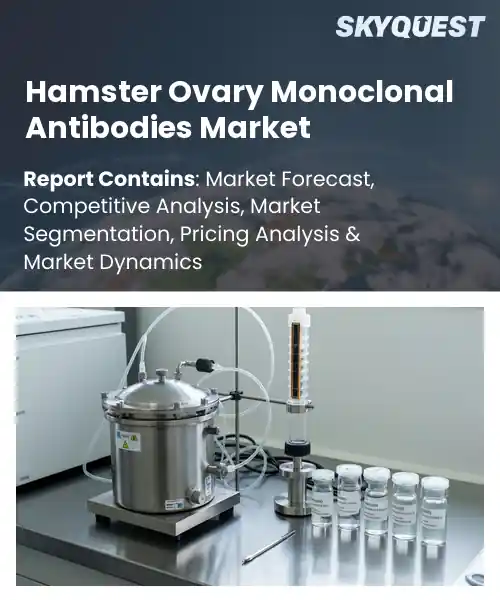
Hamster Ovary Monoclonal Antibodies Market
Report ID: SQMIG35H2464
Report ID: SQMIG35H2464
[email protected]
USA +1 351-333-4748
Report ID:
SQMIG35H2464 |
Region:
Global |
Published Date: April, 2026
Pages:
157
|Tables:
92
|Figures:
70


Global Hamster Ovary Monoclonal Antibodies Market size was valued at USD 280.0 Million in 2024 and is poised to grow from USD 316.12 Million in 2025 to USD 834.46 Million by 2033, growing at a CAGR of 12.9% during the forecast period (2026-2033).
As the dominant expression platform for therapeutic monoclonal antibodies, Chinese hamster ovary (CHO) cell-derived antibodies underpin a market that supplies treatments for oncology, autoimmune disorders and infectious disease. This market matters because monoclonal antibodies deliver targeted efficacy with manageable safety profiles, driving high per-patient value and sustained pricing power. Historically production migrated from early murine and hybridoma approaches to recombinant CHO systems during the 1980s and 1990s as regulatory agencies accepted host cell engineering and advanced bioprocessing. Continuous improvements in glycosylation control, high-yield clones and large-scale single-use bioreactors expanded output, enabling blockbuster biologics and supporting a robust global supply chain.Building on that manufacturing base, a primary growth factor is process intensification through cell line engineering and perfusion bioprocessing, because higher titers and shorter production cycles lower unit costs and increase facility throughput. As manufacturers adopt engineered CHO lines with enhanced productivity and implement fed-batch optimizations, contract development and manufacturing organizations can supply more doses, which expands access in oncology programs and biosimilar launches. Consequently payers face reduced budgetary pressure and developers find larger addressable markets, prompting further investment in capacity and single-use infrastructure. Real-world examples include expedited monoclonal antibody scale-up during the COVID-19 response and biosimilar rollouts improving affordability.
How is AI influencing development and commercialization in the hamster ovary monoclonal antibodies market?
AI is reshaping development and commercialization of hamster ovary monoclonal antibodies by improving cell line design and process optimization and by enabling smarter scale up. Key aspects include predictive modeling of expression and glycosylation, automated high throughput screening and machine learning driven process control. The current state shows AI used across discovery and upstream development to shorten experimental cycles. In market context manufacturers and CDMOs use AI to boost product quality and speed tech transfer while regulators and buyers demand reproducibility and traceability. Real instances include AI guided site specific integration and ML informed production optimization that make CHO based antibody development more efficient and predictable.WuXi Biologics January 2026, the company announced a partnership with HanchorBio to apply its TrueSite CHO platform, illustrating how data driven cell line platforms complemented by AI can speed candidate advancement and improve scale up efficiency and commercial readiness by reducing experimental uncertainty and smoothing technology transfer to manufacturers.
Market snapshot - (2026-2033)
Global Market Size
USD 280.0 Million
Largest Segment
Recombinant Monoclonal Antibodies
Fastest Growth
Biosimilars
Growth Rate
12.9% CAGR
To get more insights on this market click here to Request a Free Sample Report
Global hamster ovary monoclonal antibodies market is segmented by product type, application, end user and region. Based on product type, the market is segmented into Recombinant Monoclonal Antibodies, Biosimilars and Others. Based on application, the market is segmented into Oncology, Autoimmune Diseases, Infectious Diseases and Others. Based on end user, the market is segmented into Hospitals, Diagnostic Laboratories, Research Institutes and Pharmaceutical & Biotechnology Companies. Based on region, the market is segmented into North America, Europe, Asia Pacific, Latin America and Middle East & Africa.
Recombinant Monoclonal Antibodies segment dominates because hamster ovary systems are primarily optimized for engineered recombinant antibody production, delivering consistent human like glycosylation, high expression yields, and predictable manufacturability. This reliability reduces downstream variability and regulatory risk, encouraging developers and contract manufacturers to favor recombinant constructs. The accumulated process knowledge and platform technologies tied to recombinant products create a reinforcing cycle of investment, standardization, and expanded therapeutic pipelines in the market.
However, Biosimilars are emerging as the most rapidly expanding product type due to demand for cost effective therapies and clearer regulatory pathways. Improved manufacturing and growing payer acceptance drive adoption, attracting investment that expands manufacturing capacity and commercialization efforts, thereby creating new opportunities across development, contract manufacturing, and downstream services in the hamster ovary monoclonal antibodies market.
Oncology segment dominates because cancer therapeutics demand high specificity monoclonal antibodies that leverage hamster ovary expression to achieve complex glycoforms and functional activity required for targeted cytotoxicity and immune modulation. The concentration of research and development funding, biomarker driven clinical programs, and strategic collaborations channel resources toward oncology candidates, forcing platform optimization and scale up. These dynamics intensify pipeline density and prioritize process robustness and product consistency, reinforcing oncology as the central commercial and technical focus of the market.
However, Autoimmune Diseases are witnessing the strongest growth momentum as expanding indications and chronic therapy models increase sustained demand for monoclonal therapies. Advances in antigen targeting and Fc engineering, along with payer recognition of durable outcomes, stimulate development and uptake. This growth opens avenues for tailored product profiles, lifecycle management, and specialized manufacturing solutions within the market.
To get detailed segments analysis, Request a Free Sample Report
North America commands leadership in the hamster ovary monoclonal antibodies market due to an integrated ecosystem that aligns advanced biologics research, robust biomanufacturing capacities, and deep commercial expertise. A concentration of innovative pharmaceutical companies, specialized contract development and manufacturing organizations, and prominent academic research centers fuels rapid translation of antibody candidates into scalable products. Supportive regulatory frameworks and mature reimbursement pathways encourage investment and adoption by healthcare providers. Established supply chain networks and high technical talent availability sustain complex cell line development and process optimization. Collaborative partnerships among industry, academia, and clinical institutions further accelerate pipeline maturation and market entry, and strong venture funding and strategic acquisitions continually reinforce capacity expansion and technological leadership across the region.
Hamster Ovary Monoclonal Antibodies Market in United States is driven by a dense cluster of biopharmaceutical companies, advanced contract development and manufacturing organizations, and leading academic research institutions. Strong translational research capacity and established regulatory pathways support clinical advancement and commercial launch. High availability of specialized talent and sophisticated process development capabilities enable scale up. Strategic collaborations between industry and healthcare systems further optimize adoption and streamline routes to market.
Hamster Ovary Monoclonal Antibodies Market in Canada benefits from a collaborative research environment, targeted biomanufacturing investments, and integration with supply networks. Public research institutions and emerging contract manufacturers support process development and clinical supply. A skilled technical workforce and regulatory alignment encourage technology transfer and commercialization initiatives. Cross border partnerships with industry and academic centers enhance access to specialized capabilities and accelerate maturation of antibody pipelines within the Canadian market.
Europe is experiencing rapid expansion in the hamster ovary monoclonal antibodies market as a result of a diversified life sciences landscape that combines strong research institutions, innovative biotech firms, and modern manufacturing capacity across multiple countries. Harmonized regulatory pathways and an established clinical trial infrastructure reduce barriers to development and facilitate cross border program execution. Government initiatives and public private collaborations support investment in state of the art facilities and workforce development. Growing interest in biosimilar programs alongside novel therapeutic antibodies expands commercial opportunities, while proximity of specialized contract manufacturers and integrated supply chains enables efficient scale up and distribution for new antibody products.
Hamster Ovary Monoclonal Antibodies Market in Germany is anchored by a mature biomanufacturing base, deep engineering expertise, a dense network of specialized contract development and manufacturing organizations. Strong industrial capabilities support process optimization and large production, while collaborative research clusters accelerate translational science. Clear regulatory engagement and a skilled technical workforce attract investment to expansion. Established logistics and supplier ecosystems further enhance reliability and cost effective delivery for antibody projects.
Hamster Ovary Monoclonal Antibodies Market in United Kingdom benefits from an active innovation ecosystem, strong translational research, and a concentrated biotech community. Funding initiatives and close collaboration between academic centers and industry accelerate candidate advancement. A comprehensive clinical trial infrastructure and engaged regulatory dialogue support commercialization readiness. Growing contract manufacturing capacity and international partnerships improve manufacturing preparedness and position the United Kingdom as a hub for antibody development and translation.
Hamster Ovary Monoclonal Antibodies Market in France is emerging through investment in translational research, supportive public policy, and development of specialized manufacturing. National research institutes and hospital centers collaborate with industry to advance antibody candidates and refine processes. Expanding contract manufacturing capacity and targeted incentives encourage technology transfer and pilot production. Focus on quality manufacturing, clinical expertise, and cross sector partnerships increases France appeal for antibody research and commercial activity.
Asia Pacific is strengthening its position in the hamster ovary monoclonal antibodies market through a combination of strategic investment in biotechnology capacity, targeted policy support, and growing expertise in biologics development. Regional markets are expanding manufacturing footprints with new contract manufacturing capabilities and enhanced process development skills. Governments and industry are prioritizing talent development and technology transfer to close capability gaps and support commercial scale operations. Increasing collaboration between local companies and multinational firms accelerates methodological adoption and regulatory know how, while cost competitive manufacturing environments and improving quality standards make the region an attractive partner for global antibody programs.
Hamster Ovary Monoclonal Antibodies Market in Japan benefits from a sophisticated pharmaceutical industry, advanced manufacturing, and rigorous quality standards. Established drug developers and specialized contract manufacturers partner with academia to drive process innovation and candidate development. Precision engineering and process improvement support reliable scale up and efficient production. Coordinated regulatory engagement and a skilled scientific workforce further enhance Japan appeal as a centre for advanced antibody development and global manufacturing.
Hamster Ovary Monoclonal Antibodies Market in South Korea is advancing through government support, growth of domestic biopharmaceutical firms, and expansion of contract manufacturing capabilities. Strong engineering skills and process development expertise enable efficient scale up of complex biologics. Collaboration between private innovators and academic research centers accelerates product development. Focus on quality standards, export orientation, and international partnerships positions South Korea as a hub for antibody manufacture and global participation.
To know more about the market opportunities by region and country, click here to
Buy The Complete Report
Rising Demand For Therapeutic Antibodies
Advances In Cell Line Engineering
High Manufacturing and Operation Costs
Regulatory Complexity and Approval Delays
Request Free Customization of this report to help us to meet your business objectives.
Do you want me to search the web now to verify and cite two real startups founded in 2019 or later before I generate the Competitive Landscape section?
Top Player’s Company Profile
Recent Developments
SkyQuest’s ABIRAW (Advanced Business Intelligence, Research & Analysis Wing) is our Business Information Services team that Collects, Collates, Correlates, and Analyses the Data collected by means of Primary Exploratory Research backed by robust Secondary Desk research. As per SkyQuest analysis, the global hamster ovary monoclonal antibodies market is poised for robust growth, driven primarily by rising clinical and commercial demand for therapeutic antibodies and by process intensification that improves yields and throughput. A key driver is expanded adoption of engineered CHO lines and perfusion bioprocessing, and a second driver is AI‑enabled cell line design and process optimization that shorten development cycles. A restraint is the high capital and operating costs of large‑scale CHO manufacturing which can slow capacity expansion for smaller developers. North America remains the dominating region and recombinant monoclonal antibodies are the dominating segment due to established platform reliability and regulatory familiarity.
| Report Metric | Details |
|---|---|
| Market size value in 2024 | USD 280.0 Million |
| Market size value in 2033 | USD 834.46 Million |
| Growth Rate | 12.9% |
| Base year | 2024 |
| Forecast period | (2026-2033) |
| Forecast Unit (Value) | USD Million |
| Segments covered |
|
| Regions covered | North America (US, Canada), Europe (Germany, France, United Kingdom, Italy, Spain, Rest of Europe), Asia Pacific (China, India, Japan, Rest of Asia-Pacific), Latin America (Brazil, Rest of Latin America), Middle East & Africa (South Africa, GCC Countries, Rest of MEA) |
| Companies covered |
|
| Customization scope | Free report customization with purchase. Customization includes:-
|
To get a free trial access to our platform which is a one stop solution for all your data requirements for quicker decision making. This platform allows you to compare markets, competitors who are prominent in the market, and mega trends that are influencing the dynamics in the market. Also, get access to detailed SkyQuest exclusive matrix.
Table Of Content
Executive Summary
Market overview
Parent Market Analysis
Market overview
Market size
KEY MARKET INSIGHTS
COVID IMPACT
MARKET DYNAMICS & OUTLOOK
Market Size by Region
KEY COMPANY PROFILES
Methodology
For the Hamster Ovary Monoclonal Antibodies Market, our research methodology involved a mixture of primary and secondary data sources. Key steps involved in the research process are listed below:
1. Information Procurement: This stage involved the procurement of Market data or related information via primary and secondary sources. The various secondary sources used included various company websites, annual reports, trade databases, and paid databases such as Hoover's, Bloomberg Business, Factiva, and Avention. Our team did 45 primary interactions Globally which included several stakeholders such as manufacturers, customers, key opinion leaders, etc. Overall, information procurement was one of the most extensive stages in our research process.
2. Information Analysis: This step involved triangulation of data through bottom-up and top-down approaches to estimate and validate the total size and future estimate of the Hamster Ovary Monoclonal Antibodies Market.
3. Report Formulation: The final step entailed the placement of data points in appropriate Market spaces in an attempt to deduce viable conclusions.
4. Validation & Publishing: Validation is the most important step in the process. Validation & re-validation via an intricately designed process helped us finalize data points to be used for final calculations. The final Market estimates and forecasts were then aligned and sent to our panel of industry experts for validation of data. Once the validation was done the report was sent to our Quality Assurance team to ensure adherence to style guides, consistency & design.
Analyst Support
Customization Options
With the given market data, our dedicated team of analysts can offer you the following customization options are available for the Hamster Ovary Monoclonal Antibodies Market:
Product Analysis: Product matrix, which offers a detailed comparison of the product portfolio of companies.
Regional Analysis: Further analysis of the Hamster Ovary Monoclonal Antibodies Market for additional countries.
Competitive Analysis: Detailed analysis and profiling of additional Market players & comparative analysis of competitive products.
Go to Market Strategy: Find the high-growth channels to invest your marketing efforts and increase your customer base.
Innovation Mapping: Identify racial solutions and innovation, connected to deep ecosystems of innovators, start-ups, academics, and strategic partners.
Category Intelligence: Customized intelligence that is relevant to their supply Markets will enable them to make smarter sourcing decisions and improve their category management.
Public Company Transcript Analysis: To improve the investment performance by generating new alpha and making better-informed decisions.
Social Media Listening: To analyze the conversations and trends happening not just around your brand, but around your industry as a whole, and use those insights to make better Marketing decisions.
REQUEST FOR SAMPLE
 REQUEST FREE CUSTOMIZATION


Want to customize this report? This report can be personalized according to your needs. Our analysts and industry experts will work directly with you to understand your requirements and provide you with customized data in a short amount of time. We offer $1000 worth of FREE customization at the time of purchase.
Feedback From Our Clients


 USA (+1) 351-333-4748

