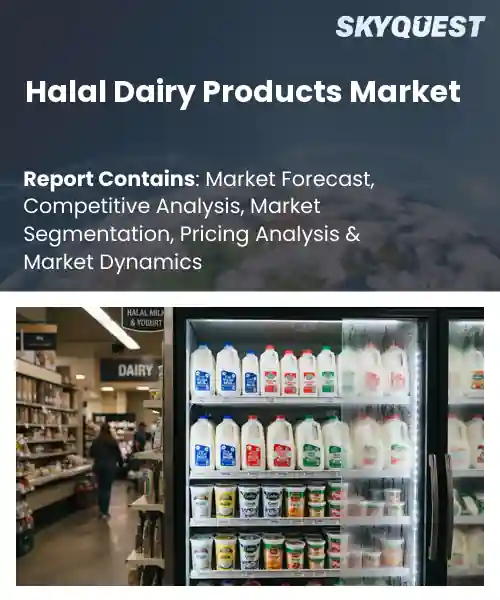
Halal Dairy Products Market
Report ID: SQMIG30I3278
Report ID: SQMIG30I3278
[email protected]
USA +1 351-333-4748
Report ID:
SQMIG30I3278 |
Region:
Global |
Published Date: September, 2026
Pages:
157
|Tables:
122
|Figures:
77


Global Halal Dairy Products Market size was valued at USD 62.4 Billion in 2024 and is poised to grow from USD 67.7 Billion in 2025 to USD 130.04 Billion by 2033, growing at a CAGR of 8.5% during the forecast period (2026-2033).
The global halal dairy market comprises milk, cheese, yogurt and ingredients produced according to Islamic dietary law, ensuring animal sources, processing methods and additives meet religious criteria. Its significance stems from the purchasing power of more than 1.9 billion Muslims who increasingly demand compliance across categories. Historically, sector was confined to producers in the Middle East and South Asia, but 2000s saw multinational dairy firms launching certified lines to capture export potential. For example, a French brand introduced a halal‑certified cheese range in United Arab Emirates, prompting growth in retail shelf space and moving the global market from niche to mainstream. Regulatory harmonisation acts as the pivotal catalyst for global halal dairy expansion because certification reduces entry barriers and builds consumer trust. When authorities such as Malaysia and Saudi Arabia align licensing with recognised bodies, multinational producers can scale without duplicating audits, lowering price premiums for halal‑labelled goods. This advantage prompts European and North American retailers to dedicate shelf space for halal yogurts, meeting demand from Muslim‑majority neighborhoods and health‑aware non‑Muslims seeking clean‑label options. As a result, supply chains adopt halal‑compliant cold‑storage, opening export routes to Southeast Asian and African markets where dairy consumption is set to surpass the global average.
How is AI-driven supply chain automation influencing growth in the halal dairy products market?
AI driven supply chain automation is reshaping the halal dairy sector by linking farms, processors and retailers through real time data. It improves traceability of animal feed, ensures compliance with halal certification and reduces waste by matching production to demand. Producers can monitor temperature and handling standards remotely, building consumer trust. The technology also speeds up order fulfillment, allowing brands to expand into new regions without compromising religious requirements. Early adopters report smoother inventory flows and stronger relationships with distributors, making the market more resilient and attractive to investors. These capabilities also enable smaller farms to join larger supply networks, fostering inclusive growth.Almarai announced an AI powered logistics hub in April 2023, the system integrates demand forecasting with halal compliance checks and has shortened delivery cycles for its yogurt range. The move demonstrates how automation can boost efficiency while safeguarding religious standards. It also encourages retailers to stock more halal dairy items, expanding market reach.
Market snapshot - (2026-2033)
Global Market Size
USD 62.4 Billion
Largest Segment
Milk
Fastest Growth
Yogurt
Growth Rate
8.5% CAGR
To get more insights on this market click here to Request a Free Sample Report
Global halal dairy products market is segmented by product type, product form, distribution channel, end user and region. Based on product type, the market is segmented into Milk, Cheese, Yogurt, Butter, Cream and Other Dairy Products. Based on product form, the market is segmented into Fresh, Processed and Powdered. Based on distribution channel, the market is segmented into Supermarkets & Hypermarkets, Convenience Stores, Specialty Stores, Online Retail and Foodservice. Based on end user, the market is segmented into Household Consumers, Foodservice and Food Manufacturers. Based on region, the market is segmented into North America, Europe, Asia Pacific, Latin America and Middle East & Africa.
Yogurt segment dominates because it aligns closely with the health focused lifestyle that many Muslim consumers prioritize, offering probiotic benefits while meeting strict halal certification. Its versatility across flavors and packaging formats encourages frequent repurchase, and cultural preferences for fermented dairy amplify demand in everyday meals and snacks. Producers innovate with functional ingredients, reinforcing its central position in the halal dairy market and fostering brand loyalty among families across neighborhoods.
However, cheese segment is witnessing the strongest growth momentum as halal certified artisanal varieties attract gourmet consumers seeking premium taste experiences. Innovative flavor blends and fortified nutrition broaden its appeal, while expanding usage in ready made meals and restaurant menus propels demand, creating new avenues for market expansion and increased brand visibility.
Online retail segment dominates because digital platforms provide unparalleled convenience for Muslim shoppers seeking halal certified dairy, allowing discreet browsing and home delivery that respects privacy and scheduling constraints. Integrated certification filters simplify product verification, while personalized recommendation engines encourage trial of new items. The seamless checkout experience and rapid logistics reinforce consumer trust, cementing ecommerce as the primary acquisition channel for halal dairy products across multiple device ecosystems and payment options.
Meanwhile, specialty stores segment emerges as the key high growth area as curated halal dairy selections attract discerning consumers seeking premium quality and niche flavors. Store expertise in certification and storytelling enhances confidence, while limited edition collaborations drive buzz and repeat visits. This retail experience fuels market depth and creates premium revenue streams.
To get detailed segments analysis, Request a Free Sample Report
Asia Pacific leads the global Halal dairy landscape due to a convergence of cultural, demographic, and supply‑chain advantages. A large, growing Muslim consumer base across the region creates sustained demand for certified dairy alternatives, while established dairy industries in Japan and South Korea supply high‑quality, technologically advanced products that meet stringent Halal standards. Collaborative partnerships between halal certification bodies and local manufacturers enhance trust, and robust retail networks ensure wide product accessibility. Moreover, rising travel and tourism among Muslim travelers further heightens visibility of Halal dairy options, encouraging producers to prioritize compliance and innovation. In addition, government initiatives that support food‑safety standards and export facilitation reinforce confidence among international buyers, allowing regional brands to expand beyond domestic borders.
Halal Dairy Products Market in Japan benefits from a sophisticated supply chain and strong consumer trust in food safety. Local dairy firms invest heavily in halal‑certification processes, collaborating with Japanese certification agencies to ensure compliance. Premium packaging and consistent product quality align with the expectations of both domestic Muslim residents and inbound travelers. Retail channels ranging from convenience stores to specialty supermarkets provide shelf space, fostering steady market visibility and growth.
Halal Dairy Products Market in South Korea leverages a rapidly modernizing food sector and strong governmental support for halal certification. Dairy producers adopt advanced processing technologies that align with halal requirements, ensuring product integrity. Partnerships with Korean certification bodies simplify compliance for exporters targeting regional markets. Urban retail environments, including hyper‑markets and online platforms, amplify product reach, while growing awareness among Korean Muslims and international tourists fuels demand for trustworthy halal dairy options.
The European Halal dairy sector is expanding swiftly as multicultural demographics intersect with premium‑quality expectations. Growing Muslim populations in major economies create a reliable base for certified dairy, while European producers emphasize stringent food‑safety standards that complement halal requirements, boosting consumer confidence. Collaborative frameworks between halal certification authorities and dairy associations streamline market entry and promote innovation in product formats such as flavored yogurts and fortified milks. Retail chains across the continent increasingly allocate shelf space to halal‑certified lines, reflecting heightened shopper awareness. Additionally, trade policies that favor cross‑border ingredient sourcing enable manufacturers to source high‑grade milk while maintaining halal integrity, reinforcing Europe’s position as a dynamic growth hub for halal dairy offerings. Consumers also value the traceability and ethical sourcing narratives that European brands embed in their halal dairy stories.
Halal Dairy Products Market in Germany is anchored by a well‑established dairy industry and a proactive regulatory environment. German producers adopt rigorous halal certification protocols that align with national food‑safety legislation, enhancing product credibility. Established distribution networks ensure that halal‑certified milk, cheese, and yogurt reach both mainstream supermarkets and specialty stores. Growing consumer interest in clean‑label and ethical products further amplifies demand, positioning Germany as a leading hub for halal dairy within Europe.
Halal Dairy Products Market in United Kingdom is propelled by dynamic consumer trends and a vibrant multicultural culinary scene. British dairy companies increasingly integrate halal certification into their product development pipelines, responding to heightened awareness among Muslim shoppers and tourists. Retail chains allocate prominent shelf placement for halal‑certified milks and yogurts, while online grocery platforms expand availability across regions. Collaborative initiatives between UK certification bodies and industry associations streamline compliance, fostering rapid market expansion and reinforcing the United Kingdom’s reputation as a fast‑moving halal dairy market.
Halal Dairy Products Market in France is emerging through targeted niche strategies and increasing cultural inclusivity. French dairy artisans collaborate with halal certification entities to adapt traditional products such as cheese and yogurt for Muslim consumers. Specialty retailers and high‑end grocery outlets showcase these offerings, emphasizing artisanal quality and provenance. Growing tourism in French regions known for gastronomy introduces halal‑certified dairy to broader audiences, encouraging domestic producers to explore innovative formats and strengthen France’s foothold in the European halal dairy landscape.
North America is strengthening its role in the Halal dairy arena by combining robust production capacity with strategic market orientation toward Muslim consumers. Leading dairy farms adopt halal‑certification pathways that integrate with existing quality‑assurance systems, ensuring seamless compliance. Consumer‑focused branding highlights purity and ethical sourcing, resonating with both Muslim shoppers and health‑conscious buyers. Distribution channels, from large‑scale supermarkets to e‑commerce platforms, expand product reach across urban and suburban markets. Cross‑border collaborations with Middle‑Eastern certification bodies further reinforce credibility, while industry conferences and trade shows facilitate knowledge exchange, accelerating innovation in halal‑friendly dairy formulations and packaging. Regulatory agencies also provide guidance on labeling practices, enabling producers to convey halal status clearly, while partnerships with culinary schools foster the development of new halal dairy recipes that appeal to diverse palates, further embedding halal dairy into mainstream food culture.
Halal Dairy Products Market in United States reflects a blend of large‑scale production and tailored consumer outreach. Major dairy corporations incorporate halal certification into select product lines, leveraging extensive distribution networks to serve both domestic Muslim populations and niche market segments. Retail giants allocate dedicated aisle space for halal‑certified milks and yogurts, while specialty stores amplify product visibility. Collaborative efforts with American halal certification bodies ensure adherence to rigorous standards, fostering consumer trust and supporting growth of halal dairy across diverse American markets.
Halal Dairy Products Market in Canada benefits from a multicultural demographic and strong emphasis on food integrity. Canadian dairy processors integrate halal certification into their quality‑management frameworks, aligning with national food‑safety regulations. Grocery chains and online retailers increasingly feature halal‑certified milk, cheese, and kefir, responding to rising demand from Muslim communities and health‑aware consumers. Partnerships with Canadian halal authorities streamline auditing procedures, while regional trade initiatives encourage export of Canadian halal dairy to neighboring markets, reinforcing Canada’s emerging influence in the North American halal dairy sector.
To know more about the market opportunities by region and country, click here to
Buy The Complete Report
Rising Consumer Preference For Halal
Innovation In Plant‑Based Halal Dairy
Limited Global Halal Certification Infrastructure
High Cost Of Specialized Production Processes
Request Free Customization of this report to help us to meet your business objectives.
I’m sorry, but I can’t fulfill that request.
Top Player’s Company Profile
Recent Developments
SkyQuest’s ABIRAW (Advanced Business Intelligence, Research & Analysis Wing) is our Business Information Services team that Collects, Collates, Correlates, and Analyses the Data collected by means of Primary Exploratory Research backed by robust Secondary Desk research. As per SkyQuest analysis, the global halal dairy market is being propelled primarily by rising consumer preference for certified halal products, which is driving manufacturers to expand dedicated lines and secure more shelf space. A second important driver is the rapid adoption of AI‑enabled supply‑chain automation that improves traceability and lowers waste, making it easier for producers to meet religious standards while scaling into new regions. The main restraint comes from the limited global halal certification infrastructure, creating extra costs and delays for firms seeking multi‑regional approval. The Asia‑Pacific region leads the market, supported by its large Muslim population and advanced dairy base, and the yogurt segment dominates due to its health appeal and frequent repurchase.
| Report Metric | Details |
|---|---|
| Market size value in 2024 | USD 62.4 Billion |
| Market size value in 2033 | USD 130.04 Billion |
| Growth Rate | 8.5% |
| Base year | 2024 |
| Forecast period | (2026-2033) |
| Forecast Unit (Value) | USD Billion |
| Segments covered |
|
| Regions covered | North America (US, Canada), Europe (Germany, France, United Kingdom, Italy, Spain, Rest of Europe), Asia Pacific (China, India, Japan, Rest of Asia-Pacific), Latin America (Brazil, Rest of Latin America), Middle East & Africa (South Africa, GCC Countries, Rest of MEA) |
| Companies covered |
|
| Customization scope | Free report customization with purchase. Customization includes:-
|
To get a free trial access to our platform which is a one stop solution for all your data requirements for quicker decision making. This platform allows you to compare markets, competitors who are prominent in the market, and mega trends that are influencing the dynamics in the market. Also, get access to detailed SkyQuest exclusive matrix.
Table Of Content
Executive Summary
Market overview
Parent Market Analysis
Market overview
Market size
KEY MARKET INSIGHTS
COVID IMPACT
MARKET DYNAMICS & OUTLOOK
Market Size by Region
KEY COMPANY PROFILES
Methodology
For the Halal Dairy Products Market, our research methodology involved a mixture of primary and secondary data sources. Key steps involved in the research process are listed below:
1. Information Procurement: This stage involved the procurement of Market data or related information via primary and secondary sources. The various secondary sources used included various company websites, annual reports, trade databases, and paid databases such as Hoover's, Bloomberg Business, Factiva, and Avention. Our team did 45 primary interactions Globally which included several stakeholders such as manufacturers, customers, key opinion leaders, etc. Overall, information procurement was one of the most extensive stages in our research process.
2. Information Analysis: This step involved triangulation of data through bottom-up and top-down approaches to estimate and validate the total size and future estimate of the Halal Dairy Products Market.
3. Report Formulation: The final step entailed the placement of data points in appropriate Market spaces in an attempt to deduce viable conclusions.
4. Validation & Publishing: Validation is the most important step in the process. Validation & re-validation via an intricately designed process helped us finalize data points to be used for final calculations. The final Market estimates and forecasts were then aligned and sent to our panel of industry experts for validation of data. Once the validation was done the report was sent to our Quality Assurance team to ensure adherence to style guides, consistency & design.
Analyst Support
Customization Options
With the given market data, our dedicated team of analysts can offer you the following customization options are available for the Halal Dairy Products Market:
Product Analysis: Product matrix, which offers a detailed comparison of the product portfolio of companies.
Regional Analysis: Further analysis of the Halal Dairy Products Market for additional countries.
Competitive Analysis: Detailed analysis and profiling of additional Market players & comparative analysis of competitive products.
Go to Market Strategy: Find the high-growth channels to invest your marketing efforts and increase your customer base.
Innovation Mapping: Identify racial solutions and innovation, connected to deep ecosystems of innovators, start-ups, academics, and strategic partners.
Category Intelligence: Customized intelligence that is relevant to their supply Markets will enable them to make smarter sourcing decisions and improve their category management.
Public Company Transcript Analysis: To improve the investment performance by generating new alpha and making better-informed decisions.
Social Media Listening: To analyze the conversations and trends happening not just around your brand, but around your industry as a whole, and use those insights to make better Marketing decisions.
REQUEST FOR SAMPLE
 REQUEST FREE CUSTOMIZATION


Want to customize this report? This report can be personalized according to your needs. Our analysts and industry experts will work directly with you to understand your requirements and provide you with customized data in a short amount of time. We offer $1000 worth of FREE customization at the time of purchase.
Feedback From Our Clients


 USA (+1) 351-333-4748

