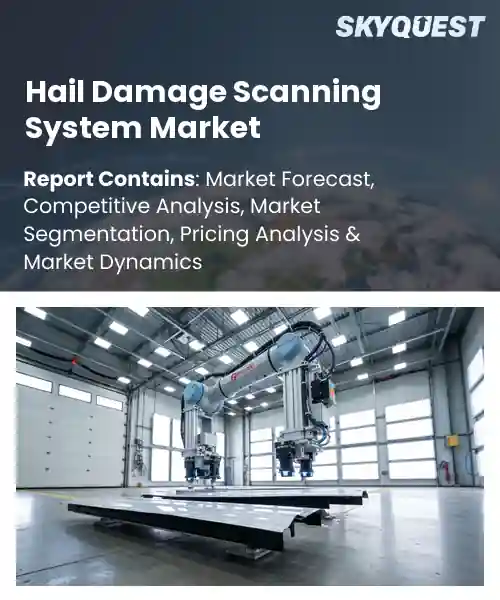
Hail Damage Scanning System Market
Report ID: SQMIG45J2851
Report ID: SQMIG45J2851
[email protected]
USA +1 351-333-4748
Report ID:
SQMIG45J2851 |
Region:
Global |
Published Date: August, 2026
Pages:
157
|Tables:
117
|Figures:
77


Global Hail Damage Scanning System Market size was valued at USD 326.0 Million in 2024 and is poised to grow from USD 363.49 Million in 2025 to USD 868.35 Million by 2033, growing at a CAGR of 11.5% during the forecast period (2026-2033).
Rising incidence of severe hailstorms, driven by climate variability, stands as the primary catalyst for the global hail‑damage scanning system market. This market comprises LiDAR, radar, and drone‑mounted imaging platforms that assess structural impact for insurers, municipalities, and agricultural producers. Its significance lies in the ability to quantify losses quickly, reduce manual inspection costs, and improve safety for field assessors. Historically, post‑storm evaluation relied on visual walkthroughs and handheld gauges; the past decade, however, witnessed a shift toward AI‑enhanced remote sensing, exemplified by the Midwest U.S. where drone fleets now generate centimeter‑level surface maps within hours of a hail event. Insurance firms’ demand for loss data constitutes the second growth engine for the hail‑damage scanning system market.
Integrating drones to generate point clouds for insurance companies makes them able to make payments 40 % faster, which decreases the burden of bureaucracy and enhances the customer experience; hence, making it more efficient encourages its use from rooftops to vineyards. Regulation requiring insurance providers to make reports pushes them to invest, which makes them offer scanning services combined with software-as-a-service solutions that combine satellite data and weather models. For example, in Australia, a company has collaborated with a startup to automate the assessment of hail losses, reducing travel by 70 %.
How is AI Improving Accuracy in the Hail Damage Scanning System Market?
AI is reshaping the hail damage scanning market by turning raw image data into precise damage maps. Modern systems capture high resolution aerial or drone photos and feed them to deep learning models that recognize the unique texture of hail dents. The algorithms learn from thousands of inspected roofs, reducing false alarms and distinguishing hail from other wear. This level of detail lets insurers estimate loss with confidence and speeds claim workflows. Integration with cloud platforms allows adjusters to view results on any device, while continuous model updates keep accuracy ahead of evolving storm patterns.
Market snapshot - (2026-2033)
Global Market Size
USD 326.0 Million
Largest Segment
Hardware
Fastest Growth
Services
Growth Rate
11.5% CAGR
To get more insights on this market click here to Request a Free Sample Report
Global hail damage scanning system market is segmented by offering, technology, deployment, end user and region. Based on offering, the market is segmented into Hardware, Software and Services. Based on technology, the market is segmented into 3D Laser Scanning, AI & Computer Vision and Imaging Systems. Based on deployment, the market is segmented into Fixed Systems and Portable Systems. Based on end user, the market is segmented into Automotive Repair Centers, Insurance Companies, Vehicle Inspection Service Providers and Automotive OEMs & Dealers. Based on region, the market is segmented into North America, Europe, Asia Pacific, Latin America and Middle East & Africa.
Hardware segment dominates because it provides the tangible measurement tools essential for detecting hail impact on vehicle surfaces. The reliability of laser emitters, rugged scanners, and integrated mounting solutions ensures consistent data capture across varying weather conditions, which builds customer confidence. Consequently, manufacturers prioritize hardware development to meet stringent accuracy requirements, driving procurement decisions and establishing the foundation for system performance and enabling seamless integration with downstream analysis tools.
On the flip side, the Services vertical is experiencing the most dynamic growth momentum owing to the rising demand from the insurance companies and repair centers for subscription-based diagnostic solutions that offer software upgrades, remote calibration, and claims processing backed by data analytics. Such a business model reduces capital investments and enables rapid implementation and monetization, compelling players to expand their ecosystems.
3D Laser Scanning segment leads because it delivers high resolution depth information that directly maps dent morphology, enabling precise quantification of hail impact. The physical measurement principle eliminates reliance on visual inference, guaranteeing repeatable results across diverse vehicle designs. Engineers therefore prioritize laser scanning hardware as the core sensor, reinforcing market confidence and establishing it as the benchmark for system fidelity. It also integrates smoothly with downstream analytics platforms, fostering comprehensive damage assessment workflows.
However, the Artificial Intelligence and Computer Vision section turns out to be the one that shows high growth potential due to the ability to make sense out of the scanned data by automatically detecting and classifying defects. The continuous improvement of algorithms and increase in training data sets speed up the process, making it possible for insurers to handle claims faster and for repair shops to save time on inspections.
To get detailed segments analysis, Request a Free Sample Report
North America is the leader because of the synergy between the development of technological infrastructure, insurance industry maturity, and a high level of development of precision agriculture. In North America, research centers are constantly improving the quality of sensors and data processing, and regulations favoring the use of scanners in agricultural processes contribute to their rapid implementation. Cooperation of equipment makers, insurance companies, and agronomists creates a system of constant improvement. This enables fast development of the next-generation systems and guarantees the efficient prevention of hail-related losses.
Hail Damage Scanning System Market in United States benefits from a mature insurance ecosystem that values precision assessment, coupled with extensive research institutions driving continuous innovation in sensor technology. Farmers and insurers alike prioritize early detection to mitigate loss, prompting rapid integration of advanced scanning platforms across the Midwest and Southern regions. Strong industry collaborations further accelerate deployment of next‑generation solutions throughout the national agricultural landscape and service provision firmly.
Hail Damage Scanning System Market in Canada is reinforced by proactive government policies that encourage adoption of precision agriculture tools, especially in the prairie provinces where hail events are frequent. Collaborative networks between universities, technology providers, and insurance firms create a supportive environment for pilot projects and knowledge transfer. This synergy speeds the rollout of sophisticated scanning solutions, enhancing risk management and crop resilience across the national farming sector today.
Europe’s rapid expansion stems from strong policy incentives, a focus on sustainability, and the presence of high‑value specialty crops that demand precise risk mitigation. Integrated research collaborations across leading universities and industry partners foster continuous improvement of scanning technologies, while harmonized regulatory standards ease market entry for innovative solutions. The region’s mature insurance frameworks recognize the value of early hail assessment, encouraging widespread adoption among growers. Additionally, a thriving agritech investment climate supports startups developing tailored applications, reinforcing Europe’s position as a dynamic hub for advanced hail damage detection.
Hail Damage Scanning System Market in Germany is propelled by strong industrial engineering capabilities and a network of agricultural cooperatives that emphasize data‑driven risk assessment. Robust funding mechanisms enable refinement of lidar and radar‑based scanning platforms, while stringent building codes increase demand for protective solutions in the horticultural sector. The collaborative culture between research institutes and equipment manufacturers ensures rapid translation of innovations into operational field tools across the nation.
Hail Damage Scanning System Market in United Kingdom experiences accelerated adoption driven by research initiatives and a venture capital ecosystem supporting agritech startups. The presence of specialty crops motivates growers to integrate scanning technologies for damage detection. Collaborative frameworks linking universities, weather services, and insurance providers streamline data sharing, enhancing predictive analytics. This approach strengthens market confidence and drives swift implementation of hail assessment solutions throughout the British agricultural landscape.
Hail Damage Scanning System Market in France is emerging as innovators combine traditional viticulture expertise with modern remote‑sensing tools to protect vineyards. Government incentives for sustainable agriculture encourage adoption of scanning platforms that identify hail‑induced stress before visual symptoms appear. Partnerships between research labs, equipment manufacturers, and wine growers facilitate solutions tailored to the diverse terroir. This collaborative momentum is expanding market presence across both wine and cereal production zones.
Positioning of Asia Pacific is being done on the basis of higher investment in agritech research, greater realization about climate threats, and governmental support in favor of making agriculture more resilient. The countries of the region are utilizing satellite and drones for surveillance of wide and varied farm lands in the region, which improves early warning systems. Collaborative efforts among technology companies, universities and insurance firms help gain more knowledge about adapting international practices to local conditions. All these developments have made Asia Pacific a rising player in hail damage management.
Hail Damage Scanning System Market in Japan benefits from a high‑technology manufacturing base and a culture of meticulous risk management that drives early adoption of advanced scanning tools. Government initiatives promote research into AI‑enhanced image analysis, while strong partnerships between universities and equipment suppliers facilitate rapid prototyping and field testing. These efforts enable precise hail impact assessment, supporting both rice and specialty crop producers in maintaining quality and minimizing losses.
Hail Damage Scanning System Market in South Korea is strengthened by a dynamic start‑up ecosystem focused on sensor miniaturization and real‑time data analytics. National initiatives encourage integration of smart farming solutions, fostering collaboration between telecom providers, agronomy experts, and insurance companies. This synergy accelerates the deployment of compact scanning devices across diverse crop regions, enhancing early detection capabilities and supporting resilient agricultural practices throughout the country.
To know more about the market opportunities by region and country, click here to
Buy The Complete Report
Rising Frequency of Hail Events
Regulatory Incentives for Damage Mitigation
High Initial Capital Expenditure
Limited Technical Expertise Availability
Request Free Customization of this report to help us to meet your business objectives.
The global market for hail damage scanning system is relatively new and moderately fragmented, with competition coming from automated scanning systems, AI-driven vehicle inspection systems, and hail repair service providers. Both Tractable and Inspektlabs utilize AI-driven image processing technologies to detect and quantify hail dents, while ADI integrates calibrated cameras, structured lights, and AI in drive-through hail scanning systems. Competition revolves around the ability of these scanning systems to detect hail dents with high accuracy, perform fast and effective scans, quantify the damages, cover more area, automation capability, integration into the insurance process, and cost per inspection. Drive-through scanning systems compete in their ability to perform fast and standardized vehicle inspection, whereas image processing software systems offer flexible scanning capabilities via smartphones or images.
SkyQuest’s ABIRAW (Advanced Business Intelligence, Research & Analysis Wing) is our Business Information Services team that Collects, Collates, Correlates, and Analyses the Data collected by means of Primary Exploratory Research backed by robust Secondary Desk research.
As per SkyQuest analysis, the market for the global hail damage scanning system is growing at an exponential rate due to two major factors; one is the increasing occurrence of hailstorms making the insurance companies and farmers look for a fast and efficient measurement tool. While the other factor is the regulatory encouragement of damage mitigation that promotes the usage of such systems. The hardware sector is the leading part of the market owing to the requirement of accurate laser scanning and imaging equipment and North America dominates the region owing to the development of their insurance industry along with their agritech segment. However, capital investment in scanning technology is a restraint in the market.
| Report Metric | Details |
|---|---|
| Market size value in 2024 | USD 326.0 Million |
| Market size value in 2033 | USD 868.35 Million |
| Growth Rate | 11.5% |
| Base year | 2024 |
| Forecast period | (2026-2033) |
| Forecast Unit (Value) | USD Million |
| Segments covered |
|
| Regions covered | North America (US, Canada), Europe (Germany, France, United Kingdom, Italy, Spain, Rest of Europe), Asia Pacific (China, India, Japan, Rest of Asia-Pacific), Latin America (Brazil, Rest of Latin America), Middle East & Africa (South Africa, GCC Countries, Rest of MEA) |
| Companies covered |
|
| Customization scope | Free report customization with purchase. Customization includes:-
|
To get a free trial access to our platform which is a one stop solution for all your data requirements for quicker decision making. This platform allows you to compare markets, competitors who are prominent in the market, and mega trends that are influencing the dynamics in the market. Also, get access to detailed SkyQuest exclusive matrix.
Table Of Content
Executive Summary
Market overview
Parent Market Analysis
Market overview
Market size
KEY MARKET INSIGHTS
COVID IMPACT
MARKET DYNAMICS & OUTLOOK
Market Size by Region
KEY COMPANY PROFILES
Methodology
For the Hail Damage Scanning System Market, our research methodology involved a mixture of primary and secondary data sources. Key steps involved in the research process are listed below:
1. Information Procurement: This stage involved the procurement of Market data or related information via primary and secondary sources. The various secondary sources used included various company websites, annual reports, trade databases, and paid databases such as Hoover's, Bloomberg Business, Factiva, and Avention. Our team did 45 primary interactions Globally which included several stakeholders such as manufacturers, customers, key opinion leaders, etc. Overall, information procurement was one of the most extensive stages in our research process.
2. Information Analysis: This step involved triangulation of data through bottom-up and top-down approaches to estimate and validate the total size and future estimate of the Hail Damage Scanning System Market.
3. Report Formulation: The final step entailed the placement of data points in appropriate Market spaces in an attempt to deduce viable conclusions.
4. Validation & Publishing: Validation is the most important step in the process. Validation & re-validation via an intricately designed process helped us finalize data points to be used for final calculations. The final Market estimates and forecasts were then aligned and sent to our panel of industry experts for validation of data. Once the validation was done the report was sent to our Quality Assurance team to ensure adherence to style guides, consistency & design.
Analyst Support
Customization Options
With the given market data, our dedicated team of analysts can offer you the following customization options are available for the Hail Damage Scanning System Market:
Product Analysis: Product matrix, which offers a detailed comparison of the product portfolio of companies.
Regional Analysis: Further analysis of the Hail Damage Scanning System Market for additional countries.
Competitive Analysis: Detailed analysis and profiling of additional Market players & comparative analysis of competitive products.
Go to Market Strategy: Find the high-growth channels to invest your marketing efforts and increase your customer base.
Innovation Mapping: Identify racial solutions and innovation, connected to deep ecosystems of innovators, start-ups, academics, and strategic partners.
Category Intelligence: Customized intelligence that is relevant to their supply Markets will enable them to make smarter sourcing decisions and improve their category management.
Public Company Transcript Analysis: To improve the investment performance by generating new alpha and making better-informed decisions.
Social Media Listening: To analyze the conversations and trends happening not just around your brand, but around your industry as a whole, and use those insights to make better Marketing decisions.
REQUEST FOR SAMPLE
 REQUEST FREE CUSTOMIZATION
Global Hail Damage Scanning System Market size was valued at USD 326.0 Million in 2024 and is poised to grow from USD 363.49 Million in 2025 to USD 868.35 Million by 2033, growing at a CAGR of 11.5% during the forecast period (2026-2033).
Top Player’s Company Profile 'UVeye Ltd.', 'ProovStation SAS', 'DeGould Limited', 'Tractable Ltd.', 'Ravin AI Ltd.', 'AirPro Diagnostics, LLC', 'Opus IVS, Inc.', 'Solera Holdings, LLC', 'Mitchell International, Inc.', 'CCC Intelligent Solutions Holdings Inc.', 'Cox Automotive, Inc.', 'Launch Tech Co., Ltd.', 'Autel Intelligent Technology Corp., Ltd.', 'PDR LINX LLC', 'Spanesi S.p.A.', 'Car-O-Liner Group AB', 'Chief Automotive Technologies', 'MAHA Maschinenbau Haldenwang GmbH & Co. KG', 'Sherwin-Williams Company', '3M Company'
The growing incidence of hailstorms across major agricultural and urban regions creates heightened awareness of property and crop losses, prompting insurers and asset owners to seek proactive detection tools. Advanced scanning systems enable early identification of hail‑prone zones, allowing stakeholders to implement protective measures and adjust underwriting practices. This awareness drives investment in sophisticated monitoring technologies, fostering market expansion as providers cater to a broader customer base seeking resilience against increasingly unpredictable weather patterns. Consequently, organizations prioritize integration of these solutions into their risk management frameworks, further accelerating adoption.
Ai‑Driven Damage Prediction: The integration of advanced artificial intelligence algorithms into hail‑damage scanning platforms is accelerating the shift from reactive assessments to proactive risk mitigation. Machine‑learning models continuously ingest weather patterns, historical impact data, and real‑time sensor inputs to forecast damage zones before storms strike. This predictive capability enables insurers and agricultural producers to allocate resources, adjust insurance underwriting, and implement protective measures pre‑emptively, thereby reducing claim volumes and enhancing operational resilience across vulnerable regions and supporting long‑term sustainability initiatives for affected communities globally worldwide
Why does North America Dominate the Global Hail Damage Scanning System Market? |@12


Want to customize this report? This report can be personalized according to your needs. Our analysts and industry experts will work directly with you to understand your requirements and provide you with customized data in a short amount of time. We offer $1000 worth of FREE customization at the time of purchase.
Feedback From Our Clients


 USA (+1) 351-333-4748

