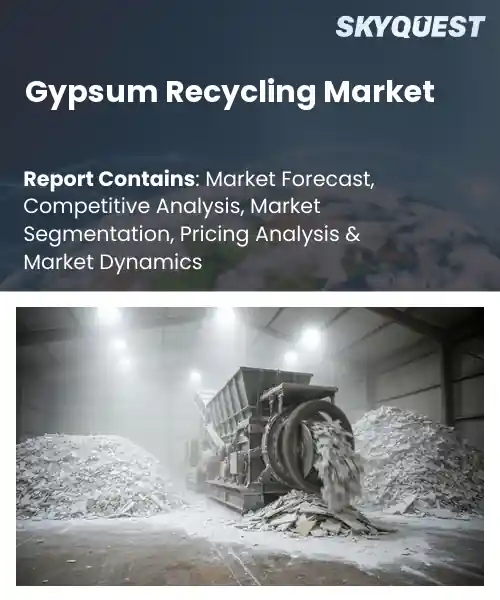
Gypsum Recycling Market
Report ID: SQMIG15P2040
Report ID: SQMIG15P2040
[email protected]
USA +1 351-333-4748
Report ID:
SQMIG15P2040 |
Region:
Global |
Published Date: June, 2026
Pages:
157
|Tables:
88
|Figures:
76


Global Gypsum Recycling Market size was valued at USD 2.1 Billion in 2024 and is poised to grow from USD 2.22 Billion in 2025 to USD 3.4 Billion by 2033, growing at a CAGR of 5.5% during the forecast period (2026-2033).
The primary driver of the gypsum recycling market is regulatory pressure paired with rising construction waste, because landfill restrictions and circular economy policies compel developers and waste managers to find alternatives. Gypsum recycling encompasses collection, processing and reconstitution of waste plasterboard and other calcium sulfate into new building products, and it matters because it reduces landfill occupation, limits emissions from anaerobic decomposition, and conserves finite natural gypsum. The market emerged first in northern Europe where landfill bans and producer responsibility schemes created incentives, and over two decades technologies for sorting, decontaminating and regrinding now matured, enabling commercially viable closed-loop systems.Building on regulatory impetus and technological readiness, a key factor accelerating global gypsum recycling is demand from sustainable construction and manufacturers seeking lower costs and carbon, because acceptance of recycled gypsum as feedstock reduces reliance on mines and lowers embodied carbon in wallboard production. As recycling yields higher purity through advanced separation, manufacturers substitute recycled gypsum into plasterboard, cement and soil-amendment uses, creating volume demand and justifying investment in collection networks. In practice contractors segregating demolition gypsum and processors delivering standardized recycled product enable closed-loop procurement, which drives economies of scale and unlocks opportunities in fast-growing urbanizing markets internationally too.
How is automation improving efficiency in the gypsum recycling market?
Automation is improving efficiency in the gypsum recycling market by tightening control over each step of recovery and processing. Key aspects include sensor driven sorting, automated conveyors, robotic material handling and real time process control. In the current market, mixed demolition streams and contamination make consistent recycled gypsum quality hard to achieve. Automation reduces manual sorting, lowers contamination risk and creates steadier feedstock for reprocessors. Facilities that combine optical and AI vision sorters with automated crushing and moisture control see smoother throughput and fewer rejects. This boosts confidence among manufacturers and supports wider adoption of closed loop recycling across construction projects.Knauf April 2024, partnered on pilot gypsum board recycling projects in mainland China, showing how coordinated collection and automated sorting can raise recycled gypsum quality and reduce contamination, which in turn expands reliable supply and helps the market scale more efficiently.
Market snapshot - (2026-2033)
Global Market Size
USD 2.1 Billion
Largest Segment
Mechanical Recycling
Fastest Growth
Chemical Recycling
Growth Rate
5.5% CAGR
To get more insights on this market click here to Request a Free Sample Report
Global gypsum recycling market is segmented by recycling methods, end-user industries, product types and region. Based on recycling methods, the market is segmented into Mechanical Recycling and Chemical Recycling. Based on end-user industries, the market is segmented into Construction, Agriculture and Environment. Based on product types, the market is segmented into Recycled Gypsum and By-Products. Based on region, the market is segmented into North America, Europe, Asia Pacific, Latin America and Middle East & Africa.
Mechanical Recycling segment dominates because it offers a straightforward pathway to recover gypsum board materials with minimal chemical alteration, enabling efficient material sorting and particle size control that preserve reuse quality. Its process compatibility with existing demolition and waste handling streams reduces logistical friction, lowers processing complexity and fosters steady feedstock supply, which incentivizes investment in collection infrastructure and drives broader adoption across producers and waste managers seeking reliable, low risk recycling outcomes.
However, Chemical Recycling is emerging as the fastest growing approach due to advances in solvent and reagent technologies that enable recovery of high purity gypsum suitable for specialized applications. Regulatory momentum favoring material recovery and continued innovation in closed loop chemistries are expanding application scope, attracting new entrants and catalyzing partnerships that accelerate investment and scale up.
Recycled Gypsum segment dominates because it directly substitutes virgin gypsum in common applications while preserving material properties that satisfy industry performance expectations, enabling immediate uptake by manufacturers and contractors. Its straightforward processing pathways align with existing supply chains, reducing barriers to integration and creating predictable value recovery for waste generators, which in turn stimulates investment in collection systems and standards development that reinforce market trust and steady demand.
However, By-Products is emerging as the fastest growing product area as producers monetize secondary streams like additives and binders, unlocking new revenue channels. Advances in conversion technologies and rising acceptance of circular formulations broaden application scope, prompting partnerships with downstream users and pilot initiatives that accelerate commercialization and create sustained market opportunities.
To get detailed segments analysis, Request a Free Sample Report
Europe dominates the global gypsum recycling market due to an integrated combination of regulatory rigor, advanced waste management infrastructure, and mature construction and renovation activity. Strong policy frameworks encourage source separation and material recovery, while established recycling networks and specialized processing facilities enable efficient turnaround of gypsum waste into usable derivatives. Collaboration among industry, municipalities, and research institutions has fostered innovation in processing techniques and quality assurance, increasing acceptance among builders and manufacturers. Market consolidation, presence of experienced service providers, and high awareness of circular economy principles further reinforce the leading role held by Europe, enabling consistent supply chains for recycled gypsum and stimulating demand from sustainable construction projects that prioritize resource efficiency and reduced environmental impact. Significant investment in logistics and certification schemes underpins market confidence and allows recyclable gypsum to move across borders with assured quality.
Gypsum Recycling Market in Germany benefits from well developed waste sorting systems, robust industrial recycling capacity, and adoption of circular building practices. Strong collaboration between manufacturers, waste operators, and local authorities drives improvement in processing standards and quality control. Market participants emphasize traceability, end use validation, and certification to support recycled gypsum acceptance in repair, refurbishment and construction projects, reinforcing Germany role as a logistical leader in gypsum material recovery.
Gypsum Recycling Market in United Kingdom has progressed through policy support, established recycling firms, and growing acceptance by construction stakeholders. Emphasis on quality assurance and standardized processing fosters confidence in recycled gypsum applications for renovation and new build projects. Close coordination between municipal waste programs and operators enhances collection efficiency, while research into reuse pathways and product certification strengthens market credibility and encourages broader adoption across commercial national construction sectors.
Gypsum Recycling Market in France reflects strong municipal engagement, collection pilots, and involvement from building material producers. Emphasis on product certification and selective sorting has improved feedstock quality for recyclers, while partnerships between industry and local governments support logistical solutions for urban renovation projects. Market dynamics prioritize environmental credentials and reuse innovation, encouraging acceptance of recycled gypsum in interior systems and specialty construction products across diverse renovation and refurbishment initiatives.
Rapid expansion of the gypsum recycling market in North America is driven by a confluence of evolving regulatory expectations, rising demand for sustainable building materials, and active private sector investment in end to end recycling infrastructure. Growing corporate commitments to resource efficiency have prompted builders and material suppliers to integrate recycled gypsum into supply chains, while waste management companies scale collection and processing capabilities. Public procurement preferences and green building certifications create market pull, incentivizing technology adoption and quality control measures. Regional logistics networks, strong industrial know how, and collaborative pilots between municipalities and recyclers accelerate operational maturity, improving material consistency and widening commercial acceptance across renovation, retrofit, and new construction segments. Collaborations with manufacturers and research and development enhance decontamination methods and support closed loop strategies.
Gypsum Recycling Market in United States is characterized by private sector engagement, diverse waste streams from construction activity, and growing integration of recycled gypsum into supply chains. Emphasis on scalable collection logistics and efficient processing has enabled broader acceptance by drywall and plaster manufacturers. Collaborations between waste firms, recyclers, and builders drive innovation in sorting and beneficiation, while policy encouragement and corporate sustainability commitments shape market pathways and material suppliers.
Gypsum Recycling Market in Canada is shaped by coordinated municipal programs and collaboration with building material manufacturers. Focus on improving collection networks and harmonizing quality standards supports reliable inputs for recyclers, while pilot initiatives explore innovative reuse in prefabricated products and specialty applications. Stakeholder partnerships promote operational efficiency and foster market acceptance of recycled gypsum within renovation and sustainable construction practices across varied regional building contexts and provincial government stakeholders.
Asia Pacific is strengthening its position in the gypsum recycling market through targeted investments in processing technology, pilot projects in urban centers, and growing policy recognition of material circularity. Industry players are adapting advanced separation and purification methods to local waste characteristics, while partnerships between manufacturers and recyclers support development of consistent quality specifications. Public and private stakeholders are increasingly focused on building supply chains that integrate recovered gypsum into prefabrication and interior finishing applications. Cross border knowledge transfer, clustering of specialized service providers, and rising acceptance among construction professionals collectively enhance the region capability to scale recycling operations and diversify end use pathways. Investment in workforce training, establishment of regional standards, and incentives for green building adoption further support maturation of recycling ecosystems and encourage manufacturers to incorporate recycled gypsum into product portfolios.
Gypsum Recycling Market in Japan reflects integration of precision processing technologies, research collaborations, and municipal sorting programs tailored to dense urban environments. Focus on material purity and performance testing has enabled recycled gypsum to meet product expectations for interior finishes and prefabricated components. Partnerships between board manufacturers and recyclers facilitate feedstock consistency and closed loop trials, while policy support and training promote adoption within renovation and low carbon construction practices.
Gypsum Recycling Market in South Korea benefits from urban renovation demand, processing pilots, and industry adoption of circular building principles. Emphasis on efficient collection networks and technology driven separation has improved recyclate quality, enabling acceptance in interior systems and specialty boards. Collaboration among recyclers, manufacturers, and municipal programs supports demonstration projects and quality assurance regimes, while sustainability messaging fosters uptake across commercial and residential refurbishment activities and export partnership initiatives.
To know more about the market opportunities by region and country, click here to
Buy The Complete Report
Rising Construction Sector Demand
Recycling of gypsum materials gains momentum as expanding construction activities increase the availability of gypsum-containing waste and create a reliable feedstock stream that reduces dependence on virgin mined gypsum. By converting waste into reusable material, recycling supports material supply continuity and can lower procurement pressure for builders, encouraging adoption across projects. The practice aligns with industry goals to improve resource efficiency, reduce transport of raw materials, and demonstrate environmental stewardship, which collectively incentivize contractors and developers to incorporate recycled gypsum into building processes.
Stricter Environmental Regulations
Tighter environmental regulations and waste diversion targets encourage construction and demolition stakeholders to adopt gypsum recycling as a compliant waste management strategy, creating stronger demand for recycling services and processed materials. Compliance requirements make diversion of gypsum from landfills a priority, prompting firms to integrate recycling into project planning and contractor responsibilities. Regulatory frameworks can also create market signals that favor recycled content, stimulate investment in recycling facilities, and foster partnerships across the value chain, thereby supporting expansion of collection networks and processing capacity.
Inconsistent Quality Of Recycled Gypsum
Variability in chemical composition and contamination levels of reclaimed gypsum can undermine confidence among manufacturers and end users, limiting uptake of recycled material and constraining market expansion. When recycled gypsum presents inconsistent performance in finishing products or requires additional processing to meet standards, manufacturers face integration challenges and potential liability concerns, so they may prefer virgin material. These perceptions create barriers to acceptance, reduce demand for recycled outputs, and discourage investment in large-scale processing infrastructure, thereby slowing the establishment of dependable recycling supply chains.
High Collection And Logistics Costs
Fragmented generation points and the need for careful separation of gypsum waste increase collection and transport complexity, making logistics a significant barrier to widespread recycling adoption. When costs and operational effort to gather, sort, and deliver gypsum to processing facilities are perceived as high relative to alternative disposal routes, stakeholders may deprioritize recycling, reducing material availability for processors. Limited return on logistical investment discourages expansion of collection networks, hampers economies of scale, and makes it more difficult to establish consistent supply streams needed for stable market growth.
Request Free Customization of this report to help us to meet your business objectives.
Competitive landscape in global gypsum recycling is accelerating as tighter landfill rules and corporate net zero targets push manufacturers and startups into M&A partnerships and technology competition. Major consolidation such as Knauf's 2019 acquisition of USG shows scale plays while recent collaborations like Dekiln's pilot with Johnson Tiles and Japan's public support for local recycling startups illustrate partnership led scaling and process innovation.
Top Player’s Company Profile
Recent Developments
SkyQuest’s ABIRAW (Advanced Business Intelligence, Research & Analysis Wing) is our Business Information Services team that Collects, Collates, Correlates, and Analyses the Data collected by means of Primary Exploratory Research backed by robust Secondary Desk research. As per SkyQuest analysis, a key driver is regulatory pressure and rising construction waste that forces diversion from landfills and creates feedstock for recyclers. A restraint is inconsistent quality of recycled gypsum and contamination that undermines manufacturer confidence and limits uptake. Europe remains the dominating region due to mature policy frameworks, established collection networks and processing capacity, while mechanical recycling is the dominating segment because it offers efficient, low-risk recovery compatible with demolition streams. A second driver is growing demand from sustainable construction and manufacturers seeking lower costs and embodied carbon, which motivates closed-loop sourcing and investment in sorting and processing infrastructure.
| Report Metric | Details |
|---|---|
| Market size value in 2024 | USD 2.1 Billion |
| Market size value in 2033 | USD 3.4 Billion |
| Growth Rate | 5.5% |
| Base year | 2024 |
| Forecast period | (2026-2033) |
| Forecast Unit (Value) | USD Billion |
| Segments covered |
|
| Regions covered | North America (US, Canada), Europe (Germany, France, United Kingdom, Italy, Spain, Rest of Europe), Asia Pacific (China, India, Japan, Rest of Asia-Pacific), Latin America (Brazil, Rest of Latin America), Middle East & Africa (South Africa, GCC Countries, Rest of MEA) |
| Companies covered |
|
| Customization scope | Free report customization with purchase. Customization includes:-
|
To get a free trial access to our platform which is a one stop solution for all your data requirements for quicker decision making. This platform allows you to compare markets, competitors who are prominent in the market, and mega trends that are influencing the dynamics in the market. Also, get access to detailed SkyQuest exclusive matrix.
Table Of Content
Executive Summary
Market overview
Parent Market Analysis
Market overview
Market size
KEY MARKET INSIGHTS
COVID IMPACT
MARKET DYNAMICS & OUTLOOK
Market Size by Region
KEY COMPANY PROFILES
Methodology
For the Gypsum Recycling Market, our research methodology involved a mixture of primary and secondary data sources. Key steps involved in the research process are listed below:
1. Information Procurement: This stage involved the procurement of Market data or related information via primary and secondary sources. The various secondary sources used included various company websites, annual reports, trade databases, and paid databases such as Hoover's, Bloomberg Business, Factiva, and Avention. Our team did 45 primary interactions Globally which included several stakeholders such as manufacturers, customers, key opinion leaders, etc. Overall, information procurement was one of the most extensive stages in our research process.
2. Information Analysis: This step involved triangulation of data through bottom-up and top-down approaches to estimate and validate the total size and future estimate of the Gypsum Recycling Market.
3. Report Formulation: The final step entailed the placement of data points in appropriate Market spaces in an attempt to deduce viable conclusions.
4. Validation & Publishing: Validation is the most important step in the process. Validation & re-validation via an intricately designed process helped us finalize data points to be used for final calculations. The final Market estimates and forecasts were then aligned and sent to our panel of industry experts for validation of data. Once the validation was done the report was sent to our Quality Assurance team to ensure adherence to style guides, consistency & design.
Analyst Support
Customization Options
With the given market data, our dedicated team of analysts can offer you the following customization options are available for the Gypsum Recycling Market:
Product Analysis: Product matrix, which offers a detailed comparison of the product portfolio of companies.
Regional Analysis: Further analysis of the Gypsum Recycling Market for additional countries.
Competitive Analysis: Detailed analysis and profiling of additional Market players & comparative analysis of competitive products.
Go to Market Strategy: Find the high-growth channels to invest your marketing efforts and increase your customer base.
Innovation Mapping: Identify racial solutions and innovation, connected to deep ecosystems of innovators, start-ups, academics, and strategic partners.
Category Intelligence: Customized intelligence that is relevant to their supply Markets will enable them to make smarter sourcing decisions and improve their category management.
Public Company Transcript Analysis: To improve the investment performance by generating new alpha and making better-informed decisions.
Social Media Listening: To analyze the conversations and trends happening not just around your brand, but around your industry as a whole, and use those insights to make better Marketing decisions.
REQUEST FOR SAMPLE
 REQUEST FREE CUSTOMIZATION


Want to customize this report? This report can be personalized according to your needs. Our analysts and industry experts will work directly with you to understand your requirements and provide you with customized data in a short amount of time. We offer $1000 worth of FREE customization at the time of purchase.
Feedback From Our Clients


 USA (+1) 351-333-4748

