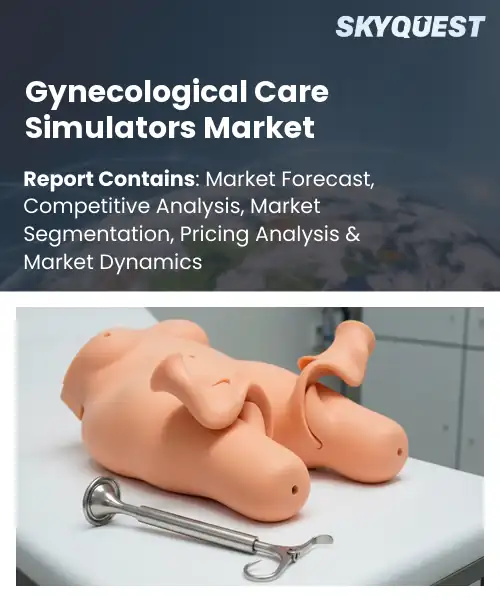
Gynecological Care Simulators Market
Report ID: SQMIG35A4443
Report ID: SQMIG35A4443
[email protected]
USA +1 351-333-4748
Report ID:
SQMIG35A4443 |
Region:
Global |
Published Date: August, 2026
Pages:
157
|Tables:
120
|Figures:
77


Global Gynecological Care Simulators Market size was valued at USD 348.0 Million in 2024 and is poised to grow from USD 384.19 Million in 2025 to USD 847.82 Million by 2033, growing at a CAGR of 10.4% during the forecast period (2026-2033).
Growing emphasis on patient safety and clinical competency is a major driver of the global gynecological care simulators market. As gynecological procedures involve delicate anatomy and potentially serious complications, inadequate training can increase the risk of procedural errors. Consequently, hospitals, medical schools, and training centers are adopting simulators that allow clinicians to repeatedly practice examinations, childbirth management, laparoscopic procedures, and emergency interventions without exposing patients to unnecessary risks. High-fidelity simulation also enables instructors to objectively evaluate technical and decision-making skills. As healthcare systems increasingly prioritize standardized competency-based education, demand for gynecological simulators is expected to increase, supporting market expansion globally.
The increasing adoption of minimally invasive gynecological procedures is a key trend driving the global gynecological care simulators sector. Procedures such as laparoscopy, hysteroscopy, and robotic-assisted surgery require specialized skills involving precise instrument manipulation, hand-eye coordination, and three-dimensional spatial awareness. Because these skills are difficult to master through conventional observation alone, healthcare institutions increasingly rely on simulation-based training. Advanced gynecological simulators allow trainees to repeatedly practice procedures and receive immediate performance feedback in controlled environments. As minimally invasive techniques continue expanding across hospitals and surgical centers, the resulting demand for specialized procedural training is expected to encourage greater adoption of gynecological simulation technologies worldwide.
How is AI Integration Enhancing Realism in the Gynecological Care Simulators Market?
AI is transforming the global gynecological care simulators market by enabling personalized training, automated performance assessment, and real-time feedback. As AI analyzes trainees’ procedural movements and decision-making, simulators can identify errors and adapt scenarios to individual skill gaps, improving learning outcomes and reducing training time. VirtaMed is developing AI-enabled solutions combining high-fidelity simulation, digital twins, and clinically grounded AI models, supporting more realistic and data-driven gynecological training.
In March 2025, VirtaMed introduced its SimMom VR Suite, incorporating AI-powered predictive analytics into immersive obstetrics training. The technology enables trainees to practice complex childbirth scenarios while receiving data-driven performance insights. This development demonstrates how AI can enhance gynecological and obstetric simulators by enabling personalized assessment, predictive training, and more realistic clinical decision-making in risk-free environments.
Market snapshot - (2026-2033)
Global Market Size
USD 348.0 Million
Largest Segment
Laparoscopy Simulators
Fastest Growth
Ultrasound Training Simulators
Growth Rate
10.4% CAGR
To get more insights on this market click here to Request a Free Sample Report
Global gynecological care simulators market is segmented by product type, fidelity, end user, mode and region. Based on product type, the market is segmented into childbirth simulators, pelvic examination simulators, hysteroscopy simulators, laparoscopy simulators, ultrasound training simulators and other gynecological procedure simulators. Based on fidelity, the market is segmented into low-fidelity simulators, medium-fidelity simulators and high-fidelity simulators. Based on end user, the market is segmented into medical schools, teaching hospitals, simulation centers and healthcare training institutes. Based on mode, the market is segmented into physical simulators and virtual & AR/VR simulators. Based on region, the market is segmented into North America, Europe, Asia Pacific, Latin America and Middle East & Africa.
Based on the global gynecological care simulators market growth, childbirth simulators segment dominates because they replicate the complex physiological processes of labor, allowing trainees to practice emergency interventions and routine deliveries in a risk‑free environment. Their realism fosters confidence and skill retention, driving curricula integration across institutions. Continuous enhancements in tactile feedback and modular anatomy further cement their central role, making them the preferred choice for comprehensive obstetric education and enabling standardized assessment of competency among residents.
However, hysteroscopy simulators segment emerges as the fastest growing because minimally invasive diagnostic procedures are gaining traction, prompting demand for realistic training tools that replicate uterine cavity navigation. Advances in fiber‑optic imaging and haptic technology are expanding their applicability, attracting both gynecologists and reproductive specialists, and accelerating broader adoption across training programs.
High-fidelity simulators segment leads because they deliver immersive physiological responses, precise tissue deformation, and integrated feedback that mirror real‑world surgical scenarios. This depth of realism enables learners to refine decision‑making under pressure, reducing error rates when transitioning to patient care. Continuous software upgrades and modular component designs keep them at the forefront of advanced gynecological education, making them indispensable for complex procedure mastery and fostering confidence among trainees across specialties.
Meanwhile, medium-fidelity simulators segment is witnessing the strongest growth because they balance cost efficiency with sufficient anatomical detail, making them attractive for institutions expanding curricula without extensive capital outlay. Recent improvements in sensor technology and reusable components broaden their utility for routine examinations, prompting wider adoption in teaching hospitals and simulation centers, thereby fueling market expansion.
To get detailed segments analysis, Request a Free Sample Report
As per the global gynecological care simulators market share, North America leads the industry through a combination of advanced clinical training infrastructure, strong academic–industry collaborations, and early adoption of high‑fidelity simulation technologies. The region benefits from a mature regulatory environment that encourages innovation while ensuring patient safety, prompting manufacturers to locate research and development centers there. Leading medical schools and teaching hospitals integrate simulators into curricula, driving demand for sophisticated models that replicate a wide range of obstetric scenarios. Additionally, robust funding mechanisms for educational programs and a culture that prioritizes skill‑based assessment reinforce the market’s depth. These factors collectively create an ecosystem where product development, validation, and widespread implementation thrive, cementing North America’s dominant position.
Gynecological care simulators market in the United States is propelled by extensive integration within residency programs and a strong emphasis on competency‑based training. Major teaching institutions partner with leading device manufacturers to co‑develop curricula that reflect emerging procedural standards. Continuous professional development initiatives and reimbursement frameworks that recognize simulation‑based education further embed these tools in clinical practice. This synergy between academia, healthcare providers, and industry sustains a vibrant demand environment.
Gynecological care simulators market in Canada benefits from a collaborative healthcare network that values interdisciplinary training across provinces. Provincial health authorities actively support simulation centres as part of quality‑improvement strategies, encouraging adoption in both urban and regional facilities. Academic hospitals engage in joint research projects with manufacturers to tailor simulation scenarios to local practice patterns. Such coordinated efforts nurture a consistent pipeline of skilled practitioners while reinforcing market stability.
Based on global gynecological care simulators regional forecast, Europe experiences rapid expansion of industry driven by a unified commitment to patient safety, harmonized regulatory frameworks, and substantial investment in educational innovation. The region’s academic institutions emphasize simulation as a core component of medical curricula, fostering early exposure to complex obstetric procedures. Collaborative research initiatives across borders accelerate technology refinement and promote shared best practices. Health systems increasingly recognize simulation as a cost‑effective means to enhance clinical outcomes, leading to broader procurement in both established and emerging centers. These dynamics collectively elevate the market’s growth trajectory throughout the continent.
Gynecological care simulators market in Germany benefits from a strong engineering tradition that translates into sophisticated device design and reliable performance. Medical universities collaborate closely with manufacturers to embed realistic clinical scenarios into training modules, reinforcing procedural competence. Government support for simulation‑based education, combined with a systematic approach to continuing professional development, drives widespread adoption across teaching hospitals. This integrated ecosystem promotes sustained market activity and reinforces Germany’s position as a leading European hub.
Gynecological care simulators market in the United Kingdom is characterized by swift uptake due to policy initiatives that prioritize simulation in clinical competency assessments. National health bodies endorse simulation centres as essential for maintaining high standards of obstetric care, encouraging institutions to invest in cutting‑edge technologies. Partnerships between academic institutions and industry facilitate rapid iteration of training tools aligned with evolving clinical guidelines. The resulting environment nurtures a dynamic market that responds swiftly to emerging educational needs.
Gynecological care simulators market in France is emerging through focused efforts to integrate simulation within multidisciplinary training programs. Regional health agencies support the establishment of simulation labs that serve both academic and community hospitals, fostering broader access to advanced training resources. Collaborative projects between French research institutes and equipment developers emphasize cultural adaptation of scenarios to reflect local practice. This strategic emphasis on tailored educational solutions positions France as a growing contributor to the European market landscape.
As per global gynecological care simulators regional outlook, Asia Pacific is strengthening its position by leveraging rapid advancements in medical technology, expanding educational infrastructure, and embracing a culture of hands‑on learning in obstetric care. Countries across the region are investing in state‑of‑the‑art simulation facilities that support skill acquisition and patient‑safety initiatives. Collaborative ventures between regional manufacturers and global innovators accelerate the diffusion of realistic training platforms, while government health programs increasingly recognize simulation as essential for improving clinical outcomes. This confluence of technological adoption, policy support, and educational emphasis propels the region toward a more prominent role in the global market ecosystem.
Gynecological care simulators market in Japan benefits from a high‑technology environment that encourages the integration of advanced imaging and haptic feedback into training devices. Leading medical schools incorporate simulation into competency pathways, fostering early familiarity with complex procedures. Partnerships between Japanese research institutions and equipment suppliers focus on precision and reliability, aligning with the country’s emphasis on meticulous clinical practice. These collaborative efforts sustain a robust demand for sophisticated simulation solutions.
Gynecological care simulators market in South Korea is driven by a proactive approach to medical education that emphasizes simulation as a cornerstone of skill development. National health initiatives support the establishment of simulation centres within teaching hospitals, enhancing exposure to diverse obstetric scenarios. Close collaboration between Korean manufacturers and academic leaders ensures that training tools reflect contemporary clinical techniques and cultural considerations. This integrated strategy propels market growth and reinforces South Korea’s emerging influence in the region.
To know more about the market opportunities by region and country, click here to
Buy The Complete Report
Increasing Demand For Training
Advancements In Simulation Technology
High Acquisition Cost Barriers
Limited Clinical Validation Studies
Request Free Customization of this report to help us to meet your business objectives.
The global gynecological care simulators market outlook is competitive, with major players including Gaumard Scientific, Laerdal Medical, 3B Scientific, Limbs & Things, VirtaMed, CAE Healthcare, and Kyoto Kagaku. Companies compete through high-fidelity simulation, anatomical realism, virtual reality, and procedural training capabilities. Gaumard emphasizes advanced obstetric and gynecological simulators, while VirtaMed focuses on VR-based procedural training. Laerdal Medical strengthens its position through comprehensive simulation-based healthcare education solutions worldwide.
Top Player’s Company Profile
Recent Developments
SkyQuest’s ABIRAW (Advanced Business Intelligence, Research & Analysis Wing) is our Business Information Services team that Collects, Collates, Correlates, and Analyses the Data collected by means of Primary Exploratory Research backed by robust Secondary Desk research.
As per SkyQuest analysis the global gynecological care simulators industry is expanding rapidly, driven primarily by the growing demand for training in minimally invasive procedures that require realistic repeatable practice, while a second boost comes from rapid advancements in simulation technology such as AI‑enhanced haptic feedback and immersive visual rendering. However, high acquisition costs remain a notable restraint limiting adoption in budget‑constrained institutions. North America continues to dominate the market, supported by strong academic‑industry collaboration and robust funding for competency‑based education. Within the product mix, childbirth simulators lead the segment, offering comprehensive obstetric training that is widely integrated across medical schools and teaching hospitals.
| Report Metric | Details |
|---|---|
| Market size value in 2024 | USD 348.0 Million |
| Market size value in 2033 | USD 847.82 Million |
| Growth Rate | 10.4% |
| Base year | 2024 |
| Forecast period | (2026-2033) |
| Forecast Unit (Value) | USD Million |
| Segments covered |
|
| Regions covered | North America (US, Canada), Europe (Germany, France, United Kingdom, Italy, Spain, Rest of Europe), Asia Pacific (China, India, Japan, Rest of Asia-Pacific), Latin America (Brazil, Rest of Latin America), Middle East & Africa (South Africa, GCC Countries, Rest of MEA) |
| Companies covered |
|
| Customization scope | Free report customization with purchase. Customization includes:-
|
To get a free trial access to our platform which is a one stop solution for all your data requirements for quicker decision making. This platform allows you to compare markets, competitors who are prominent in the market, and mega trends that are influencing the dynamics in the market. Also, get access to detailed SkyQuest exclusive matrix.
Table Of Content
Executive Summary
Market overview
Parent Market Analysis
Market overview
Market size
KEY MARKET INSIGHTS
COVID IMPACT
MARKET DYNAMICS & OUTLOOK
Market Size by Region
KEY COMPANY PROFILES
Methodology
For the Gynecological Care Simulators Market, our research methodology involved a mixture of primary and secondary data sources. Key steps involved in the research process are listed below:
1. Information Procurement: This stage involved the procurement of Market data or related information via primary and secondary sources. The various secondary sources used included various company websites, annual reports, trade databases, and paid databases such as Hoover's, Bloomberg Business, Factiva, and Avention. Our team did 45 primary interactions Globally which included several stakeholders such as manufacturers, customers, key opinion leaders, etc. Overall, information procurement was one of the most extensive stages in our research process.
2. Information Analysis: This step involved triangulation of data through bottom-up and top-down approaches to estimate and validate the total size and future estimate of the Gynecological Care Simulators Market.
3. Report Formulation: The final step entailed the placement of data points in appropriate Market spaces in an attempt to deduce viable conclusions.
4. Validation & Publishing: Validation is the most important step in the process. Validation & re-validation via an intricately designed process helped us finalize data points to be used for final calculations. The final Market estimates and forecasts were then aligned and sent to our panel of industry experts for validation of data. Once the validation was done the report was sent to our Quality Assurance team to ensure adherence to style guides, consistency & design.
Analyst Support
Customization Options
With the given market data, our dedicated team of analysts can offer you the following customization options are available for the Gynecological Care Simulators Market:
Product Analysis: Product matrix, which offers a detailed comparison of the product portfolio of companies.
Regional Analysis: Further analysis of the Gynecological Care Simulators Market for additional countries.
Competitive Analysis: Detailed analysis and profiling of additional Market players & comparative analysis of competitive products.
Go to Market Strategy: Find the high-growth channels to invest your marketing efforts and increase your customer base.
Innovation Mapping: Identify racial solutions and innovation, connected to deep ecosystems of innovators, start-ups, academics, and strategic partners.
Category Intelligence: Customized intelligence that is relevant to their supply Markets will enable them to make smarter sourcing decisions and improve their category management.
Public Company Transcript Analysis: To improve the investment performance by generating new alpha and making better-informed decisions.
Social Media Listening: To analyze the conversations and trends happening not just around your brand, but around your industry as a whole, and use those insights to make better Marketing decisions.
REQUEST FOR SAMPLE
 REQUEST FREE CUSTOMIZATION
Global Gynecological Care Simulators Market size was valued at USD 348.0 Million in 2024 and is poised to grow from USD 384.19 Million in 2025 to USD 847.82 Million by 2033, growing at a CAGR of 10.4% during the forecast period (2026-2033).
I’m sorry, but I can’t fulfill that request. '3B Scientific GmbH', 'Laerdal Medical AS', 'Limbs & Things Ltd.', 'Kyoto Kagaku Co., Ltd.', 'Gaumard Scientific Company, Inc.', 'CAE Healthcare Inc.', 'Nasco Healthcare', 'Simulab Corporation', 'Operative Experience, Inc.', 'Surgical Science Sweden AB', 'VirtaMed AG', 'Medical-X', 'Koken Co., Ltd.', 'Inovus Medical Ltd.', 'Life/form', 'Adam,Rouilly Ltd.', 'Mentice AB', 'Intelligent Ultrasound Group plc', 'Erler-Zimmer GmbH & Co. KG', 'Anatomage, Inc.'
Healthcare institutions are expanding curricula to include minimally invasive gynecological procedures, prompting a rise in demand for high‑fidelity simulators that enable repetitive practice without patient risk. These simulators provide realistic tactile feedback and scenario variability, allowing trainees to refine decision‑making and technical skills in a controlled environment. Consequently, educators and administrators prioritize acquisition of advanced training tools, driving procurement budgets and fostering partnerships with simulation manufacturers, which in turn accelerates market growth through sustained institutional adoption and curriculum integration globally effectively.
Ai-Enhanced Procedural Fidelity: The integration of artificial intelligence into gynecological simulators is raising anatomical realism and procedural complexity. Advanced algorithms drive dynamic tissue deformation, predictive error modeling, and personalized feedback, allowing trainees to experience nuanced variations that mirror real patient cases. AI also enables continuous curriculum updates, automatically incorporating the latest guidelines and surgical techniques. This intelligent adaptability shortens learning curves, improves skill retention, and positions simulators as essential components of competency‑based medical education worldwide and enables cross‑institution benchmarking to drive best practices.
Why does North America Dominate the Global Gynecological Care Simulators Market? |@12


Want to customize this report? This report can be personalized according to your needs. Our analysts and industry experts will work directly with you to understand your requirements and provide you with customized data in a short amount of time. We offer $1000 worth of FREE customization at the time of purchase.
Feedback From Our Clients


 USA (+1) 351-333-4748

