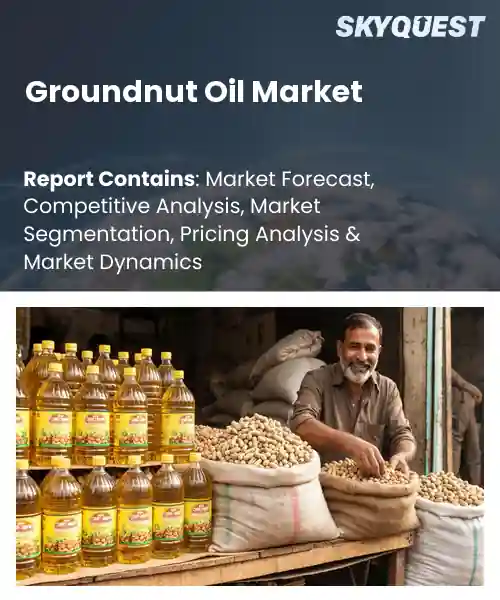
Groundnut Oil Market
Report ID: SQMIG30I2891
Report ID: SQMIG30I2891
[email protected]
USA +1 351-333-4748
Report ID:
SQMIG30I2891 |
Region:
Global |
Published Date: March, 2026
Pages:
157
|Tables:
173
|Figures:
79


Global Groundnut Oil Market size was valued at USD 10.80 Million in 2024 and is poised to grow from USD 11.30 Million in 2025 to USD 16.19 Million by 2033, growing at a CAGR of 4.6% during the forecast period (2026-2033).
Key Takeaways: Market Trends & Insights
Growing demand for edible oils, increasing consumer preference for healthy cooking oils, rising awareness of nutritional benefits, expansion of food processing industries, and growing use in traditional cuisines are driving sales of groundnut oil.
Organic, non-GMO, and cold-pressed forms of groundnut oil are being developed by oil companies due to an increasing requirement for high-quality oils and clean labels. Moreover, innovations in contract farming as well as development of more efficient seed strains are improving yield stability along with ensuring regular supply of groundnuts to food processing industries and eateries. Such improvements are not only helping in contributing towards developing cosmetics, thus generating profits from these products as well as making way for more investments. Extensive consumption of groundnut oil for frying and cooking purposes makes sales stable. Growing health consciousness among consumers worldwide, coupled with increasing demand for oils with a high smoke point and favorable fatty acid profile, is expected to primarily drive groundnut oil market growth.
On the contrary, price volatility of raw peanuts, competition from alternative edible oils, susceptibility to climate conditions affecting crop yield, and concerns regarding adulteration are slated to slow down groundnut oil market penetration across the study period.
How is AI Improving Groundnut oil Supply Chain Efficiency?
The use of artificial intelligence technology is increasing efficiency within the supply chain of the groundnut oil industry through accurate prediction, quick assessment of quality, and effective logistics management. Moreover, artificial intelligence technology facilitates traceability in the supply chain process. Using computer vision and spectroscopy technologies to conduct quality assessment at the point of origin, machine learning to estimate future demand and inventory, and cloud computing technologies to integrate all stakeholders in the supply chain process are also boosting consumption of groundnut oil.
In May 2025, Arjena Foods set up a new peanut processing facility in Nigeria. When combined with AI-based quality testing and predictive logistics, this improves traceability, reduces supply fluctuations, and ensures consistent raw material supply for groundnut oil production.

To get more insights on this market click here to Request a Free Sample Report
Global groundnut oil market is segmented by product type, processing method, nature, application, end-user, distribution channel, and region. Based on product type, the market is segmented into refined oil and unrefined oil. Based on processing method, the market is segmented into cold pressed and hot pressed. Based on nature, the market is segmented into organic and conventional. Based on application, the market is segmented into food & cooking, food processing (snacks, bakery, frying oils), pharmaceuticals, and others. Based on end-user, the market is segmented into household / retail consumers, food service industry (hotels, restaurants, cafés), food manufacturers, and others. Based on distribution channel, the market is segmented into B2B and B2C. Based on region, the market is segmented into North America, Europe, Asia Pacific, Latin America, and Middle East & Africa.
The refined oil segment is estimated to lead the global groundnut oil market revenue generation in the long run. Its ability to meet mainstream consumer and industrial demands for consistent quality, neutral flavor, and extended shelf life allows this segment to hold sway over others. Regulatory compliance and standardization of refinement contribute to consistent frying behavior, thus promoting the preference of such a vegetable oil by big food companies. In addition to this, brand building, packaging techniques, and wide availability have also helped the oil maintain its supremacy through economies of scale.
However, unrefined oil segment is witnessing the strongest growth momentum as per this groundnut oil market forecast. Consumer appetite for minimally processed oils is creating new opportunities for companies focusing on this segment. With an increasing trend of clean labels and demand for authentic flavors, innovations will lead to more products being manufactured under specialty conditions, resulting in more channels through which products can be distributed, especially in the area of premium groundnut oil.
The cold pressed segment is projected to account for the highest global groundnut oil market share in the long run. The ability of this extraction method to preserve native flavor compounds and micronutrients, aligns with consumer priorities for authenticity thereby cementing the high share of this segment. This technique facilitates easy claims for labelling purposes and helps to meet the requirements for organic certification, thus making it attractive to niche producers. The increased traceability and the ability to label smaller batches also make retail inclusion more likely and ensure brand loyalty among consumers.
On the other hand, hot pressed segment is becoming important in terms of rapid growth since process developments improve the rate of extraction, making it a viable option for big companies producing food who want to source cheap crude oil. This development opens new applications in deep frying and further processing of food items.

To get detailed segments analysis, Request a Free Sample Report
Deep culinary integration, mature processing capabilities, and strong distribution networks support the high consumption of groundnut oil in Asia Pacific. With a highly developed technologically advanced crushing and refining infrastructure within the region, there is a large amount of available capital to support the efficient transformation of groundnut oil from its natural form to consumer-ready packaging through the entire length of the value chain, and significant investment has been made in quality control and certification systems to ensure that products produced will be safe for human consumption. With the rapid rate of retail modernization and continued growth of private label products within the region, opportunities for new products have increased enormously with the introduction of several different higher-quality groundnut oil products (e.g., higher-priced premium oils and cold-pressed oils). The importance of investment in exporting facilities in Asia Pacific, along with improvements made in the growing of groundnuts, means that there are likely to be consistent availability of raw materials to process into groundnut oil; therefore, Asia Pacific is expected to be a consistently large producer of groundnut oil.
A premium consumer base that prioritizes refined quality, food safety, and culinary nuance helps govern groundnut oil demand in Japan. Specialty products such as light-taste and cold-pressed oils have been popular, leading to differentiation. The relationship between the processor and retailer has improved visibility, where marketing has been health and culinary-oriented. The importance of traceability and transparency in retail channels drives processors into using advanced technology in refinement and testing.
Robust demand for culinary oils that balance flavor and health help shape groundnut oil consumption across South Korea. Retailing through e-commerce platforms and partnership with culinary personalities have expanded awareness about groundnut oil products among consumers. Consumption patterns in urban areas and food service trends require more adaptable forms of oil that can be used for cooking purposes. In terms of manufacturing processes and food safety measures, companies stress quality and food safety measures.
Evolving consumer preferences toward oils perceived as healthier and more flavorful helps boost demand for GROUNDNUT OIL across European countries going forward. Clean label, traceability and sustainability are all major factors that have increased the visibility of groundnut oils to a wider range of consumers. Cold-pressed and premium groundnut oils have generated new market niches. Grocery stores and online sales channels are two of the most efficient methods manufacturers can use to launch new products (specifically differentiated SKUs) and build brand identity. The rapid growth of the restaurant sector, including both traditional and fusion restaurants, provides another outlet for larger groundnut oil pack sizes. An increasing number of regulations aimed at ensuring food safety, as well as increased integration and investment in processing technologies across the supply chain, have all decreased barriers to scaling up production.
Rise in consumer preference for goods that conform to clean label and healthy trends is driving up the demand for groundnut oil in Germany. Companies are making investments in sustainability and material traceability in order to meet the needs of customers, and changes in the manufacturing process will increase the quality of the products. Products are also being offered in cold pressed forms to help new entrants grab some shelf space.
Widespread awareness and good retail penetration are influencing the use of groundnut oil within the United Kingdom up until 2033. The extensive retail chains and the branding of groundnut oil have made this food item. At the same time, varying cuisine types keep on demanding groundnut oil in their preparation. This is because of the availability of different packaging forms, both hot and cold, along with online presence.
Demand for groundnut oil in France is influenced by gourmet culinary trends, consumer interest in organic foods, and increased knowledge about taste. Specialty stores and farmers’ markets function as means through which consumers can interact directly with these products, while chefs play a role in the incorporation of groundnut oil in French dishes. Local producers have recognized the potential of handcrafted manufacturing and cold pressing in adding prestige to groundnut oil.
Advancements in production, processing technology, and channel reach drives steady groundnut oil demand across the region. Using modern retail formats and digital sales channels, the introduction of new premium and functional product variations have increased speed-to-market. The foodservice industry has adopted these products across various culinary segments, and therefore the demand for these products continues to grow. Similarly, the ongoing integration of supply chains and diversification of sources has decreased the risk of being too reliant on single-source suppliers. Additionally, the focus on sustainability, traceability, and certification has increased market credibility, allowing North American participants to grow their share of the domestic market and establish cross-border trade relations with other countries. The expansion of private-label sales and collaboration with producers has resulted in increased procurement resilience and product diversification across retail levels. Educating consumers and partnering with chefs have encouraged the community to experiment with food and subsequently normalize groundnut oil usage at home.
Sophisticated national retail infrastructure and dynamic foodservice sector are boosting sales of groundnut oil across the United States. Effective marketing campaigns and collaboration with chefs foster culinary applications, ensuring acceptance in both domestic and commercial settings. Investments in state-of-the-art refinement and labelling practices ensure compliance with stringent safety protocols and consumer demands for openness. Private-label initiatives and innovations boost product range, whereas relationships with farmers and efficient logistics support supply consistency.
An increased interest in specialty oils that are aligned with the healthy living and sustainable trend influences groundnut oil consumption in Canada. Digital marketing and logistics play a role in making these oils available, while collaboration with chefs contributes to finding innovative ways of using them. Major food stores and natural food stores are introducing new types such as cold pressed and organic ones, while artisans focus on their ecological origin.

To know more about the market opportunities by region and country, click here to
Buy The Complete Report
Rising Demand For Plant Based Oils
Expansion Of Foodservice Demand
Volatile Raw Material Supply
Strict Food Safety Regulations
Request Free Customization of this report to help us to meet your business objectives.
Competition in the global groundnut oil market centers on scale and product differentiation, with major refiners pursuing consolidation, branded premium positioning and upstream breeding partnerships to secure high oleic varieties. Recent competitive actions include MOU led crop innovation between large processors and seed partners, aggressive FMCG distribution and regional brand campaigns by major players, and product differentiation based on new high oleic groundnut lines from research institutes.
SkyQuest’s ABIRAW (Advanced Business Intelligence, Research & Analysis Wing) is our Business Information Services team that Collects, Collates, Correlates, and Analyses the Data collected by means of Primary Exploratory Research backed by robust Secondary Desk research.
As per SkyQuest analysis, rising demand for healthy edible oils and increasing consumer preference for nutrient-rich cooking oils are anticipated to drive the demand for groundnut oil going forward. However, price volatility of raw peanuts, competition from alternative edible oils, and concerns regarding adulteration are slated to slow down the adoption of groundnut oil in the future. Asia Pacific, particularly India, is slated to spearhead the demand for groundnut oil owing to strong culinary usage, large-scale production, and growing consumer awareness regarding health benefits. Integration of AI in supply chain management, expansion of cold-pressed and organic variants, and improvements in traceability and quality testing are anticipated to be key trends driving the groundnut oil sector across the study period.
| Report Metric | Details |
|---|---|
| Market size value in 2024 | USD 10.80 Million |
| Market size value in 2033 | USD 16.19 Million |
| Growth Rate | 4.6% |
| Base year | 2024 |
| Forecast period | 2026-2033 |
| Forecast Unit (Value) | USD Million |
| Segments covered |
|
| Regions covered | North America (US, Canada), Europe (Germany, France, United Kingdom, Italy, Spain, Rest of Europe), Asia Pacific (China, India, Japan, Rest of Asia-Pacific), Latin America (Brazil, Rest of Latin America), Middle East & Africa (South Africa, GCC Countries, Rest of MEA) |
| Companies covered |
|
| Customization scope | Free report customization with purchase. Customization includes:-
|
To get a free trial access to our platform which is a one stop solution for all your data requirements for quicker decision making. This platform allows you to compare markets, competitors who are prominent in the market, and mega trends that are influencing the dynamics in the market. Also, get access to detailed SkyQuest exclusive matrix.
Table Of Content
Executive Summary
Market overview
Parent Market Analysis
Market overview
Market size
KEY MARKET INSIGHTS
COVID IMPACT
MARKET DYNAMICS & OUTLOOK
Market Size by Region
KEY COMPANY PROFILES
Methodology
For the Groundnut Oil Market, our research methodology involved a mixture of primary and secondary data sources. Key steps involved in the research process are listed below:
1. Information Procurement: This stage involved the procurement of Market data or related information via primary and secondary sources. The various secondary sources used included various company websites, annual reports, trade databases, and paid databases such as Hoover's, Bloomberg Business, Factiva, and Avention. Our team did 45 primary interactions Globally which included several stakeholders such as manufacturers, customers, key opinion leaders, etc. Overall, information procurement was one of the most extensive stages in our research process.
2. Information Analysis: This step involved triangulation of data through bottom-up and top-down approaches to estimate and validate the total size and future estimate of the Groundnut Oil Market.
3. Report Formulation: The final step entailed the placement of data points in appropriate Market spaces in an attempt to deduce viable conclusions.
4. Validation & Publishing: Validation is the most important step in the process. Validation & re-validation via an intricately designed process helped us finalize data points to be used for final calculations. The final Market estimates and forecasts were then aligned and sent to our panel of industry experts for validation of data. Once the validation was done the report was sent to our Quality Assurance team to ensure adherence to style guides, consistency & design.
Analyst Support
Customization Options
With the given market data, our dedicated team of analysts can offer you the following customization options are available for the Groundnut Oil Market:
Product Analysis: Product matrix, which offers a detailed comparison of the product portfolio of companies.
Regional Analysis: Further analysis of the Groundnut Oil Market for additional countries.
Competitive Analysis: Detailed analysis and profiling of additional Market players & comparative analysis of competitive products.
Go to Market Strategy: Find the high-growth channels to invest your marketing efforts and increase your customer base.
Innovation Mapping: Identify racial solutions and innovation, connected to deep ecosystems of innovators, start-ups, academics, and strategic partners.
Category Intelligence: Customized intelligence that is relevant to their supply Markets will enable them to make smarter sourcing decisions and improve their category management.
Public Company Transcript Analysis: To improve the investment performance by generating new alpha and making better-informed decisions.
Social Media Listening: To analyze the conversations and trends happening not just around your brand, but around your industry as a whole, and use those insights to make better Marketing decisions.
REQUEST FOR SAMPLE
 REQUEST FREE CUSTOMIZATION
Global Groundnut Oil Market size was valued at USD 10.8 Million in 2024 and is poised to grow from USD 11.3 Million in 2025 to USD 16.19 Million by 2033, growing at a CAGR of 4.6% during the forecast period (2026-2033).
Competition in the global groundnut oil market centers on scale and product differentiation, with major refiners pursuing consolidation, branded premium positioning and upstream breeding partnerships to secure high oleic varieties. Recent competitive actions include MOU led crop innovation between large processors and seed partners, aggressive FMCG distribution and regional brand campaigns by major players, and product differentiation based on new high oleic groundnut lines from research institutes. Note on sourcing and gaps found during research: I focused on recent consolidation, crop breeding partnerships and product differentiation moves by major players and identified two verified post 2019 entities operating in oilseed processing and cold pressed groundnut oil branding, but publicly available, verifiable startups exclusively focused on groundnut oil and explicitly listing incorporation years after 2019 are limited in coverage and disclosure, which constrained the universe of clearly documented candidates. 'Georgia-Pacific Chemicals LLC', 'Gemini Edibles & Fats India Ltd', 'Fujian Qina Trading Co. Ltd.', 'GrantChem, Inc.', 'PAG KIMYA SAN. TIC. LTD. STI.', 'De Hekserij', 'Matole Ltd', 'Eurovanille', 'Agra Oil Industry', 'Adani Wilmar Limited', 'Cargill Agri Purification', 'AAK AB', 'Bunge Limited', 'Archer Daniels Midland Company', 'Olam International', 'Louis Dreyfus Company', 'Mustard Oil Millers Co.', 'Safflower Oil Co.', 'Ruchi Soya Industries Limited', 'Mehta Oil Mills'
Rising consumer preference for plant based and natural cooking oils has elevated the appeal of groundnut oil, contributing to market expansion. Its perceived health attributes, versatility across traditional and modern cuisines, and suitability for frying and dressings encourage manufacturers and retailers to stock and promote groundnut oil. As consumers seek familiar yet wholesome oil options, demand growth incentivizes larger production runs, broader distribution, and investment in branding, all of which support sustained market growth through enhanced visibility and consumer education rather than relying on numerical analysis
Sustainable Sourcing Practices: Sustainable sourcing is increasingly influencing procurement and branding strategies as buyers and retailers emphasize traceability, ethical farming support, and long term supplier partnerships. Groundnut oil producers are adapting by promoting responsible cultivation, reducing environmental impact, and engaging in community development initiatives to secure stable supply and positioning. This focus enhances brand trust across markets, enables differentiation against commoditized oils, and supports collaborative value chain programs that prioritize resilience, fair practices, and transparency over short term cost minimization and supply continuity.
Asia Pacific Dominate the Global Groundnut Oil Market.
Groundnut oil contains healthy monounsaturated fats, vitamin E, antioxidants, and has a high smoke point, making it suitable for frying and heart-friendly cooking applications.
The refined groundnut oil segment dominates the market because of its neutral flavor, long shelf life, affordability, and extensive use in food processing and household cooking.
Artificial intelligence is improving demand forecasting, supply chain efficiency, logistics optimization, traceability, and quality testing using machine learning and computer vision technologies.


Want to customize this report? This report can be personalized according to your needs. Our analysts and industry experts will work directly with you to understand your requirements and provide you with customized data in a short amount of time. We offer $1000 worth of FREE customization at the time of purchase.
Feedback From Our Clients


 USA (+1) 351-333-4748

