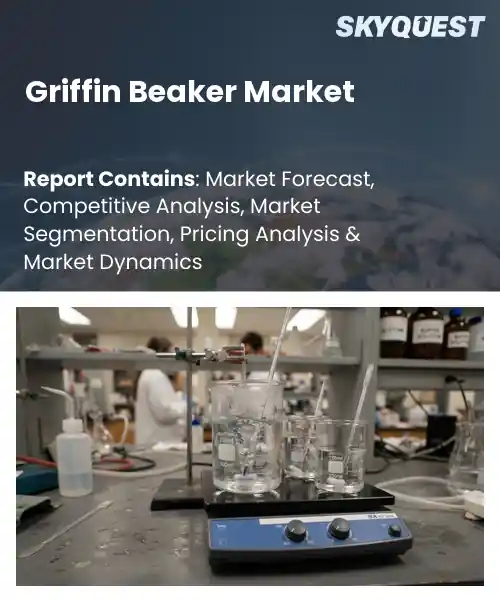
Griffin Beaker Market
Report ID: SQMIG35J2757
Report ID: SQMIG35J2757
[email protected]
USA +1 351-333-4748
Report ID:
SQMIG35J2757 |
Region:
Global |
Published Date: August, 2026
Pages:
157
|Tables:
173
|Figures:
79


Global Griffin Beaker Market size was valued at USD 342.6 Million in 2024 and is poised to grow from USD 356.99 Million in 2025 to USD 496.14 Million by 2033, growing at a CAGR of 4.2% during the forecast period (2026-2033).
The Griffin Beaker market revolves around a niche segment of laboratory glassware that combines high‑precision volume markings with enhanced thermal stability. Its primary driver is the escalating demand for reproducible experimental conditions in biotechnology and pharmaceutical research, where even minor measurement errors can compromise drug development pipelines. Historically, standard borosilicate beakers dominated the sector, but the introduction of Griffin’s low‑expansion formulation in the early 2010s enabled scientists to perform temperature‑sensitive assays with reduced distortion. Universities such as MIT and firms like Pfizer quickly adopted the technology, illustrating how reliability concerns have reshaped procurement preferences and spurred steady market expansion globally. Building on that reliability foundation, the market’s next key factor is the integration of smart sensor technology, which turns a conventional beaker into a data‑rich instrument. By embedding temperature and pH micro‑sensors, manufacturers enable real‑time monitoring that feeds laboratory information systems, reducing manual sampling and accelerating decisions. This capability has opened opportunities in throughput screening, where firms such as Thermo Fisher use Griffin beakers to automate assay validation across thousands of wells, cutting cycle time by up to 30 percent. Consequently, the convergence of precision glassware with analytics drives revenue streams and prompts R&D investment, positioning the sector for growth.
How is AI-driven automation reshaping the Griffin beaker market?
AI-driven automation is streamlining the Griffin beaker market by integrating smart sensors and predictive maintenance into production lines. Manufacturers now use machine‑learning algorithms to monitor temperature stability and glass integrity in real time, reducing waste and accelerating batch cycles. This technology enables rapid customization of beaker shapes and volumes, meeting niche laboratory demands without lengthy retooling. As a result, supply chains become more resilient, and operators can focus on higher‑value tasks rather than routine quality checks, making the market more agile and responsive to scientific trends.Griffin Beaker announced an AI‑enhanced manufacturing platform in April 2026, which cuts cycle time and improves consistency, reinforcing growth and efficiency in the sector.
Market snapshot - (2026-2033)
Global Market Size
USD 342.6 Million
Largest Segment
Borosilicate Glass
Fastest Growth
PTFE
Growth Rate
4.2% CAGR
To get more insights on this market click here to Request a Free Sample Report
Global griffin beaker market is segmented by material, capacity, application, graduation type, end user, distribution channel and region. Based on material, the market is segmented into Borosilicate Glass, Polypropylene, PTFE and Others. Based on capacity, the market is segmented into Up to 250 mL, 251–1000 mL and Above 1000 mL. Based on application, the market is segmented into Chemical Laboratories, Educational Laboratories, Pharmaceutical Laboratories and Others. Based on graduation type, the market is segmented into Graduated and Non-Graduated. Based on end user, the market is segmented into Academic & Research Institutes, Pharmaceutical & Biotechnology Companies, Industrial Laboratories and Others. Based on distribution channel, the market is segmented into Direct Sales, Laboratory Distributors and Others. Based on region, the market is segmented into North America, Europe, Asia Pacific, Latin America and Middle East & Africa.
Borosilicate glass segment dominates because its superior thermal resistance and chemical inertness make it the preferred material for high precision laboratory work. Users rely on its clarity for visual monitoring, and its durability reduces breakage risk, aligning with strict safety protocols. Consequently, manufacturers prioritize borosilicate production to meet the rigorous standards of scientific research, reinforcing its leading position in the Griffin Beaker Market throughout the entire product lifecycle and enhances long term laboratory efficiency.
However, polypropylene segment is witnessing the strongest growth momentum as emerging low cost labs seek lightweight, chemically resistant containers. Its ease of molding enables rapid design iterations and compatibility with disposable practices, driving broader adoption across teaching environments and budget constrained research units, thereby expanding market reach and creating new opportunity channels.
Chemical laboratories segment dominates because these facilities demand high accuracy, rigorous safety standards and frequent beaker turnover, making reliability and precise graduation essential. The intensity of analytical procedures pushes suppliers to offer robust designs that withstand aggressive reagents and thermal cycling. Accordingly, product development prioritizes features such as resistance to corrosion and clear volume markings, cementing chemical laboratories as the primary driver of demand in the Griffin Beaker Market.
Meanwhile, pharmaceutical laboratories segment emerges as the fastest growing area as drug discovery pipelines expand and require stringent quality control. The need for traceability and compliance with regulatory guidelines spurs adoption of specialized beakers with enhanced sterility and validated material composition, accelerating market expansion and opening new avenues for premium product offerings.
To get detailed segments analysis, Request a Free Sample Report
North America benefits from a deeply entrenched laboratory culture supported by world‑class research universities and a long history of chemical manufacturing excellence. The region’s extensive distribution networks and sophisticated procurement processes enable rapid adoption of advanced glassware solutions. Strong collaboration between academic institutions, instrument manufacturers, and industry consortia drives continuous innovation in design and material performance. Moreover, a highly skilled technical workforce ensures rigorous quality standards and responsive after‑sales service, reinforcing customer confidence. These combined advantages create a resilient ecosystem that sustains leadership and attracts global suppliers seeking a reliable and expansive market base.
Griffin Beaker Market in the United States thrives on the proximity to premier research universities and a vibrant biotech corridor that prioritize precision glassware. The demand is fueled by a culture of experimental rigor and ongoing investment in high‑throughput laboratory automation, prompting vendors to tailor product lines for diverse scientific disciplines. Robust logistics infrastructure further enhances market responsiveness and reinforces the United States as a central hub for innovation and procurement.
Griffin Beaker Market in Canada is shaped by a strong emphasis on environmental sustainability and rigorous safety regulations that guide laboratory practices. Collaboration between government research agencies and private sector labs encourages the adoption of high‑quality glassware that meets stringent performance criteria. The country’s well‑developed distribution channels and focus on specialized scientific research, particularly in health and materials science, support steady demand and foster close relationships with global manufacturers.
Europe’s expansion is propelled by a harmonized regulatory framework that encourages standardization and cross‑border trade of laboratory equipment. The region’s deep investment in research excellence, especially within the chemical and pharmaceutical sectors, cultivates a persistent need for reliable glassware. Innovative collaborations among academic consortia, industry clusters, and equipment providers accelerate product development, while a mature procurement culture values sustainability and long‑term supplier partnerships. Additionally, strong intellectual property protections and a focus on precision science reinforce Europe’s attractiveness as a growth engine for Griffin Beaker offerings.
Griffin Beaker Market in Germany benefits from a robust industrial base and a tradition of meticulous scientific methodology. The presence of leading chemical manufacturers and engineering firms drives demand for high‑performance glassware that supports complex experimentation. Collaborative research institutes and federal funding programs further stimulate adoption of advanced beaker designs, emphasizing durability and precision. Efficient logistics and a culture of quality assurance cement Germany’s role as a cornerstone of European market activity.
Griffin Beaker Market in the United Kingdom experiences accelerated uptake due to a dynamic biotech ecosystem and a strong focus on translational research. Academic medical centers and emerging life‑science startups prioritize reliable glassware to support rapid prototyping and discovery. Government incentives for innovation and a well‑established distribution network enhance market accessibility, while a tradition of academic excellence drives continual refinement of laboratory standards. These factors collectively propel the United Kingdom as a leading growth market.
Griffin Beaker Market in France is emerging alongside strategic investments in renewable chemistry and advanced materials research. National research laboratories and collaborative industry clusters emphasize high‑quality glassware to meet evolving experimental requirements. The French emphasis on precision and regulatory compliance encourages adoption of premium beaker solutions. Growing interdisciplinary initiatives and supportive public funding create a fertile environment for market development, positioning France as an increasingly important contributor to European expansion.
Asia Pacific advances its role through a combination of rapid technological adoption and expanding research infrastructure across diverse economies. Nations in the region are investing heavily in state‑of‑the‑art laboratory facilities, fostering a culture that values cutting‑edge analytical capabilities. Partnerships between multinational equipment manufacturers and local distributors accelerate knowledge transfer and tailor product offerings to regional scientific needs. Additionally, a growing emphasis on sustainability and high‑quality standards propels the demand for durable glassware, reinforcing the region’s emerging prominence in the global Griffin Beaker landscape.
Griffin Beaker Market in Japan is characterized by a meticulous approach to scientific inquiry and a strong tradition of precision engineering. Leading universities and advanced research institutes prioritize high‑quality glassware that aligns with exacting experimental protocols. Collaborative networks between manufacturers and academic laboratories drive continuous enhancements in beaker design, focusing on durability and clarity. Efficient supply chains and a culture of continuous improvement further solidify Japan’s influential position within the regional market.
Griffin Beaker Market in South Korea benefits from aggressive expansion of biotech parks and a vibrant semiconductor research sector that demands reliable laboratory apparatus. Government support for innovation and a highly educated workforce stimulate demand for superior glassware solutions. Close cooperation between domestic suppliers and global manufacturers ensures that product offerings cater to sophisticated research requirements. This proactive ecosystem, combined with a commitment to quality and rapid adoption of new technologies, underpins South Korea’s growing significance in the Asia Pacific market.
To know more about the market opportunities by region and country, click here to
Buy The Complete Report
Increasing Demand for Laboratory Flexibility
Advancements in Chemical Resistance Materials
High Production Cost Compared To Alternatives
Stringent Regulatory Compliance Requirements
Request Free Customization of this report to help us to meet your business objectives.
The Griffin beaker market is shaped by intense competition among established glassware leaders, with firms leveraging strategic acquisitions, joint ventures, and advanced manufacturing technologies to secure market share; DWK Life Sciences integrated Kimble Chase’s product line through acquisition, Corning expanded its high‑performance glass portfolio via R&D partnerships, and Thermo Fisher Scientific accelerated innovation by launching next‑generation polymer‑coated beakers, intensifying competitive pressure.
Top Player’s Company Profile
Recent Developments
SkyQuest’s ABIRAW (Advanced Business Intelligence, Research & Analysis Wing) is our Business Information Services team that Collects, Collates, Correlates, and Analyses the Data collected by means of Primary Exploratory Research backed by robust Secondary Desk research. As per SkyQuest analysis the global Griffin beaker market is being propelled primarily by the increasing demand for laboratory flexibility which lets researchers switch tasks quickly and reduces downtime while a second important driver stems from recent advancements in chemical‑resistance materials that broaden the beaker’s applicability across harsh reagents. The market is still constrained by the high production cost of premium glassware compared with cheaper plastic alternatives, limiting uptake in cost‑sensitive labs. North America remains the dominant region thanks to its strong research ecosystem and sophisticated procurement channels and the borosilicate‑glass segment continues to lead in share because of its superior thermal stability and clarity.
| Report Metric | Details |
|---|---|
| Market size value in 2024 | USD 342.6 Million |
| Market size value in 2033 | USD 496.14 Million |
| Growth Rate | 4.2% |
| Base year | 2024 |
| Forecast period | (2026-2033) |
| Forecast Unit (Value) | USD Million |
| Segments covered |
|
| Regions covered | North America (US, Canada), Europe (Germany, France, United Kingdom, Italy, Spain, Rest of Europe), Asia Pacific (China, India, Japan, Rest of Asia-Pacific), Latin America (Brazil, Rest of Latin America), Middle East & Africa (South Africa, GCC Countries, Rest of MEA) |
| Companies covered |
|
| Customization scope | Free report customization with purchase. Customization includes:-
|
To get a free trial access to our platform which is a one stop solution for all your data requirements for quicker decision making. This platform allows you to compare markets, competitors who are prominent in the market, and mega trends that are influencing the dynamics in the market. Also, get access to detailed SkyQuest exclusive matrix.
Table Of Content
Executive Summary
Market overview
Parent Market Analysis
Market overview
Market size
KEY MARKET INSIGHTS
COVID IMPACT
MARKET DYNAMICS & OUTLOOK
Market Size by Region
KEY COMPANY PROFILES
Methodology
For the Griffin Beaker Market, our research methodology involved a mixture of primary and secondary data sources. Key steps involved in the research process are listed below:
1. Information Procurement: This stage involved the procurement of Market data or related information via primary and secondary sources. The various secondary sources used included various company websites, annual reports, trade databases, and paid databases such as Hoover's, Bloomberg Business, Factiva, and Avention. Our team did 45 primary interactions Globally which included several stakeholders such as manufacturers, customers, key opinion leaders, etc. Overall, information procurement was one of the most extensive stages in our research process.
2. Information Analysis: This step involved triangulation of data through bottom-up and top-down approaches to estimate and validate the total size and future estimate of the Griffin Beaker Market.
3. Report Formulation: The final step entailed the placement of data points in appropriate Market spaces in an attempt to deduce viable conclusions.
4. Validation & Publishing: Validation is the most important step in the process. Validation & re-validation via an intricately designed process helped us finalize data points to be used for final calculations. The final Market estimates and forecasts were then aligned and sent to our panel of industry experts for validation of data. Once the validation was done the report was sent to our Quality Assurance team to ensure adherence to style guides, consistency & design.
Analyst Support
Customization Options
With the given market data, our dedicated team of analysts can offer you the following customization options are available for the Griffin Beaker Market:
Product Analysis: Product matrix, which offers a detailed comparison of the product portfolio of companies.
Regional Analysis: Further analysis of the Griffin Beaker Market for additional countries.
Competitive Analysis: Detailed analysis and profiling of additional Market players & comparative analysis of competitive products.
Go to Market Strategy: Find the high-growth channels to invest your marketing efforts and increase your customer base.
Innovation Mapping: Identify racial solutions and innovation, connected to deep ecosystems of innovators, start-ups, academics, and strategic partners.
Category Intelligence: Customized intelligence that is relevant to their supply Markets will enable them to make smarter sourcing decisions and improve their category management.
Public Company Transcript Analysis: To improve the investment performance by generating new alpha and making better-informed decisions.
Social Media Listening: To analyze the conversations and trends happening not just around your brand, but around your industry as a whole, and use those insights to make better Marketing decisions.
REQUEST FOR SAMPLE
 REQUEST FREE CUSTOMIZATION


Want to customize this report? This report can be personalized according to your needs. Our analysts and industry experts will work directly with you to understand your requirements and provide you with customized data in a short amount of time. We offer $1000 worth of FREE customization at the time of purchase.
Feedback From Our Clients


 USA (+1) 351-333-4748

