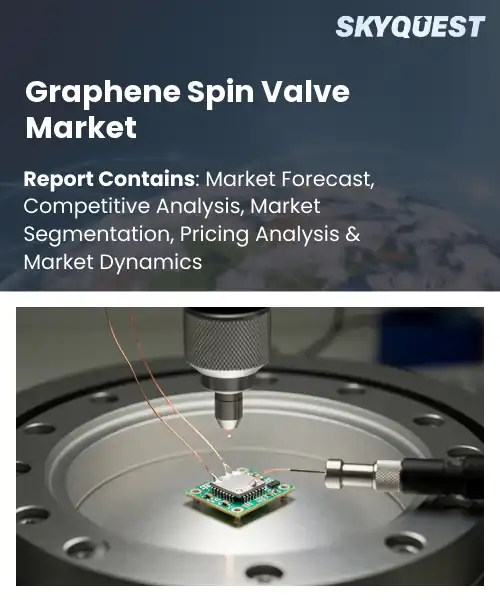
Graphene Spin Valve Market
Report ID: SQMIG20I2659
Report ID: SQMIG20I2659
[email protected]
USA +1 351-333-4748
Report ID:
SQMIG20I2659 |
Region:
Global |
Published Date: February, 2026
Pages:
157
|Tables:
116
|Figures:
77


Global Graphene Spin Valve Market size was valued at USD 4.8 Billion in 2024 and is poised to grow from USD 5.54 Billion in 2025 to USD 17.56 Billion by 2033, growing at a CAGR of 15.5% during the forecast period (2026-2033).
Graphene spin valve market centers on devices that control electron spin to detect and manipulate magnetic states, and the primary driver is graphene's exceptional spin transport combined with device architectures. This market matters because it promises improvements in energy efficiency and sensor sensitivity compared with conventional magnetoresistive technologies, which attracts investment from semiconductor firms and materials startups. Over the past decade commercial and academic advances such as vapor deposition growth, improved ferromagnet-graphene interfaces, and room-temperature spin injection demonstrations have matured the technology from proofs to pilot production. These developments create tangible pathways for integration into memory and sensing platforms.Building on production advances, the most important growth factor is scalable wafer-level graphene synthesis and reliable ferromagnet interfaces because these capabilities lower costs and enable industry-standard integration. When chemical vapor deposition and transfer protocols yield uniform films, semiconductor foundries can adopt spin valve fabrication without bespoke tooling, which causes supply chain partners to invest in pilot lines and system-level testing. Lower manufacturing cost then catalyzes deployment in concrete use cases such as low-power MRAM for mobile and edge devices, high-sensitivity magnetometers in automotive ADAS, and biosensors for medical diagnostics. Consequently, commercialization opportunities expand into licensing, foundry services, and cross-industry collaborations.
How is AI enhancing performance and commercialization of the graphene spin valve market?
Graphene spin valves are spintronic devices that use graphene as a long‑range spin channel between magnetic contacts, and their commercialization depends on material quality, contact engineering, and scalable fabrication. Recent research has improved spin injection and device yield, moving performance from laboratory curiosity toward practical components. Industry efforts and pilot lines are closing the gap between prototypes and product platforms, and AI is now central to that transition. Machine learning and autonomous experiments accelerate material selection, predict optimal contact and substrate combinations, and power in situ defect detection and process control, all of which raise device reproducibility and shorten development cycles.Graphene Manufacturing Group, June 2025, announced early works on a second‑generation production plant to increase output and lower costs, and this capacity gain paired with AI guided process tuning and quality analytics helps translate graphene spin valve prototypes into scalable, market ready devices by improving yield and reproducibility.
Market snapshot - (2026-2033)
Global Market Size
USD 4.8 Billion
Largest Segment
Valves
Fastest Growth
Integrated Circuits
Growth Rate
15.5% CAGR
To get more insights on this market click here to Request a Free Sample Report
Global graphene spin valve market is segmented by component type, material type, application, end-user industry and region. Based on component type, the market is segmented into Valves and Integrated Circuits. Based on material type, the market is segmented into Monolayer Graphene, Bilayer Graphene and Multilayer Graphene. Based on application, the market is segmented into Data Storage, Sensor Technology and Quantum Computing. Based on end-user industry, the market is segmented into Consumer Electronics, Automotive and Telecommunications. Based on region, the market is segmented into North America, Europe, Asia Pacific, Latin America and Middle East & Africa.
Valves segment dominates because it embodies the core device that implements spin filtering and magnetoresistive switching within graphene spin valve architectures, providing the most direct path from material property to functional output. Its relatively straightforward device topology reduces integration complexity and shortens development cycles, enabling faster translation from lab prototypes to demonstrators. Strong compatibility with measurement systems and packaging workflows further encourages supplier focus and design optimization around valve implementations.
However, Integrated Circuits segment is the fastest growing as on chip spin valve integration enables system level functions and compact architectures. Progress in CMOS compatible fabrication and design tools is unlocking practical monolithic implementations, spurring investment from device makers and driving partnerships to commercialize scalable, application ready spintronic ICs that broaden market opportunities.
Bilayer Graphene segment dominates because its inherent capacity to open and tune an electronic band gap under external fields offers practical control over carrier concentration and spin transport in graphene spin valves. That tunability enables engineers to tailor switching thresholds and modulation behavior at the device level, improving repeatability and functional versatility. The material’s fit with layered heterostructure fabrication and focused research efforts consolidate developer preference and industrial momentum.
Meanwhile, Monolayer Graphene segment is emerging as the key high growth area due to its exceptional carrier mobility and improving large area synthesis techniques. Advances in defect control and scalable production are accelerating adoption for high sensitivity sensors and compact spintronic prototypes, creating pathways to wider commercialization and new application classes.
To get detailed segments analysis, Request a Free Sample Report
Asia Pacific dominance in the global graphene spin valve market stems from a strong concentration of advanced research capabilities, integrated supply chains, and proactive industrial partnerships. Major technology hubs cultivate collaboration between universities, national laboratories, and specialty manufacturers, accelerating material refinement and prototype commercialization. Robust manufacturing ecosystems enable rapid scaling of device fabrication while close collaboration with semiconductor and sensor industries fosters application driven development. Policy frameworks and targeted funding encourage translational research and infrastructure investment, and established electronics value chains support talent development and supplier networks. Together, these strengths create a virtuous cycle of innovation, supply security, and market readiness that positions the region ahead in both early adoption and sustained competitive advantage. A dynamic ecosystem of startups and specialized suppliers, combined with strong domestic demand for advanced sensing and memory technologies, fuels iterative product refinement and market validation. Cross border collaborations and regional standards alignment accelerate commercialization pathways.
Graphene Spin Valve Market in Japan benefits from expertise in precision manufacturing, strong university research networks, and close ties to semiconductor supply chains. Collaborative programs between industry and academia enable iterative prototyping and validation. Robust equipment vendors and materials specialists support translation from lab scale to production. A culture of quality promotes integration of spin valve devices into advanced performance electronics and sensor platforms, reinforcing Japan as an innovation hub.
Graphene Spin Valve Market in South Korea benefits from strong electronics manufacturing ecosystems, corporate research programs, and coordinated industry consortia. Alignment between materials scientists and device engineers accelerates prototype maturation. Flexible production capabilities and responsive supply networks support deployment in communication and sensing applications. Innovation initiatives and startup activity create pathways from lab proof of concept to commercial integration, strengthening South Korea position in advanced spintronic components.
Rapid expansion in North America arises from a combination of strong private investment, active collaboration between industry and research institutions, and a market environment receptive to disruptive materials and device concepts. A diverse base of system integrators and end users in computing, defense, and sensing accelerates demand validation and application testing. Venture capital and corporate R and D funding support startups and scale up activities, while national laboratories provide specialized facilities for characterization and prototype fabrication. Emphasis on intellectual property development, strategic partnerships, and supply chain diversification drives commercialization pathways. A deep talent pool of materials scientists and device engineers, alongside established semiconductor fabrication infrastructure, enables smoother scale up and integration. Flexible regulatory pathways and pilot program incentives encourage industry trials with end users, shortening the path from concept to market acceptance.
Graphene Spin Valve Market in United States benefits from innovation ecosystem of research universities and national laboratories supported by venture capital networks. Collaborations between defense contractors, semiconductor firms, and sensor manufacturers enable targeted application development. Access to specialized fabrication facilities and system integrators supports prototype scaling. Intellectual property strategies and corporate partnerships foster commercialization, while a receptive market for advanced electronic solutions accelerates validation and adoption across diverse end users.
Graphene Spin Valve Market in Canada is supported by networks linking universities, research institutes, and technology firms. Emphasis on materials science and device characterization provides a foundation for early development. Public programs and industry partnerships enable access to specialized labs and pilot fabrication. Focused efforts on sensing and communications foster iterative testing with strategic partners. Collaboration and expertise position Canada as a productive environment for translating research into commercial devices.
Europe is strengthening its position through coordinated research programs, cross border collaboration, and strategic investments in pilot production and standardization. A network of specialized research centers and universities focuses on materials optimization, device engineering, and integration into application sectors such as sensors and advanced memory. Strong industrial participation from equipment manufacturers and system integrators supports translation efforts, while public private partnerships lower barriers to scale up. Emphasis on regulatory alignment, interoperability standards, and collaborative consortia encourages shared infrastructure use and pooled expertise. Targeted funding for pilot lines and collaborative testbeds, combined with industry led standard setting and supply chain coordination, accelerates technology maturation and reinforces Europe as a collaborative center for spintronic innovation. Strong talent pipelines and cross border commercialization networks enable companies to move from demonstration to market deployment. Emphasis on sustainable manufacturing practices and supply chain resilience further strengthens long term competitiveness.
Graphene Spin Valve Market in Germany leverages a strong industrial base, precision engineering expertise, and collaborative research institutes focused on device fabrication and materials science. Close ties between equipment manufacturers and system integrators facilitate pilot production and quality control. Industry led consortia and technical testbeds support standards development and interoperability testing. An ecosystem oriented toward industrialization and automotive reliability encourages integration of spin valve devices into sensing and control applications.
Graphene Spin Valve Market in United Kingdom benefits from strong university research, materials characterization facilities, and technology transfer pathways. Collaboration between startups, manufacturers, and national laboratories supports prototype development and commercialization. Focus on application driven research in sensing, communications, and instrumentation fosters adopter engagement. Funding and industry consortia enable access to pilot production resources and testing environments, positioning United Kingdom as a hub for translating spintronic research into marketable solutions.
Graphene Spin Valve Market in France draws on national research centers, laboratories, and a startup community focused on materials innovation and device prototyping. Collaboration among academic groups, technology platforms, and industry partners accelerates validation in sensor and communication applications. Supportive public programs and pilot facilities enable access to fabrication and testing services. Emphasis on multiscale characterization and application oriented design positions France as an active contributor to European spintronic development.
To know more about the market opportunities by region and country, click here to
Buy The Complete Report
Rising Demand For Spintronic Devices
Advancements In Material Synthesis
High Manufacturing Complexity And Costs
Regulatory And Standardization Gaps
Request Free Customization of this report to help us to meet your business objectives.
Competition in the global graphene spin valve market centers on technology differentiation, strategic partnerships, and targeted acquisitions. Companies convert academic advances into devices by formalising research collaborations and commercial licences, for example INBRAIN’s collaboration with Merck on graphene bioelectronics and CIC nanoGUNE’s proximitized graphene spin valve research. Commercialisation of enabling tools, such as Vitrotem’s Naiad 1, shortens development cycles and intensifies rivalry.
Top Player’s Company Profile
Recent Developments
SkyQuest’s ABIRAW (Advanced Business Intelligence, Research & Analysis Wing) is our Business Information Services team that Collects, Collates, Correlates, and Analyses the Data collected by means of Primary Exploratory Research backed by robust Secondary Desk research. As per SkyQuest analysis, the global graphene spin valve market is driven primarily by scalable wafer-level graphene synthesis and improved ferromagnet interfaces that lower costs and enable foundry adoption, and rising interest in energy-efficient spintronic devices reinforces this momentum. A key driver is maturation of material synthesis and interface engineering, while a second driver is AI-enabled process optimization and in situ quality analytics that boost yield and reproducibility. A restraint is high manufacturing complexity and costs tied to precise fabrication and cleanliness requirements. Asia Pacific dominates the market thanks to integrated supply chains and strong research-industrial collaboration, and the valves segment leads adoption as the most direct device pathway to functional products.
| Report Metric | Details |
|---|---|
| Market size value in 2024 | USD 4.8 Billion |
| Market size value in 2033 | USD 17.56 Billion |
| Growth Rate | 15.5% |
| Base year | 2024 |
| Forecast period | (2026-2033) |
| Forecast Unit (Value) | USD Billion |
| Segments covered |
|
| Regions covered | North America (US, Canada), Europe (Germany, France, United Kingdom, Italy, Spain, Rest of Europe), Asia Pacific (China, India, Japan, Rest of Asia-Pacific), Latin America (Brazil, Rest of Latin America), Middle East & Africa (South Africa, GCC Countries, Rest of MEA) |
| Companies covered |
|
| Customization scope | Free report customization with purchase. Customization includes:-
|
To get a free trial access to our platform which is a one stop solution for all your data requirements for quicker decision making. This platform allows you to compare markets, competitors who are prominent in the market, and mega trends that are influencing the dynamics in the market. Also, get access to detailed SkyQuest exclusive matrix.
Table Of Content
Executive Summary
Market overview
Parent Market Analysis
Market overview
Market size
KEY MARKET INSIGHTS
COVID IMPACT
MARKET DYNAMICS & OUTLOOK
Market Size by Region
KEY COMPANY PROFILES
Methodology
For the Graphene Spin Valve Market, our research methodology involved a mixture of primary and secondary data sources. Key steps involved in the research process are listed below:
1. Information Procurement: This stage involved the procurement of Market data or related information via primary and secondary sources. The various secondary sources used included various company websites, annual reports, trade databases, and paid databases such as Hoover's, Bloomberg Business, Factiva, and Avention. Our team did 45 primary interactions Globally which included several stakeholders such as manufacturers, customers, key opinion leaders, etc. Overall, information procurement was one of the most extensive stages in our research process.
2. Information Analysis: This step involved triangulation of data through bottom-up and top-down approaches to estimate and validate the total size and future estimate of the Graphene Spin Valve Market.
3. Report Formulation: The final step entailed the placement of data points in appropriate Market spaces in an attempt to deduce viable conclusions.
4. Validation & Publishing: Validation is the most important step in the process. Validation & re-validation via an intricately designed process helped us finalize data points to be used for final calculations. The final Market estimates and forecasts were then aligned and sent to our panel of industry experts for validation of data. Once the validation was done the report was sent to our Quality Assurance team to ensure adherence to style guides, consistency & design.
Analyst Support
Customization Options
With the given market data, our dedicated team of analysts can offer you the following customization options are available for the Graphene Spin Valve Market:
Product Analysis: Product matrix, which offers a detailed comparison of the product portfolio of companies.
Regional Analysis: Further analysis of the Graphene Spin Valve Market for additional countries.
Competitive Analysis: Detailed analysis and profiling of additional Market players & comparative analysis of competitive products.
Go to Market Strategy: Find the high-growth channels to invest your marketing efforts and increase your customer base.
Innovation Mapping: Identify racial solutions and innovation, connected to deep ecosystems of innovators, start-ups, academics, and strategic partners.
Category Intelligence: Customized intelligence that is relevant to their supply Markets will enable them to make smarter sourcing decisions and improve their category management.
Public Company Transcript Analysis: To improve the investment performance by generating new alpha and making better-informed decisions.
Social Media Listening: To analyze the conversations and trends happening not just around your brand, but around your industry as a whole, and use those insights to make better Marketing decisions.
REQUEST FOR SAMPLE
 REQUEST FREE CUSTOMIZATION


Want to customize this report? This report can be personalized according to your needs. Our analysts and industry experts will work directly with you to understand your requirements and provide you with customized data in a short amount of time. We offer $1000 worth of FREE customization at the time of purchase.
Feedback From Our Clients


 USA (+1) 351-333-4748

