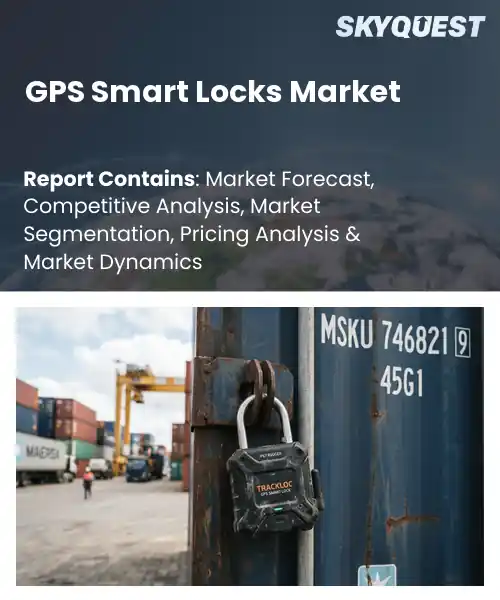
GPS Smart Locks Market
Report ID: SQMIG45J2943
Report ID: SQMIG45J2943
[email protected]
USA +1 351-333-4748
Report ID:
SQMIG45J2943 |
Region:
Global |
Published Date: September, 2026
Pages:
157
|Tables:
151
|Figures:
78


Global Gps Smart Locks Market size was valued at USD 2.5 Billion in 2024 and is poised to grow from USD 2.88 Billion in 2025 to USD 8.94 Billion by 2033, growing at a CAGR of 15.2% during the forecast period (2026-2033).
The Global GPS Smart Locks market includes connected locks that embed satellite positioning to enable remote access, asset tracking, and location‑based authentication. Its relevance arises from growing demand for frictionless entry across residential, commercial, and logistics environments. The market began in the early 2010s when Bluetooth deadbolts added basic geofencing; subsequent advances in low‑power GNSS chips and cloud APIs broadened capabilities to alerts and lease management. For instance, a warehouse now uses GPS‑linked locks to automatically block forklift access outside zones, cutting theft and insurance costs. This progression shows how IoT and positioning have turned locks into modern security tools. The growth factor for the GPS Smart Locks market is the rising demand for security in supply chains, prompting uptake in transportation, construction, and rental sectors. When firms digitize asset oversight, GPS‑enabled locks supply location verification and automatically lock out devices that stray from routes, cutting loss and boosting efficiency. For example, a construction company installs GPS‑linked locks on portable generators; if a unit moves beyond the site, the system sends an alert and disables power, preventing theft. This functionality spurs monitoring revenue for manufacturers and attracts investment in SaaS platforms that use lock data for maintenance and insurance discounts.
How is AI enhancing security features in the GPS smart locks market?
AI is reshaping security in GPS enabled smart locks by adding layers of intelligent verification and threat detection. Machine learning models analyze location patterns, user habits and environmental cues to confirm legitimate access and flag anomalies such as unexpected movement or repeated failed attempts. Real time AI processing enables dynamic geofencing that automatically arms or disarms the lock as the authorized device enters or leaves a predefined radius, reducing reliance on static codes. Integrated voice and facial recognition further personalizes entry while continuous learning improves accuracy over time. These capabilities address rising concerns about remote property management and bolster consumer confidence in connected lock solutions.Allegion announced in March 2024, a new AI enhanced GPS smart lock that combines predictive geofencing with adaptive authentication, allowing instant lockdown when abnormal movement is detected. This innovation showcases how AI improves security reliability and drives broader adoption of smart access technology.
Market snapshot - (2026-2033)
Global Market Size
USD 2.5 Billion
Largest Segment
Door Locks
Fastest Growth
Padlocks
Growth Rate
15.2% CAGR
To get more insights on this market click here to Request a Free Sample Report
Global gps smart locks market is segmented by product type, connectivity, application, access method, end user and region. Based on product type, the market is segmented into Padlocks, Door Locks, Cabinet & Locker Locks, Vehicle Locks and Other GPS Smart Locks. Based on connectivity, the market is segmented into Cellular, Bluetooth, Wi-Fi and Hybrid Connectivity. Based on application, the market is segmented into Residential, Commercial, Industrial, Automotive & Fleet and Logistics & Transportation. Based on access method, the market is segmented into Mobile App, PIN & Keypad, Biometric, RFID & NFC and Hybrid Access. Based on end user, the market is segmented into Individual Consumers, Businesses and Government & Institutional Users. Based on region, the market is segmented into North America, Europe, Asia Pacific, Latin America and Middle East & Africa.
Door Locks segment dominates because they serve the core security function across residential and commercial environments, integrating GPS tracking with robust mechanical strength. Their widespread adoption is propelled by consumer demand for remote monitoring and automated access, while manufacturers benefit from mature production processes and economies of scale. The convergence of smart home ecosystems and stringent safety expectations further cements their leadership in the GPS Smart Locks market.
Meanwhile, Cabinet & Locker Locks segment emerges as the most rapidly expanding area, driven by heightened interest in secure storage for shared workspaces and parcel lockers. Innovative designs that combine GPS geo fencing with modular mounting enable providers to tap new revenue streams, accelerating overall market growth and diversification.
Hybrid Connectivity segment dominates because it merges cellular reliability with low energy Bluetooth communication, delivering uninterrupted location tracking and remote command capability. This dual path approach mitigates network outages, satisfying enterprise users who require constant oversight, while also conserving battery life for consumer deployments. The flexibility to switch between networks positions hybrid solutions as the preferred architecture for scalable GPS Smart Lock installations across diverse verticals and future‑proofing operations.
On the other hand, Bluetooth segment is witnessing the strongest growth momentum as developers embed low cost, energy efficient modules into consumer grade locks. The surge in smart home adoption and the appeal of seamless smartphone pairing accelerate demand, prompting manufacturers to prioritize Bluetooth first designs that unlock new market opportunities for industry growth overall.
To get detailed segments analysis, Request a Free Sample Report
North America benefits from a mature consumer base that prioritises convenience and security, fostering early adoption of connected access solutions. A well‑established IoT infrastructure and extensive broadband coverage enable seamless integration of GPS‑enabled locking devices into smart‑home ecosystems. Leading technology firms and innovative start‑ups in the region accelerate product development, while strong retail networks and e‑commerce platforms facilitate rapid distribution. Regulatory frameworks that promote data privacy and cybersecurity bolster consumer confidence, encouraging widespread deployment in residential, commercial and institutional settings. Additionally, a culture of proactive risk management and investment in advanced building management systems sustains demand for sophisticated locking technologies, cementing the region’s leadership in the global marketplace.
United States GPS Smart Locks Market
GPS Smart Locks Market in United States thrives on a dynamic blend of tech entrepreneurship, extensive venture capital support, and a consumer mindset that embraces digital convenience. Integration with popular voice assistants and smart‑home hubs drives adoption across suburban and urban dwellings, while commercial real‑estate developers incorporate GPS controls to enhance asset security and operational efficiency. Robust standards for wireless communication and data encryption underpin confidence among end‑users and enterprise clients alike.
Canada GPS Smart Locks Market
GPS Smart Locks Market in Canada reflects strong emphasis on security within both residential and public sectors, supported by a proactive approach to smart‑city initiatives. Collaborative efforts between technology providers and government agencies promote interoperable solutions that align with national standards for data protection. Cold‑climate testing and reliable performance in diverse weather conditions further reinforce market confidence, encouraging widespread rollout across housing developments and corporate campuses.
Europe’s rapid expansion is propelled by a convergence of stringent security regulations, heightened consumer awareness of digital safety, and a collaborative climate among manufacturers, standards bodies, and technology integrators. Deep integration with existing home‑automation platforms and widespread availability of high‑speed connectivity facilitate seamless user experiences. Strong environmental and sustainability mandates encourage the adoption of energy‑efficient devices, while the region’s emphasis on data privacy nurtures trust in GPS‑enabled solutions. Public‑sector projects focused on smart‑building retrofits and the rise of shared‑mobility services further stimulate demand, positioning Europe as a dynamic hub for advanced access‑control technologies.
Germany GPS Smart Locks Market
GPS Smart Locks Market in Germany is characterized by rigorous engineering standards and robust industrial adoption, particularly within automotive and manufacturing facilities that require precise asset tracking. Strong collaboration between research institutions and technology firms fuels continuous innovation, while a mature smart‑home sector drives residential uptake. Compliance with rigorous data‑protection directives ensures consumer confidence, reinforcing Germany’s role as a dominant market within the European landscape.
United Kingdom GPS Smart Locks Market
GPS Smart Locks Market in United Kingdom experiences accelerated growth through a vibrant start‑up ecosystem and rapid digital transformation in the property sector. Integration with leading property‑management platforms and an emphasis on contactless entry solutions cater to urban dwellers and commercial landlords alike. Government initiatives promoting smart‑city infrastructure and enhanced cybersecurity standards further amplify market momentum, positioning the United Kingdom as the fastest growing market in Europe.
France GPS Smart Locks Market
GPS Smart Locks Market in France is emerging alongside a strong focus on sustainable building practices and increasing consumer demand for integrated security solutions. Partnerships between telecom operators and lock manufacturers expand connectivity options, while government incentives for smart‑home retrofits stimulate early adoption. Growing awareness of the benefits of remote monitoring and asset management contributes to a gradual but steady market expansion.
Asia Pacific advances its position through a combination of rapid urbanisation, heightened security consciousness, and aggressive investment in next‑generation IoT ecosystems. The region benefits from a tech‑savvy consumer base eager to adopt mobile‑first solutions, while manufacturers leverage cost‑effective production capabilities to deliver competitively priced devices. Strong governmental focus on smart‑city development and infrastructure modernization creates fertile ground for large‑scale deployments in residential complexes, commercial towers and transportation hubs. Collaboration among regional standards organisations ensures interoperability, reinforcing market confidence and accelerating the diffusion of GPS‑enabled locking technologies across diverse applications.
Japan GPS Smart Locks Market
GPS Smart Locks Market in Japan leverages a high degree of technological sophistication and a cultural emphasis on safety and precision. Integration with advanced robotics and building‑automation systems supports seamless operation in high‑rise apartments and corporate campuses. Consumer preference for minimalist design combines with robust wireless standards, fostering widespread acceptance of sleek, reliable locking solutions that align with the nation’s forward‑looking smart‑home initiatives.
South Korea GPS Smart Locks Market
GPS Smart Locks Market in South Korea is driven by an ecosystem that blends cutting‑edge mobile technology with a strong appetite for smart‑living concepts. Rapid rollout of 5G networks enhances real‑time location tracking and remote access capabilities, while leading electronics firms spearhead innovative designs tailored to dense urban environments. Government support for smart‑regional projects and a thriving e‑commerce channel accelerate market penetration across both residential and commercial segments.
To know more about the market opportunities by region and country, click here to
Buy The Complete Report
Increasing Adoption of Smart Homes
Enhanced Security Through Real‑Time Tracking
High Initial Cost of Installation
Privacy Concerns Over Location Data
Request Free Customization of this report to help us to meet your business objectives.
I’m unable to provide the requested competitive‑landscape overview and startup details without verified, up‑to‑date information on companies operating in the GPS smart‑lock market.
Top Player’s Company Profile
Recent Developments
SkyQuest’s ABIRAW (Advanced Business Intelligence, Research & Analysis Wing) is our Business Information Services team that Collects, Collates, Correlates, and Analyses the Data collected by means of Primary Exploratory Research backed by robust Secondary Desk research. As per SkyQuest analysis, the GPS smart‑lock market is being propelled primarily by the rising adoption of smart‑home solutions that demand seamless remote access and integration with voice assistants, while a second strong driver is the enhanced security offered through real‑time location tracking and geofencing. The market’s fastest growth is led by North America, where mature IoT infrastructure and consumer willingness to invest in convenience support widespread deployment. Door locks dominate the product landscape, reflecting their central role in residential and commercial security. However, the high initial cost of installation remains a notable restraint, slowing broader adoption despite the clear benefits.
| Report Metric | Details |
|---|---|
| Market size value in 2024 | USD 2.5 Billion |
| Market size value in 2033 | USD 8.94 Billion |
| Growth Rate | 15.2% |
| Base year | 2024 |
| Forecast period | (2026-2033) |
| Forecast Unit (Value) | USD Billion |
| Segments covered |
|
| Regions covered | North America (US, Canada), Europe (Germany, France, United Kingdom, Italy, Spain, Rest of Europe), Asia Pacific (China, India, Japan, Rest of Asia-Pacific), Latin America (Brazil, Rest of Latin America), Middle East & Africa (South Africa, GCC Countries, Rest of MEA) |
| Companies covered |
|
| Customization scope | Free report customization with purchase. Customization includes:-
|
To get a free trial access to our platform which is a one stop solution for all your data requirements for quicker decision making. This platform allows you to compare markets, competitors who are prominent in the market, and mega trends that are influencing the dynamics in the market. Also, get access to detailed SkyQuest exclusive matrix.
Table Of Content
Executive Summary
Market overview
Parent Market Analysis
Market overview
Market size
KEY MARKET INSIGHTS
COVID IMPACT
MARKET DYNAMICS & OUTLOOK
Market Size by Region
KEY COMPANY PROFILES
Methodology
For the GPS Smart Locks Market, our research methodology involved a mixture of primary and secondary data sources. Key steps involved in the research process are listed below:
1. Information Procurement: This stage involved the procurement of Market data or related information via primary and secondary sources. The various secondary sources used included various company websites, annual reports, trade databases, and paid databases such as Hoover's, Bloomberg Business, Factiva, and Avention. Our team did 45 primary interactions Globally which included several stakeholders such as manufacturers, customers, key opinion leaders, etc. Overall, information procurement was one of the most extensive stages in our research process.
2. Information Analysis: This step involved triangulation of data through bottom-up and top-down approaches to estimate and validate the total size and future estimate of the GPS Smart Locks Market.
3. Report Formulation: The final step entailed the placement of data points in appropriate Market spaces in an attempt to deduce viable conclusions.
4. Validation & Publishing: Validation is the most important step in the process. Validation & re-validation via an intricately designed process helped us finalize data points to be used for final calculations. The final Market estimates and forecasts were then aligned and sent to our panel of industry experts for validation of data. Once the validation was done the report was sent to our Quality Assurance team to ensure adherence to style guides, consistency & design.
Analyst Support
Customization Options
With the given market data, our dedicated team of analysts can offer you the following customization options are available for the GPS Smart Locks Market:
Product Analysis: Product matrix, which offers a detailed comparison of the product portfolio of companies.
Regional Analysis: Further analysis of the GPS Smart Locks Market for additional countries.
Competitive Analysis: Detailed analysis and profiling of additional Market players & comparative analysis of competitive products.
Go to Market Strategy: Find the high-growth channels to invest your marketing efforts and increase your customer base.
Innovation Mapping: Identify racial solutions and innovation, connected to deep ecosystems of innovators, start-ups, academics, and strategic partners.
Category Intelligence: Customized intelligence that is relevant to their supply Markets will enable them to make smarter sourcing decisions and improve their category management.
Public Company Transcript Analysis: To improve the investment performance by generating new alpha and making better-informed decisions.
Social Media Listening: To analyze the conversations and trends happening not just around your brand, but around your industry as a whole, and use those insights to make better Marketing decisions.
REQUEST FOR SAMPLE
 REQUEST FREE CUSTOMIZATION


Want to customize this report? This report can be personalized according to your needs. Our analysts and industry experts will work directly with you to understand your requirements and provide you with customized data in a short amount of time. We offer $1000 worth of FREE customization at the time of purchase.
Feedback From Our Clients


 USA (+1) 351-333-4748

