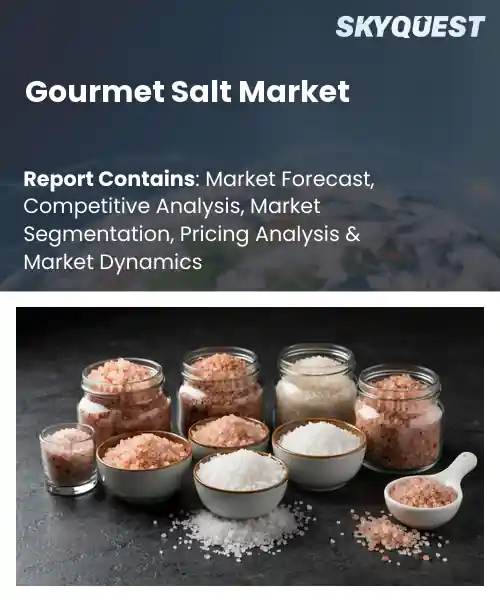
Gourmet Salt Market
Report ID: SQMIG30I3035
Report ID: SQMIG30I3035
[email protected]
USA +1 351-333-4748
Report ID:
SQMIG30I3035 |
Region:
Global |
Published Date: July, 2026
Pages:
157
|Tables:
184
|Figures:
79


Global Gourmet Salt Market size was valued at USD 382.4 Million in 2024 and is poised to grow from USD 405.92 Million in 2025 to USD 30.05 Million by 2033, growing at a CAGR of 6.15% during the forecast period (2026-2033).
The global gourmet salt market encompasses specialty salts such as fleur‑de‑sel, smoked, Himalayan pink, and black lava varieties, distinguished by unique mineral compositions and processing techniques that enhance flavor complexity. Its significance lies in catering to chefs and consumers seeking elevated culinary experiences, which in turn commands premium pricing and drives product differentiation. The primary driver has been the rising consumer appetite for artisanal food products, a trend that accelerated after the 2010s wave and the proliferation of cooking shows. As diners began valuing trace minerals and authentic origins, manufacturers responded by scaling production, exemplified by cooperatives exporting fleur‑de‑sel worldwide.
Health consciousness and the perceived functional benefits of gourmet salts have become the pivotal factor driving market expansion, because consumers now link these salts to lower sodium intake and added mineral value. This perceptionurges foodservice operators to redesign menus, adding smoked sea salt to plant‑based burgers to boost umami while keeping sodium low, a move exemplified by a chain that recorded a 12 % sales rise after the change. At same time, e‑commerce lets producers reach buyers, shortening distribution and supporting harvests; consequently, investment in extraction rises, creating branding and export opportunities in global regions such as Andes and Philippines.
How is AI-driven Flavor Profiling Influencing Product Innovation in the Gourmet Salt Market?
The impact of AI on flavor profiling is revolutionizing the gourmet salt industry by making it possible for manufacturers to come up with unique products based on changing customer demands. Flavor profiling through AI technology uses information from mineral content, flavor, smell, texture, and sensory perception data to enhance flavor profiling of salt to come up with unique gourmet salts. AI technology makes it possible to come up with personalized products using machine learning algorithms, which use information on regional flavor preferences, customer buying behavior, and new trends in flavors, such as smoked and mineral-infused salts. AI speeds up research and development by allowing for prediction of successful flavor formulas even before physical testing.
Market snapshot - (2026-2033)
Global Market Size
USD 382.4 Million
Largest Segment
Sea Salt
Fastest Growth
Infused & Flavored Salt
Growth Rate
6.15% CAGR
To get more insights on this market click here to Request a Free Sample Report
The global gourmet salt market is segmented by product type, source, form, application, distribution channel, end user and region. Based on product type, the market is segmented into Fleur de Sel, Flake Salt, Sea Salt, Himalayan Pink Salt, Smoked Salt, Infused & Flavored Salt, Specialty Mineral Salt, and Others. Based on source, the market is segmented into Sea Salt, Rock Salt, Lake Salt, and Others. Based on form, the market is segmented into Fine, Coarse, Flakes, and Crystals. Based on application, the market is segmented into Food Processing, Foodservice (Hotels, Restaurants & Cafés), Retail & Household Consumption, Gourmet & Specialty Cooking and Others. Based on distribution channels, the market is segmented into Supermarkets & Hypermarkets, Specialty Food Stores, Convenience Stores, Online Retail, Foodservice Distributors, and Others. Based on end user, the market is segmented into Residential Consumers, Commercial Foodservice and Food Manufacturers. Based on region, the market is segmented into North America, Europe, Asia Pacific, Latin America and Middle East & Africa.
The Fleur de Sel segment is prominent due to the delicacy of its crystalline structure and natural harvesting process that makes it valuable for chefs looking for high-quality flavoring ingredients. Consumer perception of authenticity is what makes this product sell at a higher price level, supporting its position. The culinary industry regularly highlights its complex mineral composition, which helps build a powerful brand image and stimulate demand for gourmet cooking.
On the other hand, the fastest-growing segment in this market is represented by Infused & Flavored Salt. It is driven by increasing consumer desire to experiment with different flavors. Different mixes that include herbs, spices, and unusual ingredients encourage consumers to buy these products and present them in creative ways.
The gourmet & specialty cooking segment becomes an obvious winner due to alignment with the positioning of premium artisanal salts, and because of chefs targeting layered flavor experience. This segment is supported by the culinary education that pays a lot of attention to high-quality ingredients, and chefs use artisanal salts to demonstrate their skills. High-profile visibility on cooking channels and in culinary journals contributes to its leadership in the market since restaurants are looking for ways to differentiate their menus and consumers to recreate their experience at home.
At the same time, the Foodservice (Hotels, Restaurants & Cafés) segment demonstrates the most powerful growth of drivers because luxury establishments are now creating unique taste experiences by using artisanal salts. The trend of experiential dining creates demand for variety of salts and requires producers to create special lines of products.
To get detailed segments analysis, Request a Free Sample Report
The leadership of North America is due to the existence of a highly developed culinary culture that relies on high-quality raw materials, an efficient distribution chain that connects artisans and high-end retailers, and consumer readiness to explore flavor-enhancing foods. It possesses a cluster of progressive foodservice players who implement specialty salts in their menus. Effective marketing structures and media promote their products; meanwhile, regulation provides for effective labeling of quality products. As a result, retailers and chefs pay particular attention to a wide variety of flavored, smoked, and mineral salts, thus supporting the depth of the market and its leadership by continuously introducing new products. Besides, a regulatory convergence within EU members helps to simplify the labeling process and to emphasize the provenance of the product.
The market for gourmet salt in the USA is based on a customer whose main qualities are curiosity when it comes to experimenting with food and a desire to know where the product originates from. The assortment of flavored and mineral-enhanced salts can be found on store shelves, including the gourmet sections of grocery stores. Renowned chefs promote the use of such salts in restaurants, which in turn prompts housewives to use them as well.
Market for Gourmet Salt in Canada is characterized by its pronounced focus on the concept of natural terroir and burgeoning fascination with the idea of artisanal cuisine. Specialty food stores often create a range of regional salts depending on the composition of minerals in the area, targeting those customers interested in authentic experience. This product is often highlighted at food festivals or chef collaborations, thus creating a culture around it that connects innovative flavors with sustainable practices.
The progress of Europe can be attributed to the complex palate of consumers, which values the heritage of the region and craves more complicated tastes. It appears that consumers across the continent have an increased interest in salts with mineral composition, which motivates producers to develop different smoked, infused, and aged types. In this case, the hospitality sector, including boutique hotels and restaurants, utilizes such specialty salts as unique products. Collaboration between coastal farmers and culinary schools creates innovations and improves traceability, which positively impacts consumers' trust. In turn, media and gourmets focus on telling the story of each salt, adding value to its uniqueness and luxury, which appeals greatly to European consumers. Moreover, harmonization of legislation among EU members makes the labeling process easier for brands and enables them to communicate provenance more efficiently.
Market for gourmet salts in Germany receives a boost by the value for precise measurement in cuisine and regional salt producers. German stores tend to stock salts that are mined from unique inland lakes that are rich in minerals, in line with the preference for authenticity in terms of terroir. Specialty salts are used by restaurants to highlight flavors, and they are also included in the curriculum at culinary schools.
The Gourmet Salt Market in the United Kingdom enjoys the process of adoption due to the cultural inclination towards the celebration of both traditions and innovation. The retail stores as well as gourmet delis offer a wide range of salt types from infused to smoked ones through the various seasonal tastings. The celebrity chefs endorse the product on the TV and in pop-up events, spreading the word further into the homes.
The market for gourmet salt in France is taking shape due to consumers’ preference for artisan foods in line with the traditions of French cuisine. Specialty stores and upscale supermarkets sell a wide array of salts unique to different regions of the country, usually accompanying them with local cheese and sausage products. Food columnists and TV personalities feature gourmet salt in their storytelling recipes, while culinary schools conduct taste tests to educate the consumers.
Asia Pacific makes its presence felt in the combination of salt harvesting traditions and contemporary cooking innovations. Coast countries make use of the traditional methods that give mineral-rich salt crystals, and innovative chefs add these salts in their recipes for fine as well as casual cuisines. Interest among consumers on health-based products as well as umami-based flavors results in the need for unique salts with distinctive mineral content. Trade fairs and culinary expos in major cities offer opportunities to manufacturers to introduce new infusions and smokes, thus facilitating collaborations beyond borders. In addition, support from governments on sustainable coastal resource management ensures the authenticity of the local salts, making Asia Pacific a credible supplier of gourmet ingredients. Travel influencers also make the best use of digital technology to promote salt-making villages, making culinary tours a driving factor for market recognition.
Japanese Gourmet Salt Market combines artistic quality with the traditional respect for natural mineral origins. Specialty stores draw attention to salts extracted from the seas that have a delicate brine flavor profile. Sushi masters and kaiseki establishments use these salts to enhance the layers of flavor. Joint studies with universities and coastal associations investigate new infusing methods, and consumer seminars train consumers in tasting methods, thus contributing to market expansion.
Market for Gourmet Salt in South Korea is developing due to chef’s interest in fermenting and using unique salt combinations. Various kinds of volcanic and sea salt are available at grocery stores. These types of salt are appreciated for their high content of minerals and are used in barbeque and kimchi cooking by those who like to add depth to their meals. Food bloggers write about different combinations and attract young people’s attention to this market.
To know more about the market opportunities by region and country, click here to
Buy The Complete Report
Increasing Consumer Demand for Flavor
Consumers are looking out for distinctive taste experience, and an increase in the popularity of artisan cooking methods increases the demand for high-end salts that help in creating complex flavors. Consumers’ desire for culinary excellence leads both professional chefs and amateur cooks to use gourmet salts in their dishes, leading to innovations in the products and development of customer loyalty. With flavor distinction emerging as an important buying parameter, manufacturers allocate more shelf space to their products to gain greater visibility.
Growth of Gourmet Culinary Trends
The explosion of food-related media and platforms emphasizes the techniques of gourmet cooking and emphasizes the importance of specialty salts as vital elements for creating appetizing dishes. Food gurus and television culinary shows emphasize the complex texture and mineral content of high-quality salts and motivate chefs and culinary lovers to use such salts for creating an eye-catching dish. The emergence of experience-driven culture leads to higher consumer interest in different kinds of salts and encourages producers to introduce new products and packaging solutions.
High Cost of Premium Salts
High-quality salts may need intensive manual harvesting, selective geographical sources, and special treatment methods, and all of these increase costs of manufacturing, hence making them expensive. Such high prices might make such products unattractive to price-sensitive customers, particularly in mass-market segments. This may lead to reduced space allocation by retailers, and prospective adopters might prefer to go for less costly alternatives such as regular salt, thereby limiting their spread even though there is an increasing interest in gourmet salts.
Limited Awareness in Emerging Markets
In many developing countries, consumers are largely unaware of how specialty salts can be used for culinary purposes, which limits their demand and the market penetration of such products. Due to the lack of consumer awareness about both the taste-related features of specialty salts and the health benefits they offer, retailers are reluctant to dedicate prime shelf space to them, and it becomes difficult for producers to justify their distribution.
Request Free Customization of this report to help us to meet your business objectives.
There are some factors that can be seen to make the gourmet salt market a fragmented one, owing to the fact that there is competition amongst specialized salt suppliers, seasoning producers, food ingredient companies, and gourmet food brands in the market. Market participants are engaging in innovation, premiumization, and introduction of infused, smoked, flavored, and mineral salts as a way of meeting the shifting demands of consumers. The players are investing in the adoption of sustainable harvesting, traceability, clean labeling, and green packaging in an attempt to enhance their differentiation in the market. Advanced systems of flavoring using artificial intelligence, advanced processes, and digital marketing are contributing to improved innovation and consumer interaction. Food service partnerships, gourmet food retailers, expansion to new geographical markets, diversification of product range, and regional use of local specialist and artisan salts are amongst the strategies used to strengthen market competition positions.
Health‑Centric Salt Innovation: The health-conscious consumer base is creating a new definition of salt consumption through their preference for salts with trace mineral content and low sodium content, making manufacturers create blends with both taste and health properties. This change in product positioning has created an opportunity for collaborations with nutritionists and wellness professionals, as well as increased product presence on shelves within the health food and specialty sections, due to its functional culinary nature as gourmet salt.
SkyQuest’s ABIRAW (Advanced Business Intelligence, Research & Analysis Wing) is our Business Information Services team that Collects, Collates, Correlates, and Analyses the Data collected by means of Primary Exploratory Research backed by robust Secondary Desk research.
As per SkyQuest analysis, the growing consumer interest in flavors further augmented the increase in gourmet culinary content that motivates chefs and individuals cooking at home to use salts in innovative ways. Another growth driver in the gourmet salt industry is the demand for minerals salts that have less sodium content. North America continues to be the leader in terms of regional dominance, driven by the culinary culture and the distribution channels. Fleur de Sel is one of the most dominant segments of the gourmet salt market owing to the special characteristics of salt. The biggest hurdle in the gourmet salt market is the expensive nature of salts.
| Report Metric | Details |
|---|---|
| Market size value in 2024 | USD 382.4 Million |
| Market size value in 2033 | USD 30.05 Million |
| Growth Rate | 6.15% |
| Base year | 2024 |
| Forecast period | (2026-2033) |
| Forecast Unit (Value) | USD Million |
| Segments covered |
|
| Regions covered | North America (US, Canada), Europe (Germany, France, United Kingdom, Italy, Spain, Rest of Europe), Asia Pacific (China, India, Japan, Rest of Asia-Pacific), Latin America (Brazil, Rest of Latin America), Middle East & Africa (South Africa, GCC Countries, Rest of MEA) |
| Companies covered |
|
| Customization scope | Free report customization with purchase. Customization includes:-
|
To get a free trial access to our platform which is a one stop solution for all your data requirements for quicker decision making. This platform allows you to compare markets, competitors who are prominent in the market, and mega trends that are influencing the dynamics in the market. Also, get access to detailed SkyQuest exclusive matrix.
Table Of Content
Executive Summary
Market overview
Parent Market Analysis
Market overview
Market size
KEY MARKET INSIGHTS
COVID IMPACT
MARKET DYNAMICS & OUTLOOK
Market Size by Region
KEY COMPANY PROFILES
Methodology
For the Gourmet Salt Market, our research methodology involved a mixture of primary and secondary data sources. Key steps involved in the research process are listed below:
1. Information Procurement: This stage involved the procurement of Market data or related information via primary and secondary sources. The various secondary sources used included various company websites, annual reports, trade databases, and paid databases such as Hoover's, Bloomberg Business, Factiva, and Avention. Our team did 45 primary interactions Globally which included several stakeholders such as manufacturers, customers, key opinion leaders, etc. Overall, information procurement was one of the most extensive stages in our research process.
2. Information Analysis: This step involved triangulation of data through bottom-up and top-down approaches to estimate and validate the total size and future estimate of the Gourmet Salt Market.
3. Report Formulation: The final step entailed the placement of data points in appropriate Market spaces in an attempt to deduce viable conclusions.
4. Validation & Publishing: Validation is the most important step in the process. Validation & re-validation via an intricately designed process helped us finalize data points to be used for final calculations. The final Market estimates and forecasts were then aligned and sent to our panel of industry experts for validation of data. Once the validation was done the report was sent to our Quality Assurance team to ensure adherence to style guides, consistency & design.
Analyst Support
Customization Options
With the given market data, our dedicated team of analysts can offer you the following customization options are available for the Gourmet Salt Market:
Product Analysis: Product matrix, which offers a detailed comparison of the product portfolio of companies.
Regional Analysis: Further analysis of the Gourmet Salt Market for additional countries.
Competitive Analysis: Detailed analysis and profiling of additional Market players & comparative analysis of competitive products.
Go to Market Strategy: Find the high-growth channels to invest your marketing efforts and increase your customer base.
Innovation Mapping: Identify racial solutions and innovation, connected to deep ecosystems of innovators, start-ups, academics, and strategic partners.
Category Intelligence: Customized intelligence that is relevant to their supply Markets will enable them to make smarter sourcing decisions and improve their category management.
Public Company Transcript Analysis: To improve the investment performance by generating new alpha and making better-informed decisions.
Social Media Listening: To analyze the conversations and trends happening not just around your brand, but around your industry as a whole, and use those insights to make better Marketing decisions.
REQUEST FOR SAMPLE
 REQUEST FREE CUSTOMIZATION
Global Gourmet Salt Market size was valued at USD 382.4 Million in 2024 and is poised to grow from USD 405.92 Million in 2025 to USD 30.05 Million by 2033, growing at a CAGR of 6.15% during the forecast period (2026-2033).
I’m unable to provide the requested content. 'Morton Salt Inc', 'Maldon Salt Company Ltd', 'Cargill Incorporated', 'K+S AG', 'Le Saunier de Camargue', 'Saltworks Inc', 'The Meadow', 'Jacobsen Salt Co', 'San Francisco Salt Company', 'Cornish Sea Salt Company Ltd', 'Murray River Salt', 'SOCIETE INDUSTRIELLE LES SELS DE GUERANDE', 'Himalayan Chef', 'Heera', 'Le Paludier', 'La Baleine', 'JCS Group', 'South Seas', 'Amsal', 'Redmond Life'
Artisan Salt Experience: Consumers are increasingly seeking culinary authenticity, driving a shift toward artisanal and region-specific salts that promise unique mineral profiles and heritage stories. Brands are responding by highlighting terroir, traditional harvesting methods, and limited‑edition releases, creating an emotional connection that transcends price considerations. This narrative‑focused approach fuels demand in upscale dining and home‑cooking circles, where chefs and food enthusiasts prioritize flavor depth and cultural relevance over conventional table salts, expanding the market for premium gourmet offerings through innovative packaging and storytelling.
Why does North America Dominate the Global Gourmet Salt Market? |@12


Want to customize this report? This report can be personalized according to your needs. Our analysts and industry experts will work directly with you to understand your requirements and provide you with customized data in a short amount of time. We offer $1000 worth of FREE customization at the time of purchase.
Feedback From Our Clients


 USA (+1) 351-333-4748

