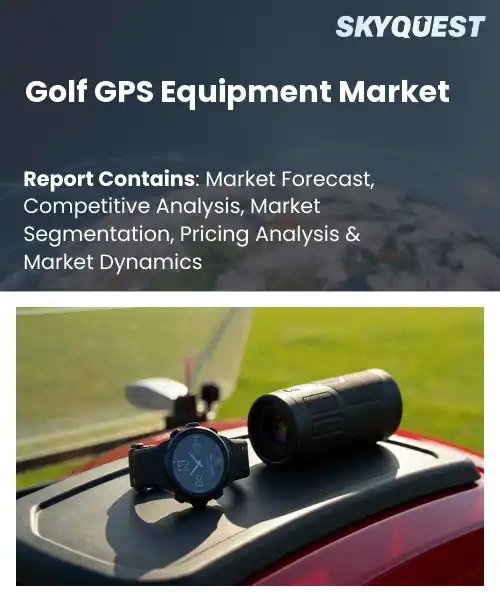
Golf GPS Equipment Market
Report ID: SQMIG25J2157
Report ID: SQMIG25J2157
[email protected]
USA +1 351-333-4748
Report ID:
SQMIG25J2157 |
Region:
Global |
Published Date: February, 2026
Pages:
157
|Tables:
113
|Figures:
77


Global Golf GPS Equipment Market size was valued at USD 600 Million in 2024 and is poised to grow from USD 650 Million in 2025 to USD 1220 Million by 2033, growing at a CAGR of 8.2% during the forecast period (2026-2033).
Growing interest in recreational sports like golf, growing smartphone penetration, advancements in satellite positioning technology, and the inclusion of wearable electronics are expected to drive the demand for golf GPS devices in the future.
Advances in satellite positioning technology and miniaturized electronics have enabled the development of affordable devices that are capable of delivering accurate distance information and course maps. Starting with optical rangefinders, the industry has progressed from smartphone apps to GPS-enabled wearables from Garmin, Bushnell, and Shot Scope.
Increased availability of smartphones and reduced prices of components are fueling adoption in the Asia Pacific and Latin American regions, while the convergence of wearables, live scoring solutions, and augmented reality overlays is unlocking new opportunities for differentiation and profit. The rising interest in improving performance on the golf course, as well as a growing awareness of data-driven training tools, is expected to be the key factor driving the golf GPS equipment market growth.
On the contrary, high initial device costs, limited adoption among casual golfers, competition from free mobile applications, and dependency on satellite signal accuracy are estimated to hamper golf GPS equipment market penetration through 2033 and beyond.
How is AI Improving Accuracy and User Experience in the Golf GPS Equipment Market?
AI is improving the level of accuracy and usability of golf GPS equipment by integrating machine learning algorithms with advanced sensors and mapping information. The latest technology has made it possible to have adaptive distance measurement, automatic shot tracking, and real-time course awareness. The growing need for software-centric solutions that learn the behavior of each golfer and make pre-shot analysis easier is also expected to increase the use of advanced AI models in the golf GPS equipment industry.
Market snapshot - 2026-2033
Global Market Size
USD 0.6 Billion
Largest Segment
Handheld Devices
Fastest Growth
Wearable Devices
Growth Rate
8.2% CAGR
To get more insights on this market click here to Request a Free Sample Report
Global golf GPS equipment market is segmented by device type, technology, end-user, distribution channel, and region. Based on device type, the market is segmented into wearable devices and handheld devices. Based on technology, the market is segmented into GPS technology and bluetooth connectivity. Based on end-user, the market is segmented into amateur golfers and professional golfers. Based on distribution channel, the market is segmented into online sales and retail sales. Based on region, the market is segmented into North America, Europe, Asia Pacific, Latin America, and Middle East & Africa.
The wearable devices segment is estimated to account for a massive chunk of the global golf GPS equipment market share in the future. GPS-enabled watches and smart sensors provide instant yardage, shot tracking, and course mapping without interruptions thereby supporting the dominance of this segment. High consumer demand for multi-functional wearables is also cementing the high share of this segment.
Meanwhile, the demand for handheld devices is slated to rise at a robust pace as per this golf GPS equipment industry analysis. Detailed views of holes, danger areas, and customizable shot information being provided by these devices are making them popular among professional golfers who want to optimize their game.
The GPS technology segment is slated to spearhead the global golf GPS equipment market revenue generation over the coming years. Accurate satellite-based yardage to greens, hazards, and fairways makes GPS essential for multiple golf equipment products. Wide compatibility across devices and strong consumer reliance on reliable distance data further reinforce the dominance of this technology.
Bluetooth connectivity is the segment that is set to witness the fastest growth in the long run. The rising trend of adopting a connected ecosystem and analytics platforms is fueling the growth of this segment. Improvements in low-energy Bluetooth and the penetration of smartphones will create new business opportunities until 2033.
To get detailed segments analysis, Request a Free Sample Report
The fact that a mature golf culture exists, as well as a general awareness of GPS technology among consumers, has contributed to this region being able to maintain its leadership position. Golf GPS equipment providers focusing on product design and user experience enhancement are expected to succeed in North America. Growing leisure spending, increasing interest in golf among people, and high concentration of courses are also expected to bolster the high share of this region in the future. The integration of golf with fitness and mobile ecosystems adds value to the end user and drives demand for aftermarket services. High emphasis on innovation and early adoption of advanced technologies are also shaping golf GPS equipment demand outlook.
High consumer preference for feature rich devices and presence of a developed golf culture are allowing the United States to lead golf GPS equipment adoption in this region. The presence of top golf equipment brands and growing number of tech-oriented golfers are also expected to create new business scope in the future. Golf GPS equipment that emphasizes accuracy, ease of use, and seamless integration with mobile platforms is projected to lead the revenue generation potential for market players through 2033.
The presence of a discerning golfer base that appreciates quality mapping, robust hardware, and connectivity between platforms supports the growth of the market in Canada. Retail and pro shop chains facilitate distribution, and tie-ups with golf courses in the region facilitate product demonstrations. Brands are working towards being flexible to different course conditions and providing customer service to gain loyalty. Mobile integration is also a supporting trend in the region of Canada.
Growing interest in recreational golfing and high adoption rates of digital sports among consumers are expected to increase golf GPS device sales in Europe. Local manufacturers and established sporting brands are tailoring products to regional course characteristics and consumer preferences. Golf GPS equipment companies are also focusing on offering integration with wearable devices and smartphones to expand their product capabilities. Golf GPS equipment vendors are teaming up with golf clubs and tourism operators to create experiential marketing channels. Diverse regulatory frameworks and collaborative industry associations facilitate cross border innovation along with standardized practices in countries such as the United Kingdom, France, and Germany.
High emphasis on precision and engineering driven product attributes is defining the golf GPS equipment industry in Germany. Golf GPS equipment manufacturers in the country are focusing on robust hardware, accurate mapping of courses, and multilingual interfaces that appeal to different golfers not just in the country but around the world as well. Robust product build quality and after-sales support sets German-made golf GPS equipment apart in the region.
Availability of extensive networks of golf clubs and a high level of visibility of golf due to professional events is influencing the adoption of golf GPS equipment in the country. Partnerships with golf course operators improve mapping functionality, and the overall support for after-sales services keeps the product in the high-end segment. The increasing number of high net worth individuals and spending on leisure activities is ensuring continued sales of golf GPS equipment in the United Kingdom.
Increasing consumer interest in golf leisure and launch of new golf club initiatives are shaping golf GPS equipment demand in France. Companies are modifying their products according to the terrain and language requirements of the region, and entry-level products are making technology accessible to new golfers. Partnerships with tour operators and golf academies are increasing trials, and emphasis on user-friendly interfaces and regional content is building consumer confidence.
Increasing consumer interest in golf and improving sports equipment manufacturing capacities are expected to drive the demand for golf GPS devices in the Asia Pacific region in the future. Developing golf GPS equipment that focuses on localized mapping, language support, and custom hardware designs remains the prime emphasis of most market players in the region. Expansion of e-commerce is also projected to play a crucial role in boosting the sales of golf GPS equipment in the long run. Partnerships with golf courses, training institutes, and tourism companies help in practical demonstrations and promotions. Use of novel sensor and battery technologies can also enhance the longevity and functionality of golf GPS equipment made in Asian countries.
High cultural emphasis on precision and strong consumer appetite for advanced technology are shaping golf GPS equipment demand in Japan. Local golf GPS equipment companies are investing in the R&D of compact, energy efficient hardware that offers advanced features as well. Partnerships with golf clubs and training institutions are also predicted to be highly essential for golf GPS equipment companies looking to make a mark in the country.
The presence of a young and tech-savvy consumer base is expected to increase the demand for golf GPS devices that support smartphone and wearable device connectivity. The golf GPS device manufacturers in South Korea are expected to emphasize designs that are compact and user-friendly, with a focus on the active lifestyle of the South Korean population. The presence of a strong digital environment is also expected to provide attractive retailing opportunities for golf GPS device manufacturers.
To know more about the market opportunities by region and country, click here to
Buy The Complete Report
Advances In Satellite Navigation Accuracy
Advancements in satellite navigation technologies have increased confidence and accuracy of GPS systems. The ability of current GPS models to accurately determine location and distance is also expected to positively influence the sales of golf GPS devices in the future. This accuracy will allow manufacturers to create advanced features such as advanced course mapping and accurate shot tracking, which is expected to improve the outlook of the golf GPS equipment market.
Integration With Mobile Connectivity Services
Integration with mobile connectivity and supporting apps is helping boost the functionality of standard golf GPS equipment. Growing golfer demand for real-time course updates, personal statistics, and easy sharing of performance data to make informed decisions are making this a key market driver. High emphasis on companies improving customer engagement and boosting repeat business potential are also creating new opportunities in the long run.
Battery Life and Power Constraints
Concerns regarding limited battery life of golf GPS equipment are reducing their practical appeal and raise issues regarding reliability. During extended play, golfers need to carry spares or forgo advanced functionality that drains batteries quickly, which is a big trade off that most golfers won’t prefer. Adding advanced and bigger batteries leads to high costs and increased complexity of devices, which is also expected to slow down market development in the long run.
High Cost and Accessibility Issues
The high initial procurement cost of golf GPS devices makes it inaccessible to anyone but a rich few. Despite the advancements in golf technology, the entry barrier is still high. The high cost of entry becomes a concern for businesses that target emerging markets with limited budgets. Perceived complexity and the need for constant services or updates could also be a commitment deterrent. These factors combined make the product more difficult to enter, thereby slowing the adoption rate of new market segments for GPS products.
Request Free Customization of this report to help us to meet your business objectives.
Enhancing accuracy, usability, and ecosystem integration of equipment remains the prime emphasis of all new and established golf GPS equipment providers. AI-driven feature upgrades to improve distance accuracy and shot analytics is emerging as a popular strategy as per this golf GPS equipment market forecast. Partnerships with golf courses and instructors are also helping boost revenue generation in the future.
SkyQuest’s ABIRAW (Advanced Business Intelligence, Research & Analysis Wing) is our Business Information Services team that Collects, Collates, Correlates, and Analyses the Data collected by means of Primary Exploratory Research backed by robust Secondary Desk research.
As per SkyQuest analysis, growing participation in golf and rising demand for performance-enhancing technologies are anticipated to drive the demand for golf GPS equipment going forward. However, high device costs, competition from free mobile applications, and limited adoption among casual golfers are slated to slow down the adoption of golf GPS equipment in the future. North America is slated to spearhead the demand for golf GPS equipment owing to strong golfing culture, high spending capacity, and widespread availability of mapped courses. Integration with wearables, AI-driven shot analytics, and augmented reality overlays are anticipated to be key trends driving the golf GPS equipment industry over the coming years.
| Report Metric | Details |
|---|---|
| Market size value in 2024 | USD 600 Million |
| Market size value in 2033 | USD 1220 Million |
| Growth Rate | 8.2% |
| Base year | 2024 |
| Forecast period | 2026-2033 |
| Forecast Unit (Value) | USD Million |
| Segments covered |
|
| Regions covered | North America (US, Canada), Europe (Germany, France, United Kingdom, Italy, Spain, Rest of Europe), Asia Pacific (China, India, Japan, Rest of Asia-Pacific), Latin America (Brazil, Rest of Latin America), Middle East & Africa (South Africa, GCC Countries, Rest of MEA) |
| Companies covered |
|
| Customization scope | Free report customization with purchase. Customization includes:-
|
To get a free trial access to our platform which is a one stop solution for all your data requirements for quicker decision making. This platform allows you to compare markets, competitors who are prominent in the market, and mega trends that are influencing the dynamics in the market. Also, get access to detailed SkyQuest exclusive matrix.
Table Of Content
Executive Summary
Market overview
Parent Market Analysis
Market overview
Market size
KEY MARKET INSIGHTS
COVID IMPACT
MARKET DYNAMICS & OUTLOOK
Market Size by Region
KEY COMPANY PROFILES
Methodology
For the Golf GPS Equipment Market, our research methodology involved a mixture of primary and secondary data sources. Key steps involved in the research process are listed below:
1. Information Procurement: This stage involved the procurement of Market data or related information via primary and secondary sources. The various secondary sources used included various company websites, annual reports, trade databases, and paid databases such as Hoover's, Bloomberg Business, Factiva, and Avention. Our team did 45 primary interactions Globally which included several stakeholders such as manufacturers, customers, key opinion leaders, etc. Overall, information procurement was one of the most extensive stages in our research process.
2. Information Analysis: This step involved triangulation of data through bottom-up and top-down approaches to estimate and validate the total size and future estimate of the Golf GPS Equipment Market.
3. Report Formulation: The final step entailed the placement of data points in appropriate Market spaces in an attempt to deduce viable conclusions.
4. Validation & Publishing: Validation is the most important step in the process. Validation & re-validation via an intricately designed process helped us finalize data points to be used for final calculations. The final Market estimates and forecasts were then aligned and sent to our panel of industry experts for validation of data. Once the validation was done the report was sent to our Quality Assurance team to ensure adherence to style guides, consistency & design.
Analyst Support
Customization Options
With the given market data, our dedicated team of analysts can offer you the following customization options are available for the Golf GPS Equipment Market:
Product Analysis: Product matrix, which offers a detailed comparison of the product portfolio of companies.
Regional Analysis: Further analysis of the Golf GPS Equipment Market for additional countries.
Competitive Analysis: Detailed analysis and profiling of additional Market players & comparative analysis of competitive products.
Go to Market Strategy: Find the high-growth channels to invest your marketing efforts and increase your customer base.
Innovation Mapping: Identify racial solutions and innovation, connected to deep ecosystems of innovators, start-ups, academics, and strategic partners.
Category Intelligence: Customized intelligence that is relevant to their supply Markets will enable them to make smarter sourcing decisions and improve their category management.
Public Company Transcript Analysis: To improve the investment performance by generating new alpha and making better-informed decisions.
Social Media Listening: To analyze the conversations and trends happening not just around your brand, but around your industry as a whole, and use those insights to make better Marketing decisions.
REQUEST FOR SAMPLE
 REQUEST FREE CUSTOMIZATION
Global Golf Gps Equipment Market size was valued at USD 0.6 Billion in 2024 and is poised to grow from USD 0.65 Billion in 2025 to USD 1.22 Billion by 2033, growing at a CAGR of 8.2% during the forecast period (2026-2033).
Competition in the global golf GPS equipment market is intensifying as tournament and club level competition raises demand for precise pin positioning and real time yardage. Consolidation and partnerships are reshaping access and distribution, shown by Golf Genius acquisitions of Golfshot and SwingU. Vendors also push differentiation through tech innovation, for example three dimensional course views and live pin mapping via club partnerships. 'Garmin Ltd.', 'Bushnell Outdoor Products', 'SkyGolf', 'Shot Scope Technologies', 'Arccos Golf', 'GoGolf', 'GolfBuddy', 'Ping', 'Callaway Golf', 'PING Golf', 'CaddyTek', 'Zepp Golf', 'Voice Caddie', 'GolfLogix', 'Easytone Golf', 'Teesnap', 'GolfGPS Pro', 'Swing Caddie', 'Deca Sports', 'SwingU'
Improved satellite navigation accuracy enhances user confidence by delivering consistently precise location and yardage information, which makes devices more reliable during play and more attractive to both serious golfers and casual players. Manufacturers can leverage this precision to introduce refined features such as more detailed course mapping and tighter shot-tracking, increasing perceived value and encouraging adoption. Higher perceived utility supports expansion of product lines and allows retailers to position GPS equipment as essential playing aids, thereby contributing directly to broader market growth through expanded demand.
The fact that a mature golf culture exists, as well as a general awareness of GPS technology among consumers, has contributed to this region being able to maintain its leadership position. Golf GPS equipment providers focusing on product design and user experience enhancement are expected to succeed in North America.


Want to customize this report? This report can be personalized according to your needs. Our analysts and industry experts will work directly with you to understand your requirements and provide you with customized data in a short amount of time. We offer $1000 worth of FREE customization at the time of purchase.
Feedback From Our Clients


 USA (+1) 351-333-4748

