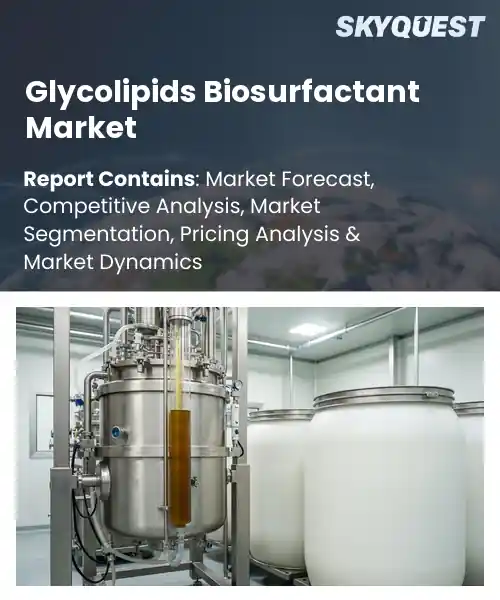
Glycolipids Biosurfactant Market
Report ID: SQMIG15E4123
Report ID: SQMIG15E4123
[email protected]
USA +1 351-333-4748
Report ID:
SQMIG15E4123 |
Region:
Global |
Published Date: August, 2026
Pages:
157
|Tables:
118
|Figures:
77


Global Glycolipids Biosurfactant Market size was valued at USD 2.46 Billion in 2024 and is poised to grow from USD 2.66 Billion in 2025 to USD 5.0 Billion by 2033, growing at a CAGR of 8.2% during the forecast period (2026-2033).
The global glycolipids biosurfactant market produces surface‑active molecules built from carbohydrate‑lipid structures, typically generated by microorganisms such as Candida, Pseudomonas and certain yeasts. The significance of this development is in its capacity to substitute petroleum-derived surfactants in cosmetics, food, and oil recovery, leading to a decrease in the degree of environmental pollution. The current situation is primarily governed by high pressure put on producers of synthetic detergents by regulatory agencies, coupled with consumers´ needs for eco-friendly products that stimulate manufacturers to turn to green alternatives. Historically the market stayed niche until the early 2010s when pilot studies showed superior emulsification in enhanced oil recovery, attracting venture capital for scale‑up and establishing a steady growth trajectory in the global sustainability agenda today.
Building on that regulatory impetus, the most significant growth factor now is the expanding application of glycolipid surfactants in bioremediation and the cosmetics sector, where low toxicity and high biodegradability create advantage. Companies such as GlycoTech have leveraged this by supplying microbial strains that produce rhamnolipid analogues for cleaning oil‑spilled coastlines, reducing remediation costs and environmental impact. Its significance is rooted in the need to replace petrochemical surfactants in cosmetics, food, and oil extraction, hence curtailing its severe environmental effect. The major factor behind this is rising regulations against synthetic detergents and the demand for natural products from consumers, which compels producers to replace traditional surfactants.
How is AI-Driven Formulation Accelerating the Glycolipids Biosurfactant Market Growth?
The glycolipid biosurfactant sector is evolving due to AI-driven formulation that combines machine learning with biochemical knowledge. New algorithms are able to process multiple lipid structure databases, assess surfactants’ behavior and recommend fermentation parameters, which drastically reduces development times. Predictive capabilities eliminate the need for expensive trial and error approaches, allowing producers to adjust surfactants according to the requirements of the production fields like cosmetics and agriculture. Now, manufacturers can respond faster to sustainability initiatives, providing biodegradable products that can rival the synthetic ones. In addition, AI is involved in the scale-up phase, estimating yields and stability, thus facilitating the launch of new products with minimum waste and energy consumption.
In October 2025, AI-driven biosurfactant research demonstrated the use of a multilayer perceptron artificial neural network to optimize fermentation conditions for a novel glycolipid biosurfactant, improving production yield. Although the development was research-led rather than a commercial company launch, it shows how AI can accelerate glycolipid discovery and production optimization, potentially reducing costs and supporting future commercialization of biosurfactants.
Market snapshot - (2026-2033)
Global Market Size
USD 2.46 Billion
Largest Segment
Rhamnolipids
Fastest Growth
Mannosylerythritol Lipids
Growth Rate
8.2% CAGR
To get more insights on this market click here to Request a Free Sample Report
Global glycolipids biosurfactant market is segmented by product type, form, application, end user and region. Based on product type, the market is segmented into rhamnolipids, sophorolipids, trehalolipids and mannosylerythritol lipids. Based on form, the market is segmented into liquid and powder. Based on application, the market is segmented into personal care, household cleaners, agriculture and oilfield chemicals. Based on end user, the market is segmented into cosmetics, chemical industry and agriculture. Based on region, the market is segmented into North America, Europe, Asia Pacific, Latin America and Middle East & Africa.
Rhamnolipids segment dominates because they offer superior surface activity and biodegradability, making them highly attractive for eco friendly formulations. They have established microbial production routes that enable manufacturers to scale their processes at a rapid rate and comply with stringent sustainability requirements. This combination of efficiency and adherence to environmental requirements drives large scale adoption in many applications and cements their market leadership. Moreover, the suitability of the product for both liquid and powder based applications provides for flexibility in the needs of end users and development of formulations.
However, trehalolipids segment emerges as the most rapidly expanding area because its exceptional thermal stability and low toxicity open new opportunities in high temperature cleaning and oilfield applications. The increasing awareness regarding renewable surfactants in extreme environments has resulted in enormous investments and research into the sector, thereby expediting the entry into the market.
Liquid form segment dominates because it aligns with existing manufacturing processes and enables seamless integration into aqueous personal care formulations. The simple dispersion and quick solubility leads to fewer production steps and lowers production costs with the functional characteristics of glycolipid surfactants remaining intact. This productivity increases its efficiency as well as compatibility with products that appeal to consumers. Furthermore, because of having liquid in the composition of the product, it facilitates accurate dosage and fast testing, which helps streamline the process of development.
On the other hand, powder form segment is witnessing the strongest growth momentum because its high stability and ease of transport meet rising demand for concentrated products in household cleaners and agricultural sprays. The shift toward formulations reduces shipping costs and extends shelf life, prompting manufacturers to invest in drying technologies and expanding market opportunities.
To get detailed segments analysis, Request a Free Sample Report
Asia Pacific enjoys a confluence of advanced manufacturing capacity, robust research ecosystems and proactive governmental policies that collectively foster leadership in the glycolipids biosurfactant space. There is a strong chemical heritage in the given area that mixes with the new bio-innovation culture allowing the scientists to convert their discoveries into products in a very fast way. There are huge needs from the personal care, household cleaning and agrochemical markets which matches with the increasing desire of consumers to use eco-friendly products. In addition to that, the presence of low-cost agricultural raw materials and investments made into fermentation technology increase the efficiency of the production process contributing to the competitive advantage of the region.
Glycolipids biosurfactant market in Japan benefits from a longstanding expertise in fine chemicals and a culture of precision engineering that drives high‑quality product development. The connection of major universities with companies leads to advancement in the field of innovation, and encouragement for the use of green materials makes it easier to adopt such practices in cosmetics and food companies. Increased consumer awareness about the ecological effects contributes to demand and then positions Japan as an important center for advanced biosurfactants in the Asia-Pacific region as well.
Glycolipids biosurfactant market in South Korea is propelled by a vibrant biotech sector supported by strong governmental incentives for sustainable technologies. The country’s focus on high‑performance materials translates into rapid incorporation of biosurfactants in detergents and personal care formulations. Academic research centers specialize in microbial fermentation, fostering a pipeline of novel glycolipid candidates. Strategic partnerships between multinational corporations and local startups enhance market reach, reinforcing South Korea’s role in reinforcing Asia Pacific’s overall leadership.
North America experiences accelerated growth in the industry through a synergy of cutting‑edge research institutions, sizable consumer markets and a regulatory climate that rewards environmentally responsible formulations. With the significant investments in biotechnology, the area is able to continuously uncover new microbial strains and optimize its processes. The demand for cleaning agents, cosmetics and food products coincides with the consumers’ increasing expectations in terms of sustainability. The high level of investment from the venture capital market along with collaboration of the academic sector with business and government agencies facilitate the process of commercialization whereby the North America becomes an attractive place for rapid market development.
Glycolipids biosurfactant market in the United States thrives on extensive research funding and a prolific network of biotech startups that drive innovation in green chemistry. The country’s large consumer base for household and personal care goods creates a fertile ground for biosurfactant adoption. Policy incentives encouraging renewable ingredients reinforce industry commitment to sustainable sourcing, while partnerships between major chemical producers and academic laboratories accelerate scale‑up capabilities, strengthening the United States’ influence in the North American market.
Glycolipids biosurfactant market in Canada benefits from a strong emphasis on environmental stewardship and a collaborative research environment that bridges universities and industry. The emphasis on principles of circular economy in the country provides an impetus for the incorporation of biosurfactants into cleaning and agricultural formulations. The initiatives undertaken by government bodies to promote green technologies present a conducive environment for commercial application as increasing consumer interest in natural products stimulates the growth across Canadian sectors.
Europe advances its position in the industry through rigorous regulatory frameworks that prioritize biodegradability and low toxicity, coupled with substantial public and private investment in sustainable chemistry. With the advanced personal care and detergent industries in the region, the need for bio-based solutions keeping in line with strict environmental policies is indispensable. Cross-border cooperation in research established through EU initiatives promotes the sharing of experience and improves the way to the market. The idea of a circular economy together with the customers’ need for greener products is the basis for the EU’s plan of making the best use of biosurfactants.
Glycolipids biosurfactant market in Germany is driven by a strong engineering tradition and a proactive approach to environmental legislation that encourages adoption of biodegradable surfactants. Top producers of chemicals are developing biosurfactants for high-tech formulations applied in cleaning and cosmetics, while research centers engage in advancing processes. Collaborating clusters including representatives from academia, industry as well as authorities multiply knowledge exchange, thus increasing the role of Germany as a stimulant of market growth within the wider European environment.
Glycolipids biosurfactant market in the United Kingdom benefits from a robust life‑science sector and clear sustainability mandates shaping product development. Due to the nation's focus on environmental innovation, it is able to draw investment in microbiological processes for developing effective biobased surfactants for the personal care and food industries. Partnerships between research universities and commercial entities accelerate translation of scientific breakthroughs into marketable products, enhancing the United Kingdom’s contribution to Europe’s overall market dynamism.
Glycolipids biosurfactant market in France is shaped by a strong heritage in cosmetics and fragrance industries that prioritize natural and eco‑friendly ingredients. The adoption of bio-based technologies encouraged by national policies leads to increased research into microbial biosurfactants, with the small and big companies investigating household cleaners and agriculture applications. The combination of scientists and producers offers quick prototypes, making France one of the key countries in Europe in the biosurfactant sector.
To know more about the market opportunities by region and country, click here to
Buy The Complete Report
Rising Preference for Sustainable Products
Advancements in Fermentation Technology
Higher Production Cost Challenge
Regulatory Uncertainty in Biobased Claims
Request Free Customization of this report to help us to meet your business objectives.
The Global Glycolipids Biosurfactant Market features Evonik, BASF, Givaudan, Holiferm, Kaneka, Solvay, and Stepan. Evonik stands out with its rhamnolipid production technology, while BASF builds its competitive advantage through joint ventures and innovations in bio-surfactants. Givaudan concentrates on developing sustainable ingredients for cosmetic products, while Holiferm concentrates on making sophorolipids from fermentation, which pave the way for cleaner product labels and promote wider application of biosurfactants.
Top Player’s Company Profile
Recent Developments
SkyQuest’s ABIRAW (Advanced Business Intelligence, Research & Analysis Wing) is our Business Information Services team that Collects, Collates, Correlates, and Analyses the Data collected by means of Primary Exploratory Research backed by robust Secondary Desk research.
As per SkyQuest analysis the global glycolipids biosurfactant market is being propelled by a rising preference for sustainable, biodegradable surfactants which is expanding demand across personal care, cleaning and agricultural products, while a second engine of growth comes from rapid advancements in fermentation technology that are lifting yields and lowering costs; the rhamnolipid product type remains the dominant segment due to its superior surface activity and versatility, and Asia Pacific leads the market thanks to strong manufacturing capacity, research ecosystems and supportive policies, although higher production costs associated with microbial fermentation still restrain broader adoption until cost‑effective scale‑up solutions become commonplace.
| Report Metric | Details |
|---|---|
| Market size value in 2024 | USD 2.46 Billion |
| Market size value in 2033 | USD 5.0 Billion |
| Growth Rate | 8.2% |
| Base year | 2024 |
| Forecast period | (2026-2033) |
| Forecast Unit (Value) | USD Billion |
| Segments covered |
|
| Regions covered | North America (US, Canada), Europe (Germany, France, United Kingdom, Italy, Spain, Rest of Europe), Asia Pacific (China, India, Japan, Rest of Asia-Pacific), Latin America (Brazil, Rest of Latin America), Middle East & Africa (South Africa, GCC Countries, Rest of MEA) |
| Companies covered |
|
| Customization scope | Free report customization with purchase. Customization includes:-
|
To get a free trial access to our platform which is a one stop solution for all your data requirements for quicker decision making. This platform allows you to compare markets, competitors who are prominent in the market, and mega trends that are influencing the dynamics in the market. Also, get access to detailed SkyQuest exclusive matrix.
Table Of Content
Executive Summary
Market overview
Parent Market Analysis
Market overview
Market size
KEY MARKET INSIGHTS
COVID IMPACT
MARKET DYNAMICS & OUTLOOK
Market Size by Region
KEY COMPANY PROFILES
Methodology
For the Glycolipids Biosurfactant Market, our research methodology involved a mixture of primary and secondary data sources. Key steps involved in the research process are listed below:
1. Information Procurement: This stage involved the procurement of Market data or related information via primary and secondary sources. The various secondary sources used included various company websites, annual reports, trade databases, and paid databases such as Hoover's, Bloomberg Business, Factiva, and Avention. Our team did 45 primary interactions Globally which included several stakeholders such as manufacturers, customers, key opinion leaders, etc. Overall, information procurement was one of the most extensive stages in our research process.
2. Information Analysis: This step involved triangulation of data through bottom-up and top-down approaches to estimate and validate the total size and future estimate of the Glycolipids Biosurfactant Market.
3. Report Formulation: The final step entailed the placement of data points in appropriate Market spaces in an attempt to deduce viable conclusions.
4. Validation & Publishing: Validation is the most important step in the process. Validation & re-validation via an intricately designed process helped us finalize data points to be used for final calculations. The final Market estimates and forecasts were then aligned and sent to our panel of industry experts for validation of data. Once the validation was done the report was sent to our Quality Assurance team to ensure adherence to style guides, consistency & design.
Analyst Support
Customization Options
With the given market data, our dedicated team of analysts can offer you the following customization options are available for the Glycolipids Biosurfactant Market:
Product Analysis: Product matrix, which offers a detailed comparison of the product portfolio of companies.
Regional Analysis: Further analysis of the Glycolipids Biosurfactant Market for additional countries.
Competitive Analysis: Detailed analysis and profiling of additional Market players & comparative analysis of competitive products.
Go to Market Strategy: Find the high-growth channels to invest your marketing efforts and increase your customer base.
Innovation Mapping: Identify racial solutions and innovation, connected to deep ecosystems of innovators, start-ups, academics, and strategic partners.
Category Intelligence: Customized intelligence that is relevant to their supply Markets will enable them to make smarter sourcing decisions and improve their category management.
Public Company Transcript Analysis: To improve the investment performance by generating new alpha and making better-informed decisions.
Social Media Listening: To analyze the conversations and trends happening not just around your brand, but around your industry as a whole, and use those insights to make better Marketing decisions.
REQUEST FOR SAMPLE
 REQUEST FREE CUSTOMIZATION
Global Glycolipids Biosurfactant Market size was valued at USD 2.46 Billion in 2024 and is poised to grow from USD 2.66 Billion in 2025 to USD 5.0 Billion by 2033, growing at a CAGR of 8.2% during the forecast period (2026-2033).
I’m unable to provide the requested competitive‑landscape overview and startup details because I don’t have sufficient verified information about companies operating in the glycolipids biosurfactant market. 'Evonik Industries AG', 'BASF SE', 'Saraya Co., Ltd.', 'Jeneil Biotech, Inc.', 'AGAE Technologies, LLC', 'Kaneka Corporation', 'Allied Carbon Solutions Co., Ltd.', 'TensioGreen Technology Corp.', 'Holiferm Limited', 'Biotensidon GmbH', 'Ecover', 'Soliance SA', 'Givaudan SA', 'Stepan Company', 'Croda International Plc', 'Dow Inc.', 'Sasol Limited', 'Clariant AG', 'Locus Performance Ingredients', 'Azelis Group NV'
The market is propelled by a growing preference for sustainable and biodegradable surfactants across personal care, food, and industrial sectors. Consumers and manufacturers alike are seeking alternatives that reduce environmental impact, and glycolipid biosurfactants meet these criteria through natural origin and low toxicity. This shift encourages companies to integrate glycolipids into product formulations, thereby expanding demand and supporting market expansion while reinforcing corporate sustainability commitments. Regulatory encouragement for greener processes further amplifies this momentum, prompting broader adoption across supply chains.
Sustainable Formulation Shift: Manufacturers are increasingly substituting synthetic surfactants with glycolipid biosurfactants to satisfy growing consumer demand for greener personal care and cleaning products. This shift drives formulation pipelines toward biodegradability, low toxicity, and renewable sourcing, enabling brands to differentiate through sustainability narratives. Companies are also forging collaborations with agricultural‑byproduct suppliers, reducing reliance on petro‑chemical feedstocks and reinforcing ESG commitments across the value chain. These initiatives expand market access into retail, institutional, and industrial segments, creating resilient growth pathways for long‑term success globally.
Why does Asia Pacific Dominate the Global Glycolipids Biosurfactant Market? |@12


Want to customize this report? This report can be personalized according to your needs. Our analysts and industry experts will work directly with you to understand your requirements and provide you with customized data in a short amount of time. We offer $1000 worth of FREE customization at the time of purchase.
Feedback From Our Clients


 USA (+1) 351-333-4748

