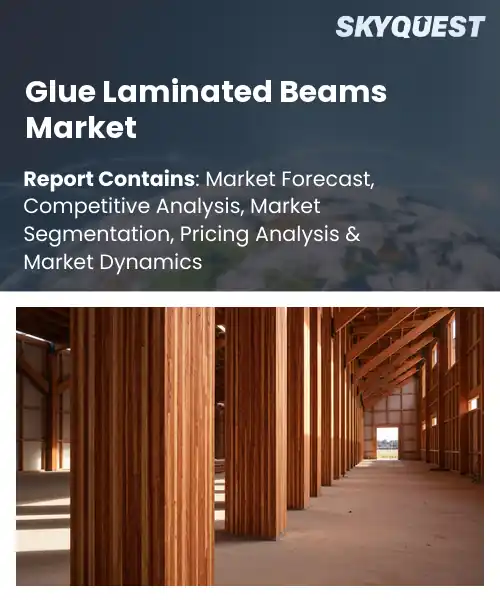
Glue Laminated Beams Market
Report ID: SQMIG15P2041
Report ID: SQMIG15P2041
[email protected]
USA +1 351-333-4748
Report ID:
SQMIG15P2041 |
Region:
Global |
Published Date: June, 2026
Pages:
157
|Tables:
147
|Figures:
78


Global Glue Laminated Beams Market size was valued at USD 6.0 Billion in 2024 and is poised to grow from USD 6.31 Billion in 2025 to USD 9.47 Billion by 2033, growing at a CAGR of 5.2% during the forecast period (2026-2033).
Glue laminated beams market is primarily driven by construction’s shift toward engineered timber as a sustainable, high-performance alternative to steel and concrete. The market covers production and distribution of layered lumber components bonded with structural adhesives for residential, commercial, and infrastructure use, and it matters because these members combine aesthetics, strength, and lighter weight to enable long spans and rapid assembly. Over recent decades the industry moved from artisanal joinery to industrial prefabrication as adhesive chemistry, kiln drying, and quality standards advanced. This transition appears in long-span airport roofs and timber pedestrian bridges replacing steel in urban regeneration projects worldwide.A central factor shaping global glue laminated beams growth is regulatory pressure to decarbonize buildings, which causes architects and developers to choose engineered wood for its lower embodied carbon and renewable credentials. As demand rises, manufacturers invest in larger presses and lines, reducing unit costs and widening applications to multi-storey offices, modular housing, and long-span arenas. This investment-cycle creates opportunities for prefabricated systems that shorten construction schedules, illustrated by school and hotel projects assembled in weeks rather than months. Consequently, increased production capacity attracts timber supply chain partners and exports, enabling regional players to scale while meeting green procurement targets.
How is automation improving production efficiency in the glue laminated beams market?
Automation is improving production efficiency in the glue laminated beams market by combining precision machining, robotic handling, automated finger jointing and inline quality inspection into integrated production lines. Key aspects are consistent adhesive application, controlled pressing and CNC shaping, which reduce variability and rework. The current state favors manufacturers investing in turnkey automation to meet demand for larger and more complex timber components while keeping finish and strength consistent. Real world instances of highly automated plants and purpose built finger jointing presses show how automation smooths flow, reduces manual bottlenecks and shortens cycle times, making deliveries more predictable and enabling firms to bid on bigger projects.Rosboro May 2026, upgraded its glulam production with a new automated line using Danish plant equipment, a change that reduces manual handling and speeds machining and pressing. This supports market growth by increasing reliable output and improving supplier responsiveness.
Market snapshot - (2026-2033)
Global Market Size
USD 6.0 Billion
Largest Segment
Straight Beams
Fastest Growth
Curved Beams
Growth Rate
5.2% CAGR
To get more insights on this market click here to Request a Free Sample Report
Global glue laminated beams market is segmented by product type, grade type, application, adhesive type, end user and region. Based on product type, the market is segmented into Straight Beams, Curved Beams and Arched Beams. Based on grade type, the market is segmented into Premium Grade, Framing Grade, Industrial Grade and Architectural Grade. Based on application, the market is segmented into Floor & Roof Beams, Columns & Structural Supports, Window & Door Headers and Bridges & Infrastructure. Based on adhesive type, the market is segmented into Phenol Resorcinol Formaldehyde (PRF), Melamine Urea Formaldehyde (MUF), Polyurethane (PUR) and Bio-Based Adhesives. Based on end user, the market is segmented into Residential Construction, Commercial Construction and Industrial Construction. Based on region, the market is segmented into North America, Europe, Asia Pacific, Latin America and Middle East & Africa.
Straight Beams segment dominates because their standardized geometry enables efficient, high-throughput production and predictable structural behavior that align with mainstream construction practices. Familiar fabrication processes and simplified engineering calculations reduce lead times and qualification hurdles, which encourages specification by architects and contractors. This reliability concentrates supply chain investment and keeps production costs manageable, reinforcing straight configurations as the default choice for many building programs across diverse project types.
However, curved beams are witnessing the strongest growth momentum as designers pursue expressive forms and nonstandard geometries that straight members cannot achieve. Advances in digital design-to-fabrication workflows, improved lamination and bending techniques, and rising demand for distinctive architectural statements drive adoption. These trends create premium project opportunities and higher-value manufacturing runs that expand market capability and stimulate innovation in tooling and finishes.
Phenol Resorcinol Formaldehyde (PRF) segment dominates because its proven structural durability, superior moisture resistance, and long-term bond performance meet stringent safety and longevity requirements for critical structural applications. Broad industry acceptance and established certification pathways simplify qualification and specification, encouraging manufacturers to rely on PRF for conservative designs. The trust in PRF’s performance reduces perceived risk for specifiers, maintaining steady demand and anchoring production practices around this adhesive chemistry.
However, bio based adhesives are emerging as the key high growth area because sustainability mandates and buyer demand for low carbon materials are pushing manufacturers to reformulate bonding systems. Advances in biopolymer chemistry are improving bond strength and durability and enabling wider qualification for structural use. This shift unlocks green certification pathways, creates differentiated product propositions, and stimulates investment in new production capabilities and supply chain adaptation.
To get detailed segments analysis, Request a Free Sample Report
North America commands the glue laminated beams market owing to a convergence of mature construction practices, emphasis on sustainable materials, and strong institutional support for engineered wood. Advanced manufacturing capabilities and established supply chains enable consistent quality and customization for complex structural applications. Market preference for timber solutions that balance aesthetics and performance bolsters uptake across commercial, institutional, and residential segments. Innovation in adhesives and lamination techniques, along with regulatory frameworks favoring low carbon construction, further reinforce competitiveness. Collaboration between architects, engineers, and manufacturers accelerates specification in high profile projects, while investment in wood science and vocational skills maintains a steady pipeline of expertise that underpins product adoption and market leadership. Robust logistics networks and proximity to large end markets sustain responsiveness to project needs and support ongoing market resilience.
Glue Laminated Beams Market in United States benefits from a broad base of design professionals specifying engineered timber for landmark and everyday projects, deep manufacturing capacity, and well developed distribution channels. High awareness of sustainable construction and strong private sector investment drive demand across commercial and institutional development. Coordination between research institutions and industry fosters product innovation and quality assurance that reinforce confidence among builders and architects and specifiers alike.
Glue Laminated Beams Market in Canada draws strength from abundant forest resources, a cultural affinity for timber architecture, and supportive provincial policies that encourage low carbon building methods. Regional manufacturers emphasize product adaptability for varied climatic conditions and collaborate with design teams to integrate laminated beams into public and private projects. Investment in certification and supplier networks enhances market confidence and enables more consistent specification by architects and builders nationwide.
Europe has seen rapid expansion in glue laminated beams driven by strong policy emphasis on low carbon construction, growing preference for timber in urban and retrofit projects, and increasing acceptance of engineered wood among design communities. Robust investment in prefabrication and offsite manufacturing improves build speed and quality, while cross border supply chains ensure material availability and consistency. National building codes that recognize engineered timber structural performance and public procurement priorities for sustainable materials further accelerate specification. Collaboration among manufacturers, certification bodies, and research institutes helps overcome technical barriers and standardization challenges, enabling broader adoption across residential, commercial, and cultural projects where aesthetic and environmental credentials are highly valued. Market momentum is also supported by growing contractor experience with timber assemblies and by architectural trends that favor visible engineered wood elements for public engagement.
Glue Laminated Beams Market in Germany is characterized by advanced manufacturing infrastructure, rigorous technical standards, and strong integration with timber engineering research. High levels of specification in public buildings and commercial developments reflect longstanding confidence in engineered wood. Manufacturers emphasize quality control and certification to meet exacting performance and durability expectations. Collaboration between architects and suppliers produces sophisticated timber solutions that combine structural efficiency with aesthetic expression, reinforcing leadership nationally.
Glue Laminated Beams Market in United Kingdom is experiencing strong uptake driven by modern methods of construction and architectural preference for visible timber in urban projects. Offsite fabrication and innovative contracting models accelerate delivery and simplify on site work. Policy support for sustainable procurement initiatives to develop timber skills bolster specification. Collaboration between manufacturers and design teams encourages creative applications that improve structural performance and visual impact across building types.
Glue Laminated Beams Market in France is emerging through targeted public projects, growing architectural interest in timber aesthetics, and expanding regional initiatives that promote sustainable building materials. Smaller scale manufacturers combine traditional woodworking skills with engineered approaches to meet design briefs. Emphasis on certification, climatic adaptation, and integration with masonry systems supports adoption. Increasing collaboration between local authorities, developers, and designers is broadening application across cultural, residential, and public sectors.
Asia Pacific is strengthening its position in the glue laminated beams market through concentrated investment in technical capability, seismic aware engineering, and adoption of prefabrication methods that suit dense urban environments. Strong manufacturer focus on material science and precision fabrication enables products that meet strict safety and durability requirements. Regional architects increasingly value engineered timber for aesthetic and sustainability credentials, prompting integration in both large scale and smaller bespoke projects. Cross border knowledge transfer, expanding supplier networks, and targeted certification efforts help address climatic diversity and construction practices, while pilot projects and collaborations with research institutions accelerate market maturation and acceptance across commercial and residential segments. Public and private initiatives that showcase timber use in culturally significant and transport projects raise visibility, and growing logistics and interregional trade links support reliable supply for complex programs.
Glue Laminated Beams Market in Japan is shaped by rigorous seismic design practices, high expectations for material precision, and cultural appreciation for timber craftsmanship. Manufacturers combine joinery knowledge with modern lamination and adhesive technologies to produce durable, high performance structural elements suited to challenging seismic conditions. Prefabrication and quality assurance processes enable efficient on site integration. Strong collaborations between research institutions and industry support refinement of technical specifications and methods.
Glue Laminated Beams Market in South Korea is advancing through industrial modernization, emphasis on offsite fabrication, and growing developer interest in timber framed solutions. Manufacturers focus on precision production and adaptable design options to suit dense urban construction and complex briefs. Government led initiatives and demonstration projects highlight environmental advantages and buildability. Strengthened supplier coordination and increasing technical expertise among design professionals support broader specification across commercial and residential developments.
To know more about the market opportunities by region and country, click here to
Buy The Complete Report
Rising Preference For Sustainable Construction
Advancements In Manufacturing Technologies
High Initial Capital Requirements
Supply Chain and Raw Material Variability
Request Free Customization of this report to help us to meet your business objectives.
Competitive pressure is driving consolidation, capacity expansion and product differentiation in the glulam landscape, with firms using acquisitions, supplier partnerships and factory upgrades to secure large prefab and infrastructure specifications. Examples include Blumer Lehmann adding a glulam line and Timberlab reviving sawmills to support glulam production. Manufacturers are also adopting digital design for manufacture workflows and supplier alliances to shorten lead times and win commercial bids.
Top Player’s Company Profile
Recent Developments
SkyQuest’s ABIRAW (Advanced Business Intelligence, Research & Analysis Wing) is our Business Information Services team that Collects, Collates, Correlates, and Analyses the Data collected by means of Primary Exploratory Research backed by robust Secondary Desk research. As per SkyQuest analysis, the global glue laminated beams market is being driven by growing preference for engineered timber as a sustainable alternative to steel and concrete, and a second driver is rapid advances in manufacturing technologies and automation that boost capacity and consistency. A restraint is the high initial capital required for specialized equipment, controlled drying and quality systems which limits new entrants and regional expansion. North America currently dominates the market due to mature supply chains, institutional support and established manufacturing, while straight beams remain the dominant product segment because their standardized geometry enables efficient high-throughput production and broad specification by architects and contractors.
| Report Metric | Details |
|---|---|
| Market size value in 2024 | USD 6.0 Billion |
| Market size value in 2033 | USD 9.47 Billion |
| Growth Rate | 5.2% |
| Base year | 2024 |
| Forecast period | (2026-2033) |
| Forecast Unit (Value) | USD Billion |
| Segments covered |
|
| Regions covered | North America (US, Canada), Europe (Germany, France, United Kingdom, Italy, Spain, Rest of Europe), Asia Pacific (China, India, Japan, Rest of Asia-Pacific), Latin America (Brazil, Rest of Latin America), Middle East & Africa (South Africa, GCC Countries, Rest of MEA) |
| Companies covered |
|
| Customization scope | Free report customization with purchase. Customization includes:-
|
To get a free trial access to our platform which is a one stop solution for all your data requirements for quicker decision making. This platform allows you to compare markets, competitors who are prominent in the market, and mega trends that are influencing the dynamics in the market. Also, get access to detailed SkyQuest exclusive matrix.
Table Of Content
Executive Summary
Market overview
Parent Market Analysis
Market overview
Market size
KEY MARKET INSIGHTS
COVID IMPACT
MARKET DYNAMICS & OUTLOOK
Market Size by Region
KEY COMPANY PROFILES
Methodology
For the Glue Laminated Beams Market, our research methodology involved a mixture of primary and secondary data sources. Key steps involved in the research process are listed below:
1. Information Procurement: This stage involved the procurement of Market data or related information via primary and secondary sources. The various secondary sources used included various company websites, annual reports, trade databases, and paid databases such as Hoover's, Bloomberg Business, Factiva, and Avention. Our team did 45 primary interactions Globally which included several stakeholders such as manufacturers, customers, key opinion leaders, etc. Overall, information procurement was one of the most extensive stages in our research process.
2. Information Analysis: This step involved triangulation of data through bottom-up and top-down approaches to estimate and validate the total size and future estimate of the Glue Laminated Beams Market.
3. Report Formulation: The final step entailed the placement of data points in appropriate Market spaces in an attempt to deduce viable conclusions.
4. Validation & Publishing: Validation is the most important step in the process. Validation & re-validation via an intricately designed process helped us finalize data points to be used for final calculations. The final Market estimates and forecasts were then aligned and sent to our panel of industry experts for validation of data. Once the validation was done the report was sent to our Quality Assurance team to ensure adherence to style guides, consistency & design.
Analyst Support
Customization Options
With the given market data, our dedicated team of analysts can offer you the following customization options are available for the Glue Laminated Beams Market:
Product Analysis: Product matrix, which offers a detailed comparison of the product portfolio of companies.
Regional Analysis: Further analysis of the Glue Laminated Beams Market for additional countries.
Competitive Analysis: Detailed analysis and profiling of additional Market players & comparative analysis of competitive products.
Go to Market Strategy: Find the high-growth channels to invest your marketing efforts and increase your customer base.
Innovation Mapping: Identify racial solutions and innovation, connected to deep ecosystems of innovators, start-ups, academics, and strategic partners.
Category Intelligence: Customized intelligence that is relevant to their supply Markets will enable them to make smarter sourcing decisions and improve their category management.
Public Company Transcript Analysis: To improve the investment performance by generating new alpha and making better-informed decisions.
Social Media Listening: To analyze the conversations and trends happening not just around your brand, but around your industry as a whole, and use those insights to make better Marketing decisions.
REQUEST FOR SAMPLE
 REQUEST FREE CUSTOMIZATION


Want to customize this report? This report can be personalized according to your needs. Our analysts and industry experts will work directly with you to understand your requirements and provide you with customized data in a short amount of time. We offer $1000 worth of FREE customization at the time of purchase.
Feedback From Our Clients


 USA (+1) 351-333-4748

