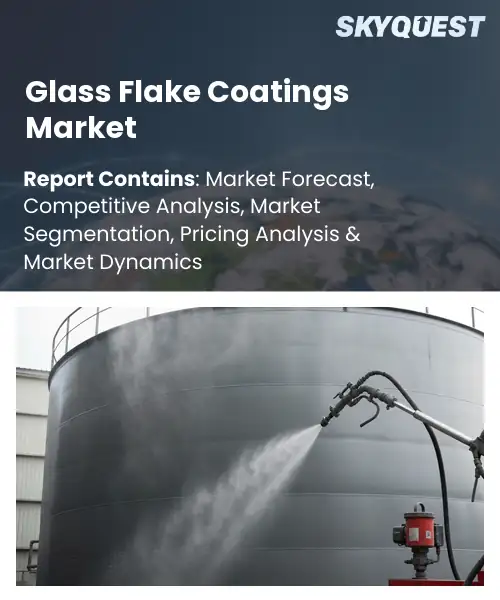
Glass Flake Coatings Market
Report ID: SQMIG15E3165
Report ID: SQMIG15E3165
[email protected]
USA +1 351-333-4748
Report ID:
SQMIG15E3165 |
Region:
Global |
Published Date: February, 2026
Pages:
183
|Tables:
90
|Figures:
71


Global Glass Flake Coatings Market size was valued at USD 2.4 Billion in 2024 and is poised to grow from USD 2.51 Billion in 2025 to USD 3.63 Billion by 2033, growing at a CAGR of 4.7% during the forecast period (2026-2033).
The demand for Glass Flake Coatings in the global market is mainly driven by an increasing need for Corrosion Resistance within Asset-Intense Industries. Infrastructure in oil and gas, marine transport, petrochemicals, and power generation is constantly exposed to salt spray, chemicals, and high humidity, which accelerates metal degradation. When glass flakes are incorporated into resin systems, they form tightly layered, impermeable barriers that dramatically slow the penetration of water and corrosive agents. This improved resistance extends asset lifespan and minimizes repainting frequency. As a result, operators experience lower maintenance expenditure and fewer shutdowns, which pushes procurement teams to increasingly select glass flake coatings over conventional alternatives, expanding market demand.
A crucial factor shaping the market is the global surge in offshore and large-scale industrial construction. Investments in offshore wind farms, oil platforms, desalination plants, and coastal infrastructure have multiplied, creating surfaces that must endure abrasive waves, chemical exposure, and mechanical impact. Most conventional coatings fail due to the extreme environment in which they are required, resulting in expensive repairs. However, Glass Flake Coatings provide both enhanced structural strength and superior adhesion to the substrate which promotes a longer lifespan of cracked and under-film corrosion. This performance encourages engineering firms to specify them in project standards. Consequently, rising construction activity directly increases consumption volumes, strengthens supplier networks, and motivates manufacturers to expand production capacity and product innovation.
How do AI Models Identify High-Exposure Assets?
The incorporation of AI in the glass flake coatings market transforms how owners specify and how frequently they apply the protective coating. With the use of AI models that harness inspection images and sensor data to provide predictions on where corrosion will progress at a more rapid pace, operators can now change from a standardized repainting schedule to one that is risk-based by focusing on their highest-exposure types of assets (for example offshore rigs, tanks and marine structures). That increases demand for long-life, high-barrier systems—a niche where glass flake coatings perform strongly—because fewer shutdown windows mean coatings must last longer per application. A related development is computer-vision models (CNNs) being used to detect coating cracks/degradation and improve lifetime prediction, tightening the link between AI inspection and premium coating selection.
In January 2025, PPG Industries launched an AI-driven coating inspection platform that uses machine learning to automate quality assurance and enable predictive maintenance across industrial and automotive coating applications. This development helps detect defects earlier and more accurately, reducing downtime and sharpening coating selection—including advanced anti-corrosion systems relevant to glass flake coatings.
Market snapshot - 2026-2033
Global Market Size
USD 3.27 Billion
Largest Segment
Epoxy
Fastest Growth
Vinyl Ester
Growth Rate
4.03% CAGR
To get more insights on this market click here to Request a Free Sample Report
Global Glass Flake Coatings Market is segmented by Resin Type, Substrate Type, End-Use Industry, Application Method and region. Based on Resin Type, the market is segmented into Epoxy, Polyester and Vinyl Ester. Based on Substrate Type, the market is segmented into Steel and Concrete. Based on End-Use Industry, the market is segmented into Oil & Gas, Marine, Chemical, Construction and Others. Based on Application Method, the market is segmented into Brush/Roller, Conventional Spray and Airless Spray. Based on region, the market is segmented into North America, Europe, Asia Pacific, Latin America and Middle East & Africa.
Current innovation in the epoxy resin segment of the global glass flake coatings market focuses on low-VOC high-solids formulations, faster curing chemistries and nano-modified hardeners that improve wetting of glass flakes and barrier continuity, expanding use in offshore, tank lining and chemical plants. The backbone of epoxy provides exceptional adhesion to steel, good chemical resistance, mechanical toughness, resulting in extended service intervals and low lifecycle costs, as well as compatibility with curing agents.
Vinyl ester resin is poised for fastest growth in the global glass flake coatings market due to its excellent chemical resistance and flexibility in high-temperature, corrosive environments, making it ideal for aggressive industrial and offshore applications. More durable and better formulated options are appealing for those users who want lower cost of maintenance and extended durability.
Steel substrates lead to the global glass flake coatings market because they are widely used in infrastructure, oil & gas, marine, and industrial equipment that demand robust corrosion protection. Innovation today is focused on improving existing and developing new pretreatment compatibility as well as enhancing adhesion promoters to increase coating performance on steel substrates, particularly when subjected to cyclic stress. Since steel is universally used structurally and has a significant rate of corrosion, premium glass flake systems will extend the service life of steel and minimize the maintenance requirement.
Concrete substrates are expected to grow fastest in the glass flake coatings market because rising infrastructure and commercial construction demand durable, abrasion-resistant protection. Glass flake products provide superior moisture and chloride barrier protection for concrete, decreasing the likelihood of cracking or spalling that reduces lifecycle costs and maintenance, thereby enhancing the desirability of use in bridges, tunnels, and industrial flooring applications.
To get detailed segments analysis, Request a Free Sample Report
North America represents a high-value region for the global glass flake coatings market due to the concentration of aging energy, marine, and industrial infrastructure that requires advanced corrosion control. Long-life protection systems are continuously in demand due to the presence of major industrial components, including oil and gas pipeline networks, offshore platforms, chemical plants, and wastewater treatment plants. Global environment and occupational safety legislations have led most asset owners to select barrier coatings of superior quality as opposed to conventional paints. Also, large maintenance budgets and ongoing technical developments are helping asset owners transition to newer generation solutions, including those that utilize glass flake technologies.
The United States is the largest contributor to North America’s glass flake coatings market due to its extensive oil and gas, marine, power, and chemical processing infrastructure. Tens of thousands of miles of pipelines, as well as refineries, offshore platforms, and storage terminals, all need to have high quality corrosion protection in order to adhere with stringent requirements for both safety and environmental protection. Consistently implemented maintenance expenditures and a high frequency of asset rehabilitation projects continue to increase the use of epoxy and vinyl ester glass flake systems in both industrial and municipal environments.
Canada contributes significantly through its energy, mining, and coastal infrastructure segments that operate in highly corrosive and cold environments. Coatings should meet these materials demanding environments by providing superior moisture and chemical resistance. The government has also been focused on creating more sustainable infrastructures; therefore, longer lasting coating technologies are favoured over having to perform maintenance too often or spending more money on new installations.
Asia Pacific’s glass flake coatings market is expanding rapidly driven by heavy industrialization, infrastructure growth, and rising offshore energy projects. Heavy investment in the Oil and Gas energy markets are taking place in China, India, Southeast Asia, and Australia for projects requiring durable corrosion protective systems (e.g., Power Plant, Port Infrastructure, Wastewater Treatment Facilities). Urbanization, as well as more strict environmental regulations, will play an important role in the development of high-performance systems. The combination of considerable refurbishment cycles and increased government spending on infrastructure programs will also create additional opportunities for long-lasting glass flake coatings across many different end-use markets.
Japan contributes strongly through its advanced shipbuilding, petrochemical, and coastal infrastructure sectors where corrosion control is a national priority. Large ports, LNG terminals, and thermal power facilities require coatings that tolerate salt exposure and seismic stress. The country’s focus on asset life extension rather than replacement encourages specification of high-durability glass flake systems. Japanese manufacturers also drive innovation in low-VOC resins and precision application methods, supporting consistent domestic demand.
South Korea’s contribution is led by its world-scale shipbuilding industry, offshore platforms, and expanding renewable energy projects. Glass flake coatings are used by shipyards making tankers & FPSOs to provide protection to the ballast tanks & steel structures from aggressive seawater. This increase in consumption due to the rapid development of coastal industrial facilities and desalination plants is continuing to grow. As a result, strong engineering standards & export-driven manufacturing is prompting contractors to seek out premium protective systems that provide reduced maintenance and improved global project competitiveness.
Europe’s glass flake coatings market is driven by strong industrial, marine, and infrastructure sectors, with significant investment in renewable energy, ports, and chemical processing facilities. The strict regulations that the European Union impose regarding corrosion protection and the environment will accelerate the uptake of highly efficient/low environmental impact coatings in Europe. Demand for such coatings will be driven predominantly by pipeline maintenance and offshore wind energy sectors in Germany, the United Kingdom, and the Nordic region. The continued focus on lifecycle costs and sustainability will also contribute to an increasing use of glass flake coatings.
Germany is a leading contributor due to its large chemical processing, automotive, and heavy engineering base where corrosion protection is critical. The expansion of offshore wind and new infrastructure projects in this country will further increase demand for high-performance (high value) barrier systems. This has led to an increasing demand for new and improved advanced glass flake technologies in both maintenance and new construction applications due to the presence of robust domestic manufacturers and stringent quality standards.
France supports the market through its nuclear power network, marine facilities, and expanding renewable energy sector. Government-funded infrastructure projects and environmental regulations have encouraged these owners to look for premium systems with higher levels of protection. Increasingly, French engineering firms are using glass flake coatings to minimize the overall cost of ownership associated with these types of applications, particularly within the energy sector, transportation sector, and municipal water treatment sector.
The UK contributes strongly through North Sea oil and gas assets, offshore wind farms, and extensive maritime infrastructure. The need for high-performance coatings in both the decommissioning and life-extension projects of structures continues to grow as these coatings will provide the structural integrity that is required. Glass-flake systems, based upon the endorsements of the standards and approval agencies, have now made the UK the technology driven centre for innovative and advanced protective coating applications.
To know more about the market opportunities by region and country, click here to
Buy The Complete Report
Expansion of Corrosion-Prone Infrastructure
Shift Toward Lifecycle Cost Optimization
Complexity of Application and Curing Conditions
Environmental and VOC Regulatory Pressures
Request Free Customization of this report to help us to meet your business objectives.
The global glass flake coatings market features intense competition among established international players such as AkzoNobel, PPG Industries, Jotun, Hempel, and Sherwin-Williams, alongside several regional manufacturers. Companies compete through product durability, technical service, and project approvals in offshore and industrial sectors. Jotun focuses on high-build epoxy systems tailored for marine splash zones, while Hempel expands solvent-free ranges to meet environmental rules. PPG pursues acquisitions and digital inspection tools to strengthen lifecycle service offerings, and AkzoNobel invests in R&D partnerships to enhance barrier performance.
The startup landscape in the global glass flake coatings market is shaped by demand for longer asset life, lower VOC emissions, and faster maintenance turnarounds. Smaller innovators focus on niche formulations such as solvent-free epoxy and vinyl ester systems tailored for tanks, chimneys, offshore structures, and wastewater assets. This pressure for performance and compliance causes startups to combine customized chemistry with on-site technical support, challenging established suppliers in specialized corrosion segments.
SkyQuest’s ABIRAW (Advanced Business Intelligence, Research & Analysis Wing) is our Business Information Services team that Collects, Collates, Correlates, and Analyses the Data collected by means of Primary Exploratory Research backed by robust Secondary Desk research.
As per SkyQuest analysis, the global glass flake coatings market is set for sustained growth as industries prioritize durable corrosion protection, lifecycle cost efficiency, and regulatory compliance. Rising offshore construction, aging infrastructure, and exposure to aggressive environments continue to shift preference from conventional paints to high-barrier glass flake systems. Advancements in epoxy and vinyl ester chemistries, combined with solvent-free formulations, are strengthening performance while meeting stricter VOC standards.
The integration of AI-driven inspection and predictive maintenance is further elevating demand for longer-lasting coatings that align with data-based asset management. Regionally, North America, Europe, and Asia Pacific remain key growth engines due to energy investments and refurbishment cycles. Competitive innovation, along with emerging startups, will accelerate product development and expand applications across critical industrial sectors.
| Report Metric | Details |
|---|---|
| Market size value in 2024 | USD 2.4 Billion |
| Market size value in 2033 | USD 3.63 Billion |
| Growth Rate | 4.7% |
| Base year | 2024 |
| Forecast period | 2026-2033 |
| Forecast Unit (Value) | USD Billion |
| Segments covered |
|
| Regions covered | North America (US, Canada), Europe (Germany, France, United Kingdom, Italy, Spain, Rest of Europe), Asia Pacific (China, India, Japan, Rest of Asia-Pacific), Latin America (Brazil, Rest of Latin America), Middle East & Africa (South Africa, GCC Countries, Rest of MEA) |
| Companies covered |
|
| Customization scope | Free report customization with purchase. Customization includes:-
|
To get a free trial access to our platform which is a one stop solution for all your data requirements for quicker decision making. This platform allows you to compare markets, competitors who are prominent in the market, and mega trends that are influencing the dynamics in the market. Also, get access to detailed SkyQuest exclusive matrix.
Table Of Content
Executive Summary
Market overview
Parent Market Analysis
Market overview
Market size
KEY MARKET INSIGHTS
COVID IMPACT
MARKET DYNAMICS & OUTLOOK
Market Size by Region
KEY COMPANY PROFILES
Methodology
For the Glass Flake Coatings Market, our research methodology involved a mixture of primary and secondary data sources. Key steps involved in the research process are listed below:
1. Information Procurement: This stage involved the procurement of Market data or related information via primary and secondary sources. The various secondary sources used included various company websites, annual reports, trade databases, and paid databases such as Hoover's, Bloomberg Business, Factiva, and Avention. Our team did 45 primary interactions Globally which included several stakeholders such as manufacturers, customers, key opinion leaders, etc. Overall, information procurement was one of the most extensive stages in our research process.
2. Information Analysis: This step involved triangulation of data through bottom-up and top-down approaches to estimate and validate the total size and future estimate of the Glass Flake Coatings Market.
3. Report Formulation: The final step entailed the placement of data points in appropriate Market spaces in an attempt to deduce viable conclusions.
4. Validation & Publishing: Validation is the most important step in the process. Validation & re-validation via an intricately designed process helped us finalize data points to be used for final calculations. The final Market estimates and forecasts were then aligned and sent to our panel of industry experts for validation of data. Once the validation was done the report was sent to our Quality Assurance team to ensure adherence to style guides, consistency & design.
Analyst Support
Customization Options
With the given market data, our dedicated team of analysts can offer you the following customization options are available for the Glass Flake Coatings Market:
Product Analysis: Product matrix, which offers a detailed comparison of the product portfolio of companies.
Regional Analysis: Further analysis of the Glass Flake Coatings Market for additional countries.
Competitive Analysis: Detailed analysis and profiling of additional Market players & comparative analysis of competitive products.
Go to Market Strategy: Find the high-growth channels to invest your marketing efforts and increase your customer base.
Innovation Mapping: Identify racial solutions and innovation, connected to deep ecosystems of innovators, start-ups, academics, and strategic partners.
Category Intelligence: Customized intelligence that is relevant to their supply Markets will enable them to make smarter sourcing decisions and improve their category management.
Public Company Transcript Analysis: To improve the investment performance by generating new alpha and making better-informed decisions.
Social Media Listening: To analyze the conversations and trends happening not just around your brand, but around your industry as a whole, and use those insights to make better Marketing decisions.
REQUEST FOR SAMPLE
 REQUEST FREE CUSTOMIZATION
Global Glass Flake Coatings Market size was valued at USD 3.27 Billion in 2025 and is expected to grow from USD 3.40 Billion in 2026 to USD 4.48 Billion by 2033, growing at a CAGR of 4.03% in the forecast period (2026-2033).
The global glass flake coatings market features intense competition among established international players such as AkzoNobel, PPG Industries, Jotun, Hempel, and Sherwin-Williams, alongside several regional manufacturers. Companies compete through product durability, technical service, and project approvals in offshore and industrial sectors. Jotun focuses on high-build epoxy systems tailored for marine splash zones, while Hempel expands solvent-free ranges to meet environmental rules. PPG pursues acquisitions and digital inspection tools to strengthen lifecycle service offerings, and AkzoNobel invests in R&D partnerships to enhance barrier performance. 'AkzoNobel (Netherlands)', 'PPG Industries (USA)', 'Jotun (Norway)', 'Hempel (Denmark)', 'Sherwin-Williams (USA)', 'Chugoku Marine Paints (Japan)', 'Nippon Paint (Japan)', 'Kansai Paint (Japan)', 'KCC Corporation (South Korea)', 'RPM International (USA)', 'Glassflake Ltd. (United Kingdom)', 'Carboline (USA)', 'Ameriflake (USA)', 'Polyflake Engineering (USA)', 'Nantong Hermeta Chemicals (China)'
Rapid expansion of offshore energy, marine transport, chemical processing, and wastewater facilities is increasing exposure of steel and concrete assets to saltwater and aggressive chemicals. This causes faster deterioration of conventional paints, driving demand for glass flake coatings that create impermeable barriers, extend service life, and reduce costly shutdowns.
Shift Toward Solvent-Free and Low-VOC Formulations: Manufacturers are rapidly transitioning to solvent-free and low-VOC glass flake coatings as environmental regulations tighten worldwide. This shift is causing R&D investment in high-solids epoxy and vinyl ester systems that deliver equal or better barrier performance with safer application conditions, making these products the preferred choice for marine and industrial refurbishment projects.
Why is North America a High-Value Region for Glass Flake Coatings?


Want to customize this report? This report can be personalized according to your needs. Our analysts and industry experts will work directly with you to understand your requirements and provide you with customized data in a short amount of time. We offer $1000 worth of FREE customization at the time of purchase.
Feedback From Our Clients


 USA (+1) 351-333-4748

