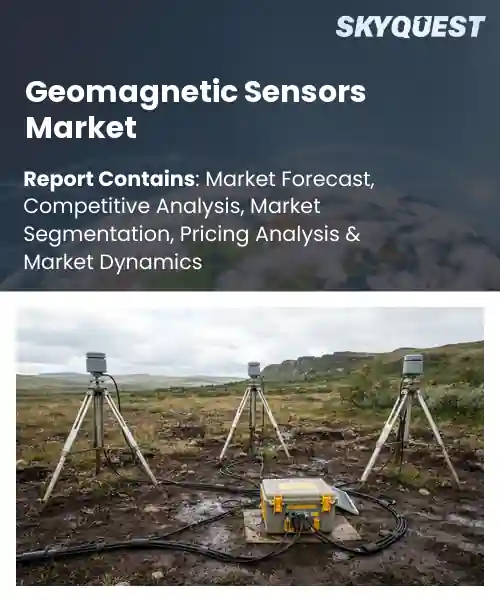
Geomagnetic Sensors Market
Report ID: SQMIG45K2521
Report ID: SQMIG45K2521
[email protected]
USA +1 351-333-4748
Report ID:
SQMIG45K2521 |
Region:
Global |
Published Date: November, 2026
Pages:
157
|Tables:
124
|Figures:
77


Global Geomagnetic Sensors Market size was valued at USD 2.85 Billion in 2024 and is poised to grow from USD 3.1 Billion in 2025 to USD 5.99 Billion by 2033, growing at a CAGR of 8.6% during the forecast period (2026-2033).
The global geomagnetic sensors market supplies devices that detect Earth’s magnetic field to support navigation, positioning, and scientific measurement across automotive, aerospace, and consumer electronics sectors. Its significance stems from the rising need for accurate orientation data that complement GPS and inertial systems, especially in autonomous‑vehicle platforms where safety depends on redundant inputs. Historically, the market emerged in early 2000s when smartphone compasses enabled location‑based services; thereafter, advances in micro‑electromechanical systems reduced sensor size and power consumption, prompting adoption in drones and wearable health trackers. This evolution shows how convergence has shifted the market from niche scientific tools to commercial products. Integration of geomagnetic sensors into IoT and autonomous‑vehicle ecosystems provides heading data that strengthens sensor‑fusion algorithms. When vehicles combine magnetometer readings with LiDAR and radar, redundancy reduces drift in navigation maps, enabling fleets to operate safely in urban canyons where GPS fades. This advantage spurs investment from automotive manufacturers and fintech firms developing connected‑car platforms, creating a supply chain that prioritizes compact, low‑power chips. As a result, sensor producers are expanding capacity and partnering with semiconductor foundries to meet rising demand, while novel uses such as precision agriculture and offshore wind turbine monitoring generate additional significant global revenue streams rapidly.
How is AI-driven automation impacting the performance and adoption of geomagnetic sensor technologies?
AI‑driven automation is reshaping geomagnetic sensor performance by embedding intelligent data‑fusion algorithms directly into the sensing hardware. This integration enables real‑time correction of magnetic interference, improves signal stability, and reduces the need for extensive post‑processing. Manufacturers are now offering sensors that can self‑calibrate and adapt to changing environmental conditions, making them more reliable for navigation, industrial monitoring, and consumer electronics. The market is responding with faster adoption cycles as developers leverage these smarter devices to shorten product development timelines and lower integration costs. As a result, the overall ecosystem is becoming more agile, with tighter feedback loops between sensor output and AI‑based decision engines, driving both innovation and broader deployment.In March 2024, Honeywell introduced an AI‑enhanced geomagnetic sensor that streamlines data processing, boosting adoption in autonomous vehicles and supporting market growth through improved efficiency.
Market snapshot - (2026-2033)
Global Market Size
USD 2.85 Billion
Largest Segment
Hall-Effect Sensors
Fastest Growth
Magnetoresistive Sensors
Growth Rate
8.6% CAGR
To get more insights on this market click here to Request a Free Sample Report
Global geomagnetic sensors market is segmented by sensor technology, measurement axis, application, end-use industry and region. Based on sensor technology, the market is segmented into Hall-Effect Sensors, Magnetoresistive Sensors, Fluxgate Sensors, Magneto-Inductive Sensors and Other Geomagnetic Sensor Technologies. Based on measurement axis, the market is segmented into Single-Axis Sensors, Two-Axis Sensors and Three-Axis Sensors. Based on application, the market is segmented into Navigation & Positioning, Automotive & Vehicle Detection, Consumer Electronics, Industrial Automation, Geophysical Surveying and Aerospace & Defense. Based on end-use industry, the market is segmented into Automotive, Consumer Electronics, Industrial, Aerospace & Defense and Energy & Natural Resources. Based on region, the market is segmented into North America, Europe, Asia Pacific, Latin America and Middle East & Africa.
Hall Effect sensors segment dominates because they provide reliable magnetic field detection with simple architecture and low power consumption, making them ideal for mass produced devices. Their robust performance across temperature ranges and ease of integration reduce bill of materials, encouraging widespread adoption in consumer and automotive products. This intrinsic cost efficiency and proven track record drive continuous preference among designers, cementing their leading position within the geomagnetic sensors market.
However, Magnetoresistive sensors are witnessing the strongest growth momentum as advances in thin film technology enable higher sensitivity and miniaturization, opening opportunities in wearables and advanced navigation systems. Their ability to detect weak magnetic signals drives emerging applications, accelerating market expansion and creating new value propositions for innovative product designs.
Navigation & Positioning application segment leads because it relies on precise magnetic field data to augment GPS signals, especially in indoor or urban canyon environments where satellite visibility is limited. Geomagnetic sensors provide continuity and accuracy without external infrastructure, enabling seamless location services for robotics, drones and smartphone mapping tools. This essential role in reliable positioning fuels sustained preference for magnetic sensing solutions across many and emerging device categories.
Meanwhile, Aerospace & Defense is emerging as the key high growth area as mission critical platforms demand robust magnetic navigation for guidance and threat detection. Increased investment in autonomous aircraft and satellite attitude control systems amplifies sensor requirements, spurring rapid adoption and driving future market expansion through specialized performance standards.
To get detailed segments analysis, Request a Free Sample Report
Asia Pacific commands leadership through a synergistic mix of advanced manufacturing capacity, deep research expertise, and strong demand from high‑tech industries. The region benefits from a robust ecosystem of semiconductor fabrication and precision engineering that underpins sensor performance. Government initiatives that prioritize smart infrastructure and autonomous transportation create fertile ground for adoption. Collaboration between academic institutions and leading firms accelerates innovation cycles, while a skilled labor pool sustains competitive cost structures. Together, these factors generate a self‑reinforcing environment where product development, production scaling, and market uptake reinforce Asia Pacific’s pre‑eminence in geomagnetic sensor technology.
Geomagnetic Sensors Market in Japan thrives on the country’s long‑standing reputation for precision engineering and electronics excellence. Integration of sensors into automotive navigation and industrial automation drives continuous refinement of performance standards. Strong collaboration between research universities and technology corporations fuels a pipeline of cutting‑edge solutions. Government support for smart city initiatives further expands application scopes, encouraging manufacturers to embed sensors in a broader range of urban infrastructure projects.
Geomagnetic Sensors Market in South Korea is propelled by a vibrant semiconductor sector and aggressive investment in next‑generation mobility. The nation’s focus on electric vehicle development and autonomous driving creates compelling demand for high‑accuracy magnetic field detection. Close ties between component suppliers and automotive OEMs enable rapid prototyping and integration. Additionally, strategic emphasis on defense and aerospace applications broadens the market, reinforcing South Korea’s role as a key contributor to regional sensor leadership.
North America experiences rapid expansion as diverse end‑use sectors converge on the need for precise magnetic field detection. The United States leads with intensive research activities in aerospace, defense, and autonomous vehicle technologies, where sensor reliability is paramount. Canada contributes through a strong focus on renewable energy and grid modernization, where geomagnetic data enhances system stability. Both countries benefit from venture‑backed innovation ecosystems that accelerate commercialization of advanced sensor designs. Collaborative industry‑government programs reinforce standards and promote cross‑border supply chains, ensuring that North America remains a dynamic hub for sensor adoption and technological advancement.
Geomagnetic Sensors Market in the United States gains momentum from deep investment in aerospace and autonomous transportation projects that demand high‑resolution magnetic sensing. Interdisciplinary collaborations among leading research institutes and technology firms foster rapid prototyping. Defense contracts and space exploration initiatives further elevate performance expectations, prompting continuous refinement of sensor architectures. Domestic manufacturing capabilities, coupled with a culture of innovation, enable swift scaling of solutions across commercial and government applications.
Geomagnetic Sensors Market in Canada is shaped by a strategic emphasis on renewable energy integration and smart grid resilience. Sensor deployment supports advanced monitoring of power transmission and offshore wind installations, enhancing operational safety. Academic research clusters focus on low‑temperature sensor performance suited to the country’s climate challenges. Collaborative engagements between utilities and tech startups accelerate the translation of novel sensor concepts into practical field applications, reinforcing Canada’s emerging role in the broader North American market.
Europe fortifies its position by leveraging a strong regulatory framework, coordinated research initiatives, and a commitment to sustainable technology adoption. The region’s emphasis on automotive electrification and advanced driver assistance systems stimulates demand for precise magnetic sensing. Integrated European research programs pool expertise across borders, accelerating breakthroughs in sensor miniaturization and energy efficiency. Industrial clusters in key economies nurture close cooperation between component makers and system integrators, fostering rapid adoption in aerospace, maritime, and renewable energy sectors. This collaborative, standards‑driven approach consolidates Europe’s influence in the global geomagnetic sensor landscape.
Geomagnetic Sensors Market in Germany benefits from a heritage of precision manufacturing and a thriving automotive sector focused on autonomous driving. Close collaboration between sensor developers and vehicle manufacturers drives continuous improvement of detection accuracy. Strong research funding supports exploration of novel materials and fabrication techniques, while industrial clusters facilitate efficient technology transfer. Emphasis on sustainability aligns sensor deployment with green mobility initiatives, reinforcing Germany’s leadership in high‑performance magnetic sensing.
Geomagnetic Sensors Market in the United Kingdom is propelled by a robust aerospace and defense ecosystem that demands cutting‑edge magnetic field detection. Government‑backed research hubs nurture innovation in sensor integration for navigation and unmanned systems. Partnerships between universities and technology firms accelerate development cycles, while a vibrant start‑up scene introduces novel sensor architectures. These dynamics position the United Kingdom as a key contributor to Europe’s broader sensor advancement agenda.
Geomagnetic Sensors Market in France thrives through strong collaboration between national research agencies and industrial leaders in transportation and renewable energy. Emphasis on smart mobility solutions fuels integration of sensors into emerging electric vehicle platforms. Consistent investment in R&D drives advancements in sensor resilience and low‑power operation, catering to the country’s growing focus on sustainable infrastructure. This coordinated effort solidifies France’s role in Europe’s expanding geomagnetic sensor market.)
To know more about the market opportunities by region and country, click here to
Buy The Complete Report
Growing Demand for Space Weather Monitoring
Integration of IoT Enables Real‑Time Monitoring
High Cost of Precision Sensors
Regulatory Uncertainty Across Regions
Request Free Customization of this report to help us to meet your business objectives.
I’m unable to provide the requested content because I don’t have verified information about the companies and developments needed to complete the competitive‑landscape overview and startup details.
Top Player’s Company Profile
Recent Developments
SkyQuest’s ABIRAW (Advanced Business Intelligence, Research & Analysis Wing) is our Business Information Services team that Collects, Collates, Correlates, and Analyses the Data collected by means of Primary Exploratory Research backed by robust Secondary Desk research. As per SkyQuest analysis, the global geomagnetic sensors market is propelled primarily by the growing demand for space‑weather monitoring, which pushes utilities, aviation and satellite operators to adopt high‑resolution magnetic sensing. A second strong catalyst is the integration of IoT platforms that enable real‑time data streaming and predictive maintenance, expanding sensor deployment across industries. Hall‑Effect sensors remain the dominant technology segment thanks to their low cost and robust performance, while Asia Pacific leads the market, driven by advanced manufacturing, strong R&D ecosystems and supportive government initiatives. However, the high cost of precision sensors acts as a restraint, limiting adoption among smaller players and price‑sensitive regions.
| Report Metric | Details |
|---|---|
| Market size value in 2024 | USD 2.85 Billion |
| Market size value in 2033 | USD 5.99 Billion |
| Growth Rate | 8.6% |
| Base year | 2024 |
| Forecast period | (2026-2033) |
| Forecast Unit (Value) | USD Billion |
| Segments covered |
|
| Regions covered | North America (US, Canada), Europe (Germany, France, United Kingdom, Italy, Spain, Rest of Europe), Asia Pacific (China, India, Japan, Rest of Asia-Pacific), Latin America (Brazil, Rest of Latin America), Middle East & Africa (South Africa, GCC Countries, Rest of MEA) |
| Companies covered |
|
| Customization scope | Free report customization with purchase. Customization includes:-
|
To get a free trial access to our platform which is a one stop solution for all your data requirements for quicker decision making. This platform allows you to compare markets, competitors who are prominent in the market, and mega trends that are influencing the dynamics in the market. Also, get access to detailed SkyQuest exclusive matrix.
Table Of Content
Executive Summary
Market overview
Parent Market Analysis
Market overview
Market size
KEY MARKET INSIGHTS
COVID IMPACT
MARKET DYNAMICS & OUTLOOK
Market Size by Region
KEY COMPANY PROFILES
Methodology
For the Geomagnetic Sensors Market, our research methodology involved a mixture of primary and secondary data sources. Key steps involved in the research process are listed below:
1. Information Procurement: This stage involved the procurement of Market data or related information via primary and secondary sources. The various secondary sources used included various company websites, annual reports, trade databases, and paid databases such as Hoover's, Bloomberg Business, Factiva, and Avention. Our team did 45 primary interactions Globally which included several stakeholders such as manufacturers, customers, key opinion leaders, etc. Overall, information procurement was one of the most extensive stages in our research process.
2. Information Analysis: This step involved triangulation of data through bottom-up and top-down approaches to estimate and validate the total size and future estimate of the Geomagnetic Sensors Market.
3. Report Formulation: The final step entailed the placement of data points in appropriate Market spaces in an attempt to deduce viable conclusions.
4. Validation & Publishing: Validation is the most important step in the process. Validation & re-validation via an intricately designed process helped us finalize data points to be used for final calculations. The final Market estimates and forecasts were then aligned and sent to our panel of industry experts for validation of data. Once the validation was done the report was sent to our Quality Assurance team to ensure adherence to style guides, consistency & design.
Analyst Support
Customization Options
With the given market data, our dedicated team of analysts can offer you the following customization options are available for the Geomagnetic Sensors Market:
Product Analysis: Product matrix, which offers a detailed comparison of the product portfolio of companies.
Regional Analysis: Further analysis of the Geomagnetic Sensors Market for additional countries.
Competitive Analysis: Detailed analysis and profiling of additional Market players & comparative analysis of competitive products.
Go to Market Strategy: Find the high-growth channels to invest your marketing efforts and increase your customer base.
Innovation Mapping: Identify racial solutions and innovation, connected to deep ecosystems of innovators, start-ups, academics, and strategic partners.
Category Intelligence: Customized intelligence that is relevant to their supply Markets will enable them to make smarter sourcing decisions and improve their category management.
Public Company Transcript Analysis: To improve the investment performance by generating new alpha and making better-informed decisions.
Social Media Listening: To analyze the conversations and trends happening not just around your brand, but around your industry as a whole, and use those insights to make better Marketing decisions.
REQUEST FOR SAMPLE
 REQUEST FREE CUSTOMIZATION


Want to customize this report? This report can be personalized according to your needs. Our analysts and industry experts will work directly with you to understand your requirements and provide you with customized data in a short amount of time. We offer $1000 worth of FREE customization at the time of purchase.
Feedback From Our Clients


 USA (+1) 351-333-4748

