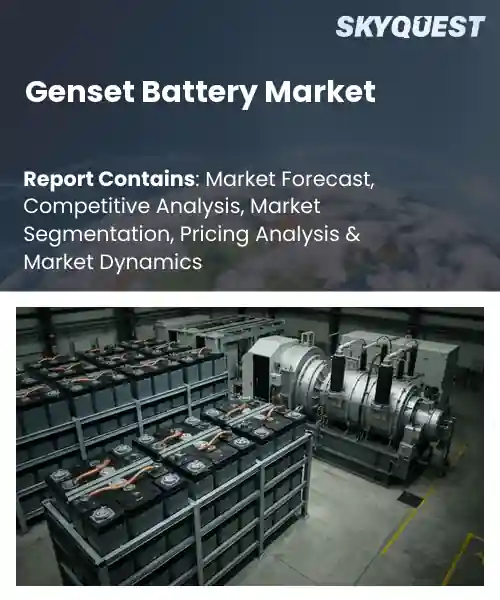
Genset Battery Market
Report ID: SQMIG20E2230
Report ID: SQMIG20E2230
[email protected]
USA +1 351-333-4748
Report ID:
SQMIG20E2230 |
Region:
Global |
Published Date: July, 2026
Pages:
157
|Tables:
118
|Figures:
77


Global Genset Battery Market size was valued at USD 16.25 Billion in 2024 and is poised to grow from USD 17.11 Billion in 2025 to USD 21.09 Billion by 2033, growing at a CAGR of 5.29% during the forecast period (2026-2033).
The increasing adoption of renewable energy sources is impacting changes in the genset battery market. Solar and wind power require operators to pair generators with storage to smooth out fluctuations and reduce fuel burn. Brazilian utilities, for instance, use hybrid systems in which lithium batteries store excess photovoltaic power and release it when clouds pass, enabling a smaller diesel engine to meet peak demand. This configuration reduces emissions, lowers operating costs and creates a demand for batteries that can cycle and are temperature resilient. This drives manufacturers to invest in chemistries and modular designs, opening export opportunities in markets lacking grid infrastructure.
The genset battery market provides rechargeable power units to support diesel or gas driven generators during start-up, load transitions and operation. Its importance lies in the need to supply an uninterrupted electricity supply to remote sites, centres and emergency services where the grid is not reliable. The market historically began in the 1990s with lead-acid cells and progressed to lithium-ion technology as density and maintenance demands escalated. Indian construction firms embraced lithium batteries to cut down on fuel consumption. In sub‑Saharan Africa, hospitals use them as backup during power outages. The evolution demonstrates how market growth has been fueled by reliability concerns and advances in chemistry.
How is AI-driven Predictive Maintenance Influencing The Genset Battery Market?
AI-based predictive maintenance is transforming the genset battery market by converting raw sensor data into actionable insights. Current generators embed temperature, voltage and load sensors that feed continuous streams into machine learning models. These models learn normal degradation patterns and raise an anomaly before a failure happens, so that operators can schedule service during planned downtimes. The result is more availability, longer battery life and less spare parts inventories.
Utilities and remote sites have fewer unplanned outages and manufacturers can differentiate their products with smarter, data-rich solutions. The move also drives closer integration of battery hardware with cloud platforms, opening new revenue streams around monitoring subscriptions. In August 2021, Cummins launched an AI-enabled battery health monitoring service that predicts when maintenance is needed and increases uptime, while also supporting market growth.
Market snapshot - (2026-2033)
Global Market Size
USD 16.25 Billion
Largest Segment
Lead Acid Batteries
Fastest Growth
Lithium Ion Batteries
Growth Rate
5.29% CAGR
To get more insights on this market click here to Request a Free Sample Report
Global genset battery market is segmented by battery type, capacity, application, end use industry and region. Based on battery type, the market is segmented into Lead Acid Batteries, Lithium Ion Batteries and Nickel Cadmium Batteries. Based on capacity, the market is segmented into Below 100 Ah, 100 to 200 Ah and Above 200 Ah. Based on application, the market is segmented into Residential, Commercial and Industrial. Based on end use industry, the market is segmented into Data Centers, Telecom Infrastructure, Healthcare Facilities and Construction. Based on region, the market is segmented into North America, Europe, Asia Pacific, Latin America and Middle East & Africa.
The lithium ion batteries segment is poised to lead the market on account of the provision of higher energy density, faster recharge and longer cycle life, in keeping with growing demand for compact and reliable backup power in modern genset installations. The light weight reduces the overall system weight and makes them easy to integrate in space constrained environments. Moreover, declining cell chemistry costs and growing confidence in safety features are pushing OEMs towards lithium solutions, further consolidating their market leadership.
However, the lead acid batteries segment is witnessing the highest growth momentum with infrastructure upgrades and cost focused projects spurring renewed interest. Utilities and industrial users have turned to them for large scale backup because their strong design, proven reliability and extensive recycling infrastructure keep total ownership costs low. This growth is helping to drive wider market expansion and create new retrofit opportunities.
The above 200 Ah capacity segment is significant because it addresses the increasing power requirements of high performance gensets utilized in critical facilities. It has a larger energy reserve, so it runs longer when there is a power outage, which reduces the need for fuel and limits interruptions to operation. Its capacity to support extended load profiles is in tune with industry trends towards more resilience, with system designers turning to high capacity modules for mission critical applications, and securing its market leadership.
Meanwhile, the below 100 Ah capacity segment is emerging as the key high-growth area with the growing portable and emergency backup applications. Its small form factor and lower upfront cost are attractive for residential and small business deployments where space and budget constraints dominate purchasing decisions. This demand is fueling innovation in lightweight designs, increasing the overall market reach and opening new use cases.
To get detailed segments analysis, Request a Free Sample Report
Asia Pacific is at the heart of a convergence of advanced manufacturing capabilities, deep engineering talent and a highly integrated supply chain that supports the rapid development of high-performance battery solutions. There is strong demand in the region for telecommunications, construction and renewable integration where reliable standby power is critical. Ongoing research and development investments develop new chemistries and smarter energy management systems. Collaborative ecosystems between OEMs, battery specialists and technology providers are driving time-to-market, while enabling regulatory frameworks are promoting the adoption of cleaner, more efficient power solutions across the region.
Japan’s Genset Battery market is driven by a culture of precision engineering and a need for highly reliable power in densely populated urban centers and advanced manufacturing hubs. The main focus for domestic manufacturers is on the quality of premium batteries and their integration with advanced control systems, such as those found in telecommunications and transport. The heavy focus on sustainability also means hybrid and fully battery-assisted generators are in widespread use, reinforcing Japan’s reputation for reliable power solutions.
The South Korean Genset Battery Market is fueled by a vibrant electronics industry and rapid industrial expansion that necessitate reliable backup power. Government incentives promote the development of next generation battery technologies, and local firms leverage expertise in high energy density cells to improve generator performance. Close ties with global OEMs and export orientation further consolidate South Korea’s position as a key supplier of advanced genset battery modules.
The North American market expands rapidly due to heightened focus on grid resilience, increasing reliance on critical infrastructure, and a shift toward cleaner energy solutions. Industries ranging from data centers to oil and gas seek dependable backup power that aligns with environmental expectations, prompting adoption of battery‑augmented generators. Policy frameworks encourage lower emissions and fuel efficiency, while private investment fuels innovation in hybrid systems and smart monitoring. The combination of robust demand, technological advancement, and sustainability commitments creates a fertile environment for sustained market growth.
Genset Battery Market in the United States is shaped by a vast industrial landscape and a strong emphasis on energy security for critical facilities. Utilities and private enterprises prioritize hybrid solutions that reduce fuel consumption and emissions. Ongoing advancements in battery management software enable real‑time optimization, while regulatory incentives support the transition toward lower‑carbon backup power, reinforcing the United States as a leading adopter of modern genset battery technologies.
Genset Battery Market in Canada reflects the country’s extensive remote communities and resource‑focused industries that demand reliable, low‑maintenance power sources. Emphasis on environmental stewardship drives interest in battery‑enhanced generators that lower diesel usage. Federal and provincial programs encourage clean energy integration, and the cold‑climate expertise of local manufacturers supports robust battery performance under challenging conditions, positioning Canada as an emerging hub for sustainable genset solutions.
Europe reinforces its market role by aligning genset battery development with stringent emissions standards and a continent‑wide commitment to decarbonization. Strong automotive battery expertise translates into high‑quality, recyclable battery modules for generators, while collaborative research initiatives across the EU accelerate technology convergence. Integration with renewable energy sources and smart grid concepts enables flexible, low‑emission backup power. Policy incentives and a focus on circular economy practices further encourage manufacturers to innovate sustainable, high‑efficiency genset battery offerings throughout the region.
Genset Battery Market in Germany leverages the nation’s renowned engineering prowess and deep automotive battery experience. Manufacturers prioritize high reliability and compatibility with renewable energy systems, catering to industrial plants and commercial facilities seeking low‑emission backup power. Strong research institutions and collaborative industry clusters drive continuous improvement in energy density and lifecycle management, reinforcing Germany’s leadership in advanced genset battery solutions.
Genset Battery Market in the United Kingdom benefits from a strategic focus on offshore wind and maritime sectors that require dependable auxiliary power. Emphasis on emissions reduction steers adoption toward battery‑assisted generators with smart monitoring capabilities. Academic‑industry partnerships foster innovation in modular battery designs, while regulatory frameworks support the transition to greener standby power for a broad range of commercial applications.
Genset Battery Market in France is shaped by a strong nuclear energy backdrop and a robust automotive supply chain that supplies high‑performance battery components. National policies encouraging energy transition stimulate interest in hybrid generator systems that lower fuel use and emissions. Research centers emphasize battery recyclability and integration with smart grid initiatives, positioning France as a key contributor to sustainable genset battery technologies.
To know more about the market opportunities by region and country, click here to
Buy The Complete Report
Increasing Renewable Energy Adoption
Growth of Remote Power Solutions
High Initial Capital Costs
Regulatory and Safety Concerns
Request Free Customization of this report to help us to meet your business objectives.
The competitive landscape is shaped by aggressive M&A activity, strategic partnerships with OEMs, and rapid tech innovation as firms race to deliver higher energy density, faster charging and longer cycle life for genset batteries, driving market differentiation and customer lock‑in. Recent examples include a high‑profile acquisition of a niche lithium‑iron‑phosphate supplier by a leading energy storage player and a joint venture between a battery startup and a major generator manufacturer to co‑develop modular battery packs for off‑grid applications.
SkyQuest’s ABIRAW (Advanced Business Intelligence, Research & Analysis Wing) is our Business Information Services team that Collects, Collates, Correlates, and Analyses the Data collected by means of Primary Exploratory Research backed by robust Secondary Desk research.
As per SkyQuest analysis the global genset battery market is being propelled primarily by the surge in renewable energy adoption, which drives operators to pair generators with lithium‑ion storage for smoother power delivery; a second strong catalyst is the expanding demand for remote and off‑grid solutions in mining, construction and telecom that require compact, high‑energy batteries. The market is led by the Asia Pacific region, where advanced manufacturing and supply‑chain depth give it a clear edge. Lithium‑ion batteries dominate the segment mix due to their high energy density and fast recharge. However, high upfront capital costs remain a significant restraint, tempering faster adoption across price‑sensitive customers.
| Report Metric | Details |
|---|---|
| Market size value in 2024 | USD 16.25 Billion |
| Market size value in 2033 | USD 21.09 Billion |
| Growth Rate | 5.29% |
| Base year | 2024 |
| Forecast period | (2026-2033) |
| Forecast Unit (Value) | USD Billion |
| Segments covered |
|
| Regions covered | North America (US, Canada), Europe (Germany, France, United Kingdom, Italy, Spain, Rest of Europe), Asia Pacific (China, India, Japan, Rest of Asia-Pacific), Latin America (Brazil, Rest of Latin America), Middle East & Africa (South Africa, GCC Countries, Rest of MEA) |
| Companies covered |
|
| Customization scope | Free report customization with purchase. Customization includes:-
|
To get a free trial access to our platform which is a one stop solution for all your data requirements for quicker decision making. This platform allows you to compare markets, competitors who are prominent in the market, and mega trends that are influencing the dynamics in the market. Also, get access to detailed SkyQuest exclusive matrix.
Table Of Content
Executive Summary
Market overview
Parent Market Analysis
Market overview
Market size
KEY MARKET INSIGHTS
COVID IMPACT
MARKET DYNAMICS & OUTLOOK
Market Size by Region
KEY COMPANY PROFILES
Methodology
For the Genset Battery Market, our research methodology involved a mixture of primary and secondary data sources. Key steps involved in the research process are listed below:
1. Information Procurement: This stage involved the procurement of Market data or related information via primary and secondary sources. The various secondary sources used included various company websites, annual reports, trade databases, and paid databases such as Hoover's, Bloomberg Business, Factiva, and Avention. Our team did 45 primary interactions Globally which included several stakeholders such as manufacturers, customers, key opinion leaders, etc. Overall, information procurement was one of the most extensive stages in our research process.
2. Information Analysis: This step involved triangulation of data through bottom-up and top-down approaches to estimate and validate the total size and future estimate of the Genset Battery Market.
3. Report Formulation: The final step entailed the placement of data points in appropriate Market spaces in an attempt to deduce viable conclusions.
4. Validation & Publishing: Validation is the most important step in the process. Validation & re-validation via an intricately designed process helped us finalize data points to be used for final calculations. The final Market estimates and forecasts were then aligned and sent to our panel of industry experts for validation of data. Once the validation was done the report was sent to our Quality Assurance team to ensure adherence to style guides, consistency & design.
Analyst Support
Customization Options
With the given market data, our dedicated team of analysts can offer you the following customization options are available for the Genset Battery Market:
Product Analysis: Product matrix, which offers a detailed comparison of the product portfolio of companies.
Regional Analysis: Further analysis of the Genset Battery Market for additional countries.
Competitive Analysis: Detailed analysis and profiling of additional Market players & comparative analysis of competitive products.
Go to Market Strategy: Find the high-growth channels to invest your marketing efforts and increase your customer base.
Innovation Mapping: Identify racial solutions and innovation, connected to deep ecosystems of innovators, start-ups, academics, and strategic partners.
Category Intelligence: Customized intelligence that is relevant to their supply Markets will enable them to make smarter sourcing decisions and improve their category management.
Public Company Transcript Analysis: To improve the investment performance by generating new alpha and making better-informed decisions.
Social Media Listening: To analyze the conversations and trends happening not just around your brand, but around your industry as a whole, and use those insights to make better Marketing decisions.
REQUEST FOR SAMPLE
 REQUEST FREE CUSTOMIZATION
Global Genset Battery Market size was valued at USD 16.25 Billion in 2024 and is poised to grow from USD 17.11 Billion in 2025 to USD 21.09 Billion by 2033, growing at a CAGR of 5.29% during the forecast period (2026-2033).
The competitive landscape is shaped by aggressive M&A activity, strategic partnerships with OEMs, and rapid tech innovation as firms race to deliver higher energy density, faster charging and longer cycle life for genset batteries, driving market differentiation and customer lock‑in. Recent examples include a high‑profile acquisition of a niche lithium‑iron‑phosphate supplier by a leading energy storage player and a joint venture between a battery startup and a major generator manufacturer to co‑develop modular battery packs for off‑grid applications. 'EnerSys Inc', 'Exide Industries Limited', 'HBL Power Systems Limited', 'GS Yuasa Corporation', 'East Penn Manufacturing Co', 'Leoch International Technology Limited', 'Amara Raja Batteries Limited', 'Generac Holdings Inc', 'Kohler Co', 'Cummins Inc', 'FIAMM Energy Technology SpA', 'Clarios LLC', 'Crown Battery Manufacturing Co', 'Discover Battery Manufacturing', 'Northstar Battery Company', 'Firefly Energy Inc', 'Saft Groupe SA', 'Panasonic Energy Co Ltd', 'C and D Technologies Inc', 'Trojan Battery Company'
Demand for reliable backup power in renewable installations is prompting operators to integrate genset batteries, as intermittent generation requires storage solutions that can quickly respond to fluctuations. This integration enhances grid stability and reduces reliance on fossil-fuel generators, encouraging broader acceptance of batteries in gensets. Consequently, manufacturers are expanding product portfolios to meet these evolving requirements, fostering innovation in battery chemistry and management systems, which in turn accelerates market expansion through improved performance and longer service life and reliability for industrial applications.
Hybrid Power Integration: The rise of hybrid power solutions is reshaping genset battery demand as manufacturers combine diesel generators with lithium‑ion modules to improve fuel efficiency and reduce emissions. Operators value the seamless transition between engine and battery power, enabling longer runtimes during peak loads while cutting operational costs. This approach also supports renewable energy tie‑ins, allowing facilities to store excess solar or wind generation for backup use, thereby extending the relevance of traditional gensets in a decarbonizing market and enhancing overall resilience.
Why does Asia Pacific Dominate the Global Genset Battery Market? |@12


Want to customize this report? This report can be personalized according to your needs. Our analysts and industry experts will work directly with you to understand your requirements and provide you with customized data in a short amount of time. We offer $1000 worth of FREE customization at the time of purchase.
Feedback From Our Clients


 USA (+1) 351-333-4748

