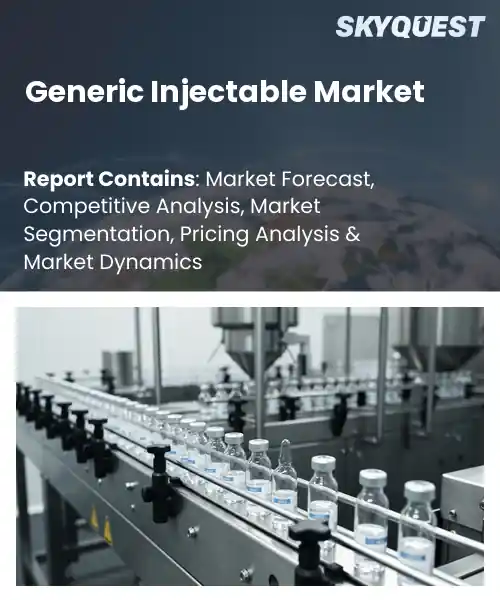
Generic Injectable Market
Report ID: SQMIG35I2660
Report ID: SQMIG35I2660
[email protected]
USA +1 351-333-4748
Report ID:
SQMIG35I2660 |
Region:
Global |
Published Date: May, 2026
Pages:
157
|Tables:
182
|Figures:
79


Global Generic Injectable Market size was valued at USD 145.80 Billion in 2024 and is poised to grow from USD 164.46 Billion in 2025 to USD 431.06 Billion by 2033, growing at a CAGR of 12.8% during the forecast period (2026-2033).
The generic injectable market trends are comprised of off patent injectable medications that are administered intravenously, intramuscularly or subcutaneously. These generic injectables are important because they provide the products necessary to support hospital formulary systems while lowering the cost of therapy for the health system. The primary factor driving the growth of this market is the increasing difference between the costs of branded biologics and the need for less expensive alternatives; consequently, this has resulted in increased investment by manufacturers to establish facilities capable of aseptic processing and to comply with regulatory guidelines. Over the years, there has been a transition from producing small volumes of sterile vials to more complicated multi dose sterile bags and biosimilar sterile injectable drugs as demonstrated by the increasing volume of generic oncology injectable products that have replaced branded chemotherapeutic agents and sterile injectable antibiotics in the intensive care unit (ICU). The evolution of this market has also seen significant consolidation among contract development and manufacturing organizations (CDMOs) and an increase in consumer quality expectations.
The global generic injectable market growth is being significantly affected by two main factors, scalable production capabilities, and regulatory harmonization. As manufacturers expand their aseptic production lines and regulatory authorities harmonize standards across geographical borders, product supply will stabilize, and prices will become predictable. Therefore, hospitals will have a more reliable source of supply for generics during times of shortages and payers will be able to utilize value-based contracting models to encourage greater investment into complex generic products, such as oncology injectables or antibiotics. For example, during the COVID-19 pandemic, many contract development and manufacturing organizations (CDMOs) that had invested in single-use technologies were able to successfully obtain contracts due to the higher demand for these products; thus, demonstrating how upgrades in production capacity lead to opening new markets in lower-income countries and establishing new biosimilar markets.
How is AI Improving Manufacturing Quality Control in the Generic Injectable Market?
The generic injectable market has benefited from the use of AI to increase the reliability of quality control by supporting automated visual inspections, providing real-time visibility into processes and predicting when processes will deviate from established norms. Noteworthy examples of how AI can assist with these tasks include the use of machine vision to identify particulate contamination and container defects, continuous monitoring of filling, finishing and sterilisation processes, and the ability to integrate data from laboratory and quality management systems allowing for traceable and auditable decisions. The introduction of more stringent sterility requirements and a need to maintain a dependable supply of medicine has resulted in manufacturers rapidly adopting the use of AI. Examples from the real world include using AI to replace manual inspections and deploying AI models to detect and alert engineers of anomalies in the manufacturing process before batches are released which result in improved product consistency and decreased costs associated with product recalls.
On January 2026, Katalyze AI announced the introduction of Katalyst, an artificial intelligence (AI) agent designed for pharmaceutical manufacturing. Katalyst provides always-on monitoring and audit-ready insight to identify potential process issues early, resulting in accelerated root cause analysis and higher yields and more reliable supplies of generic injectables.
Market snapshot - (2026-2033)
Global Market Size
USD 145.8 Billion
Largest Segment
Small Molecule Injectables
Fastest Growth
Large Molecule Injectables
Growth Rate
12.8% CAGR
To get more insights on this market click here to Request a Free Sample Report
Global generic injectable market is segmented by product type, container type, administration route, application, distribution channel, end user and region. Based on product type, the market is segmented into large molecule injectables and small molecule injectables. Based on container type, the market is segmented into vials, ampoules, prefilled syringes, cartridges, IV bags and others. Based on administration route, the market is segmented into intravenous (IV), intramuscular (IM), subcutaneous (SC), intradermal and others. Based on application, the market is segmented into oncology, infectious diseases, diabetes, cardiovascular diseases, autoimmune diseases, hormonal disorders, pain & anaesthesia and others. Based on distribution channel, the market is segmented into hospital pharmacies, retail pharmacies, online pharmacies and specialty pharmacies. Based on end user, the market is segmented into hospitals, clinics, ambulatory surgical centers and home care settings. Based on region, the market is segmented into North America, Europe, Asia Pacific, Latin America, and Middle East & Africa.
The vials segment is the largest component of the market because vials are compatible with many different formulations and are, therefore, considered the default container for generic injectable products. Vials also help to simplify inventory and manufacturing strategies by enabling lyophilized powders and single/multi dose formulations. The established regulatory processes of filling vials also help to facilitate the commercialization of generic injectables. Therefore, hospitals and contract manufacturers have a significant preference to purchase vials which solidifies the vial as the foundation of the generic injectable supply chain.
At the same time, prefilled syringes are emerging as the fastest-growing container type within the generic injectable category. This is primarily due to the rapid growth in demand for convenience, accuracy of dosing, and reducing the potential for contamination when manually disposing of used syringes. Inclining with self administration and biologic therapies, as well as technological innovations in safety features and working with device partners have created new differentiation and commercialization opportunities for generic injectable products.
The trajectory that facilitate the use of injectable medications for chronic therapy and the ability to self-administer these medications at home rather than in a hospital setting, there is a new commercial potential for generic injectables by expanding usage outside of hospitals with the subcutaneous route in general. Because of compatibility issues with the large molecule biologics and the availability of long-acting formulations that enhance patient compliance and reduce healthcare utilization, manufacturers are concentrating their formulation efforts toward the subcutaneous route of delivery.
Currently, intramuscular (IM) administration is the fastest growing segment of the injectable market largely due to renewed increases in the demand for vaccines and the growth of the use of long-acting depot therapies. As a result of the ongoing development of sustained-release formulations and continued momentum from regulators supporting the use of sustained-release products, the indications for IM administration are increasing, leading to the development of new generic IM products that will be used primarily for delivery to outpatient and community care settings and creating new opportunities for IM generics.
To get detailed segments analysis, Request a Free Sample Report
North America plays a significant role in the global generic injectable supply chain because of a combination of structural factors that increase the likelihood of reliable supply and a fast integration of products into commercial markets. Existing regulatory pathways for generics and experienced procurement methods enhance the speed at which generics enter the market and the volume in which they populate hospitals and clinics. Advanced manufacturing capabilities, contract manufacturing, and the ability to produce both consistently and at high volumes further support the reliability, consistency, and volume of products. The density of integrated health systems (IHS) and well-established payer systems for reimbursement provide a reliable basis for predicting future generics demand and allow reimbursement clarity for generics. Ongoing investments by the industry into product portfolio diversification and lifecycle management add to the availability and affordability of generic products. Collaborations between local companies and global suppliers also help to develop the reach of distribution and use of generic injectables. Collectively, these attributes build and sustain a reliable and resilient ecosystem which supports the leading position of North America in manufacturing, commercializing, and innovating in the generic injectable segment.
The market for generic injectable products in the United States has numerous advantages thanks to clinical demand, extensive hospital systems and a detailed distribution network that allows for the efficient setup and delivery of injectable generic drugs. Established contract manufacturers, along with high levels of quality compliance ensure consistent supply of these products. The existing payer interactions and procurement channels facilitate the use of injectable generic drugs in both acute-care and outpatient settings. The collaboration between innovators and generic manufacturers helps facilitate both therapeutic access and the enhancement of portfolios that meet the needs of institutions while increasing cost-effective access to these products.
Generic injectable market outlook in Canada is driven by integrated provincial procurement systems ensuring high quality, and maintaining supplier engagement. Regional buying groups and coordinated health systems align supply and demand signals, which improves the efficiency of the integration of generic injectables into hospital and clinic operations. Domestic manufacturing and its alliance partners provide for the continuity of supply, while the provincial policies designed to support cost containment and patient access to therapeutics promote competitive bidding, creating the necessity for manufacturers to continue maintaining a wide range of generic injectable products that meet local clinical guidelines.
The generic injectable market in Europe is rapidly expanding due to coordinated regulatory harmonization between jurisdictions, an increased focus on cost-effective therapies and developed procurement strategies that provide value to health systems. The speed of uptake, as well as the prevalence of demand, is also increased as a result of centralized tendering and collaborative purchasing arrangements among health care providers, which help create stable demand for established suppliers of generic injectables. Investments in manufacturing capacity and quality infrastructure on a regional level reduce the degree to which supply chains are dependent on distant sources and therefore enhance resilience. A number of other market dynamics are impacting the growth of the generic injectable market, including manufacturers actively participating in lifecycle management of their products, as well as an increasing clinical acceptance of generic injectables among hospital protocols. The combination of all of these factors leads to rapid penetration of generics into new markets, the availability of a diverse product selection, and an increase in clinicians' and payers' confidence in the safety and effectiveness of generic injectables. By aligning policies and collaborating across borders, the generic injectable market is likely to achieve long-term stability.
Generic injectable market forecast in Germany established industrial foundation, having well-defined regulations regarding the production and distribution of injectable products, and having a robust network of hospitals to purchase product(s) from, the marketplace for generic injectable products will continue to be stable. The knowledge gained from years of operating in the area of complex sterile manufacturing combined with the existence of extensive quality control procedures has led to a high level of confidence among suppliers. Furthermore, close collaboration between manufacturer, clinician, and payer will facilitate the continued use of therapeutic substitution with regard to injection-created products. Additionally, public procurement policies and focus on supply security will continue to promote diversified supply chains and have contributed to the sustained availability of generic injectable products within the health care delivery system.
Generic injectable market regional outlook in United Kingdom, generic injectables is experiencing rapid growth thanks to flexible purchasing methods and strong collaboration between hospitals and suppliers/manufacturers which facilitates the adoption of generic injectables in hospitals. The innovative approaches taken by many organisations to provide services and the willingness to be involved in trials of alternative sourcing mechanisms are helping the integration of generic injectables into the hospital formulary of hospitals in the UK. The establishment of strong clinical networks and the provision of national guidance/standards around therapeutic substitution has given clinicians the confidence to utilise therapeutic substitution. Furthermore, policy initiatives that promote affordability/equitable access and continued supply of generic injectables allow the generic injectable market in the UK to respond quickly and therefore make entry into this sector attractive to new entrants.
Generic injectable market regional forecast in France is developing through policy measures and purchasing methods used by hospitals to increase the use of generic injectables. Attention being paid to domestic manufacturers regarding capacity as well as ability to comply with regulations also helps provide more suppliers who will participate in this market. Formularies of regional healthcare authorities and clinical facilities have aligned more closely to promote using therapeutic alternatives when clinically appropriate. The use of cost-effective drugs such as generic injectables within the framework of public health systems through cooperative collaboration between manufacturers and healthcare providers contributes to expanding availability and confidence in the use of generic injectables.
There are several initiatives being taken by the Asia Pacific region to strengthen their positions in the generic injectable market by expanding their sterilized manufacturing capabilities and developing quality controls to enhance the development of local production and supply chain alternatives. National policies that encourage building domestic capability exist throughout the region, such as establishing partnerships with well-known international generic injectable manufacturers that establish technology transfer and regulatory compliance. Procurement activities will significantly increase as hospitals in the area continue to expand and there is wider acceptance among clinicians of generic injectables. Additionally, manufacturers in the Asia Pacific region will be able to export more widely and integrate into global supply chains due to their increased ability to meet international standards for quality. As a result, the increased demand by governments to provide assistance to these entities through targeted commercial plans focused on reliability and cost consideration will be greater. Finally, continual cooperation with international regulatory bodies and developing workforce training programs will help to build a compliance culture and develop aseptic manufacturing capabilities in each country.
Generic injectable market penetration in Japan has further stimulated the domestic manufacture of pharmaceuticals that ensure high quality sterile production. Clinical centers of hospitals would rather manufacture for proved safety and stability, and hence manufacturers are to comply with such stringent requirements. Partnership with international firms leads to the technology transfer and enhancement of capacity. Governmentally endorsed increased acceptance and provision of injectable generics among clinical practice continues through efficient procurement policy and initiatives aimed at widening the range of available therapeutic choices.
Generic injectable industry in South Korea is advancing through investment in sterile manufacturing plants and the focus of regulation toward international alignment with quality standards. Collaborations between domestic manufacturers and international partners augment capacity building and technology transfer. Hospital procurement practices and distribution channels are increasingly oriented toward secure sourcing and availability of products. Competitiveness and supply security policies are consolidating the manufacturers' commitment to the expansion of their injectable portfolios and stability in clinical supply overall.
To know more about the market opportunities by region and country, click here to
Buy The Complete Report
Growing Demand For Affordable Therapies
Expanding Hospital and Clinic Adoption
Complex Regulatory Approval and Compliance
Supply Chain Vulnerabilities and Dependence
Request Free Customization of this report to help us to meet your business objectives.
The global generic injectable market is experiencing changes through consolidation, the reshoring of supply chains, as well as the capture of additional capacity by all companies involved in providing these products via mergers and acquisitions, strategic alliances, and differentiation in terms of delivery method. A couple of examples are Hikma's acquisition of a portion of Xellia to increase its injectable production capabilities in the United States; and the collaboration between Fresenius Kabi and Phlow to create new partnerships with hospitals by providing ready-to-use prefilled syringes, which will help address the shortage of hospital-based injectable drugs.
Top Player’s Company Profile
Recent Developments in the Generic Injectable Market
SkyQuest’s ABIRAW (Advanced Business Intelligence, Research & Analysis Wing) is our Business Information Services team that Collects, Collates, Correlates, and Analyses the Data collected by means of Primary Exploratory Research backed by robust Secondary Desk research.
As per SkyQuest analysis, the worldwide market for generic injectable drugs is likely to continue a strong growth trajectory, with rising pressure to reduce costs, continued evolution of the manufacturing process, and increased demand for less expensive therapies, lead to the emergence of more generic alternatives to brand-name biologics. Additionally, increased manufacturing capability and the improved harmonization of regulations are driving the implementation of complex generics as they become available to improve the reliability of products by greatly reducing the amount of time it takes to get a new product onto the market. Ultimately, the primary geolocation for this sector will be North America because of the infrastructure for procurement and quality, and for supply chain support for this sector, and the primary delivery method will be by vials because of versatility in that form and established filling line capabilities.
| Report Metric | Details |
|---|---|
| Market size value in 2024 | USD 145.8 Billion |
| Market size value in 2033 | USD 431.06 Billion |
| Growth Rate | 12.8% |
| Base year | 2024 |
| Forecast period | (2026-2033) |
| Forecast Unit (Value) | USD Billion |
| Segments covered |
|
| Regions covered | North America (US, Canada), Europe (Germany, France, United Kingdom, Italy, Spain, Rest of Europe), Asia Pacific (China, India, Japan, Rest of Asia-Pacific), Latin America (Brazil, Rest of Latin America), Middle East & Africa (South Africa, GCC Countries, Rest of MEA) |
| Companies covered |
|
| Customization scope | Free report customization with purchase. Customization includes:-
|
To get a free trial access to our platform which is a one stop solution for all your data requirements for quicker decision making. This platform allows you to compare markets, competitors who are prominent in the market, and mega trends that are influencing the dynamics in the market. Also, get access to detailed SkyQuest exclusive matrix.
Table Of Content
Executive Summary
Market overview
Parent Market Analysis
Market overview
Market size
KEY MARKET INSIGHTS
COVID IMPACT
MARKET DYNAMICS & OUTLOOK
Market Size by Region
KEY COMPANY PROFILES
Methodology
For the Generic Injectable Market, our research methodology involved a mixture of primary and secondary data sources. Key steps involved in the research process are listed below:
1. Information Procurement: This stage involved the procurement of Market data or related information via primary and secondary sources. The various secondary sources used included various company websites, annual reports, trade databases, and paid databases such as Hoover's, Bloomberg Business, Factiva, and Avention. Our team did 45 primary interactions Globally which included several stakeholders such as manufacturers, customers, key opinion leaders, etc. Overall, information procurement was one of the most extensive stages in our research process.
2. Information Analysis: This step involved triangulation of data through bottom-up and top-down approaches to estimate and validate the total size and future estimate of the Generic Injectable Market.
3. Report Formulation: The final step entailed the placement of data points in appropriate Market spaces in an attempt to deduce viable conclusions.
4. Validation & Publishing: Validation is the most important step in the process. Validation & re-validation via an intricately designed process helped us finalize data points to be used for final calculations. The final Market estimates and forecasts were then aligned and sent to our panel of industry experts for validation of data. Once the validation was done the report was sent to our Quality Assurance team to ensure adherence to style guides, consistency & design.
Analyst Support
Customization Options
With the given market data, our dedicated team of analysts can offer you the following customization options are available for the Generic Injectable Market:
Product Analysis: Product matrix, which offers a detailed comparison of the product portfolio of companies.
Regional Analysis: Further analysis of the Generic Injectable Market for additional countries.
Competitive Analysis: Detailed analysis and profiling of additional Market players & comparative analysis of competitive products.
Go to Market Strategy: Find the high-growth channels to invest your marketing efforts and increase your customer base.
Innovation Mapping: Identify racial solutions and innovation, connected to deep ecosystems of innovators, start-ups, academics, and strategic partners.
Category Intelligence: Customized intelligence that is relevant to their supply Markets will enable them to make smarter sourcing decisions and improve their category management.
Public Company Transcript Analysis: To improve the investment performance by generating new alpha and making better-informed decisions.
Social Media Listening: To analyze the conversations and trends happening not just around your brand, but around your industry as a whole, and use those insights to make better Marketing decisions.
REQUEST FOR SAMPLE
 REQUEST FREE CUSTOMIZATION
Global Generic Injectable Market size was valued at USD 145.8 Billion in 2024 and is poised to grow from USD 164.46 Billion in 2025 to USD 431.06 Billion by 2033, growing at a CAGR of 12.8% during the forecast period (2026-2033).
Competitive dynamics in the global generic injectable market are shaped by consolidation, supply chain reshoring and capacity capture as firms pursue M&A, strategic partnerships and delivery differentiation. Examples include Hikma’s acquisition of parts of Xellia to boost US injectables capacity and partnerships such as Fresenius Kabi’s collaboration with Phlow and launches of ready to administer prefilled syringe presentations to secure hospital contracts and reduce shortages. 'Pfizer', 'Novartis', 'Fresenius Kabi', 'Hikma Pharmaceuticals', 'Sandoz', 'Teva Pharmaceutical Industries', 'Mylan', 'Sun Pharmaceutical Industries', 'Cipla', 'Dr. Reddy’s Laboratories', 'Aurobindo Pharma', 'Zydus Lifesciences', 'Lupin', 'Amneal Pharmaceuticals', 'Gland Pharma', 'Baxter International', 'B. Braun Melsungen', 'AdvaCare Pharma', 'Aenova Group', 'SGPharma'
Advancements in manufacturing processes and economies of scale have reduced production complexity and lowered cost structures, enabling manufacturers to offer injectable generics at more accessible price points. This wider availability encourages healthcare providers and payers to favor cost-effective therapeutic alternatives, increasing prescription uptake and hospital procurement. Confidence in consistent quality and improved supply reliability further supports substitution of branded injectables. Collectively, these factors enhance market penetration and create favorable conditions for sustained growth in demand for generic injectable therapies across diverse healthcare settings.
Portfolio Diversification Strategy: Manufacturers are broadening portfolios beyond commoditized sterile doses to include complex sterile formulations, specialty hospital injectables and niche therapeutic areas. This shift emphasizes patient centric dosing, differentiated delivery formats and collaboration with clinicians to address unmet needs. Companies prioritize pipeline diversification to reduce reliance on single product revenues, capturing higher margin hospital segments. Strategic partnerships and targeted in licensing enable faster entry into specialty injectables while preserving core generics capabilities, fostering resilience, sustained commercial growth and improving long term competitiveness.
Why does North America Dominate the Global Generic Injectable Market? |@12


Want to customize this report? This report can be personalized according to your needs. Our analysts and industry experts will work directly with you to understand your requirements and provide you with customized data in a short amount of time. We offer $1000 worth of FREE customization at the time of purchase.
Feedback From Our Clients


 USA (+1) 351-333-4748

