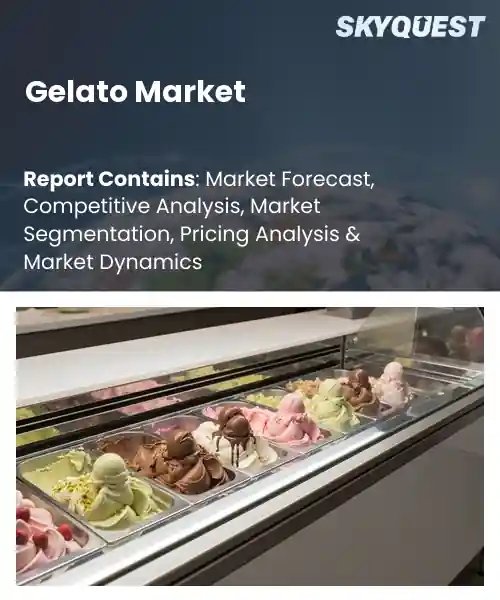
Gelato Market
Report ID: SQMIG30I2924
Report ID: SQMIG30I2924
[email protected]
USA +1 351-333-4748
Report ID:
SQMIG30I2924 |
Region:
Global |
Published Date: June, 2026
Pages:
157
|Tables:
150
|Figures:
78


Global Gelato Market size was valued at USD 15.8 Billion in 2024 and is poised to grow from USD 16.8 Billion in 2025 to USD 27.38 Billion by 2033, growing at a CAGR of 6.3% during the forecast period (2026-2033).
The primary driver of the gelato market is the global consumer shift toward premium, authentic and experiential frozen desserts. Gelato is an ice cream, or Italian style ice cream, that is known for having a lower amount of air plus having a higher temperature for serving. This means that different types of ice creams will be in the middle of gelato; hence gelato has appeal as both types of ice cream have different characteristics. Gelato has developed from a class category of gelatarias as local Italian gelato to an international retail class of brands and a class of artisanal brands, such as Grom and Talenti, made possible through technology improvements in refrigeration and improvements in trade overall.
A key trend driving global gelato sector expansion is the combination of improved cold chain logistics and targeted product innovation, which together alter distribution economics and consumer access. As the reliability of refrigerated transportation and packaging improved, gelato transitioned from stores, to shops, and subsequently into grocery stores. As health conscious consumers began demanding lower sugar and dairy free versions of the product, opportunities opened up for brands to provide a wider variety of products in these categories and expand their markets with respect to vegan and healthy food. These changes in consumer behaviour will create additional opportunities for both private label products, partnerships with foodservice operators, and tourism related specialty retail pop up stores, thereby significantly increasing market penetration.
How is AI Improving Supply Chain Efficiency in the Gelato Market?
The gelato supply chain can be enhanced through better demand prediction inventory control cold storage and transportation due to AI. Some important components of this process are prediction of demand to dictate how to produce gelato in smaller quantities and machine learning that helps determine when to put order for new products for freshness. The temperature of products in transit and storage is monitored continuously with real-time data collection and allows anomalies in temperature to be detected. The current state sees artisanal makers and larger brands adopting analytics to handle seasonal peaks and multi channel distribution to cafes retailers and delivery. Practical instances include AI driven production planning and logistics platforms that optimize refrigerated routing and warehouse operation.
In December 2025, Casa Optima announced supply and operations leadership changes aimed at making the supply chain more integrated and predictive which points toward AI enabled planning that can reduce waste improve responsiveness and support growth in the artisanal gelato segment.
Market snapshot - (2026-2033)
Global Market Size
USD 15.8 Billion
Largest Segment
Chocolate
Fastest Growth
Fruit-Based Flavors
Growth Rate
6.3% CAGR
To get more insights on this market click here to Request a Free Sample Report
Global gelato market is segmented by flavor type, product type, distribution channel, packaging type, end user and region. Based on flavor type, the market is segmented into Chocolate, Vanilla, Fruit-Based Flavors, Nut-Based Flavors and Others. Based on product type, the market is segmented into Dairy Gelato, Plant-Based Gelato, Sugar-Free Gelato and Others. Based on distribution channel, the market is segmented into Gelaterias & Specialty Stores, Supermarkets & Hypermarkets, Convenience Stores, Online Retail and Others. Based on packaging type, the market is segmented into Cups & Tubs, Cones, Sticks & Bars and Others. Based on end user, the market is segmented into Household Consumers, Foodservice & Hospitality and Others. Based on region, the market is segmented into North America, Europe, Asia Pacific, Latin America and Middle East & Africa.
Based on the global gelato market growth, chocolate segment dominates because chocolate flavors deliver broad consumer appeal through deep indulgence and versatile pairing options, driving consistent demand across premium and everyday gelato offerings. Its inherent richness supports desirable creaminess and sensory depth, encouraging product developers to feature complex inclusions and artisanal techniques. Retailers and gelaterias preferentially choose to manufacture chocolates over other flavors due to the strong sensory appeal of chocolates as a flavor and texture. This, in turn, leads them to continue large-scale manufacturing and have them visible on their shelves with new investments in the development of their chocolate flavors.
However, fruit based flavors are rapidly expanding, driven by consumer demand for refreshing, perceived healthier options and clean label ingredients. Their adaptability to seasonal sourcing and natural fruit inclusions fuels product differentiation, prompting manufacturers to innovate with sorbet hybrids, reduced fat recipes and novel fruit blends that broaden occasions and attract consumers.
Dairy gelato segment dominates because traditional milk and cream based formulations deliver the texture, mouthfeel and flavor foundation consumers expect from authentic gelato, supporting both artisanal and industrial production models. Supply chains established for dairy ingredients reduce risk during formulation while simplifying scaling up, thus encouraging retailers and foodservice operators to keep a wide variety of dairy products available. This encourages investment to develop flavors, process dairy ingredients and provide distribution networks throughout the industry.
However, plant based gelato is the most rapidly expanding area, propelled by demand for vegan and lactose free options and advances in plant proteins and stabilizers that closely replicate classic gelato creaminess. This innovation enables broader retail placement and new product formats, encouraging R and D investment and opening opportunities in health focused and ethically driven consumer groups.
To get detailed segments analysis, Request a Free Sample Report
As per the global gelato market share, Europe dominates the industry due to a confluence of cultural heritage, culinary expertise, and mature distribution frameworks that prioritize artisanal quality and innovation. A long history of creating frozen desserts results in a customer appreciation for texture, true-to-nature tastes, and all-natural ingredients while there are many coffee shops and gelato shops in each region contributing to a steady demand for Gelato products and regional visibility. Most regions have established supply chains that provide ready access to high-quality dairy and premium ingredients, which enables companies to create differentiation on their products resulting in premium positioning. Fine culinary schools and artisans continue to refine and experiment with new products, while tourism adds to the number of people who experience regional specialties. Increased emphasis on food safety and labeling by regulators builds consumer confidence and encourages premiumization of Gelato.
Gelato market in Germany benefits from strong premium dessert traditions and consumer demand for authentic texture and ingredient provenance. Artisanal gelaterias and branded concepts can access urban gourmet districts and specialty shops as distribution channels. Efforts to support traditional patisserie practices through culinary entrepreneurs working together promote innovation while providing assurance about food quality and safety through high-quality sourcing and a commitment to high food safety standards for those products.
Gelato market in United Kingdom is influenced by vibrant urban food culture and a strong café scene that favors premium frozen desserts. Multicultural eating creates new ways to experiment with flavor combinations. Additionally, restaurants and festivals that promote multicultural restaurant visibility help support the ability to consume food in an experiential way. With improved cold chain logistics offering consistent quality at each of these retail locations, retail channels and branded concepts are also creating new opportunities to reach customers outside of the typical artisanal storefronts.
Gelato market in France draws on rich culinary tradition and a refined dessert culture that places emphasis on texture and ingredient provenance. There are a few different ways that artisanal gelato is influenced by patisserie technique; therefore, artisanal gelato produced in boutique gelaterias and those that collaborate with patisseries offer premium-quality products for their consumers. Through high visitor numbers and a flourishing cafe culture, tourists gain access to regional specialty foods; culinary education nurtures and promotes the skills of artisans producing these foods.
Based on global gelato regional forecast, rapid expansion of the industry in North America reflects a convergence of evolving consumer tastes, expanding retail channels, and strategic brand investment. Customers are looking for higher-quality frozen dessert products that have transparency in their ingredient sourcing and also offer varied flavor profiles. As manufacturers continue to create healthier versions of frozen desserts that use plant-based ingredients, their market reach will broaden as well. The growth of this industry is driven by a combination of gelataria stores, coffee shops that offer gelato, and large grocery retailers who will offer gelato to customers in all areas of the country. Also, the growth of franchise opportunities and premium grocery retailers will help all gelato vendors have a large presence either via large grocery retailers or via stand-alone gelataria/coffee shop retailers. The successful distribution of frozen desserts will rely on an efficient cold chain process and food services partnerships across regions.
Gelato market in United States benefits from a broad consumer appetite for premium and experiential desserts, driven by urban dining scenes and foodservice channels. The expansion will also result in consumer awareness of ice cream products through social media, food festivals, and the emerging popularity of healthy/plant-based Ice Cream products. The growth of franchises, as well as more efficient methods for transporting products through logistics, also create more opportunity for Ice Cream products to be available in more markets.
Gelato market in Canada reflects multicultural culinary influences and emphasis on ingredient quality and sourcing. Demand for artisanal and premium product lines is fueled by urban centres or resort destinations as they are able to influence the offerings available in the retail outlet due to their greater availability. A commitment to the development of cold chain facilities and food safety practices will result in the establishment of standardised quality of products for each respective region.
As per global gelato regional outlook, Asia Pacific is strengthening its position in the gelato market by blending international artisanal techniques with local flavor traditions and rapidly improving distribution infrastructure. As cities grow larger and modern grocery stores become more widespread, people are more frequently exposed to high-quality frozen desserts. People in the younger generation, who enjoy eating out for the experience, are creating demand for high-end ice cream shops and new ways of making ice cream. New entrants into this market are changing their recipes to fit what the people in their area like to eat and to use local ingredients and flavors. These companies are also investing in the transportation of their ice cream to supermarkets and other outlets so that their products can be sold consistently all over the world. By collaborating with companies outside of their home country, these companies are able to share their experiences with ice cream with others and by using the Internet, people are now able to learn about different brands and find ways to purchase them through their homes.
Gelato market in Japan reflects a refined consumer palate and appreciation for seasonal and regional ingredients. Premium positioning and artisanal experimentation are driven by consumer expectations regarding the texture and presentation of gelato. In collaboration with other artisans, such as those involved in patisserie and tea preparation, gelato makers can create new and unique flavor combinations. The presence of gelato in urban mixed-use venues and through retail channels provides opportunities for increased visibility and diverse sales channels. Effective supply chain logistics provide consistent product quality and assurance across geographic regions.
Gelato market in South Korea is propelled by trend-driven food culture and a vibrant cafe scene that celebrates novel flavors and presentation. Custome-oriented consumers are looking for unique gelato options that use a variety of flavors through global gelato techniques with local ingredients while collaborations with established brands help create brand recognition for gelato shops all over the world. Consumers can also find gelato at retail locations through digital platforms. The gelato segment embraces a contemporary aesthetic through innovative design while continually seeking to develop new gelato flavors.
To know more about the market opportunities by region and country, click here to
Buy The Complete Report
Premiumization and Artisanal Demand
Expansion Of Distribution Channels
Seasonality Of Demand
Stringent Regulatory and Compliance Requirements
Request Free Customization of this report to help us to meet your business objectives.
Competitive pressure in the global gelato market outlook is intensifying as challengers exploit plant based formulation and rapid scale strategies, prompting incumbents to pursue acquisitions, retail partnerships and product engineering. In 2023 Next Gen Foods bought London-based plant-based gelato maker Mwah and newer, smaller innovators received initial funding to produce sugar-reduced recipes growing competition around formulation and execution of distribution models.
Top Player’s Company Profile
Recent Developments
SkyQuest’s ABIRAW (Advanced Business Intelligence, Research & Analysis Wing) is our Business Information Services team that Collects, Collates, Correlates, and Analyses the Data collected by means of Primary Exploratory Research backed by robust Secondary Desk research.
As per SkyQuest analysis, the global gelato industry is buoyed primarily by a consumer shift toward premium, authentic and experiential frozen desserts which supports higher margins and artisanal positioning, while seasonality of demand remains a key restraint that complicates production and inventory planning. Europe continues to dominate the market thanks to cultural heritage and mature distribution, and Dairy Gelato remains the leading product segment due to its texture and established supply chains. Strengthening cold chain logistics and targeted product innovation act as a second major driver by enabling supermarket rollouts, plant based extensions and consistent quality across channels, creating opportunities for scale and broader consumer access.
| Report Metric | Details |
|---|---|
| Market size value in 2024 | USD 15.8 Billion |
| Market size value in 2033 | USD 27.38 Billion |
| Growth Rate | 6.3% |
| Base year | 2024 |
| Forecast period | (2026-2033) |
| Forecast Unit (Value) | USD Billion |
| Segments covered |
|
| Regions covered | North America (US, Canada), Europe (Germany, France, United Kingdom, Italy, Spain, Rest of Europe), Asia Pacific (China, India, Japan, Rest of Asia-Pacific), Latin America (Brazil, Rest of Latin America), Middle East & Africa (South Africa, GCC Countries, Rest of MEA) |
| Companies covered |
|
| Customization scope | Free report customization with purchase. Customization includes:-
|
To get a free trial access to our platform which is a one stop solution for all your data requirements for quicker decision making. This platform allows you to compare markets, competitors who are prominent in the market, and mega trends that are influencing the dynamics in the market. Also, get access to detailed SkyQuest exclusive matrix.
Table Of Content
Executive Summary
Market overview
Parent Market Analysis
Market overview
Market size
KEY MARKET INSIGHTS
COVID IMPACT
MARKET DYNAMICS & OUTLOOK
Market Size by Region
KEY COMPANY PROFILES
Methodology
For the Gelato Market, our research methodology involved a mixture of primary and secondary data sources. Key steps involved in the research process are listed below:
1. Information Procurement: This stage involved the procurement of Market data or related information via primary and secondary sources. The various secondary sources used included various company websites, annual reports, trade databases, and paid databases such as Hoover's, Bloomberg Business, Factiva, and Avention. Our team did 45 primary interactions Globally which included several stakeholders such as manufacturers, customers, key opinion leaders, etc. Overall, information procurement was one of the most extensive stages in our research process.
2. Information Analysis: This step involved triangulation of data through bottom-up and top-down approaches to estimate and validate the total size and future estimate of the Gelato Market.
3. Report Formulation: The final step entailed the placement of data points in appropriate Market spaces in an attempt to deduce viable conclusions.
4. Validation & Publishing: Validation is the most important step in the process. Validation & re-validation via an intricately designed process helped us finalize data points to be used for final calculations. The final Market estimates and forecasts were then aligned and sent to our panel of industry experts for validation of data. Once the validation was done the report was sent to our Quality Assurance team to ensure adherence to style guides, consistency & design.
Analyst Support
Customization Options
With the given market data, our dedicated team of analysts can offer you the following customization options are available for the Gelato Market:
Product Analysis: Product matrix, which offers a detailed comparison of the product portfolio of companies.
Regional Analysis: Further analysis of the Gelato Market for additional countries.
Competitive Analysis: Detailed analysis and profiling of additional Market players & comparative analysis of competitive products.
Go to Market Strategy: Find the high-growth channels to invest your marketing efforts and increase your customer base.
Innovation Mapping: Identify racial solutions and innovation, connected to deep ecosystems of innovators, start-ups, academics, and strategic partners.
Category Intelligence: Customized intelligence that is relevant to their supply Markets will enable them to make smarter sourcing decisions and improve their category management.
Public Company Transcript Analysis: To improve the investment performance by generating new alpha and making better-informed decisions.
Social Media Listening: To analyze the conversations and trends happening not just around your brand, but around your industry as a whole, and use those insights to make better Marketing decisions.
REQUEST FOR SAMPLE
 REQUEST FREE CUSTOMIZATION
Global Gelato Market size was valued at USD 15.8 Billion in 2024 and is poised to grow from USD 16.8 Billion in 2025 to USD 27.38 Billion by 2033, growing at a CAGR of 6.3% during the forecast period (2026-2033).
Competitive pressure in the global gelato market is intensifying as challengers exploit plant based formulation and rapid scale strategies, prompting incumbents to pursue acquisitions, retail partnerships and product engineering. Examples include Next Gen Foods acquiring London plant based gelato maker Mwah in 2023 and smaller innovators securing early funding to commercialize sugar reduced recipes, shifting competition toward formulation and distribution execution. 'Unilever', 'Froneri', 'Ferrero Group', 'Mec3', 'PreGel', 'Carpigiani Group', 'Venchi', 'Sammontana Italia', 'Gelato d'Italia', 'La Romana dal 1947', 'Gelateria La Carraia', 'Amorino', 'RivaReno', 'Badiani', 'Gelatissimo', 'Gelare', 'Bilibili Gelato Holdings', 'Ciao Bella Gelato', 'Latteria Soresina', 'The Magnum Ice Cream Company'
Rising consumer interest in premium and artisanal gelato drives market expansion by increasing willingness to pay for higher-quality ingredients, unique flavor profiles, and craft production methods, enabling producers to differentiate products and expand profit margins. Specialty positioning encourages retailers and foodservice operators to dedicate shelf and menu space to premium gelato, supporting broader distribution and brand recognition. This trend stimulates product innovation, small-batch experimentation, and collaboration with chefs, which further elevates market appeal and attracts discerning consumers seeking novel, indulgent frozen dessert experiences.
Premiumization And Artisanal Shift: Consumers are trading commodity purchases for premium, craft gelato experiences that emphasize provenance, small-batch production, and elevated ingredients. Retailers and specialty shops are responding by curating artisanal flavor portfolios and immersive store concepts that signal quality and authenticity. This trend favors transparent sourcing narratives, collaborations with local producers, and limited-edition releases that cultivate loyalty and justify higher price points. Producers prioritize texture refinement, ingredient traceability, and storytelling across channels to differentiate in a crowded marketplace focused on experiential indulgence today.
Why does Europe Dominate the Global Gelato Market? |@12


Want to customize this report? This report can be personalized according to your needs. Our analysts and industry experts will work directly with you to understand your requirements and provide you with customized data in a short amount of time. We offer $1000 worth of FREE customization at the time of purchase.
Feedback From Our Clients


 USA (+1) 351-333-4748

