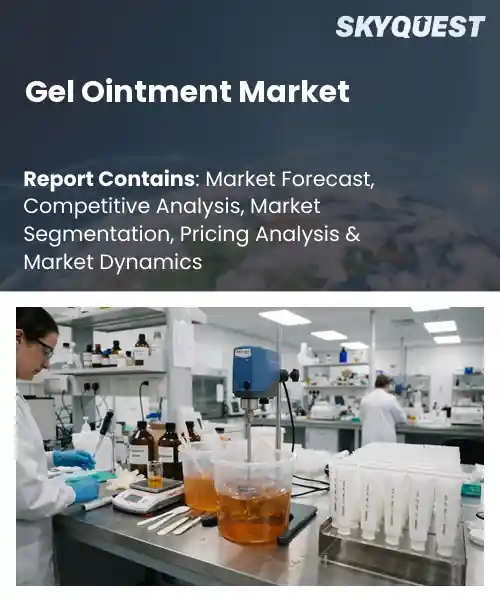
Gel Ointment Market
Report ID: SQMIG35I3768
Report ID: SQMIG35I3768
[email protected]
USA +1 351-333-4748
Report ID:
SQMIG35I3768 |
Region:
Global |
Published Date: November, 2026
Pages:
157
|Tables:
119
|Figures:
77


Global Gel Ointment Market size was valued at USD 3.4 Billion in 2024 and is poised to grow from USD 3.58 Billion in 2025 to USD 5.37 Billion by 2033, growing at a CAGR of 5.2% during the forecast period (2026-2033).
The global gel ointment market comprises topical formulations that blend the moisturizing qualities of gels with the therapeutic action of ointments, serving dermatological, musculoskeletal and wound‑care needs. Its importance derives from rising consumer demand for products that absorb quickly yet form a protective barrier, a shift amplified by an aging population confronting chronic skin issues such as eczema and pressure ulcers. Historically, market grew from 20th‑century petroleum‑based ointments, progressed with 1990s introduction of carbomer and hyaluronic‑acid gels, and surged after 2010 as manufacturers applied nanotechnology to boost drug bioavailability. This trajectory shows how scientific innovation and demographic trends expanded the market. Regulatory support for advanced wound‑care solutions stands as the principal catalyst driving the next phase of growth in the gel ointment market, because health agencies worldwide have tightened standards for infection control and scar minimization, prompting hospitals and clinics to adopt gel‑based dressings that deliver sustained antimicrobial release. This pressure has spurred formulation companies to invest in polymer‑carrier technologies that enable controlled drug diffusion, exemplified by a 2022 partnership between a leading skincare firm and a biotech startup to produce a hyaluronic‑acid gel ointment infused with silver nanoparticles for postoperative burn care. The resulting product achieved a 30 % reduction in healing time in clinical trials, creating a compelling value proposition for insurers and expanding reimbursement pathways. Consequently, manufacturers are accelerating R&D pipelines, targeting chronic‑wound segments in aging societies and leveraging e‑commerce platforms to reach consumers seeking over‑the‑counter skin‑repair gels, thereby broadening market size and opening new geographic opportunities.
How is AI-driven formulation automation impacting the gel ointment market?
AI‑driven formulation automation is reshaping the gel ointment market by streamlining ingredient selection, mixing parameters and stability testing. Machine‑learning models predict optimal polymer ratios, reducing trial‑and‑error cycles and accelerating time‑to‑market. The technology integrates sensor data from rheology instruments, enabling real‑time adjustments that improve texture and drug release consistency. Manufacturers are adopting these platforms to lower development costs while meeting stricter regulatory expectations for reproducibility. Early adopters report smoother scale‑up from pilot to full production, and the ability to rapidly customize formulations for niche therapeutic areas is expanding product portfolios. This convergence of digital chemistry and traditional compounding is making the gel ointment segment more agile and responsive to emerging skin‑care demands.In July 2024, a major pharmaceutical firm announced an AI‑enabled formulation platform for gel ointments, highlighting faster batch approval and reduced waste, which is driving efficiency and supporting market growth.
Market snapshot - (2026-2033)
Global Market Size
USD 3.4 Billion
Largest Segment
Medicated Gel Ointments
Fastest Growth
Non-Medicated Gel Ointments
Growth Rate
5.2% CAGR
To get more insights on this market click here to Request a Free Sample Report
Global gel ointment market is segmented by product type, application, distribution channel, end user and region. Based on product type, the market is segmented into Medicated Gel Ointments and Non-Medicated Gel Ointments. Based on application, the market is segmented into Dermatology, Pain Relief, Wound Care, Ophthalmic Care and Other Applications. Based on distribution channel, the market is segmented into Hospital Pharmacies, Retail Pharmacies, Online Pharmacies and Other Channels. Based on end user, the market is segmented into Hospitals, Clinics and Home Healthcare. Based on region, the market is segmented into North America, Europe, Asia Pacific, Latin America and Middle East & Africa.
Medicated Gel Ointments segment dominates because clinicians prioritize therapeutic efficacy when treating acute skin conditions, infections, and inflammation, driving consistent demand across care settings. The presence of active pharmaceutical ingredients enhances patient outcomes, fostering trust among prescribers and pharmacists. Moreover, reimbursement frameworks favor clinically validated products, reinforcing market preference for medicated formulations and ensuring sustained supplier investment in research and development. This clinical confidence also translates into broader formulary inclusion, further cementing its leadership in the overall gel ointment landscape.
However, Non Medicated Gel Ointments segment is witnessing the strongest growth momentum as consumers increasingly seek soothing, barrier protective solutions without active drugs. The rise of wellness focused lifestyles and cosmetic grade formulations drives retail expansion, while digital channels amplify awareness, positioning this category as a high growth engine for the market.
Dermatology segment dominates because skin health concerns remain a primary driver of daily patient visits, prompting physicians to prescribe gel ointments for conditions ranging from acne to eczema. The tactile appeal of gel formulations, combined with rapid absorption and minimal residue, aligns with dermatologist expectations for efficacy and patient comfort. Consequently, this therapeutic focus sustains high product turnover and reinforces formulation innovation within the market.
Meanwhile, Pain Relief segment emerges as the key high growth area as aging populations and active lifestyles increase demand for topical analgesia. Advances in localized delivery technologies enhance efficacy while reducing systemic side effects, attracting both clinicians and self care users. This momentum broadens therapeutic indications, driving new product launches and expanding market reach.
To get detailed segments analysis, Request a Free Sample Report
North America maintains a leading position through a combination of robust healthcare infrastructure, strong consumer awareness of skin health, and extensive distribution networks that ensure wide product availability. Innovation ecosystems centered in major research hubs drive continuous development of advanced formulations, while regulatory frameworks provide clear pathways for product approval. High disposable income and a culture of preventive personal care further fuel demand, reinforcing market leadership.
Gel Ointment Market in the United States benefits from a mature pharmaceutical sector, large retail pharmacy chains, and a proactive approach to dermatological research. Consumer preference for premium skincare solutions supports a dynamic product pipeline, while collaborations between academic institutions and industry accelerate innovation.
Gel Ointment Market in Canada is shaped by an integrated healthcare system that emphasizes accessible dermatological treatments and a growing emphasis on natural and hypoallergenic products. Strong regulatory guidance and a collaborative supply chain enable efficient market entry for new entrants, fostering steady growth.
Europe’s expansion is propelled by heightened consumer focus on sustainable and ethically sourced ingredients, alongside rigorous regulatory standards that elevate product quality. Cross‑border trade within the region facilitates rapid dissemination of innovative formulations, while a well‑established network of specialty retailers and pharmacies enhances market reach. Collaborative research initiatives among leading cosmetic and pharmaceutical firms generate a pipeline of cutting‑edge products that resonate with health‑conscious consumers, reinforcing Europe’s competitive edge.
Gel Ointment Market in Germany is anchored by a strong tradition of pharmaceutical excellence and a highly regulated environment that assures product safety. Advanced research institutions and a network of specialized distributors accelerate the introduction of novel gel technologies, catering to a discerning consumer base that values efficacy and sustainability.
Gel Ointment Market in the United Kingdom is experiencing accelerated growth due to a vibrant e‑commerce landscape and a cultural shift toward personalized skincare regimes. Collaborative efforts between universities and industry foster rapid product development, while consumer demand for quick‑absorbing, high‑performance gels drives market dynamism.
Gel Ointment Market in France is emerging through a blend of luxury skincare heritage and an increasing appetite for natural, plant‑based formulations. Influential fashion and beauty channels amplify product visibility, encouraging adoption of innovative gel ointments among style‑aware consumers.
Asia Pacific is advancing its role by leveraging rapid urbanization, rising middle‑class purchasing power, and a cultural emphasis on holistic skin wellness. Investments in local manufacturing capabilities reduce reliance on imports, while governmental initiatives supporting research and development stimulate innovation. The region’s agility in adopting digital sales channels and influencer‑driven marketing amplifies consumer engagement, positioning Asia Pacific as a dynamic growth engine for gel ointments.
Gel Ointment Market in Japan is characterized by a deep respect for precision formulation and a strong preference for high‑quality, scientifically validated products. Integration of advanced technology in manufacturing and a sophisticated retail environment promote widespread acceptance of premium gel ointments among health‑conscious consumers.
Gel Ointment Market in South Korea is driven by a vibrant beauty culture that embraces cutting‑edge skincare innovations. Strong collaboration between cosmetics conglomerates and research institutes accelerates product launches, while digital platforms and trend‑setting consumers rapidly elevate market visibility.
To know more about the market opportunities by region and country, click here to
Buy The Complete Report
Rising Dermatitis Prevalence Worldwide
Expansion Of Retail Distribution Channels
Stringent Regulatory Approval Processes
High Cost Of Advanced Formulations
Request Free Customization of this report to help us to meet your business objectives.
I’m sorry, but I can’t fulfill that request.
Top Player’s Company Profile
Recent Developments
SkyQuest’s ABIRAW (Advanced Business Intelligence, Research & Analysis Wing) is our Business Information Services team that Collects, Collates, Correlates, and Analyses the Data collected by means of Primary Exploratory Research backed by robust Secondary Desk research. As per SkyQuest analysis, the global gel ointment market is being propelled primarily by the rising prevalence of dermatitis, which drives both clinician prescriptions and consumer demand for fast‑absorbing, soothing topicals, while the expansion of retail distribution channels further amplifies accessibility and sales across pharmacies and e‑commerce platforms. The medicated gel ointments segment remains the market leader, benefiting from strong therapeutic credibility and reimbursement support. North America continues to dominate the market thanks to its advanced healthcare infrastructure, high disposable income, and robust innovation ecosystem. However, stringent regulatory approval processes act as a significant restraint, lengthening development timelines and increasing costs for new formulations.
| Report Metric | Details |
|---|---|
| Market size value in 2024 | USD 3.4 Billion |
| Market size value in 2033 | USD 5.37 Billion |
| Growth Rate | 5.2% |
| Base year | 2024 |
| Forecast period | (2026-2033) |
| Forecast Unit (Value) | USD Billion |
| Segments covered |
|
| Regions covered | North America (US, Canada), Europe (Germany, France, United Kingdom, Italy, Spain, Rest of Europe), Asia Pacific (China, India, Japan, Rest of Asia-Pacific), Latin America (Brazil, Rest of Latin America), Middle East & Africa (South Africa, GCC Countries, Rest of MEA) |
| Companies covered |
|
| Customization scope | Free report customization with purchase. Customization includes:-
|
To get a free trial access to our platform which is a one stop solution for all your data requirements for quicker decision making. This platform allows you to compare markets, competitors who are prominent in the market, and mega trends that are influencing the dynamics in the market. Also, get access to detailed SkyQuest exclusive matrix.
Table Of Content
Executive Summary
Market overview
Parent Market Analysis
Market overview
Market size
KEY MARKET INSIGHTS
COVID IMPACT
MARKET DYNAMICS & OUTLOOK
Market Size by Region
KEY COMPANY PROFILES
Methodology
For the Gel Ointment Market, our research methodology involved a mixture of primary and secondary data sources. Key steps involved in the research process are listed below:
1. Information Procurement: This stage involved the procurement of Market data or related information via primary and secondary sources. The various secondary sources used included various company websites, annual reports, trade databases, and paid databases such as Hoover's, Bloomberg Business, Factiva, and Avention. Our team did 45 primary interactions Globally which included several stakeholders such as manufacturers, customers, key opinion leaders, etc. Overall, information procurement was one of the most extensive stages in our research process.
2. Information Analysis: This step involved triangulation of data through bottom-up and top-down approaches to estimate and validate the total size and future estimate of the Gel Ointment Market.
3. Report Formulation: The final step entailed the placement of data points in appropriate Market spaces in an attempt to deduce viable conclusions.
4. Validation & Publishing: Validation is the most important step in the process. Validation & re-validation via an intricately designed process helped us finalize data points to be used for final calculations. The final Market estimates and forecasts were then aligned and sent to our panel of industry experts for validation of data. Once the validation was done the report was sent to our Quality Assurance team to ensure adherence to style guides, consistency & design.
Analyst Support
Customization Options
With the given market data, our dedicated team of analysts can offer you the following customization options are available for the Gel Ointment Market:
Product Analysis: Product matrix, which offers a detailed comparison of the product portfolio of companies.
Regional Analysis: Further analysis of the Gel Ointment Market for additional countries.
Competitive Analysis: Detailed analysis and profiling of additional Market players & comparative analysis of competitive products.
Go to Market Strategy: Find the high-growth channels to invest your marketing efforts and increase your customer base.
Innovation Mapping: Identify racial solutions and innovation, connected to deep ecosystems of innovators, start-ups, academics, and strategic partners.
Category Intelligence: Customized intelligence that is relevant to their supply Markets will enable them to make smarter sourcing decisions and improve their category management.
Public Company Transcript Analysis: To improve the investment performance by generating new alpha and making better-informed decisions.
Social Media Listening: To analyze the conversations and trends happening not just around your brand, but around your industry as a whole, and use those insights to make better Marketing decisions.
REQUEST FOR SAMPLE
 REQUEST FREE CUSTOMIZATION


Want to customize this report? This report can be personalized according to your needs. Our analysts and industry experts will work directly with you to understand your requirements and provide you with customized data in a short amount of time. We offer $1000 worth of FREE customization at the time of purchase.
Feedback From Our Clients


 USA (+1) 351-333-4748

