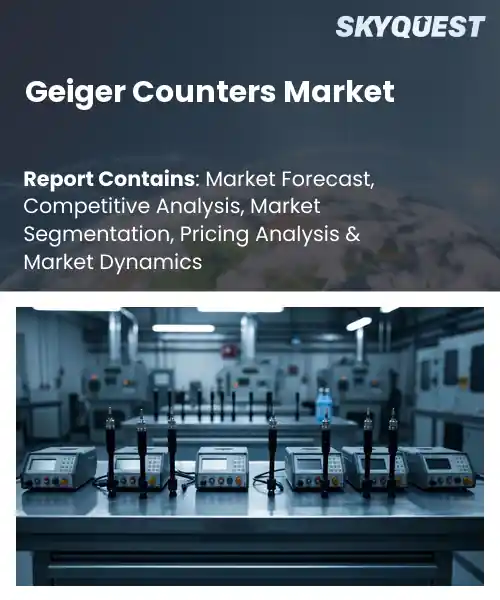
Geiger Counters Market
Report ID: SQMIG20E2218
Report ID: SQMIG20E2218
[email protected]
USA +1 351-333-4748
Report ID:
SQMIG20E2218 |
Region:
Global |
Published Date: June, 2026
Pages:
157
|Tables:
180
|Figures:
79


Global Geiger Counters Market size was valued at USD 591.1 Million in 2024 and is poised to grow from USD 630.7 Million in 2025 to USD 1059.6 Million by 2033, growing at a CAGR of 6.7% during the forecast period (2026-2033).
Regulatory tightening is a major factor for the global Geiger counter market growth, mainly because radiation safety standards are getting more and more strict, and they’re basically pushing organizations to do continuous monitoring across nuclear power plants, mining operations , healthcare facilities , research laboratories and industrial sites. Government mandates about radiation exposure tracking, environmental monitoring, and dose reporting are making it easier for companies to justify investments in more advanced radiation detection equipment. With that compliance load getting heavier, the demand is rising for portable and fixed Geiger counters, and these units are often expected to come with wireless connectivity, real-time data transmission , plus automated reporting.
In addition, the need for proper documentation, together with regulatory audits, is opening doors for software and analytics solutions that turn raw radiation measurements into something useful, like maintenance alerts and other clear insights. Some manufacturers are gaining an edge by pairing rugged hardware with integrated digital monitoring platforms, because end users increasingly want whole radiation management packages , not just a device that beeps. And as regulatory frameworks keep evolving across regions, the expectation is that demand for dependable and technologically advanced Geiger counters will keep growing at a steady pace.
AI-driven automation is changing Geiger counter technology in a few direct ways, like boosting measurement accuracy, improving day-to-day operational efficiency, and making the systems more easy to use. A lot of newer radiation detection setups are now mixing artificial intelligence, plus machine learning, to support real-time data analysis, predictive calibration , automated background radiation filtering, and self-diagnostic abilities. In practical terms, these functions reduce human error, keep detection more consistent, and help spot abnormal radiation levels faster, even when conditions get tricky.
As safety rules tighten up further, organizations are going for intelligent monitoring solutions that can learn from operational data over time, then optimize performance across varying environmental conditions. AI-powered Geiger counters can also simplify compliance management , since they can generate standardized reports and keep detailed digital records that make audits less painful. On top of that, cloud connectivity and remote monitoring let specialists review radiation data in real time, so on-site intervention is less necessary. Overall, these advancements build user confidence , improve workflow efficiency, and support faster adoption of smart radiation detection technologies across industrial, medical , and nuclear settings.
Market snapshot - (2026-2033)
Global Market Size
USD 591.1 Million
Largest Segment
Fixed/Stationary Geiger Counters
Fastest Growth
Wearable Radiation Monitors
Growth Rate
6.7% CAGR
To get more insights on this market click here to Request a Free Sample Report
The global Geiger counters market is segmented by product type, detector type, radiation type, application, end user, distribution channel, and region. Based on product type, the market is categorized into handheld Geiger counters, portable Geiger counters, fixed/stationary Geiger counters, wearable radiation monitors, and others. By detector type, the market is segmented into Geiger-Müller (GM) tube detectors, pancake GM detectors, end-window GM detectors, and others. Based on radiation type, the market is divided into alpha radiation detection, beta radiation detection, gamma radiation detection, and others. By application, the market is classified into nuclear power plants, environmental monitoring, industrial safety, homeland security and defense, healthcare and research, and others. Based on end user, the market serves government and regulatory agencies, industrial facilities, healthcare and research institutions, defense and security organizations, and others. By distribution channel, the market is segmented into direct sales, specialized instrument distributors, and others. Regionally, the market is analyzed across North America, Europe, Asia Pacific, Latin America, and the Middle East & Africa.
As per the Geiger counters market analysis, the Handheld geiger counters segment dominated the market because they blend portability with a more user friendly interface, so people can do quick on site radiation checks for different stakeholders. They are easy to roll out, sip low power, and keep solid calibration which makes them the go to choice for field inspections, emergency response, and everyday safety verifications. This broad acceptance keeps getting a boost from nonstop upgrades in detector sensitivity, plus better integration with wireless data platforms, so they stay ahead across multiple industry segments in the geiger counters market.
Meanwhile, wearable radiation monitors are showing up as the fastest growing thing, mostly because they fit right into personal protective equipment and support continuous exposure tracking, which speaks directly to the rising occupational health concerns. Better miniaturized sensor tech, together with real time analytics, pushes adoption in higher risk work areas, and that’s opening up new market possibilities while also speeding up growth.
According to the Geiger counters market forecast, the Pancake gm detectors segment is dominating a bit because the thin film design gives high sensitivity to lower energy radiation while still staying compact. That compactness is huge for embedding them into handheld or other portable platforms. Also manufacturing them is relatively straightforward, they are durable through a range of environmental conditions, and they play nicely with modern electronics… so overall they keep spreading across many use cases, and that’s basically what keeps them in the top spot. This proven dependability is what makes oems and end users keep choosing them for dependable radiation monitoring.
On the other hand, the end-window gm detectors segment is getting the strongest growth momentum because the window layout is great for catching low energy alpha particles. That lines up with the growing demand in environmental monitoring and nuclear decommissioning. Regulatory expectations and the need for surface contamination inspections are pulling investment, which expands market reach, and also creates room for more technical improvements and variations in design.
To get detailed segments analysis, Request a Free Sample Report
As per the geiger counters market regional forecast, North America gains from a fairly mature rulemaking climate, that basically keeps radiation safety in the spotlight across industrial, medical, and research areas, steady stuff. There are also major research groups and technology companies there, and they keep pushing new detector designs, plus calibration, it never stops. At the same time, nuclear power sites, defense establishments , and environmental surveillance efforts keep the whole supply chain moving, like on autopilot but still strong. When manufacturers team up with government agencies, product dependability goes up and buyers feel more confident, which is important. And the region’s push for top-tier performance and quick take‑up of newer materials basically locks in its leading position.
United States Geiger Counters Market
The Geiger Counters industry in the United States is doing well because of big government support for radiation monitoring, and because there’s already a solid web of specialist distributors in place. University labs , along with private research firms, tend to roll out detector technology upgrades often. Then strict workplace safety rules ensure stable demand spanning energy, aerospace, healthcare, and a few other adjacent corners.
Canada Geiger Counters Market
The Geiger Counters sector in Canada is backed by forward‑leaning environmental protection approaches, plus a noticeable focus on safeguarding public health. Federal bodies working together with local makers, helps drive rugged detector development for hard‑to‑reach monitoring. Meanwhile, industry norms encourage broad deployment across mining, scientific work, and emergency response efforts, which all adds up.
Europe is expanding its geiger counters market share because it has a more unified regulatory setup, where member states must keep radiation monitoring tightly controlled and consistently applied. Money flowing into renewable energy projects and upgraded medical imaging also raises the need for careful detection tools. There’s a thick layer of research institutions, they speed up innovation, and cross‑border partnerships help products reach more buyers without as much friction. People’s everyday concern about environmental safety is growing too, so portable but high‑precision detectors get pulled into the spotlight. Overall, the region’s pledge to sustainability plus technical excellence cements it as a fast‑growing arena.
Germany Geiger Counters Market
The Geiger Counters Market penetration in Germany is driven from a strong industrial backbone and strict safety requirements that basically demand more advanced monitoring options. Some of the leading engineering firms put real resources into R and D, and that supports the creation of detectors that are very accurate and also built to last. These tools end up fitting well across automotive, chemical processing, and nuclear research programs.
United Kingdom Geiger Counters Market
The Geiger Counters Market in the United Kingdom is seeing quick momentum, mainly due to extra regulatory attention and wider adoption inside public health programs. University collaborations with technology start‑ups help speed up innovation, and government initiatives back deployment of detectors for environmental surveillance, as well as security‑related uses, in practice.
France Geiger Counters Market
The Geiger Counters Market in France is developing into a lively segment due to proactive environmental rules , and also because medical imaging capacity keeps expanding. Joint efforts between research centers and manufacturers focus on compact, easy-to-handle detectors, made for both city‑side and countryside monitoring needs.
Asia Pacific is stepping up its role via strategic investments into nuclear infrastructure and this new, stronger focus on occupational health safety. Governments are now trying to build indigenous manufacturing capability, so they're less dependent on outside suppliers or external sources. More industrial momentum, plus people being more alert about environmental hazards, is pushing demand for dependable detection systems. At the same time academic collaborations, plus tech transfer programs, are speeding up the arrival of next-generation detectors, and the regional trade deals make it easier to access wider market channels. Together this all stacks into the idea that the region becomes a major driver of the global market cycle.
Japan Geiger Counters Market
In Japan, the Geiger Counters Market is supported by a mature manufacturing ecosystem and very strict safety requirements for nuclear installations. Ongoing work by top universities keeps moving toward high-precision detectors, made for industrial needs and also for disaster readiness, at the same time.
South Korea Geiger Counters Market
In South Korea, the Geiger Counters Market keeps progressing due to strong public backing for radiation safety in new nuclear undertakings, as well as upgrades in medical technology. Research centers teaming up with local manufacturers supports innovation, and that leads to compact, very sensitive detector units used across several settings, from industry to public health.
To know more about the market opportunities by region and country, click here to
Buy The Complete Report
Rising Nuclear Energy Adoption
Advancements In Portable Sensor Technology
High Cost Of Advanced Devices
Stringent Regulatory Compliance Requirements
Request Free Customization of this report to help us to meet your business objectives.
The global Geiger counters market competitive landscape is basically shaped by fierce competition, between well established manufacturers and newer entrants, which ends up pushing fast product differentiation, plus cost efficiency too. Lately there’s also been M& A movement, like the acquisition of a smaller radiation sensor company by a big instrumentation group, and then strategic tie ups between detector makers and nuclear safety consultants. It shows how firms are using tighter tech integration, along with broader service packages to grab market share.
Top Player’s Company Profile
Recent Developments in the Geiger Counters Market
SkyQuest’s ABIRAW (Advanced Business Intelligence, Research & Analysis Wing) is our Business Information Services team that Collects, Collates, Correlates, and Analyses the Data collected by means of Primary Exploratory Research backed by robust Secondary Desk research.
As per SkyQuest analysis, the global Geiger counters market is expected to grow and it is mostly tied to increased adoption of nuclear power, which then increases the need for dependable radiation monitoring. At the same time, progress in portable sensor tech is accelerating things, because those devices keep getting lighter and more battery operated for actual field use. Handheld Geiger counters currently dominate the segment landscape, mainly due to their portability and easy deployment, and North America is still the front running region because of strict safety regulations, plus solid industrial demand. Still there’s a restraint that keeps showing up, the high cost of advanced units can be a problem, and it limits adoption among smaller users or price sensitive markets.
| Report Metric | Details |
|---|---|
| Market size value in 2024 | USD 591.1 Million |
| Market size value in 2033 | USD 1059.6 Million |
| Growth Rate | 6.7% |
| Base year | 2024 |
| Forecast period | (2026-2033) |
| Forecast Unit (Value) | USD Million |
| Segments covered |
|
| Regions covered | North America (US, Canada), Europe (Germany, France, United Kingdom, Italy, Spain, Rest of Europe), Asia Pacific (China, India, Japan, Rest of Asia-Pacific), Latin America (Brazil, Rest of Latin America), Middle East & Africa (South Africa, GCC Countries, Rest of MEA) |
| Companies covered |
|
| Customization scope | Free report customization with purchase. Customization includes:-
|
To get a free trial access to our platform which is a one stop solution for all your data requirements for quicker decision making. This platform allows you to compare markets, competitors who are prominent in the market, and mega trends that are influencing the dynamics in the market. Also, get access to detailed SkyQuest exclusive matrix.
Table Of Content
Executive Summary
Market overview
Parent Market Analysis
Market overview
Market size
KEY MARKET INSIGHTS
COVID IMPACT
MARKET DYNAMICS & OUTLOOK
Market Size by Region
KEY COMPANY PROFILES
Methodology
For the Geiger Counters Market, our research methodology involved a mixture of primary and secondary data sources. Key steps involved in the research process are listed below:
1. Information Procurement: This stage involved the procurement of Market data or related information via primary and secondary sources. The various secondary sources used included various company websites, annual reports, trade databases, and paid databases such as Hoover's, Bloomberg Business, Factiva, and Avention. Our team did 45 primary interactions Globally which included several stakeholders such as manufacturers, customers, key opinion leaders, etc. Overall, information procurement was one of the most extensive stages in our research process.
2. Information Analysis: This step involved triangulation of data through bottom-up and top-down approaches to estimate and validate the total size and future estimate of the Geiger Counters Market.
3. Report Formulation: The final step entailed the placement of data points in appropriate Market spaces in an attempt to deduce viable conclusions.
4. Validation & Publishing: Validation is the most important step in the process. Validation & re-validation via an intricately designed process helped us finalize data points to be used for final calculations. The final Market estimates and forecasts were then aligned and sent to our panel of industry experts for validation of data. Once the validation was done the report was sent to our Quality Assurance team to ensure adherence to style guides, consistency & design.
Analyst Support
Customization Options
With the given market data, our dedicated team of analysts can offer you the following customization options are available for the Geiger Counters Market:
Product Analysis: Product matrix, which offers a detailed comparison of the product portfolio of companies.
Regional Analysis: Further analysis of the Geiger Counters Market for additional countries.
Competitive Analysis: Detailed analysis and profiling of additional Market players & comparative analysis of competitive products.
Go to Market Strategy: Find the high-growth channels to invest your marketing efforts and increase your customer base.
Innovation Mapping: Identify racial solutions and innovation, connected to deep ecosystems of innovators, start-ups, academics, and strategic partners.
Category Intelligence: Customized intelligence that is relevant to their supply Markets will enable them to make smarter sourcing decisions and improve their category management.
Public Company Transcript Analysis: To improve the investment performance by generating new alpha and making better-informed decisions.
Social Media Listening: To analyze the conversations and trends happening not just around your brand, but around your industry as a whole, and use those insights to make better Marketing decisions.
REQUEST FOR SAMPLE
 REQUEST FREE CUSTOMIZATION
Global Geiger Counters Market size was valued at USD 591.1 Million in 2024 and is poised to grow from USD 630.7 Million in 2025 to USD 1059.6 Million by 2033, growing at a CAGR of 6.7% during the forecast period (2026-2033).
The competitive landscape of the global Geiger counters market is shaped by intense rivalry among established manufacturers and emerging players, driving rapid product differentiation and cost efficiencies. Recent M&A activity, such as the acquisition of a niche radiation sensor firm by a leading instrumentation group, and strategic partnerships between detector makers and nuclear safety consultants, illustrate how companies are leveraging technology integration and expanded service offerings to capture market share. 'Mirion Technologies', 'Thermo Fisher Scientific', 'Berthold Technologies', 'Ludlum Measurements', 'SE International, Inc.', 'Arrow-Tech, Inc.', 'Tracerco', 'Fuji Electric Co., Ltd.', 'Polimaster', 'RAE Systems Technologies', 'ATOMTEX', 'Canberra Industries', 'Ecotest', 'Unfors RaySafe', 'GQ Electronics', 'Saphymo (Bertin Technologies)', 'Bertin Instruments', 'Nuvia Instruments', 'Radiation Detection Company', 'Gamma Scout GmbH'
The expansion of nuclear power facilities worldwide drives demand for reliable radiation monitoring, prompting manufacturers to develop advanced Geiger counters that meet stringent safety standards, thereby accelerating market growth as utilities seek comprehensive detection solutions to protect personnel and the environment, and regulatory bodies require continuous monitoring to ensure compliance with evolving safety protocols, fostering increased adoption of sophisticated instruments across power generation sites, research laboratories, and medical institutions. These trends also encourage investment in training programs and integration of digital data analytics, further expanding the market’s reach and relevance.
Portable Detection Surge: Growing demand for field‑ready radiation monitoring drives manufacturers to prioritize compact, battery‑efficient Geiger counters. Customers across nuclear decommissioning, emergency response, and environmental surveying seek handheld units that combine rugged designs with real‑time data transmission. This shift encourages integration of wireless connectivity, intuitive user interfaces, and modular sensor upgrades. As portable solutions become essential for on‑site safety protocols, supply chains adapt by sourcing lightweight materials and expanding after‑sales service networks to support remote deployments worldwide and ensuring compliance with evolving standards.
Why does North America Dominate the Global Geiger Counters Market? |@12


Want to customize this report? This report can be personalized according to your needs. Our analysts and industry experts will work directly with you to understand your requirements and provide you with customized data in a short amount of time. We offer $1000 worth of FREE customization at the time of purchase.
Feedback From Our Clients


 USA (+1) 351-333-4748

