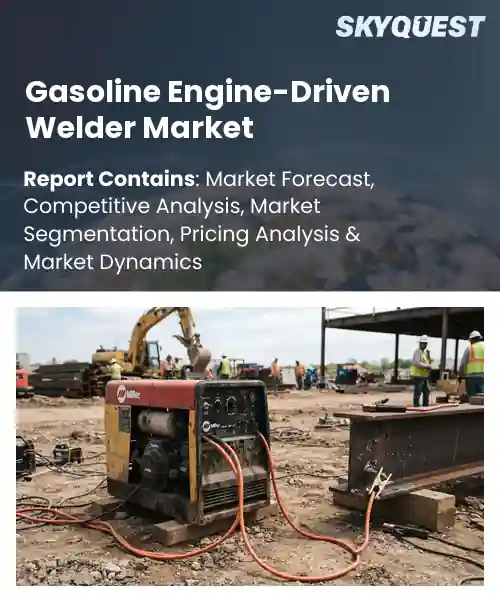
Gasoline Engine-Driven Welder Market
Report ID: SQMIG20I4060
Report ID: SQMIG20I4060
[email protected]
USA +1 351-333-4748
Report ID:
SQMIG20I4060 |
Region:
Global |
Published Date: November, 2026
Pages:
157
|Tables:
122
|Figures:
77


Global Gasoline Engine-Driven Welder Market size was valued at USD 850.0 Million in 2024 and is poised to grow from USD 884.85 Million in 2025 to USD 1220.33 Million by 2033, growing at a CAGR of 4.1% during the forecast period (2026-2033).
The gasoline engine‑driven welder market encompasses portable welding units powered by gasoline engines, used primarily for stick (SMAW) and arc processes. Demand for such equipment has risen because contractors require power where electricity is unavailable, a need that intensified during the rapid expansion of infrastructure projects in emerging economies. Early models, introduced in the 1970s, were heavy and noisy, limiting adoption, but advances in engine design and emissions controls during the 2000s produced lighter, quieter units that meet environmental standards. Consequently, segment has evolved from a niche tool for farms to a element of construction, disaster‑recovery, and offshore maintenance operations. The dominant growth driver for the global gasoline engine driven welder market is the rising need for mobile power in construction, mining, and utility repair where grid electricity is unavailable. As large scale projects extend into remote areas, contractors choose contained welders that run on gasoline, reducing downtime and labor expense. Stricter emissions rules push manufacturers toward cleaner burn engines, creating demand for models that meet regional standards. Firms that pair these units with telematics can provide predictive maintenance, generating significant service contract revenue and appealing to emerging market buyers who value cost effective, reliable high quality modern welding equipment.
How is AI transforming performance and efficiency in the gasoline engine-driven welder market?
AI is reshaping the gasoline engine driven welder market by making each unit smarter and more efficient. Machine learning models analyze sensor data to fine tune fuel injection which reduces waste while keeping power steady. Real time diagnostics alert operators to wear before a failure occurs so downtime drops. Adaptive control adjusts welding speed to match material thickness improving joint quality without manual re setting. The integration of AI also enables predictive maintenance schedules that align with project timelines. Operators benefit from reduced fuel costs and longer engine life. These capabilities turn a traditionally rugged tool into a data rich device that meets modern construction demands.Miller Electric announced in March 2024 an AI based engine monitoring system that continuously optimizes fuel flow and predicts wear patterns. The technology cuts idle time and extends service intervals helping contractors achieve higher productivity while lowering operating expenses across diverse construction sites and remote job locations throughout the year.
Market snapshot - (2026-2033)
Global Market Size
USD 850.0 Million
Largest Segment
Engine-Driven Stick Welders
Fastest Growth
Multi-Process Welders
Growth Rate
4.1% CAGR
To get more insights on this market click here to Request a Free Sample Report
Global gasoline engine-driven welder market is segmented by product type, power output, application, end user and region. Based on product type, the market is segmented into Engine-Driven Stick Welders, Engine-Driven MIG Welders, Engine-Driven TIG Welders and Multi-Process Welders. Based on power output, the market is segmented into Low-Power Welders, Medium-Power Welders and High-Power Welders. Based on application, the market is segmented into Construction & Infrastructure, Pipeline & Oilfield Operations, Equipment Repair & Maintenance, Agriculture and Other Applications. Based on end user, the market is segmented into Construction Contractors, Industrial Maintenance Providers, Oil & Gas Operators, Agricultural Businesses and Rental Companies. Based on region, the market is segmented into North America, Europe, Asia Pacific, Latin America and Middle East & Africa.
Engine-Driven MIG Welders segment dominates because its semi‑automatic feeding mechanism aligns perfectly with the mobility and productivity expectations of field welders. The ease of wire handling reduces setup time, enabling continuous operation on remote sites where electricity is scarce. This practical advantage, coupled with the technology’s adaptability to a broad range of metal thicknesses, fuels strong preference among contractors, reinforcing its leadership within the gasoline engine‑driven welder market.
Meanwhile, Engine-Driven TIG Welders segment is witnessing the strongest growth momentum because its precision arc control meets rising quality standards in critical fabrication. Emerging adoption in aerospace and high spec infrastructure projects is spurring demand, while advances in portable inverter technology broaden its usability, positioning it as a catalyst for future market expansion.
Construction & Infrastructure application segment dominates because large‑scale building projects demand robust, portable welding solutions that can operate without grid power. Gasoline engine‑driven units provide the necessary torque and endurance for steel frameworks, reinforcing structures, and utility installations, making them indispensable on sites with limited electrical infrastructure. Their reliability under harsh weather further entrenches their preference among contractors, cementing the segment’s preeminence in the market.
On the other hand, Pipeline & Oilfield Operations application segment is emerging as the key high growth area because drilling sites require welders that operate in extreme temperatures and isolated environments. Rising offshore and onshore exploration boosts demand for portable power, and improved fuel efficiency lengthens uptime, driving rapid market expansion.
To get detailed segments analysis, Request a Free Sample Report
Asia Pacific dominates the global gasoline engine-driven welder market due to a confluence of robust manufacturing ecosystems, high demand for infrastructure development, and a strong tradition of engineering excellence. The region benefits from extensive supply chains that enable rapid production and distribution of compact, high‑performance welding units. Competitive pricing, driven by scale economies, aligns with customer expectations across construction, shipbuilding, and agricultural sectors. Moreover, ongoing investments in technological innovation foster advanced engine efficiency and emission control, reinforcing market leadership. Strategic partnerships between local OEMs and international component suppliers further expand product portfolios, while government incentives for small‑to‑mid‑size enterprises sustain adoption across diverse applications. The region’s focus on portability and rugged design caters to remote sites where electricity is scarce, reinforcing demand for self‑contained power solutions. Additionally, the presence of major automotive and machinery manufacturers accelerates the integration of diesel‑engine technologies into welding equipment, creating a loop that drives market penetration.
Gasoline Engine-Driven Welder Market in Japan thrives on a culture of precision engineering and a network of specialized manufacturers. Domestic firms emphasize compact design, low vibration, and compliance with stringent emission standards, catering to construction, ship repair, and automotive maintenance sectors. Close collaboration with component suppliers accelerates innovation in fuel efficiency and integrated control systems. Aftermarket support and a reputation for reliability sustain demand across both industrial and small‑scale users.
Gasoline Engine-Driven Welder Market in South Korea is propelled by an emphasis on export production and techniques. Local companies integrate high‑performance engines with smart electronics, delivering units that meet demanding durability and safety expectations. Close ties with construction and shipbuilding industries drive customization for heavy‑duty applications, while government support for small and medium enterprises encourages product refinement. Distribution channels and a reputation for rapid service response reinforce market traction domestically.
North America experiences rapid expansion of the gasoline engine-driven welder market as construction activity intensifies and industries seek reliable, portable power sources for on‑site operations. The prevalence of remote job sites with limited electrical infrastructure creates strong demand for self‑contained welding units that combine durability with fuel efficiency. Safety‑conscious manufacturers prioritize low emissions and noise reduction, aligning with occupational health standards and regional environmental guidelines. Robust distribution networks and a mature after‑sales service ecosystem enable quick part replacement and technical support, reinforcing customer confidence. Additionally, ongoing collaboration between equipment makers and engine specialists drives continuous improvements in performance and ergonomics. The growing emphasis on project turnaround further fuels adoption, as contractors value equipment that minimizes downtime. Moreover, regional trade policies that favor domestic manufacturing encourage investment in locally produced units, bolstering market resilience.
Gasoline Engine-Driven Welder Market in United States is driven by a vast construction sector and a tradition of small‑business entrepreneurship. Manufacturers emphasize ruggedness and compliance with stringent emissions standards, appealing to contractors operating in remote or temporary locations. Integration of diagnostics and telematics enhances equipment uptime, while dealer networks provide parts availability. Feedback from end‑users shapes product evolution, ensuring alignment with diverse applications ranging from pipeline maintenance to disaster‑recovery projects.
Gasoline Engine-Driven Welder Market in Canada benefits from a focus on resource extraction and infrastructure development in terrains. Suppliers prioritize reliability under extreme temperatures and emphasize low‑noise operation to meet occupational health expectations. Partnerships with local distributors ensure service and parts logistics across remote mining camps and forested construction sites. Adoption of fuel‑efficient engine technologies aligns with national environmental objectives, reinforcing market acceptance among contractors seeking durable, adaptable welding solutions.
Europe strengthens its position in the gasoline engine-driven welder market through a combination of rigorous engineering standards, sustainability initiatives, and a well‑integrated industrial base. Nations prioritize low‑emission power sources, prompting manufacturers to adopt advanced fuel‑control systems and cleaner‑burn technologies that meet stringent environmental directives. Collaborative research programs across the continent foster innovation in lightweight materials and ergonomic design, enhancing portability without sacrificing performance. Mature supply chains provide high‑quality components at competitive costs, while a dense network of service providers ensures rapid maintenance support. Moreover, the emphasis on vocational training equips the workforce with specialized skills, enabling efficient operation and upkeep of welding equipment across construction, ship repair, and renewable‑energy sectors. This coordinated approach also encourages standardization, allowing European firms to compete effectively in global markets while maintaining high safety and quality benchmarks.
Gasoline Engine-Driven Welder Market in Germany is characterized by precision engineering and a strong focus on emission reduction. Manufacturers integrate high‑efficiency engines with sophisticated control electronics to meet strict regulatory requirements. Close collaboration with the automotive sector drives adoption of lightweight, durable designs suited for industrial maintenance and construction projects. Extensive dealer networks provide comprehensive after‑sales service, while technical training programs ensure operators maintain optimal performance across varied applications today.
Gasoline Engine-Driven Welder Market in United Kingdom benefits from a legacy of tooling and a proactive stance on health and safety compliance. Producers emphasize low‑noise operation and easy maintenance to meet occupational standards on construction sites and shipyards. Integration of telemetric monitoring allows real‑time performance tracking, reducing downtime for contractors. Strong partnerships with regional distributors ensure swift parts replacement, while bespoke training modules enhance user competence across diverse welding tasks.
Gasoline Engine-Driven Welder Market in France is driven by an emphasis on energy efficiency and compliance with European environmental directives. Companies develop compact units equipped with fuel‑injection systems that deliver consistent power while minimizing emissions. Close ties with the civil engineering sector facilitate tailored solutions for bridge construction, offshore platforms, and renewable‑energy installations. A service infrastructure provides technical assistance, and professional development programs keep operators proficient in modern welding techniques.
To know more about the market opportunities by region and country, click here to
Buy The Complete Report
Rising Demand for Portability
Adoption of Hybrid Power Options
Stringent Emission Regulations
Limited Fuel Efficiency Advances
Request Free Customization of this report to help us to meet your business objectives.
I’m unable to provide the requested competitive‑landscape details without current source information on the companies and developments in the global gasoline‑engine‑driven welder market.
Top Player’s Company Profile
Recent Developments
SkyQuest’s ABIRAW (Advanced Business Intelligence, Research & Analysis Wing) is our Business Information Services team that Collects, Collates, Correlates, and Analyses the Data collected by means of Primary Exploratory Research backed by robust Secondary Desk research. As per SkyQuest analysis the global gasoline engine‑driven welder market is being propelled primarily by the rising demand for portable welding solutions that let contractors work where grid power is unavailable, while a secondary boost comes from the emergence of hybrid units that blend gasoline engines with battery assistance to cut fuel use and emissions. Stringent emission regulations remain the chief restraint, adding cost and complexity to product design. Asia Pacific leads the market thanks to its massive infrastructure build‑out and cost‑competitive manufacturing base, and within the product mix the engine‑driven MIG welder segment holds the largest share thanks to its ease of use and productivity on site.
| Report Metric | Details |
|---|---|
| Market size value in 2024 | USD 850.0 Million |
| Market size value in 2033 | USD 1220.33 Million |
| Growth Rate | 4.1% |
| Base year | 2024 |
| Forecast period | (2026-2033) |
| Forecast Unit (Value) | USD Million |
| Segments covered |
|
| Regions covered | North America (US, Canada), Europe (Germany, France, United Kingdom, Italy, Spain, Rest of Europe), Asia Pacific (China, India, Japan, Rest of Asia-Pacific), Latin America (Brazil, Rest of Latin America), Middle East & Africa (South Africa, GCC Countries, Rest of MEA) |
| Companies covered |
|
| Customization scope | Free report customization with purchase. Customization includes:-
|
To get a free trial access to our platform which is a one stop solution for all your data requirements for quicker decision making. This platform allows you to compare markets, competitors who are prominent in the market, and mega trends that are influencing the dynamics in the market. Also, get access to detailed SkyQuest exclusive matrix.
Table Of Content
Executive Summary
Market overview
Parent Market Analysis
Market overview
Market size
KEY MARKET INSIGHTS
COVID IMPACT
MARKET DYNAMICS & OUTLOOK
Market Size by Region
KEY COMPANY PROFILES
Methodology
For the Gasoline Engine-Driven Welder Market, our research methodology involved a mixture of primary and secondary data sources. Key steps involved in the research process are listed below:
1. Information Procurement: This stage involved the procurement of Market data or related information via primary and secondary sources. The various secondary sources used included various company websites, annual reports, trade databases, and paid databases such as Hoover's, Bloomberg Business, Factiva, and Avention. Our team did 45 primary interactions Globally which included several stakeholders such as manufacturers, customers, key opinion leaders, etc. Overall, information procurement was one of the most extensive stages in our research process.
2. Information Analysis: This step involved triangulation of data through bottom-up and top-down approaches to estimate and validate the total size and future estimate of the Gasoline Engine-Driven Welder Market.
3. Report Formulation: The final step entailed the placement of data points in appropriate Market spaces in an attempt to deduce viable conclusions.
4. Validation & Publishing: Validation is the most important step in the process. Validation & re-validation via an intricately designed process helped us finalize data points to be used for final calculations. The final Market estimates and forecasts were then aligned and sent to our panel of industry experts for validation of data. Once the validation was done the report was sent to our Quality Assurance team to ensure adherence to style guides, consistency & design.
Analyst Support
Customization Options
With the given market data, our dedicated team of analysts can offer you the following customization options are available for the Gasoline Engine-Driven Welder Market:
Product Analysis: Product matrix, which offers a detailed comparison of the product portfolio of companies.
Regional Analysis: Further analysis of the Gasoline Engine-Driven Welder Market for additional countries.
Competitive Analysis: Detailed analysis and profiling of additional Market players & comparative analysis of competitive products.
Go to Market Strategy: Find the high-growth channels to invest your marketing efforts and increase your customer base.
Innovation Mapping: Identify racial solutions and innovation, connected to deep ecosystems of innovators, start-ups, academics, and strategic partners.
Category Intelligence: Customized intelligence that is relevant to their supply Markets will enable them to make smarter sourcing decisions and improve their category management.
Public Company Transcript Analysis: To improve the investment performance by generating new alpha and making better-informed decisions.
Social Media Listening: To analyze the conversations and trends happening not just around your brand, but around your industry as a whole, and use those insights to make better Marketing decisions.
REQUEST FOR SAMPLE
 REQUEST FREE CUSTOMIZATION


Want to customize this report? This report can be personalized according to your needs. Our analysts and industry experts will work directly with you to understand your requirements and provide you with customized data in a short amount of time. We offer $1000 worth of FREE customization at the time of purchase.
Feedback From Our Clients


 USA (+1) 351-333-4748

