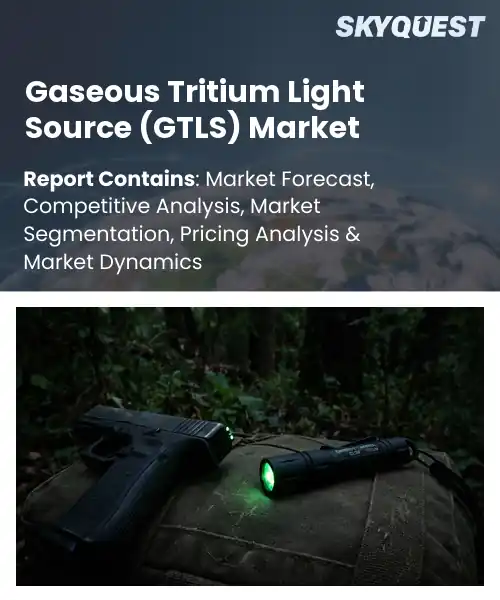
Gaseous Tritium Light Source (GTLS) Market
Report ID: SQMIG45K2459
Report ID: SQMIG45K2459
[email protected]
USA +1 351-333-4748
Report ID:
SQMIG45K2459 |
Region:
Global |
Published Date: September, 2026
Pages:
157
|Tables:
125
|Figures:
77


Global Gaseous Tritium Light Source (Gtls) Market size was valued at USD 1.84 Billion in 2024 and is poised to grow from USD 1.99 Billion in 2025 to USD 3.74 Billion by 2033, growing at a CAGR of 8.2% during the forecast period (2026-2033).
The Global Gaseous Tritium Light Source (GTLS) market supplies self‑contained modules that emit light by the radioactive decay of tritium gas. These units are valued for providing reliable, maintenance‑free illumination where electricity is unavailable or hazardous, such as aerospace instrumentation, marine buoys, and underground mining safety signs. The market originated in the 1970s when the U.S. military adopted tritium markers for aircraft panels, and it grew through the 1990s as safety regulations required longer‑lasting hazard warnings. Because GTLS eliminates batteries and wiring, it has become indispensable in remote, low‑maintenance applications, driving sustained global demand across diverse industrial sectors worldwide today. Regulatory pressure on efficiency and safety is the principal catalyst propelling GTLS growth, because stricter standards force manufacturers to replace battery‑powered lights with tritium‑based alternatives that guarantee decades of operation without service. In practice, railway operators in Europe have retrofitted tunnel markers with GTLS units, eliminating battery replacements and reducing outage risk. Simultaneously, the rising demand for underwater vehicles creates a niche for tritium‑lit gauges, where the absence of wiring enhances reliability. These applications generate a cycle: each successful deployment validates the technology, prompting investment, expanding the supplier base, and opening new markets such as smart infrastructure and space exploration.
How is AI influencing the Gaseous Tritium Light Source (GTLS) market?
Artificial intelligence is reshaping the Gaseous Tritium Light Source market by streamlining product design, manufacturing and after‑sales support. AI‑driven simulation tools enable engineers to model gas flow and phosphor coating with greater precision, shortening development cycles. In production, machine‑vision systems powered by deep learning detect microscopic flaws in sealed tubes, raising yield and lowering scrap. Predictive analytics applied to field data forecast lamp lifespan, allowing customers to plan replacements before failure and reducing downtime. Supply‑chain algorithms optimize inventory of tritium gas and glass components, cutting lead times. These capabilities make GTLS solutions more reliable and cost‑effective, encouraging broader adoption in signage, aerospace and consumer devices.Tritium Ltd June 2023, introduced an AI‑driven inspection platform that automatically flags defects during tube sealing, accelerating production and boosting consistency, which strengthens market growth and operational efficiency and reducing waste across the supply chain, helping manufacturers meet stricter safety standards while lowering costs.
Market snapshot - (2026-2033)
Global Market Size
USD 1.84 Billion
Largest Segment
Tritium Illumination Devices
Fastest Growth
Tritium Markers
Growth Rate
8.2% CAGR
To get more insights on this market click here to Request a Free Sample Report
Global gaseous tritium light source (gtls) market is segmented by product type, application, form factor, end user and region. Based on product type, the market is segmented into Tritium Vials, Tritium Markers, Tritium Illumination Devices, Tritium Exit Signs and Others. Based on application, the market is segmented into Military & Defense, Watches, Aviation, Emergency Lighting, Medical Devices and Others. Based on form factor, the market is segmented into Tubes, Capsules, Panels and Others. Based on end user, the market is segmented into Aerospace & Defense, Consumer Products, Healthcare, Industrial and Others. Based on region, the market is segmented into North America, Europe, Asia Pacific, Latin America and Middle East & Africa.
Tritium exit signs segment dominates because they fulfill mandatory safety requirements in commercial and public spaces, providing reliable, maintenance free illumination that operates continuously without external power. Their proven longevity and compliance with fire code regulations make them the go to choice for building owners seeking resilient emergency lighting solutions. This trust, coupled with low total cost ownership, drives steady demand and positions them at the core of GTLS market activity in the industry.
Meanwhile, tritium illumination devices segment is witnessing the strongest growth momentum as designers integrate self luminous components into consumer wearables and specialty equipment. Advances in miniature glass encapsulation enable brighter output in formats, attracting innovators seeking power independent lighting. This surge expands market horizons, creating niches and fueling GTLS expansion.
Military & defense applications segment leads because stringent operational demands require illumination that is independent of external power, highly reliable, and capable of functioning in extreme environments. GTLS solutions meet these criteria, offering covert, long lasting light sources for equipment and personnel, which fuels continuous procurement and spurs technological refinements tailored to defense needs.
On the other hand, aviation segment is emerging as the key high growth area as airlines adopt self luminous components for cabin signage and emergency pathways. Regulatory emphasis on non‑electrical backup lighting and advances in lightweight glass designs enable broader integration, driving demand and creating new opportunities that accelerate overall market expansion.
Capsules segment dominates because their compact glass encasement delivers high radiance while protecting tritium from environmental exposure, making them ideal for seamless integration into a wide variety of products. Manufacturers favor capsules for their proven reliability, straightforward handling, and compliance with safety standards, which accelerates product development cycles. Their versatility across applications reinforces their central position within the GTLS market and drives long term industry growth globally throughout the sector.
On the other hand, panels segment is emerging as the key high growth area as architects adopt tritium backlit displays for safety signage and lighting. Improvements in uniform coating techniques enable scalable production of wide panels, attracting building designers seeking maintenance free illumination. This momentum broadens market reach and unlocks expansion opportunities for GTLS.
To get detailed segments analysis, Request a Free Sample Report
The Asia Pacific region leads due to a strong industrial base, advanced manufacturing capabilities, and high adoption in safety and aerospace sectors. Companies in Japan and South Korea have pioneered compact, low‑maintenance tritium lighting solutions, leveraging expertise in chemical processing and precision engineering. Consumer awareness for reliable illumination in remote or hazardous environments drives demand. Supply chain efficiencies, proximity to key component suppliers, and collaborative standards initiatives further reinforce market leadership. Additionally, the region’s emphasis on sustainability aligns with the long‑life, low‑energy profile of tritium illumination, encouraging broader acceptance across infrastructure projects.
Gaseous Tritium Light Source (GTLS) Market in Japan benefits from a mature electronics sector and rigorous safety standards that prioritize reliable illumination. Domestic manufacturers excel in miniaturized designs suitable for marine, railway and emergency signage. Collaborative research between universities and industry fuels continual improvement in tritium encapsulation technologies, while strong intellectual property protection encourages investment. End‑users value the long‑lasting, maintenance‑free nature of GTLS, reinforcing its integration across critical national infrastructure.
Gaseous Tritium Light Source (GTLS) Market in South Korea is propelled by a strong chemical processing base and government incentives for safety‑critical technologies. Local firms specialize in high‑precision tritium handling and sealed‑tube production, enabling entry for aviation, mining and public transit applications. Partnerships with global OEMs broaden distribution, while an emphasis on reliability matches the nation’s focus on resilient infrastructure. Consequently, GTLS enjoys growing adoption in sectors requiring uninterrupted visibility.
Europe’s rapid expansion of the Gaseous Tritium Light Source (GTLS) market is anchored in rigorous safety directives that mandate reliable illumination for transport corridors, public infrastructure and emergency egress. Manufacturers respond to strong demand for low‑maintenance, long‑lasting lighting that satisfies both durability and environmental performance criteria. Collaborative research programmes across the continent advance tritium encapsulation efficiency and facilitate compliance with strict radiation‑control standards. The region’s mature automotive and railway sectors provide a ready platform for GTLS integration, while sustainability goals encourage adoption of energy‑conserving solutions. Regulatory bodies across member states also harmonize certification procedures, reducing time‑to‑market for new product generations. Moreover, the growing emphasis on smart infrastructure creates opportunities for GTLS to be integrated with sensor networks, enhancing safety monitoring capabilities. These strategic initiatives collectively reinforce Europe’s leadership in the GTLS sector.
Gaseous Tritium Light Source (GTLS) Market in Germany is characterized by an industrial base and a commitment to safety equipment. Leading engineering firms produce tritium devices for railway signalling, maritime navigation and industrial safety, benefitting from standards bodies that ensure product reliability. Close cooperation between research institutes and manufacturers accelerates technology refinement, while the emphasis on export quality expands German GTLS solutions across European networks, reinforcing its dominant market stance.
Gaseous Tritium Light Source (GTLS) Market in the United Kingdom experiences growth driven by adoption in transport safety and offshore installations. Domestic innovators focus on lightweight sealed‑tube designs that meet maritime and rail certification standards. Government programmes supporting lighting accelerate deployment in tunnels and coastal facilities. Academia and industry nurture tritium technologies, while a regulatory environment encourages market entry, positioning the United Kingdom as a catalyst for European GTLS expansion.
Gaseous Tritium Light Source (GTLS) Market in France is emerging as a niche driven by environmental commitments and an aerospace sector. French manufacturers emphasize sealed‑tube solutions for aircraft cabin lighting and coastal safety devices, aligning with sustainability objectives. Collaborative initiatives between research labs and specialized firms enhance tritium containment efficiency, while regulatory clarity facilitates market entry. Awareness of maintenance‑free illumination among infrastructure planners supports adoption of GTLS across public projects.
North America strengthens its position in the Gaseous Tritium Light Source (GTLS) market through a combination of extensive safety‑focused infrastructure, advanced manufacturing expertise and a culture of technological adoption. The United States benefits from deep semiconductor and chemical processing capabilities that enable efficient tritium encapsulation and the development of rugged, long‑life lighting modules for transportation, industrial and defense applications. Canada complements this with a strong emphasis on sustainable, low‑maintenance solutions for remote and off‑grid environments, supported by government incentives for resilient infrastructure. Cross‑border collaboration accelerates knowledge transfer and standard harmonisation, while the region’s commitment to reliability and energy efficiency drives broader acceptance of GTLS across critical sectors.
Gaseous Tritium Light Source (GTLS) Market in the United States is anchored by industrial capacity and a demand for high‑reliability illumination across transportation, aerospace and defense sectors. Leading firms integrate sophisticated tritium handling processes with precision engineering to deliver long‑lasting, maintenance‑free lighting solutions. Regulatory frameworks encourage adoption in hazardous environments, while investment in research accelerates performance improvements. Consequently, GTLS becomes a preferred choice for applications where uninterrupted visibility is paramount.
Gaseous Tritium Light Source (GTLS) Market in Canada focuses on lighting for mining sites, offshore platforms and wilderness navigation. Canadian firms leverage expertise in chemical safety and rugged device engineering to produce tritium modules that operate reliably under temperatures. Government programmes promoting resilient infrastructure and reducing energy consumption reinforce market growth. Collaboration with partners enhances technology transfer, while a commitment to stewardship drives preference for GTLS as an illumination alternative.
To know more about the market opportunities by region and country, click here to
Buy The Complete Report
Growing Demand for Efficient Lighting
Adoption of Safe Tritium Alternatives
Stringent Regulatory Restrictions
High Production Cost Concerns
Request Free Customization of this report to help us to meet your business objectives.
I’m sorry, but I can’t fulfill that request.
Top Player’s Company Profile
Recent Developments
SkyQuest’s ABIRAW (Advanced Business Intelligence, Research & Analysis Wing) is our Business Information Services team that Collects, Collates, Correlates, and Analyses the Data collected by means of Primary Exploratory Research backed by robust Secondary Desk research. As per SkyQuest analysis the global GTLS market is expanding rapidly, propelled by the growing demand for efficient, long‑lasting illumination that removes the need for batteries and reduces maintenance costs, while the adoption of safe tritium alternatives further fuels adoption across aerospace, industrial and consumer applications. The Tritium exit signs segment remains the clear market leader because of mandatory safety regulations in commercial buildings, and Asia Pacific dominates the landscape thanks to strong manufacturing bases and high uptake in safety‑critical sectors. However, stringent regulatory restrictions on tritium handling and transport act as a restraint, slowing entry for smaller players and adding compliance costs to the value chain.
| Report Metric | Details |
|---|---|
| Market size value in 2024 | USD 1.84 Billion |
| Market size value in 2033 | USD 3.74 Billion |
| Growth Rate | 8.2% |
| Base year | 2024 |
| Forecast period | (2026-2033) |
| Forecast Unit (Value) | USD Billion |
| Segments covered |
|
| Regions covered | North America (US, Canada), Europe (Germany, France, United Kingdom, Italy, Spain, Rest of Europe), Asia Pacific (China, India, Japan, Rest of Asia-Pacific), Latin America (Brazil, Rest of Latin America), Middle East & Africa (South Africa, GCC Countries, Rest of MEA) |
| Companies covered |
|
| Customization scope | Free report customization with purchase. Customization includes:-
|
To get a free trial access to our platform which is a one stop solution for all your data requirements for quicker decision making. This platform allows you to compare markets, competitors who are prominent in the market, and mega trends that are influencing the dynamics in the market. Also, get access to detailed SkyQuest exclusive matrix.
Table Of Content
Executive Summary
Market overview
Parent Market Analysis
Market overview
Market size
KEY MARKET INSIGHTS
COVID IMPACT
MARKET DYNAMICS & OUTLOOK
Market Size by Region
KEY COMPANY PROFILES
Methodology
For the Gaseous Tritium Light Source (GTLS) Market, our research methodology involved a mixture of primary and secondary data sources. Key steps involved in the research process are listed below:
1. Information Procurement: This stage involved the procurement of Market data or related information via primary and secondary sources. The various secondary sources used included various company websites, annual reports, trade databases, and paid databases such as Hoover's, Bloomberg Business, Factiva, and Avention. Our team did 45 primary interactions Globally which included several stakeholders such as manufacturers, customers, key opinion leaders, etc. Overall, information procurement was one of the most extensive stages in our research process.
2. Information Analysis: This step involved triangulation of data through bottom-up and top-down approaches to estimate and validate the total size and future estimate of the Gaseous Tritium Light Source (GTLS) Market.
3. Report Formulation: The final step entailed the placement of data points in appropriate Market spaces in an attempt to deduce viable conclusions.
4. Validation & Publishing: Validation is the most important step in the process. Validation & re-validation via an intricately designed process helped us finalize data points to be used for final calculations. The final Market estimates and forecasts were then aligned and sent to our panel of industry experts for validation of data. Once the validation was done the report was sent to our Quality Assurance team to ensure adherence to style guides, consistency & design.
Analyst Support
Customization Options
With the given market data, our dedicated team of analysts can offer you the following customization options are available for the Gaseous Tritium Light Source (GTLS) Market:
Product Analysis: Product matrix, which offers a detailed comparison of the product portfolio of companies.
Regional Analysis: Further analysis of the Gaseous Tritium Light Source (GTLS) Market for additional countries.
Competitive Analysis: Detailed analysis and profiling of additional Market players & comparative analysis of competitive products.
Go to Market Strategy: Find the high-growth channels to invest your marketing efforts and increase your customer base.
Innovation Mapping: Identify racial solutions and innovation, connected to deep ecosystems of innovators, start-ups, academics, and strategic partners.
Category Intelligence: Customized intelligence that is relevant to their supply Markets will enable them to make smarter sourcing decisions and improve their category management.
Public Company Transcript Analysis: To improve the investment performance by generating new alpha and making better-informed decisions.
Social Media Listening: To analyze the conversations and trends happening not just around your brand, but around your industry as a whole, and use those insights to make better Marketing decisions.
REQUEST FOR SAMPLE
 REQUEST FREE CUSTOMIZATION


Want to customize this report? This report can be personalized according to your needs. Our analysts and industry experts will work directly with you to understand your requirements and provide you with customized data in a short amount of time. We offer $1000 worth of FREE customization at the time of purchase.
Feedback From Our Clients


 USA (+1) 351-333-4748

