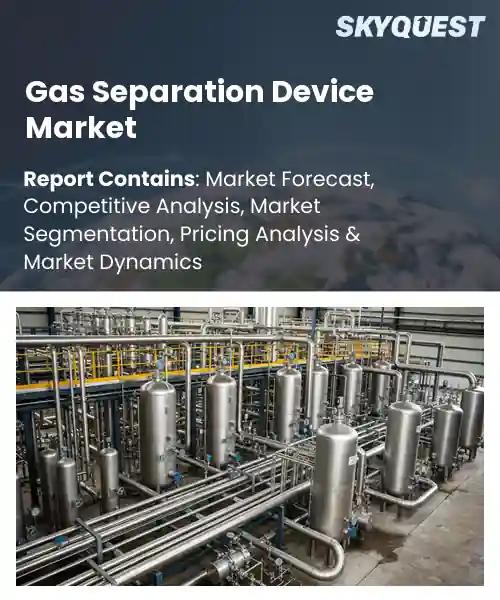
Gas Separation Device Market
Report ID: SQMIG20I2658
Report ID: SQMIG20I2658
[email protected]
USA +1 351-333-4748
Report ID:
SQMIG20I2658 |
Region:
Global |
Published Date: February, 2026
Pages:
157
|Tables:
186
|Figures:
79


Global Gas Separation Device Market size was valued at USD 457.3 Million in 2024 and is poised to grow from USD 477.88 Million in 2025 to USD 679.59 Million by 2033, growing at a CAGR of 4.5% during the forecast period (2026-2033).
The primary driver of the gas separation device market is the accelerating need for efficient, low‑carbon gas production across industries, which has pushed demand for technologies that deliver higher purity with lower energy input. Gas separation devices membranes, pressure swing adsorption units, and cryogenic systems enable selective recovery of oxygen, nitrogen, hydrogen, carbon dioxide, and biogas constituents to manufacturers, healthcare providers, and energy companies by cutting logistics and emissions. Historically the sector moved from large cryogenic trains toward compact PSA and advanced polymeric and ceramic membranes as material science and process engineering improved; for example, hospitals replaced cylinder supplies with oxygen concentrators.Building on those developments, materials and process innovations represent a central factor shaping market growth because higher membrane permeability and tailored adsorbents lower capital and operating expenses, which encourages users to replace expensive centralized supply chains with modular, on‑site units. As a result, industries deploy membrane-based biogas upgrading to produce pipeline-quality renewable natural gas for utilities, while refineries capture and separate hydrogen economically for low-carbon fuels and chemicals. In healthcare and food processing the availability of compact PSA and membrane generators reduces logistics, cuts costs, and improves resilience, creating new commercial opportunities for makers of scalable, energy-efficient separation systems worldwide.
How is AI improving efficiency in the gas separation device market?
AI is improving efficiency in the gas separation device market by accelerating materials discovery, optimizing operating conditions, and enabling smarter process control. Machine learning models predict membrane and sorbent performance and prioritize promising candidates so developers spend less time on trial and error and reach deployable materials faster. AI frameworks help tune geometry and operating parameters for membrane modules and enable rapid virtual testing which lowers energy intensity and improves throughput. Data driven control, predictive maintenance, and digital twins reduce unexpected downtime and shorten commissioning cycles, making gas separation systems more reliable and commercially attractive.Carbon Clean April 2025, the company completed industrial deployment of its CycloneCC modular capture unit and demonstrated rapid on site installation and sustained high purity CO2 output which combined with AI enabled solvent and process tuning supports faster scaling and improved operational efficiency in gas separation projects.
Market snapshot - (2026-2033)
Global Market Size
USD 457.3 Million
Largest Segment
Adsorption-Based Devices
Fastest Growth
Membrane Gas Separation Devices
Growth Rate
4.5% CAGR
To get more insights on this market click here to Request a Free Sample Report
Global gas separation device market is segmented by product type, technology type, gas type, capacity, application area, end user and region. Based on product type, the market is segmented into Membrane Gas Separation Devices, Adsorption-Based Devices, Cryogenic Gas Separation Devices, Absorption-Based Devices, Distillation Systems and Others. Based on technology type, the market is segmented into Physical Separation, Chemical Separation and Hybrid Systems. Based on gas type, the market is segmented into Nitrogen, Oxygen, Hydrogen, Carbon Dioxide (CO₂), Methane and Other Gases. Based on capacity, the market is segmented into Small-Scale Systems, Medium-Scale Systems and Large-Scale Systems. Based on application area, the market is segmented into Air Separation, Hydrogen Recovery & Purification, Natural Gas Processing, Carbon Capture & Storage (CCS), Biogas Upgrading, Industrial Gas Production, Refining & Petrochemical Processing and Others. Based on end user, the market is segmented into Oil & Gas, Chemicals & Petrochemicals, Healthcare & Pharmaceuticals, Food & Beverage, Power Generation, Metallurgy & Mining and Others. Based on region, the market is segmented into North America, Europe, Asia Pacific, Latin America and Middle East & Africa.
Membrane Gas Separation Devices segment dominates because membranes deliver compact, energy efficient continuous separation with low footprint and modular scaling that align with industrial decarbonization and onsite generation needs. Advances in polymer and inorganic membrane materials and module design reduce operational complexity and maintenance, enabling broad deployment across air separation, biogas upgrading, and hydrogen purification. Their ability to integrate with existing process lines and lower lifecycle costs boosts preference among buyers seeking flexible solutions.
However, Adsorption-Based Devices are the most rapidly expanding area as new adsorbents and pressure swing advances improve recovery and purity while enabling retrofit deployment. Regulatory emphasis on gas quality and growing demand for modular compact units spur adoption in hydrogen recovery and industrial applications, opening pathways for rapid market expansion.
Physical Separation segment dominates because established techniques such as membranes, pressure swing adsorption, and cryogenic processes deliver robust, scalable solutions with predictable operational profiles that fit a broad range of gas separations. Their lower chemical handling requirements, mature supply chains, and compatibility with modular plant designs reduce adoption friction for industrial users. Continuous innovation in materials and process integration further reinforces preference for physical approaches across applications requiring reliable purity and throughput.
Meanwhile, Hybrid Systems are emerging as the most rapidly expanding area because they combine physical and chemical methods to solve difficult separations with improved selectivity and reduced energy use. Advances in integrated sorbent and membrane reactor designs, plus demand for multi-pollutant removal and ultra-pure streams, accelerate uptake and create new application opportunities.
To get detailed segments analysis, Request a Free Sample Report
Asia Pacific commands the global gas separation device market through a blend of dense industrial demand, concentrated manufacturing capability, and focused innovation ecosystems. Heavy activity across chemicals, steel, electronics, and energy sectors creates sustained need for high purity gases and onsite separation solutions. Regional manufacturers leverage competitive production scales and localized supply chains to serve domestic and export markets, while research institutions and corporate centers drive membrane, adsorbent, and process optimization advances. Policy support for energy transition and gas infrastructure expansion further encourages adoption of advanced separation technologies. Close collaboration between equipment vendors, end users, and service providers shortens deployment cycles and enhances aftermarket provision, reinforcing regional leadership and enabling rapid technology diffusion across adjacent industries. Integration of digital monitoring and predictive maintenance further improves operational efficiency and supports long term performance.
Gas Separation Device Market Japan benefits from advanced materials science and strong collaboration between manufacturers and semiconductor producers. High demand for ultra high purity gases and compact, efficient separation units supports local innovation in membrane and adsorbent technologies. Established OEMs and specialized service networks facilitate equipment customization and deployment. Close ties between research institutes and industry accelerate technology transfer while export orientation helps production and sustain investment in performance improvements.
Gas Separation Device Market South Korea is driven by strong demand from petrochemical, shipbuilding, and electronics sectors, fostering adoption of high efficiency separation systems. Local manufacturers focus on integration with process plants and custom engineering for offshore and industrial applications. Government support for energy infrastructure and collaborations with academic centers bolster development of advanced membranes and adsorbents. Robust service ecosystems enable maintenance and performance optimization for industrial gas consumers nationwide.
Rapid expansion in North America stems from a convergence of energy resource development, industrial modernization, and policy emphasis on cleaner processes. Large scale gas production and processing activities create demand for efficient separation devices across natural gas treatment, hydrogen handling, and industrial gas supply chains. Strong engineering and service sectors enable deployment of tailored solutions and aftermarket support, while technology developers concentrate on membrane performance and adsorption innovations suited to local operating conditions. Market growth is further supported by investment in infrastructure upgrades, cross border trade in energy products, and collaboration between energy producers and equipment suppliers to optimize plant efficiency and lower operational costs, reinforcing the region as a dynamic hub for gas separation advancement. Robust academic and private sector research ecosystems accelerate commercialization of compact, energy efficient systems and drive vendor differentiation through service models.
Gas Separation Device Market United States exhibits a large and diversified demand base spanning oil and gas processing, petrochemicals, power generation, encouraging suppliers to offer scalable and high performance systems. Strong presence of engineering firms and services facilitates complex project execution and aftermarket contracts. Continuous innovation in membranes, adsorbents, and process integration is driven by collaboration among manufacturers, technology startups, and research institutions focused on operational efficiency and emissions reduction.
Gas Separation Device Market Canada benefits from natural gas production and a focus on remote and modular processing solutions, creating demand for on site separation and compression equipment. Emphasis on energy export corridors and integration encourages suppliers to develop robust systems. Collaboration between provincial agencies, research centers, and service providers supports pilot projects for hydrogen and gas initiatives. Aftermarket services and localized engineering strengthen long term operational reliability and resilience.
Europe is strengthening its position through strategic alignment of regulatory pressure, industrial decarbonization goals, and strong engineering capabilities. Emphasis on hydrogen development, renewable gas integration, and carbon management is directing investment toward advanced separation technologies that offer energy efficient and compact footprints. Established industrial clusters and specialist equipment manufacturers enable rapid prototyping and scale up of membrane and adsorption solutions tailored to stringent purity requirements. Collaboration among technology providers, utilities, and research institutions accelerates commercialization of hybrid systems while public incentives and standards foster interoperability and high quality aftermarket services, positioning the region as a leader in sustainable gas separation solutions. Cross border industrial partnerships and digitization of operations support integration of separation systems into complex energy networks, while a focus on retrofit projects and service excellence ensures long term asset performance across diverse end use sectors.
Gas Separation Device Market Germany leverages a strong industrial base in chemicals, automotive manufacturing, and engineering to demand high reliability and precision in separation equipment. Local machine builders and research institutes collaborate on developing robust, energy efficient membrane and adsorption systems suited to heavy industrial applications. Emphasis on industrial quality standards and services encourages suppliers to offer comprehensive maintenance and integration packages that align with decarbonization programs and modernization initiatives.
Gas Separation Device Market United Kingdom draws on experience in offshore gas processing to support specialized separation solutions for harsh environments. Development of hydrogen blending and carbon management strategies in industrial clusters fosters demand for modular, transportable units and integration services. Strong service providers and port based supply chains enable efficient installation and maintenance for onshore and offshore facilities. Close industry regulator engagement steers technical standards and project feasibility assessments.
Gas Separation Device Market France combines strong research institutions and a diversified industrial base in chemicals and energy to demand precise separation capabilities. Equipment manufacturers emphasize compact, low energy designs suitable for industrial settings, while partnerships with utilities and integrators advance pilot deployments for hydrogen and renewable gas. High standards for equipment certification and mature service sector ensure reliable aftermarket support and encourage cooperation between vendors and end users nationwide.
To know more about the market opportunities by region and country, click here to
Buy The Complete Report
Increasing Industrial Gas Demand
Stringent Environmental Regulations
High Capital Investment Requirements
Technical Complexity and Maintenance Costs
Request Free Customization of this report to help us to meet your business objectives.
The competitive landscape is shaped by incumbent gas suppliers and engineering firms forming large infrastructure partnerships and investment vehicles while deep tech entrants pursue membrane breakthroughs to disrupt thermal separation. Market drivers tied to hydrogen supply chains and CO2 management intensify competition. Examples include industry infrastructure funds and joint ventures backing hydrogen projects and recent venture and grant-backed membrane startups advancing pilot deployments.
Top Player’s Company Profile
Recent Developments
SkyQuest’s ABIRAW (Advanced Business Intelligence, Research & Analysis Wing) is our Business Information Services team that Collects, Collates, Correlates, and Analyses the Data collected by means of Primary Exploratory Research backed by robust Secondary Desk research. As per SkyQuest analysis, the global gas separation device market is driven primarily by accelerating demand for efficient, low‑carbon gas production and on‑site generation, while adoption is restrained by high upfront capital investment and integration costs. Asia Pacific dominates the market due to dense industrial demand, manufacturing scale and supportive policy, and membrane gas separation devices are the leading product segment because of their compact, energy‑efficient, modular designs. A second important growth driver is ongoing materials and process innovation that improves membrane and adsorbent performance, lowers lifecycle costs and enables retrofit and distributed deployments, together favoring modular, low‑energy systems and service‑oriented business models.
| Report Metric | Details |
|---|---|
| Market size value in 2024 | USD 457.3 Million |
| Market size value in 2033 | USD 679.59 Million |
| Growth Rate | 4.5% |
| Base year | 2024 |
| Forecast period | (2026-2033) |
| Forecast Unit (Value) | USD Million |
| Segments covered |
|
| Regions covered | North America (US, Canada), Europe (Germany, France, United Kingdom, Italy, Spain, Rest of Europe), Asia Pacific (China, India, Japan, Rest of Asia-Pacific), Latin America (Brazil, Rest of Latin America), Middle East & Africa (South Africa, GCC Countries, Rest of MEA) |
| Companies covered |
|
| Customization scope | Free report customization with purchase. Customization includes:-
|
To get a free trial access to our platform which is a one stop solution for all your data requirements for quicker decision making. This platform allows you to compare markets, competitors who are prominent in the market, and mega trends that are influencing the dynamics in the market. Also, get access to detailed SkyQuest exclusive matrix.
Table Of Content
Executive Summary
Market overview
Parent Market Analysis
Market overview
Market size
KEY MARKET INSIGHTS
COVID IMPACT
MARKET DYNAMICS & OUTLOOK
Market Size by Region
KEY COMPANY PROFILES
Methodology
For the Gas Separation Device Market, our research methodology involved a mixture of primary and secondary data sources. Key steps involved in the research process are listed below:
1. Information Procurement: This stage involved the procurement of Market data or related information via primary and secondary sources. The various secondary sources used included various company websites, annual reports, trade databases, and paid databases such as Hoover's, Bloomberg Business, Factiva, and Avention. Our team did 45 primary interactions Globally which included several stakeholders such as manufacturers, customers, key opinion leaders, etc. Overall, information procurement was one of the most extensive stages in our research process.
2. Information Analysis: This step involved triangulation of data through bottom-up and top-down approaches to estimate and validate the total size and future estimate of the Gas Separation Device Market.
3. Report Formulation: The final step entailed the placement of data points in appropriate Market spaces in an attempt to deduce viable conclusions.
4. Validation & Publishing: Validation is the most important step in the process. Validation & re-validation via an intricately designed process helped us finalize data points to be used for final calculations. The final Market estimates and forecasts were then aligned and sent to our panel of industry experts for validation of data. Once the validation was done the report was sent to our Quality Assurance team to ensure adherence to style guides, consistency & design.
Analyst Support
Customization Options
With the given market data, our dedicated team of analysts can offer you the following customization options are available for the Gas Separation Device Market:
Product Analysis: Product matrix, which offers a detailed comparison of the product portfolio of companies.
Regional Analysis: Further analysis of the Gas Separation Device Market for additional countries.
Competitive Analysis: Detailed analysis and profiling of additional Market players & comparative analysis of competitive products.
Go to Market Strategy: Find the high-growth channels to invest your marketing efforts and increase your customer base.
Innovation Mapping: Identify racial solutions and innovation, connected to deep ecosystems of innovators, start-ups, academics, and strategic partners.
Category Intelligence: Customized intelligence that is relevant to their supply Markets will enable them to make smarter sourcing decisions and improve their category management.
Public Company Transcript Analysis: To improve the investment performance by generating new alpha and making better-informed decisions.
Social Media Listening: To analyze the conversations and trends happening not just around your brand, but around your industry as a whole, and use those insights to make better Marketing decisions.
REQUEST FOR SAMPLE
 REQUEST FREE CUSTOMIZATION


Want to customize this report? This report can be personalized according to your needs. Our analysts and industry experts will work directly with you to understand your requirements and provide you with customized data in a short amount of time. We offer $1000 worth of FREE customization at the time of purchase.
Feedback From Our Clients


 USA (+1) 351-333-4748

