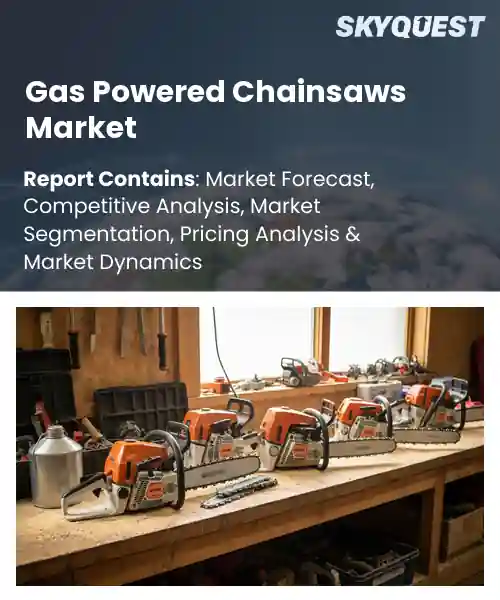
Gas Powered Chainsaws Market
Report ID: SQMIG20I3262
Report ID: SQMIG20I3262
[email protected]
USA +1 351-333-4748
Report ID:
SQMIG20I3262 |
Region:
Global |
Published Date: July, 2026
Pages:
157
|Tables:
143
|Figures:
78


Global Gas Powered Chainsaws Market size was valued at USD 2.84 Billion in 2024 and is poised to grow from USD 2.96 Billion in 2025 to USD 4.08 Billion by 2033, growing at a CAGR of 4.12% during the forecast period (2026-2033).
Demand for land development economies drives growth for chainsaws, because contractors need machines that combine mobility with speed. Alternatives depend on grid access and limited battery life, so firms in remote timber zones favor models that run for hours on a tank. This preference fuels investment in engines, exemplified by EcoPower series that reduces emissions and keeps power, opening markets with stricter regulations. Disaster‑relief agencies also adopt these tools to clear fallen trees after hurricanes, creating a niche that broadens sales beyond forestry.
The mix of infrastructure gaps and regulatory pressure expands opportunities and pushes manufacturers toward low‑emission, lightweight designs. The global gas‑powered chainsaw market comprises cutting tools that rely on internal‑combustion engines to deliver power output for timber harvesting, land‑clearing, and emergency response. Its relevance stems from the ability to operate without infrastructure, making it indispensable in forests and construction sites.
How is IoT integration improving efficiency in the gas powered chainsaws market?
IoT integration in gas‑powered chainsaws is reshaping how operators manage performance and maintenance. Connected sensors capture engine load, fuel consumption and vibration, feeding data to cloud platforms where algorithms detect inefficiencies. Real‑time alerts let users adjust throttle or schedule service before wear escalates, reducing downtime. Manufacturers such as Echo, Husqvarna and Ego embed these capabilities in their latest models, allowing fleet managers to monitor multiple units from a single dashboard. This visibility supports smarter scheduling, extends tool life and lowers operating costs, keeping the market responsive to rising demand for reliable outdoor equipment.
In January 2026, Stihl introduced a gas‑powered chainsaw with built‑in IoT telemetry that streams engine performance to a mobile app, enabling technicians to plan maintenance proactively and improve fuel efficiency, thereby boosting overall market productivity.
Market snapshot - (2026-2033)
Global Market Size
USD 2.84 Billion
Largest Segment
16 to 18 Inches
Fastest Growth
More Than 24 Inches
Growth Rate
4.12% CAGR
To get more insights on this market click here to Request a Free Sample Report
Global gas powered chainsaws market is segmented by bar length, engine displacement, engine stroke type, end-user application, distribution channel and region. Based on bar length, the market is segmented into Less Than 14 Inches, 16 to 18 Inches, 20 to 24 Inches and More Than 24 Inches. Based on engine displacement, the market is segmented into Under 40cc, 40cc to 60cc and Above 60cc. Based on engine stroke type, the market is segmented into Two-Stroke Engines and Four-Stroke Engines. Based on end-user application, the market is segmented into Residential, Commercial Landscaping and Industrial. Based on distribution channel, the market is segmented into Offline Retail and Online Platforms. Based on region, the market is segmented into North America, Europe, Asia Pacific, Latin America and Middle East & Africa.
20 To 24 inches segment dominates with large gas powered chainsaws market share because it strikes the optimal balance between cutting capacity and maneuverability for a wide range of tasks. Professional arborists and serious homeowners prefer this size as it handles medium‑to‑large trees while remaining lightweight enough for prolonged use, reducing operator fatigue. Manufacturers prioritize this bar length in product design, ensuring robust material quality and easy blade replacement, which builds consumer confidence and reinforces market preference.
As per gas powered chainsaws market outlook, more than 24 inches segment is witnessing the strongest growth momentum because expanding commercial contracts demand longer cuts for timber harvesting and utility line clearance. Advancements in ergonomic handles and vibration reduction enable operators to handle larger tools safely, attracting new users and stimulating product line extensions across industries.
As per gas powered chainsaws market analysis, 40 to 60 cc segment dominates because it offers sufficient power for most residential and commercial tasks while maintaining manageable fuel consumption. Users find this range delivers reliable torque for cutting hardwood and thick brush without the bulk and weight associated with larger engines, leading to higher satisfaction and repeat purchases. Manufacturers also target this displacement with diverse accessory options, enhancing versatility and reinforcing its market leadership among professionals worldwide.
As per gas powered chainsaws market forecast, above 60 cc segment emerges as the key high growth area because intensive logging and infrastructure projects require extra cutting power and durability. Innovations such as low emission two stroke designs and reinforced crankcases reduce operational costs, prompting broader adoption and spawning new niche applications, particularly in remote construction sites and mining.
To get detailed segments analysis, Request a Free Sample Report
North America’s dominance drives from a mature market where professional forestry, landscaping, and utility sectors heavily rely on powerful, reliable tools. Strong purchasing power supports demand for high‑end models, while extensive dealer networks ensure rapid product availability and service. Advanced manufacturing capabilities within the United States and Canada facilitate rapid innovation, allowing manufacturers to integrate ergonomic designs and emission‑reduction technologies that meet strict regional standards. A culture that values durability and performance drives preference for gas‑powered solutions over electric alternatives, especially in remote or rugged environments. Additionally, well‑established after‑sales infrastructures and readily accessible spare parts reinforce user confidence, sustaining a persistent preference for gas‑powered chainsaws across both commercial and consumer segments.
As per gas powered chainsaws market regional outlook, United States thrives on a broad base of professional loggers, utility crews, and homeowners who prioritize reliability and power. Extensive dealer networks provide swift access to the latest models, while a strong culture of outdoor work sustains continuous demand. Collaboration between manufacturers and research institutions fuels frequent product enhancements, reinforcing a reputation for durability that keeps the market vibrant and competitive.
As per gas powered chainsaws industry analysis, Canada is shaped by extensive forested regions where commercial timber operations demand robust, high‑performance equipment. A tight network of specialized retailers ensures prompt service and parts availability, while stringent environmental guidelines encourage manufacturers to adopt cleaner engine technologies. Seasonal outdoor activities and a strong tradition of land management further stimulate household interest, creating a balanced demand across professional and recreational users that sustains market vitality.
European landscape is witnessing a swift expansion of the gas‑powered chainsaw segment driven by a confluence of professional forestry practices, stringent safety standards, and an evolving consumer preference for high‑output tools. Robust regulatory frameworks demand low‑emission engines, prompting manufacturers to innovate with cleaner combustion technologies. A strong tradition of craftsmanship and quality assurance resonates with both commercial users and DIY enthusiasts, fostering a market that values durability and precision. Increasing investments in urban green space maintenance and infrastructure projects amplify the need for portable, powerful cutting solutions. Moreover, well‑integrated distribution channels across member states facilitate rapid product rollout, while cross‑border trade agreements ease access to advanced models, collectively accelerating market momentum throughout the region.
Germany stands as a benchmark of engineering excellence, supported by a dominant professional timber sector and a culture that values precision tools. Manufacturers use advanced research facilities to deliver low‑emission, high‑efficiency engines that meet strict environmental standards. A network of dealers provides swift after‑sales support, reinforcing confidence among contractors and forestry operators. This blend of technological leadership and service infrastructure sustains Germany’s position at the forefront of the European market.
United Kingdom is accelerating as a result of rising demand from both professional arborists and a growing DIY community engaged in garden maintenance. Tight emission regulations push manufacturers toward cleaner engine designs, while a strong tradition of outdoor leisure fuels consumer interest in portable cutting tools. Comprehensive dealer coverage and readily available training programs enhance user confidence, driving broader adoption across residential and commercial sectors.
France is emerging, supported by a revitalized forestry sector and increased interest in rural land management. Environmental directives encourage the use of low‑emission equipment, prompting manufacturers to adapt their offerings. A network of regional distributors provides localized support, while training initiatives raise awareness of safe operation. This combination of regulatory encouragement and expanding professional use positions France as a promising growth frontier within the European landscape.
Asia Pacific region is steadily strengthening its foothold in the gas‑powered chainsaw arena through a strategic blend of cost‑effective manufacturing, rising urban development, and expanding forestry activities. Homegrown OEMs benefit from skilled labor pools and supply‑chain efficiencies, enabling the production of competitively priced yet robust equipment. Growing construction and landscaping projects increase demand for portable, high‑output tools, while heightened awareness of safety and emissions drives innovation toward cleaner engine designs. Government initiatives that support small‑scale agriculture and sustainable land management further reinforce market expansion, positioning the region as a dynamic contributor to global supply and consumption patterns.
Japan is characterized by a strong emphasis on precision engineering and compact design, catering to both professional contractors and a sizable homeowner segment. Manufacturers integrate advanced fuel‑efficiency technologies to meet stringent local emission standards, while a dense dealer network ensures rapid product availability. Cultural appreciation for well‑maintained gardens and meticulous landscaping fuels ongoing demand, encouraging continuous product refinement and after‑sales service excellence.
South Korea benefits from a technologically progressive manufacturing base that focuses on lightweight, high‑performance models suitable for rugged terrain and urban green spaces. Companies prioritize low‑emission engine development to align with national environmental policies, and an agile distribution system provides swift market penetration. Increasing popularity of outdoor recreation and a resurgence in commercial timber processing drive broader adoption, while comprehensive training programs enhance user competency and safety awareness.
To know more about the market opportunities by region and country, click here to
Buy The Complete Report
Increasing Forestry Management Needs
Advancements In Engine Efficiency
Stringent Emission Regulations
Rising Fuel Cost Pressures
Request Free Customization of this report to help us to meet your business objectives.
The market is highly fragmented, with established vendors pursuing both organic expansions and inorganic moves such as acquisitions and strategic alliances; for example, Stihl recently acquired a small engine‑component firm to broaden its product line, while Husqvarna entered a partnership with a forestry equipment manufacturer to co‑develop next‑generation low‑emission chainsaws, illustrating how competition is driven by technology upgrades and collaborative growth.
SkyQuest’s ABIRAW (Advanced Business Intelligence, Research & Analysis Wing) is our Business Information Services team that Collects, Collates, Correlates, and Analyses the Data collected by means of Primary Exploratory Research backed by robust Secondary Desk research.
As per SkyQuest analysis, the global gas powered chainsaws market growth is being pushed forward primarily by the growing need for sustainable forest management, which fuels demand for powerful, portable tools, while a second catalyst comes from recent gains in engine efficiency that deliver better fuel use and lower emissions. The North American region leads the market due to strong professional forestry and a well‑established dealer network. The 20‑to‑24‑inch bar‑length segment remains the top seller, balancing cutting capacity with maneuverability for both pros and serious homeowners. At the same time, tighter emission standards pose a restraint, raising production costs and prompting some users to consider electric alternatives. The global gas powered chainsaws market trend is driven by increasing demand from forestry, logging, construction, landscaping, and agricultural sectors.
| Report Metric | Details |
|---|---|
| Market size value in 2024 | USD 2.84 Billion |
| Market size value in 2033 | USD 4.08 Billion |
| Growth Rate | 4.12% |
| Base year | 2024 |
| Forecast period | (2026-2033) |
| Forecast Unit (Value) | USD Billion |
| Segments covered |
|
| Regions covered | North America (US, Canada), Europe (Germany, France, United Kingdom, Italy, Spain, Rest of Europe), Asia Pacific (China, India, Japan, Rest of Asia-Pacific), Latin America (Brazil, Rest of Latin America), Middle East & Africa (South Africa, GCC Countries, Rest of MEA) |
| Companies covered |
|
| Customization scope | Free report customization with purchase. Customization includes:-
|
To get a free trial access to our platform which is a one stop solution for all your data requirements for quicker decision making. This platform allows you to compare markets, competitors who are prominent in the market, and mega trends that are influencing the dynamics in the market. Also, get access to detailed SkyQuest exclusive matrix.
Table Of Content
Executive Summary
Market overview
Parent Market Analysis
Market overview
Market size
KEY MARKET INSIGHTS
COVID IMPACT
MARKET DYNAMICS & OUTLOOK
Market Size by Region
KEY COMPANY PROFILES
Methodology
For the Gas Powered Chainsaws Market, our research methodology involved a mixture of primary and secondary data sources. Key steps involved in the research process are listed below:
1. Information Procurement: This stage involved the procurement of Market data or related information via primary and secondary sources. The various secondary sources used included various company websites, annual reports, trade databases, and paid databases such as Hoover's, Bloomberg Business, Factiva, and Avention. Our team did 45 primary interactions Globally which included several stakeholders such as manufacturers, customers, key opinion leaders, etc. Overall, information procurement was one of the most extensive stages in our research process.
2. Information Analysis: This step involved triangulation of data through bottom-up and top-down approaches to estimate and validate the total size and future estimate of the Gas Powered Chainsaws Market.
3. Report Formulation: The final step entailed the placement of data points in appropriate Market spaces in an attempt to deduce viable conclusions.
4. Validation & Publishing: Validation is the most important step in the process. Validation & re-validation via an intricately designed process helped us finalize data points to be used for final calculations. The final Market estimates and forecasts were then aligned and sent to our panel of industry experts for validation of data. Once the validation was done the report was sent to our Quality Assurance team to ensure adherence to style guides, consistency & design.
Analyst Support
Customization Options
With the given market data, our dedicated team of analysts can offer you the following customization options are available for the Gas Powered Chainsaws Market:
Product Analysis: Product matrix, which offers a detailed comparison of the product portfolio of companies.
Regional Analysis: Further analysis of the Gas Powered Chainsaws Market for additional countries.
Competitive Analysis: Detailed analysis and profiling of additional Market players & comparative analysis of competitive products.
Go to Market Strategy: Find the high-growth channels to invest your marketing efforts and increase your customer base.
Innovation Mapping: Identify racial solutions and innovation, connected to deep ecosystems of innovators, start-ups, academics, and strategic partners.
Category Intelligence: Customized intelligence that is relevant to their supply Markets will enable them to make smarter sourcing decisions and improve their category management.
Public Company Transcript Analysis: To improve the investment performance by generating new alpha and making better-informed decisions.
Social Media Listening: To analyze the conversations and trends happening not just around your brand, but around your industry as a whole, and use those insights to make better Marketing decisions.
REQUEST FOR SAMPLE
 REQUEST FREE CUSTOMIZATION
Global Gas Powered Chainsaws Market size was valued at USD 2.84 Billion in 2024 and is poised to grow from USD 2.96 Billion in 2025 to USD 4.08 Billion by 2033, growing at a CAGR of 4.12% during the forecast period (2026-2033).
The market is highly fragmented, with established vendors pursuing both organic expansions and inorganic moves such as acquisitions and strategic alliances; for example, Stihl recently acquired a small engine‑component firm to broaden its product line, while Husqvarna entered a partnership with a forestry equipment manufacturer to co‑develop next‑generation low‑emission chainsaws, illustrating how competition is driven by technology upgrades and collaborative growth. 'Husqvarna AB', 'Andreas Stihl AG & Co. KG', 'Makita Corporation', 'Yamabiko Corporation', 'Stanley Black & Decker, Inc.', 'AL-KO Kober SE', 'Emak S.p.A.', 'Techtronic Industries Co. Ltd.', 'Hitachi Ltd.', 'Zhejiang Jialong Mechanical Equipment Co., Ltd.', 'Sumec Corporation Limited', 'Active S.r.l.', 'Solo Kleinmotoren GmbH', 'Efco S.p.A.', 'Maruyama Mfg. Co., Inc.', 'Zenoah Co., Ltd.', 'Jenn Feng New Energy Co., Ltd.', 'Sanying Precision Machinery Co., Ltd.', 'Fuji Robin Industries Ltd.', 'Texas A/S'
The expanding need for sustainable forest management drives higher demand for efficient, high‑power cutting tools, prompting professional users to prefer gas‑powered chainsaws for their reliability in remote or rugged environments. This requirement encourages manufacturers to innovate and expand product lines, thereby reinforcing market growth through broader adoption across commercial forestry, land‑clearing operations, and infrastructure projects where electric alternatives lack sufficient portability or runtime. Such operational flexibility also supports seasonal work cycles, allowing contractors to meet tight timelines without dependence on charging infrastructure.
Smart Connectivity Integration: Manufacturers are embedding IoT sensors and Bluetooth modules into gas‑powered chainsaws, enabling real‑time performance monitoring, predictive maintenance alerts, and remote configuration. This connectivity empowers professional users to minimize downtime, optimize fuel consumption, and extend tool lifespan while providing data streams for manufacturers to refine product designs. As forestry contractors and utility crews demand more accountable equipment, the shift toward smart, connected chainsaws is reshaping service contracts and creating recurring revenue opportunities through subscription‑based diagnostics platforms for ongoing operational insight benefits.
Why does North America Dominate the Global Gas Powered Chainsaws Market? |@12


Want to customize this report? This report can be personalized according to your needs. Our analysts and industry experts will work directly with you to understand your requirements and provide you with customized data in a short amount of time. We offer $1000 worth of FREE customization at the time of purchase.
Feedback From Our Clients


 USA (+1) 351-333-4748

